Vysokopetrovsky Monastery: A Historic Russian Orthodox Monastery in Moscow


Site at a Glance
- Rating
- 4.8
- Popularity
- Low
- Country
- Russia
- Primary era
- Early Modern
- External website
- Open
- Eras represented
- Medieval, Early Modern, Modern
- Civilizations
- Russian
- Site type
- Religious
- Remains
- Monastery
On this page19 sections
History
Vysokopetrovsky Monastery is a Russian Orthodox male stauropegial monastery in Moscow, Russia, at the corner of Petrovka Street and Petrovsky Boulevard. Its foundation is traditionally dated to 1315, although the monastery is first documented in 1317. A stauropegial monastery stands directly under a patriarch or another central church authority rather than under the ordinary administration of a local bishop.
Foundation and medieval development
The monastery’s origins are connected with several traditions. One associates its foundation with Metropolitan Peter of Kiev, Vladimir, and All Rus, who may have established a wooden Church of Saints Peter and Paul near the Kremlin in 1315–1317, or in 1326 when he transferred the metropolitan see from Vladimir to Moscow. Another, more widely known tradition attributes the foundation to Ivan Kalita in 1326, after a vision interpreted by Metropolitan Peter. A third tradition connects its foundation or refoundation with Grand Prince Dmitry Donskoy after his return from the Battle of Kulikovo in 1380.
The original dedication was to Saints Peter and Paul. Following Metropolitan Peter’s death and canonization, the church was rededicated to him in 1339. The monastery was known by several names, including Petropavlovsky, Petrovsky, Peter the Metropolitan’s Monastery, and Petrovsky High. Vysokopetrovsky became its official name in the early eighteenth century, although Petropavlovsky remained in use into that period.
By the middle of the fourteenth century, the monastery had adopted a communal monastic rule earlier than many other Moscow communities and had become a burial place for members of prominent Moscow families. A fifteenth-century chronicle records that its abbot John accompanied Archimandrite Mityai to Constantinople in 1379, when Mityai was seeking appointment as metropolitan of All Rus.
The monastery’s wooden buildings were destroyed during Khan Tokhtamysh’s raid on Moscow in 1382 and rebuilt under Dmitry Donskoy’s patronage. A church dedicated to the Bogolyubovo Icon of the Mother of God was established there by the grand prince’s order, though it was later destroyed by fire.
Stone rebuilding and early modern expansion
The great Moscow fire of 1493 destroyed the monastery’s wooden buildings and killed about 200 people, including several members of the monastic community. Under Grand Prince Vasily III, the complex was rebuilt, and its first stone church, the Cathedral of St. Peter, was erected in 1514–1517 by the Italian architect Aloisio the New.
The monastery suffered another destruction in 1611 during the Polish-Lithuanian intervention, a period of military and political conflict in Russia. It was restored after the expulsion of the Polish forces in 1612, then enclosed by a stone wall and governed by archimandrites. Its stauropegial privilege is dated to 1588.
Major patrons included Dmitry Donskoy, Ivan Kalita, Vasily III, Tsar Alexei Mikhailovich, and Peter I. In 1671, Cyril Naryshkin transferred his adjoining estate to Alexei Mikhailovich, who donated it to the monastery. The monastic territory consequently almost doubled.
The Naryshkin family became closely associated with the monastery after Ivan and Afanasy Naryshkin were killed during the Moscow streltsy revolt of 1682, an uprising by units of the Russian infantry. Their mother, Natalia Naryshkina, buried them at the monastery, and Cyril Naryshkin and his wife Anna were later buried there as well. The Bogolyubsky Cathedral became the family mausoleum.
Under Peter I, with substantial Naryshkin patronage, the monastery entered its principal period of late-seventeenth-century expansion. The Bogolyubsky Cathedral was completed in 1684–1685, the Church of St. Sergius of Radonezh was built in 1690–1702, and the Intercession Gate Church, its bell tower, and the brotherhood buildings were erected in 1690–1696. This was the monastery’s greatest period of prosperity.
Estates, administration, and war
During the late seventeenth and early eighteenth centuries, the monastery possessed estates, mills, fishponds, and peasant households. It held approximately 519 peasant households in 1682 and 612 in 1700, while about 6,000 peasants were recorded in 1735. Several religious institutions were affiliated with it, including the Saratov Kazan Monastery, the Saransk Bogoroditsky Monastery, and two hermitages.
Metropolitan Joseph of Moscow administered the monastery from 1743 to 1745, after which it came under the Holy Synod until 1764. The secularization of monastic lands in 1764 made it a second-class monastery supported by the state, although it retained its stauropegial status. From 1775 it belonged to the Moscow Diocese and had the right to be governed by an archimandrite with the tablets of office. Bishop Theophylact of Pereslavl lived there and received medical treatment in 1788.
The monastery was severely damaged after Napoleon’s forces occupied Moscow in 1812 during the French invasion of Russia. About 1,000 French cavalrymen were quartered there, the churches were desecrated, and furnishings and Naryshkin tomb monuments were destroyed or looted. Marshal Mortier used the monastery to issue death sentences against people accused of setting fires in Moscow. Executions took place on the boulevard outside the monastery, and the victims were buried near the bell tower. Archimandrite Ioannicius evacuated the sacristy and relics to Yaroslavl.
Nineteenth-century religious and educational life
After the war, the Churches of St. Pachomius and the Intercession were abolished, although the Intercession Church was later restored. During the nineteenth century, the monastery recovered as a center of Moscow’s religious and educational life. A theological school transferred there from Zaikonospassky Monastery in 1822, the Moscow Diocesan Library was housed within the complex, and the Society of Lovers of Spiritual Enlightenment held meetings there from 1863.
Closure, underground monastic life, and Soviet uses
The monastery was formally closed in 1918 after the October Revolution. Its residential buildings were requisitioned for housing, while the churches initially continued to function. In 1923, Bishop Bartholomew Remov organized a major underground monastic community at Vysokopetrovsky, incorporating monks from the recently closed Smolensk-Zosimova Hermitage.
The community continued secretly after the last monastery church closed in 1929. It moved first to the Church of St. Sergius of Radonezh on Bolshaya Dmitrovka and later to the Church of the Nativity of the Mother of God at Putinki, where it survived until arrests in 1935. The underground period is associated with nine canonized monks and lay religious figures who were executed, imprisoned, exiled, or otherwise persecuted after the Revolution. They include Macarius Gnevushev, Ignatius Lebedev, Herman Polyansky, Theodore Bogoyavlensky, Varlaam Nikolsky, Macarius Morzhov, Cosmas Magda, Nicholas Varzhansky, and John Popov.
Soviet authorities converted the former monastery to secular uses. The Bogolyubsky Cathedral became an agricultural-machinery repair plant, the Church of St. Sergius became a library and later a gymnasium, and the Cathedral of St. Peter became a foundry. Communal apartments occupied the Tolga Church, the Kazan Church, the abbot’s quarters, the brotherhood buildings, and the Naryshkin Chambers, while the monastery garden became a kindergarten. By about 1950, the architectural ensemble had been severely compromised.
Restoration and revival
Restoration and archaeological investigation began in 1952 under the architect Boris Dedushenko. The work cleared the site, excavated the grounds, and reconstructed the historical development of the territory. Excavations revealed traces of a fourteenth- or fifteenth-century wooden church and helped establish that the Cathedral of St. Peter had been built in the 1510s by Aloisio the New rather than in the late seventeenth century.
In 1959, the complex was transferred to the Soviet Ministry of Culture and recognized as an architectural monument. Industrial and communal uses were removed, although cultural institutions and workshops continued to occupy several buildings. Restoration directed by Dedushenko continued from 1953 to 1987 but remained incomplete because of inadequate funding.
Parts of the monastery were returned to the Russian Orthodox Church through decisions in 1992 and 1994. In 1992, the Patriarchal Department for Religious Education and Catechization moved into the abbot’s building, worship resumed in the Church of St. Sergius, and the monastery became a patriarchal metochion under Archimandrite John Economtsev. A patriarchal metochion is a dependent ecclesiastical establishment representing a patriarch or central church institution. The Russian Orthodox Institute of St. John the Theologian was founded at the monastery in 1992–1993.
On 10 October 2009, the Holy Synod decided to revive monastic life at Vysokopetrovsky Monastery. A patriarchal service was held there on 20 February 2010 for the first time after the long interruption, and a new bell named Saint Peter was consecrated. The monastery celebrated its 700th anniversary in 2015. The Church of the Bogolyubovo Icon returned to liturgical use in 2013, and the Naryshkin Chambers were returned to the monastery in December 2014.
Large-scale restoration in 2017–2018 repaired facades, restored wall paintings, strengthened and replastered church walls, and repainted them red using sixteenth-century techniques. The Naryshkin burial crypt was restored in 2021. Vysokopetrovsky Monastery is a federally significant cultural-heritage site of the Russian Federation. Its grounds and buildings have been progressively restored, while part of the former monastic necropolis remains occupied by a kindergarten. In 2019, the brotherhood comprised 11 monks.
Remains
The monastery occupies a hill in Moscow’s Bely Gorod area, where Petrovka Street descends toward the Kremlin. Its present ensemble was formed mainly during the seventeenth and eighteenth centuries and combines earlier Russian church forms with Naryshkin Baroque, a late-seventeenth-century style associated with the Naryshkin family. The plan developed around northern ceremonial and southern service courtyards. The Cathedral of St. Peter stood in the center of the northern courtyard, the Bogolyubsky Cathedral to its north, and the Church of St. Sergius to its south.
Central churches and courtyards
Cathedral of St. Peter
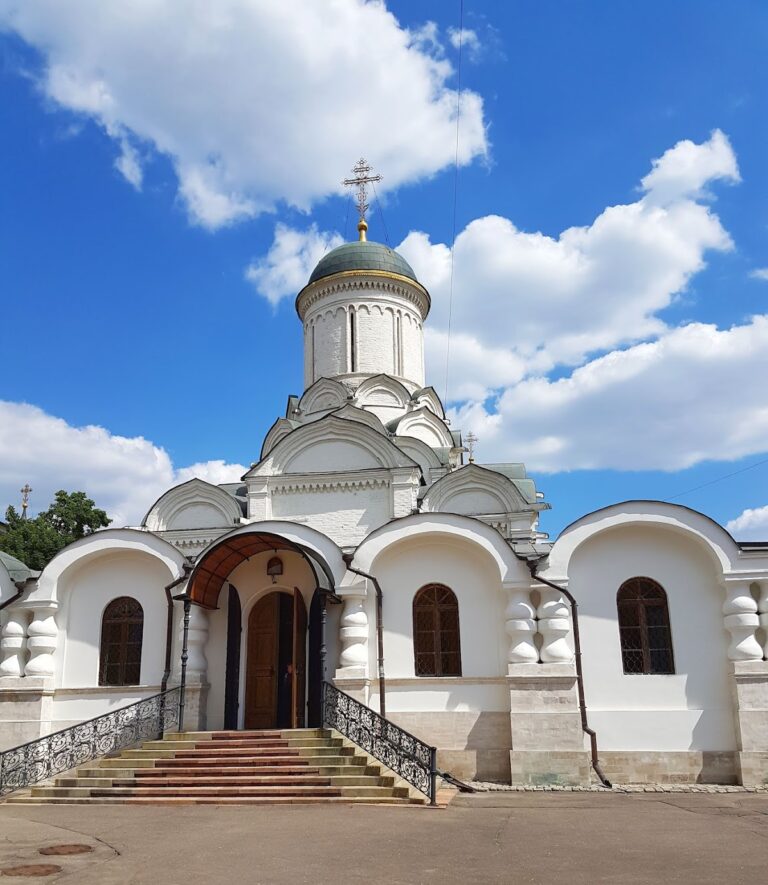
The Cathedral of St. Peter is a small pillar-shaped church built in 1514–1517. Its main space rises as an octagonal tower-like volume rather than as a broad dome on a square base, making it one of Russia’s earliest examples of this form. A helmet-shaped dome crowns the octagon above an eight-lobed lower tier. The larger lobes correspond to the cardinal directions, while the smaller diagonal lobes are covered by conches. Entrances occupy the north, south, and west sides, with windows in the remaining sides.
The cathedral has restrained exterior decoration, including corner pilasters, a brick cornice with an arcade, an entablature, and a high socle. Its upper octagon is a light-bearing octagon covered by a vault. Part of the building was remodeled in 1690 in the Moscow Baroque style. The narrow windows were enlarged, and painted surrounds, ornate portals, pilasters, and an arcade frieze were added. A white-stone open gallery was built around the cathedral in 1689–1690, followed by a western porch on four pillars later in the seventeenth century. The windows were enlarged into broad square openings in 1713–1714.
Klim Mikhailov completed the original iconostasis in 1691. After the cathedral closed during the Soviet period, it was used as a storage facility until the 1980s. Dedushenko restored it toward its sixteenth-century form in 1984. A new iconostasis and modern fresco cycle were later installed, and the cathedral was consecrated on 3 January 1998.
Bogolyubsky Cathedral
The Bogolyubsky Cathedral was built in 1684–1685 on the site of the sixteenth-century wooden Intercession Church and above the burials of Ivan and Afanasy Naryshkin. It served as the Naryshkin mausoleum until 1771 and contained the graves of 18 family members. Its exterior has paired columns, a profiled cornice, keeled decorative gables, and an arcade-and-column frieze.
The cathedral originally had a low open gallery on three sides. Part of it was enclosed in 1805 when the refectory was enlarged, while other sections became concealed by the accumulated ground level. The refectory opens through three broad arches into the main quadrangle. An entresol in the southern apse housed the sacristy and was reached by an internal staircase. The interior retains fragments of eighteenth-century stucco and academic paintings from the eighteenth and nineteenth centuries, while further restoration is required.
Klim Mikhailov made the elaborate iconostasis in 1687, with icons by Spiridon Grigoriev, Fyodor Zubov, Tikhon Filatyev, and Mikhail Milyutin. It survived until the church closed in 1929, when the icons were removed and reportedly burned. The dome, cross, and Naryshkin tomb monuments were destroyed in 1930 and later reconstructed. The reconstructed work also includes the decorative roof covering that had been lost in the eighteenth century.
Church of St. Sergius of Radonezh
The Church of St. Sergius of Radonezh was built as a refectory church in 1690–1702 on the site of a southern wooden building. A refectory church is connected with a large communal dining hall. The brotherhood cells were constructed with it and linked by an arched passage, while the interior work and iconostasis were completed in 1697.
The church stands at the center of the complex and separates the northern and southern courtyards. It is a two-light, three-apse quadrangle with a western refectory and ceremonial porch, raised on a basement and surrounded by an arcaded gallery. Originally single-domed, it was remodeled in 1702–1705 with a new vault and a five-domed completion. Kokoshniks with shell motifs and extensive white-stone detailing decorate the windows, portals, domes, and other architectural elements. A balcony above the porch once served the tsar during solemn services and processions.
The gallery and passage to the brotherhood buildings were dismantled in 1808. Side chapels dedicated to Alexius of Moscow and Mitrophan of Voronezh were added and consecrated in 1862–1863, though they were not later restored. The church’s domes and crosses, destroyed in the 1930s, were reconstructed in the 1960s.
Later churches and gate buildings
Church of the Tolga Icon
The Church of the Tolga Icon of the Mother of God was built in 1744–1750 between the monastery bell tower and the brotherhood building. It is a single-domed, rectangular, pillarless Baroque church on a basement, with a five-sided apse and a western facade facing Petrovka Street. Paired pilasters, narrow dome windows, and volutes shape its exterior. The design is provisionally attributed to Ivan Michurin or one of his pupils.
Natalia Naryshkina, a maternal relative of Peter I, financed the church. A copy of the Tolga icon made by Ivan Andreev in the 1740s is held in the State Historical Museum’s storage collection.
Church of Saints Peter and Paul
The Church of St. Pachomius the Great, later rededicated to Saints Peter and Paul, was built in 1753–1755 in the southwestern corner of the southern courtyard by Archimandrite Pachomius. Its foundations incorporated the white-stone gate of the former Naryshkin estate. The brick Baroque building consists of an octagon above a quadrangle, covered by a closed eight-part vault and crowned with a decorative dome. It has a projecting five-sided apse, an open gallery connecting it with the cells, pilasters, triangular pediments, curved window pediments, blind niches, and Baroque surrounds on the octagonal faces. Its design is associated with the school of Dmitry Ukhtomsky.
The church suffered severe damage in 1812 and remained unconsecrated until 13 September 1914, when it was rededicated to Saints Peter and Paul. After the Revolution, it was used for housing and later as a changing room for restoration workers. It is not currently used for worship. On 25 November 2012, a construction crane fell onto the building, damaging the dome, roof timbers, white-stone cornice, and cross.
Intercession Gate Church
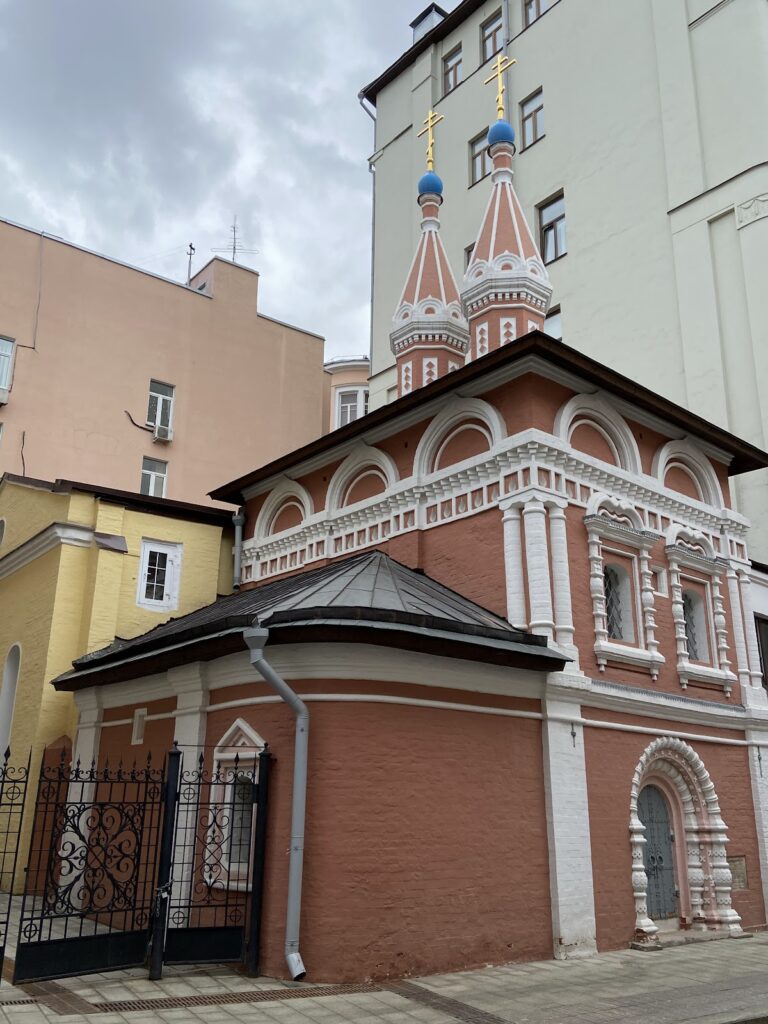
The Intercession Gate Church was built above the western gate in 1690–1696 by order of Peter I in memory of Ivan and Afanasy Naryshkin. A passage connects it to the abbot’s residence, and its altar came from the former wooden church on the site of the Bogolyubsky Cathedral. The square building is covered by a closed vault. Triple columns mark its corners, while the windows have column-form surrounds with broken pediments.
Its attached two-tier bell tower consists of two octagons with arched openings, pilasters, roof finials, panels, and a small dome. The church was damaged and abolished after the 1812 war, then restored in 1865. It closed again in 1924 and was reconsecrated on 14 October 1998.
Kazan Church
The Kazan Church began as a chapel built in 1905 in the southern passage of the monastery gate and consecrated on 28 August that year. The nineteenth-century Kazan icon formerly associated with the site was lost during the Revolution. The chapel was closed and looted in 1924, then restored as a church in 2001.
Residential buildings and former service structures
The Naryshkin Chambers and brotherhood cells originated as seventeenth-century residential buildings. A separate cell building was added to the brotherhood building in 1890 under the design of the diocesan architect S. Krygin. The abbot’s building and service buildings also formed part of the historical ensemble.
At the corner of Petrovka Street and Petrovsky Boulevard, wooden almshouses were replaced in 1901 by a three-story income building designed by Ivan Boni. It ceased to belong to the monastery after the Revolution and now contains apartments and shops. A fourth floor was added in the 1990s.
Cemetery and sacred objects
The monastery cemetery has served since the fifteenth century as a burial ground for monks and prominent Moscow residents. Excavations behind the apse of the Cathedral of St. Peter between 1955 and 1986 uncovered well-preserved sixteenth- and seventeenth-century burials, including sarcophagi and inscribed tomb slabs. The excavated remains were removed from the ground and placed near the southern wall of the Church of St. Sergius pending appropriate reburial. Part of the historic necropolis is physically occupied by a kindergarten, whose playground extends into the former cemetery area.
The Church of St. Sergius houses a reliquary containing part of the relics of Metropolitan Peter, as well as a reliquary associated with Seraphim of Sarov and relic fragments of other Orthodox saints. The monastery also holds a revered full-length icon of Metropolitan Peter containing a relic fragment; its reverse depicts the Moscow Kremlin and Vysokopetrovsky Monastery.
The monastery’s medieval and early-modern religious treasury was looted after the Revolution. Later additions to its sacred objects include part of the relics of Metropolitan Peter, transferred by Patriarch Kirill in 2010; relics associated with the Kiev Caves; and a cross containing a fragment of the True Cross, donated in 2013. Other objects associated with the monastery include a Kazan icon of the Mother of God, a Vlakherna icon, relics of Mitrophan of Voronezh, an eighteenth-century copy of the Tolga icon, and a reliquary containing fragments of relics of the monks of the Kiev Caves.
Nearby sites