Sretensky Monastery: An Orthodox Monastic Complex in Moscow


Site at a Glance
- Rating
- 4.9
- Popularity
- Medium
- Country
- Russia
- Primary era
- Early Modern
- External website
- Open
- Eras represented
- Early Modern, Modern
- Civilizations
- Russian
- Site type
- Religious
- Remains
- Monastery
On this page17 sections
History
Sretensky Monastery is an Orthodox male monastery of the Russian Orthodox Church in Moscow, Russia. Grand Prince Vasili I founded it in 1397 to commemorate Moscow’s deliverance from Tamerlane’s invasion of 1395. The monastery later became stauropegial, meaning that it was placed directly under patriarchal authority, in 1995.
Foundation and medieval development
The monastery’s foundation was linked to the meeting of the Vladimir Icon of the Mother of God on 26 August 1395. Brought from Vladimir to protect Moscow, the icon was met by a procession led by Metropolitan Cyprian. Tamerlane, the Central Asian conqueror also known as Timur, turned south the following day without reaching the city. An annual procession was established in commemoration, first involving the grand prince and metropolitan and later the tsar and patriarch.
The original monastery stood on Kuchkovo Field, near the Vladimir Road and probably close to the Nikolsky Gates of Kitai-Gorod. Kuchkovo Field had belonged to the boyar Stepan Kuchka and had also been used for executions. A wooden Church of Mary of Egypt was built there in 1385 near the place associated with the execution of Ivan Velyaminov. About ten years later, a larger church dedicated to the Vladimir Icon was built nearby. The Church of Mary of Egypt was subsequently incorporated into the monastery.
The monastery was later moved to the area of present-day Bolshaya Lubyanka Street, although the date of the relocation is uncertain. A hypothesis proposed in 1984 connects the move with the construction of the Kitai-Gorod wall and is supported by chronicle evidence. During the reign of Ivan III, the churches dedicated to the Vladimir Icon and Mary of Egypt were rebuilt in stone.
The monastery also became associated with further commemorative processions. A procession marking deliverance from Khan Akhmat began in 1480. Another, commemorating Moscow’s deliverance from the Crimean Khan Mehmed Giray in 1521, began later. After 1695, the latter procession was transferred to the Vladimir Icon church near the Nikolsky Gates.
Royal patronage and the seventeenth century
Sretensky Monastery stood on the route between Moscow and the Trinity-Sergius Lavra and consequently received pilgrims. On 8 November 1552, Muscovites and clergy led by Metropolitan Macarius met Ivan IV at the monastery after his conquest of Kazan. Ivan visited the monastery and made substantial donations.
During the Time of Troubles, the period of political crisis, dynastic uncertainty, foreign intervention, and civil conflict in Russia from the late sixteenth to the early seventeenth century, the monastery housed the headquarters of militia forces associated with Kuzma Minin and Dmitry Pozharsky. Pozharsky received first aid there after being seriously wounded on Sretenka Street in March 1611.
In May 1613, the monastery received the newly elected Tsar Michael Romanov, founder of the Romanov dynasty, and his mother, the nun Martha. The monastery’s abbot Ephraim was later sent to retrieve Michael’s father, Metropolitan Filaret Romanov, from Polish captivity. Ephraim remained with him until Filaret returned in 1619 and became Patriarch of All Russia.
Royal donations increased during the seventeenth century. The surrounding district became known as Sretenskaya Sloboda and later as Sretenskaya Part. Under Tsar Michael Romanov, monastic cells and an abbot’s residence were constructed, and the monastery reached a high point of prosperity by the end of the century. The principal cathedral was rebuilt on a new site in 1679 by order of Tsar Feodor Alexeyevich. In 1706, Abbot Moses Velikoselsky added a chapel dedicated to the Nativity of John the Forerunner as a votive addition. Relics of Mary of Egypt arrived from Constantinople in a silver reliquary on 18 February 1707.
Eighteenth and nineteenth centuries
The monastery declined during the eighteenth century. The Trinity Fire of 1737 destroyed or damaged parts of the complex. In 1764, Empress Catherine II’s secularization of church lands made Sretensky a non-staffed monastery dependent on its own income, with no more than seven residents permitted. Its northern courtyard and part of its land toward Rozhdestvensky Boulevard were leased to provide revenue.
During the Patriotic War of 1812, the war between Russia and Napoleonic France, a public procession with miracle-working icons left the monastery on the day of the Battle of Borodino. A hospital for wounded soldiers was established there, and soldiers killed in the fighting were buried in the monastery cemetery. During the French occupation, two hieromonks and several monks remained. Two older churches were looted and converted into a hospital, while services continued in the gate church of Saint Nicholas. The relics of Mary of Egypt were deliberately retained in Moscow to prevent public unrest.
The monastery survived the Moscow Fire of 1812. From 7 November that year, it housed the episcopal see of Metropolitan Augustine. The Vladimir and Iveron Icons remained there until spring 1813, when they were returned to the restored Dormition Cathedral.
Sretensky Monastery revived during the nineteenth century with the active involvement of the Moscow Metropolitans Platon Levshin and Philaret Drozdov. By the end of the century, it was one of Moscow’s best-known monasteries, particularly because of its bells. The community numbered 25 monks and maintained a parish school, a hotel, and a cemetery used by members of Moscow’s noble families.
Revolution, closure, and Soviet destruction
After the 1917 Revolution, monks were expelled and the monastic cells were confiscated. The first arrests of monks began in October 1919. Archimandrite Gurii Stepanov administered the monastery from 1919 until his consecration as a bishop in February 1920. Hilarion Troitsky, a bishop, theologian, preacher, and opponent of the Renovationist movement, served as abbot from spring 1920 until 1923.
In 1922, authorities confiscated much of the monastery’s valuables, including icons, silver altar crosses, precious Gospel bindings, mitres, liturgical vessels, and other church objects. Bishop Hilarion was arrested in March 1922 and sentenced to exile in the Arkhangelsk region. For part of 1922 and 1923, services were conducted by Antonin Granovsky, a bishop of the Renovationist movement, which sought to reform the Russian Orthodox Church under Soviet conditions.
After Hilarion’s return, he reconsecrated the cathedral on 5 July 1923. Patriarch Tikhon celebrated the liturgy there on 6 July before more than 1,000 people, following the public repentance of Renovationist clergy. Sergei Izvekov, the future Patriarch Pimen, received the monastic tonsure at Sretensky in December 1925.
The monastery closed at the end of 1925. The cathedral continued for a time as a parish church, and a parish council was formed from members of the remaining brotherhood. Between 1928 and 1930, Soviet authorities dismantled most of the complex, officially to widen the roadway. The Church of Saint Nicholas, the Church of Mary of Egypt, the Holy Gates and bell tower, cells, and parts of the abbot’s and brotherhood buildings were demolished. Icons and liturgical objects that had escaped confiscation were dispersed among museums and other institutions.
The surviving buildings were used by auxiliary structures of the NKVD. The Vladimir Cathedral became a dormitory for NKVD employees and later a garage and restoration workshop. The former monastery grounds were also associated with executions. A school was built in 1952 on the site of the former cells and cemetery. The cathedral’s exterior was restored between 1958 and 1959, or between 1958 and 1962, under the architect G. K. Ignatiev. From 1990, it housed a department of the Grabar Art Conservation Center.
Restoration and revival after 1991
The Vladimir Cathedral was returned to the Russian Orthodox Church in 1991 and reopened for worship as a parish church. A parish associated with the Sretenie Brotherhood operated there under Priest Georgy Kochetkov until the community moved to another church in early 1994.
A dependency of Pskovo-Pechersky Monastery was established at Sretensky in 1993 or 1994, with Tikhon Shevkunov as its superior. By decision of the Holy Synod on 6 July 1995, the dependency became an independent stauropegial male monastery, and Tikhon was appointed its first superior. Restoration and rebuilding from the mid-1990s were supported by donations, the monastery’s publishing activities, and state assistance. Buildings on the historic territory were gradually returned for monastic use.
In 1995, Patriarch Alexy II consecrated the cathedral, a memorial cross to victims of Soviet repression, and a new iconostasis. A procession marking the six-hundredth anniversary of the meeting of the Vladimir Icon took place on 8 September, and the monastery celebrated its six-hundredth anniversary in 1997. The theological school was founded in 1999 and became a theological seminary in December 2002. After reconstruction, the former School No. 1216 building housed the Sretensky Theological Seminary from 2013.
The relics of Hilarion Troitsky were solemnly glorified at the monastery in 1999 and placed in the Vladimir Cathedral. In 2004, a reliquary containing relics of Mary of Egypt was transferred there from the Monastery of Saint Nicholas on the Greek island of Andros. Between 2006 and 2007, Sretensky played a major part in restoring canonical communion between the Russian Orthodox Church and the Russian Orthodox Church Outside Russia. On 17 May 2007, Russian and foreign hierarchs held a joint service at the monastery on the day the Act of Canonical Communion was signed.
The former school building on Bolshaya Lubyanka was transferred to the monastery in 2010 and reconstructed for seminary use in 2013. Since 2008 to 2012, additional premises on Rozhdestvensky Boulevard have also been placed at the monastery’s disposal. House churches dedicated to the Holy Trinity and John of Kronstadt were established in the abbot’s building and the monastery infirmary.
Plans for a new cathedral dedicated to the New Martyrs and Confessors of the Russian Orthodox Church were developed in the early 2010s. Preservation groups objected because the project required the demolition of nineteenth- and early twentieth-century buildings and threatened archaeological layers dating from the fourteenth century. Six buildings were nevertheless dismantled in December 2013. The new cathedral was consecrated by Patriarch Kirill on 25 May 2017, after which the relics of Hilarion Troitsky were transferred there from the Vladimir Cathedral.
Sretensky Monastery maintains a skete dedicated to Seraphim of Sarov in the settlement of Krasnoye in Mikhailovsky District, Ryazan Region, and an all-male choir that performs at services and concerts in Russia and abroad. In 2025, the monastery received Serbia’s Sretenje Order, third class, by presidential decree.
Remains
The monastery occupies the area of present-day Bolshaya Lubyanka Street in central Moscow. Its surviving historic complex is centered on the Cathedral of the Meeting of the Vladimir Icon of the Mother of God and the newer Cathedral of the New Martyrs and Confessors. The former monastic territory also includes the abbot’s building, the infirmary, the seminary building, and associated service premises. Sretensky Monastery is protected as a regional cultural-heritage property of the peoples of the Russian Federation.
Historic cathedral
Cathedral of the Vladimir Icon
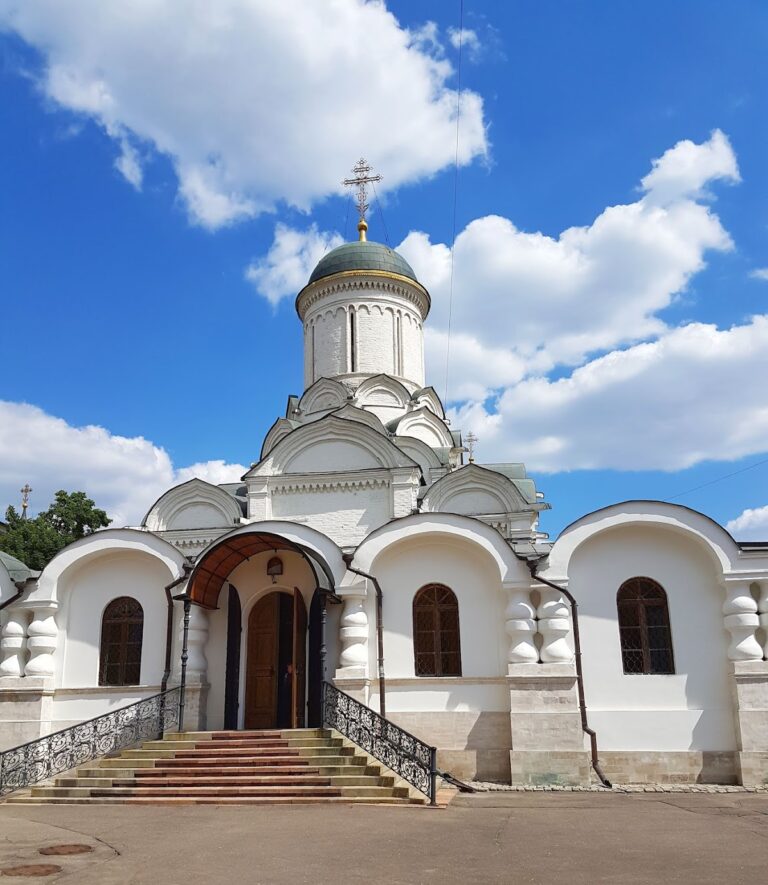
Built in 1679 on the site of an earlier sixteenth-century church, the Cathedral of the Meeting of the Vladimir Icon is a square, two-pillar, three-aisled building with a three-part apse, five domes, and a central light-bearing drum. The other drums have decorative windows. Its architecture belongs to the Moscow-Yaroslavl tradition and reflects features associated with church building during the age of Patriarch Nikon. Three arches articulate the upper exterior of each wall, with a large icon in the central arch.
The south chapel, dedicated to the Nativity of John the Forerunner, was added in 1706. A north chapel dedicated to Mary of Egypt was created in 2000 and consecrated in 2008, when a gallery with a bell tower was also added. The cathedral’s vaults, pillars, window reveals, and interior walls were painted in 1707 by artists of the Kostroma and Yaroslavl schools, commissioned by the court official Semyon Griboedov. Their frescoes depict Christ’s earthly life, miracles, Gospel parables, the Passion, martyrs, apostles, monastics, and scenes connected with the Vladimir Icon.
The central dome contains Christ Pantocrator, while four archangels occupy the spaces between the drum windows. Martyrs appear on the pillars, apostles with the instruments of their martyrdom in the arches, and standing monastic saints between the windows. The cathedral’s five-tiered, beam-supported iconostasis was created in 1995 in a style based on fifteenth- and sixteenth-century examples. Its tiers were painted between 1995 and 1997, and Hieromonk Alipy painted the icon of the Vladimir Mother of God in 1995.
Frescoes and crypt
During the twentieth-century conversion of the cathedral into a dormitory, the interior was divided into several floors and fitted with stoves. Water damaged the paintings after the crosses were removed and the dome covering was damaged. The frescoes survived in part because the walls had been painted and covered with wallpaper. After residents were removed in the 1960s, the wallpaper and paint were stripped away, and the paintings were consolidated with egg emulsion. A complete fresco restoration was carried out in 2005.
The cathedral crypt contains the Chapel of the Resurrection of Christ, consecrated in 2008 and modeled on the aedicule of the Church of the Holy Sepulchre in Jerusalem. The chapel is finished in white marble and decorated with mosaic using ancient Christian and catacomb-inspired symbolism. The crypt also contains a life-size exact copy of the Shroud of Turin, consecrated by Patriarch Alexy II.
Shumayev Cross and relics
The cathedral preserves the Shumayev Cross, made by the merchant and craftsman Grigory Shumayev and installed there in 1761. Approximately eight metres high, the large carved composition is centered on the Crucifixion and illustrates the redemptive sacrifice of Jesus Christ.
The Cathedral of the New Martyrs and Confessors contains the relics of Hilarion Troitsky. The monastery also holds particles of relics associated with Mary of Egypt, Nicholas the Wonderworker, John Chrysostom, Basil the Great, Seraphim of Sarov, and other saints. Its venerated icon is a copy of the Vladimir Icon of the Mother of God.
New cathedral
Cathedral of the New Martyrs and Confessors
The Cathedral of the New Martyrs and Confessors is a roughly sixty-metre-high complex faced with carved white limestone and crowned by seven golden domes. Designed in the Russian style with Byzantine elements, it has an upper church dedicated to the Resurrection of Christ and the New Martyrs and Confessors of the Russian Church. Its lower church is dedicated to John the Forerunner and the Twelve Apostles and contains a baptistery.
The walls contain painted images of the New Martyrs and Confessors. Christ Pantocrator appears in the central dome, and a Last Supper fresco above the upper altar includes the apostles and the New Martyrs. Much of the planned area is occupied by museum, administrative, archival, storage, tailoring, and technical facilities rather than worship space.
Former buildings and present structures
Church of Mary of Egypt
The Church of Mary of Egypt began as a wooden building in 1385 and was rebuilt in stone during the fifteenth century. It was a small, nearly square, single-domed church whose stone altar screen served in place of an iconostasis. A chapel dedicated to the Meeting of the Lord was added in 1706. The church closed in the 1720s, was renovated about forty years later with funding from Afanasy Goncharov, and was reinforced with iron bands in 1883. It was dismantled in 1930.
Church of Saint Nicholas and bell tower
The Church of Saint Nicholas was built in stone between 1679 and 1688 on the site of the original wooden Vladimir church. It retained older architectural forms and cross-shaped vaults, while its upper section originally carried a pyramid of keel-shaped gables. After the fire of 1737, it was rebuilt, and a chapel dedicated to All Saints was added in the late eighteenth century at the expense of Demid Meshchaninov, Moscow’s first city head. The church was demolished in 1928.
The former gate bell tower stood beside Saint Nicholas. Built in the 1670s as an octagon over a square base, it received a new Baroque cupola from the architect Ivan Michurin in 1740 after the fire destroyed its top. When the bell tower was demolished in 1928, its bells were sold to England. Several may have been acquired by the American engineer Thomas Whittemore and presented to Harvard University, where a special belfry was built for them.
Seminary and house churches
The former school building stands on the site of the monastery cemetery and now contains the Sretensky Theological Seminary. The abbot’s building contains a house church dedicated to the Holy Trinity, while the infirmary houses a church dedicated to John of Kronstadt. These structures form part of the monastery’s post-Soviet working complex alongside the restored cathedrals.
Nearby sites