Zaikonospassky Monastery: An Orthodox Monastery and Centre of Learning in Moscow


Site at a Glance
- Rating
- 4.8
- Popularity
- Low
- Country
- Russia
- Primary era
- Early Modern
- External website
- Open
- Eras represented
- Early Modern, Modern
- Civilizations
- Russian
- Site type
- Religious
- Remains
- Monastery
On this page8 sections
History
Zaikonospassky Monastery is an Orthodox male monastery of the Russian Orthodox Church in Moscow, Russia. Located in the historic Kitai-gorod district on Nikolskaya Street, it was traditionally founded by Tsar Boris Godunov in 1600 and became an important centre of Orthodox education through its association with the Slavic-Greek-Latin Academy.
Foundation and Early Development
Some local historians have linked the site with a fourteenth-century Saviour monastery, identified with an earlier Monastery of St Nicholas the Old. The foundation of the present monastery is traditionally attributed to Boris Godunov, whose reign preceded the Romanov dynasty. The earliest documentary reference to the monastery dates from 1635. It was initially called the Saviour monastery and later took the name Zaikonospassky from its position behind shops that sold icons.
During the reign of Tsar Alexei Mikhailovich, work began in 1660 on a two-storey stone cathedral. Prince Fyodor Volkonsky financed the project, which was completed on 20 November 1661. After the death of Archimandrite Dionysius in 1665, Simeon of Polotsk became head of the monastery. Simeon, an Orthodox cleric, writer, and educator, founded a school to train clerks for the Prikaz of Secret Affairs, a central government office of the seventeenth-century Russian state. This educational role gave the monastery the reputation of being the “teacherly” monastery.
The Academy and Its Educational Role
Sylvester Medvedev, who had studied at Simeon’s school, became head of the monastery in 1680. He proposed a charter for a Slavic-Greek-Latin Academy to Tsar Fyodor Alexeyevich, but the project was not carried out because of the tsar’s death. In 1687, a school founded in 1685 by the Greek brothers Ioannicius and Sophronius Likhud was transferred from the Epiphany Monastery to Zaikonospassky. Known as the Hellenic-Greek or Saviour schools, it was combined with the printing school and developed into the Slavic-Greek-Latin Academy.
The academy combined Slavic, Greek, and Latin learning with Orthodox theology. Modelled on the Kyiv-Mohyla Academy, it is regarded as the first higher educational institution in Great Russia. The monastery remained associated with it until 1814. The monastery’s abbots and archimandrites served as the academy’s rectors, while the monastic churches acted as house churches and provided students with places to practise ecclesiastical oratory. After Moscow University was established in 1755, the academy’s educational importance declined.
Rebuilding and Institutional Change
Fires in 1701 and 1737 caused rebuilding and alterations within the monastery and its churches. The work was associated with Ivan Zarudny, an architect connected with the Moscow Baroque, as well as Ivan Michurin, Mikhail Preobrazhensky, and Zinovy Ivanov. Following Catherine II’s secularization of church property, Zaikonospassky became a second-class stauropegial male monastery. Stauropegial status placed it directly under the patriarch rather than under the ordinary authority of a diocesan bishop, and the monastery no longer maintained a common monastic household.
In 1814, the Slavic-Greek-Latin Academy moved to the Trinity Lavra of St Sergius, where it became the Moscow Theological Academy. The former academy buildings at Zaikonospassky then housed the Zaikonospassky theological school. The monastery was also badly affected by the 1812 Moscow fire and the French occupation of the city. Restoration took place in 1851.
By 1900, two commercial buildings in the Russian style and a tall entrance bell tower had been erected on Nikolskaya Street. The bell tower incorporated the earlier Holy Gates. The monastery’s educational history is also associated with Mikhail Lomonosov, whose memory is marked by a plaque at the site.
Soviet Closure and Religious Revival
After the monastery was closed, its cathedral became the centre of the renovationist Union of Church Renewal in 1922. Renovationism was a reformist current within Russian Orthodoxy that emerged after the 1917 Revolution and operated with Soviet support. Antonin Granovsky, a former bishop of the Russian Orthodox Church and a leader of the movement, served at the cathedral until his death in 1927. The centre was closed in 1929, when the monastery itself was shut.
In 1931, a former monastery house was occupied by a Soviet television studio. Its equipment was transferred to the monastery bell tower in 1934, and regular sound television broadcasting continued from the tower from autumn 1934 until 1941. The cathedral underwent partial restoration during the 1960s. It was returned to the Russian Orthodox Church in 1992, and services resumed in July of that year. The cathedral initially functioned as a patriarchal metochion, a church or monastic dependency administered by the patriarch.
The Russian Orthodox University opened at the monastery in February 1993. The cathedral was considered for use as the university’s educational church, but its unsafe condition and the lack of suitable premises prevented that plan. The university later moved to Vysokopetrovsky Monastery. The revival of Zaikonospassky was accompanied by a property dispute with the Russian State University for the Humanities, while several premises continued to be occupied by non-ecclesiastical organizations.
On 20 February 2010, Patriarch Kirill celebrated the first patriarchal service at the ancient monastery in 310 years. On 5 March, the Holy Synod authorized its reopening as a stauropegial male monastery, separate from the former joint patriarchal metochion of Zaikonospassky and St Nicholas monasteries. Zaikonospassky remains an active monastery and is protected in Russia as a cultural-heritage monument of federal significance. Peter Afanasyev served as its superior from 2010 to 2016, followed by Daniel Konstantinov from 25 July 2016.
Remains
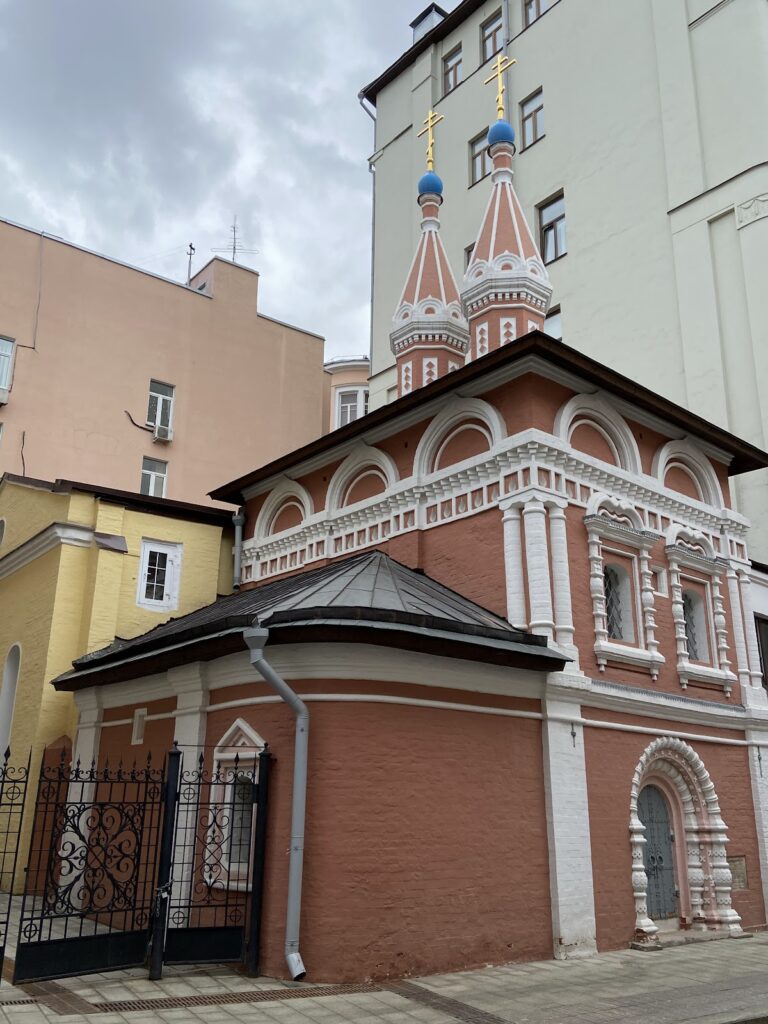
The surviving ensemble occupies part of the historic monastery complex on Nikolskaya Street in Kitai-gorod, the central Moscow district formerly enclosed by a fortified wall near the Kremlin. Its principal elements include the Cathedral of the Holy Mandylion, the fraternal or teachers’ building, trading rows, a revenue house with a bell tower, and the building of the Slavic-Greek-Latin Academy Collegium. Several seventeenth-century chambers and a former school building dated to 1822 also survive.
Cathedral of the Holy Mandylion
The existing cathedral incorporates the volume of the stone church completed in 1661. Its present form belongs to rebuilding in the early eighteenth century, although the exact date is uncertain. The structure has a lower church with a refectory, or communal monastic dining hall, dating from 1701, and an upper church. Two-storey monastic cells adjoin the lower church beneath the porch of the upper church. The surrounding gallery, dated to the second quarter of the eighteenth century, is attributed to Ivan Zarudny or to an architect associated with him.
The cathedral follows the traditional Russian arrangement of an octagon raised over a square. Its exterior includes classical pilaster-order details, distinctive round windows, and a gallery surrounding the octagonal upper volume. The gallery is enclosed by a balustrade. The lower level contains a church dedicated to the Saviour Not Made by Hands, referring to the Christian image of Christ’s face believed to have been produced without human painting, and another dedicated to the All-Merciful Saviour. The upper church has an altar dedicated to the icon of the Mother of God known as “Joy of All Who Sorrow.” Repair and construction work carried out by Ivan Michurin in 1742 did not substantially alter the building’s basic appearance.
Monastic and Educational Buildings
The fraternal or teachers’ building preserves the monastery’s combined educational and residential function. The former academy complex includes the building of the Slavic-Greek-Latin Academy Collegium, while the trading rows and revenue house reflect the commercial buildings present on Nikolskaya Street by 1900. The entrance bell tower, which incorporated the earlier Holy Gates, was demolished after the October Revolution and rebuilt in 2014 to the same design. Together with the surviving seventeenth-century chambers and the former school building of 1822, these structures preserve the architectural framework of the monastery’s religious, educational, and economic life.
Nearby sites