Village Church Blumberg: An Early Gothic Fieldstone Church in Germany
Site at a Glance
- Rating
- 4.8
- Popularity
- Very Low
- Country
- Germany
- Primary era
- Medieval
- External website
- Open
- Eras represented
- Medieval, Early Modern, Modern
- Civilizations
- German, Holy Roman Empire, Margraviate of Brandenburg
- Site type
- Religious
- Remains
- Church
On this page15 sections
History
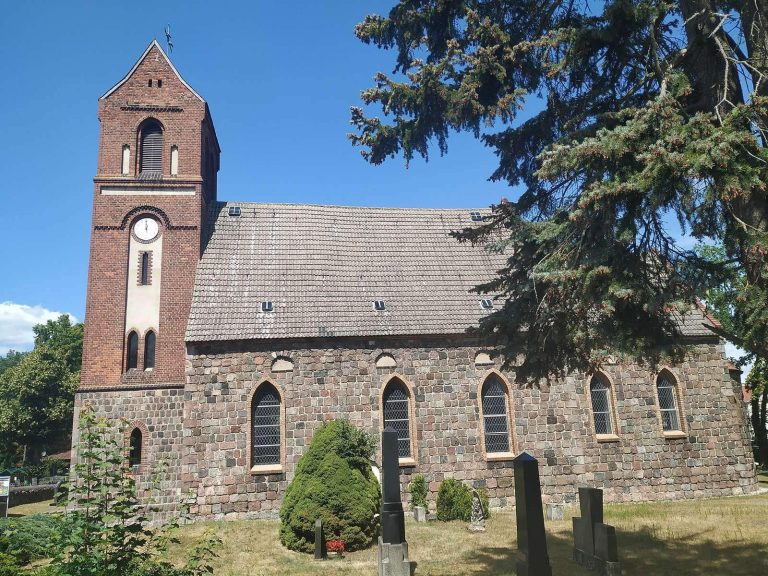
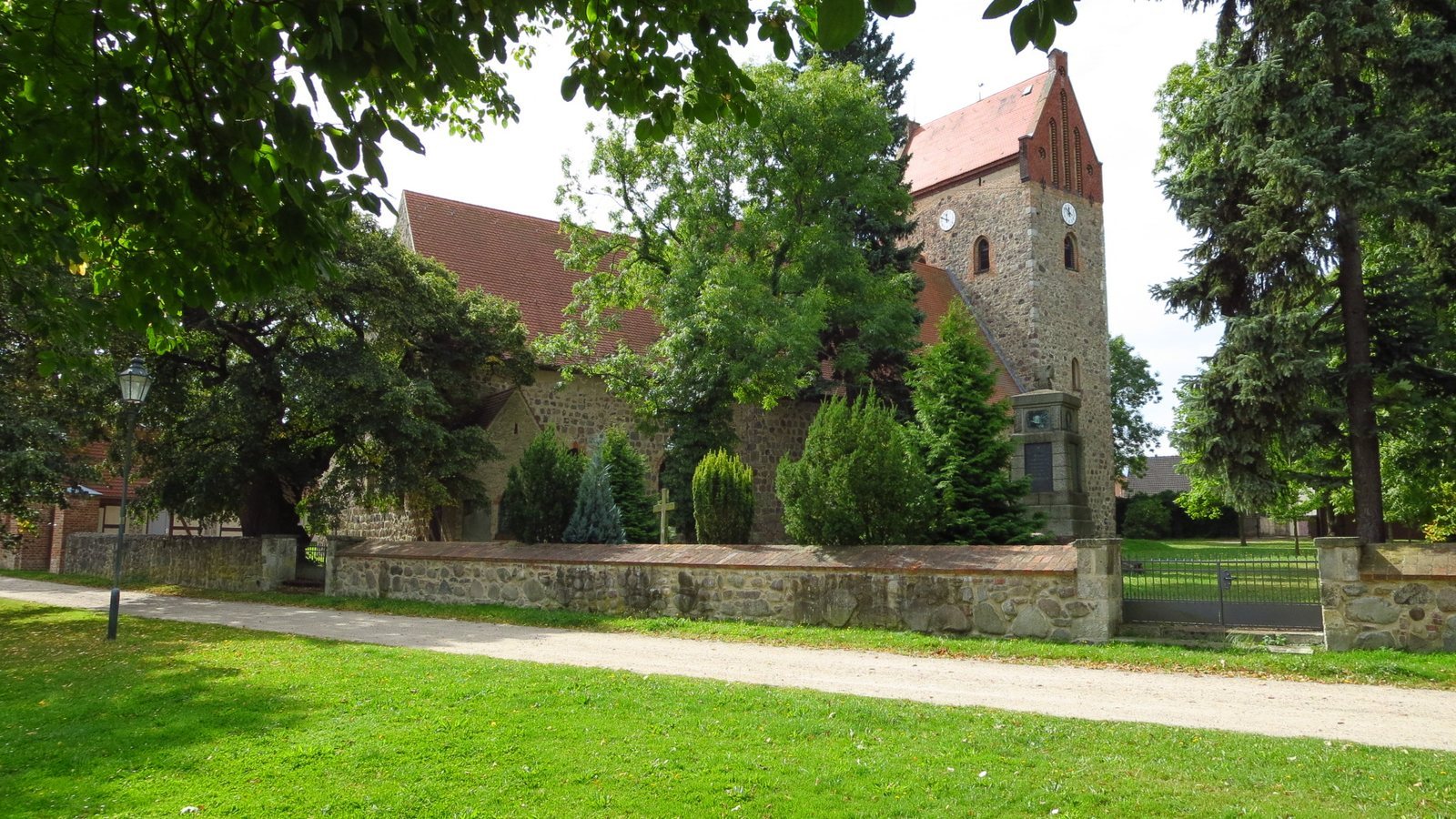
Village Church Blumberg is an early Gothic Evangelical fieldstone church in Germany, built in the second half of the thirteenth century in the Blumberg district of Ahrensfelde. Constructed chiefly from roughly shaped local stones, it was designed as a substantial hall church with a long, narrower choir and a tall western transverse tower. The church belongs to the Blumberg parish within the Berlin Nord-Ost church district of the Evangelical Church Berlin-Brandenburg-Silesian Upper Lusatia.
Medieval foundation and alteration
The southern sacristy, a service room for vestments and liturgical equipment, was probably added toward the end of the thirteenth century. The western tower probably dates from the fourteenth century, although another attribution connects it with the bell donated in 1462 by Dietrich von Stechow, bishop of Brandenburg. The broad southern portal was installed in the fifteenth century.
At the beginning of the sixteenth century, pillars and vaults were inserted into the nave. This transformed the original arrangement into a two-aisled hall church, in which the two longitudinal divisions are of approximately equal height. The same period produced wall paintings and sculptural details in the vaults, including a depiction of Saint Mark and reliefs associated with the apostles.
Patronage and later changes
Toward the end of the seventeenth century, the church continued to receive memorial works and portraits connected with local families. In 1724, the southern sacristy was extended and converted into a patron’s box, a reserved seating area for the church’s patron or holders of hereditary patronage rights, with a crypt. A late-eighteenth-century urn monument later commemorated Carl Wilhelm Börger, who died in 1793.
A comprehensive restoration in 1878–81 included the construction of a new northeast sacristy. The windows opened during the early-sixteenth-century vaulting were enlarged, and a west portal was built in forms similar to the fifteenth-century southern entrance. Community-funded improvements included a memorial plaque for the fallen and a red pulpit and altar cloth decorated with gold embroidery. Countess Anna von Arnim-Blumberg, superior of Berlin’s Saint Elisabeth Hospital, donated the sandstone pulpit in 1879.
In 1957, fragments of the Saint Mark wall painting were uncovered in the western choir vault. The church’s present organ was built by Schuke Orgelbau in 1963. Its modern parish use continues within the Evangelical Church, and the building is maintained as an open church.
Pastoral history
The succession of pastors begins with Arnold in 1357. Around 1540, the parish was served by the vicar Peter Mathis and Erasmus Schultz, while Peter Simon served around 1574. Later incumbents included Georg Schröder, Joachim Hellwig, Jakob Hellwig, Jakob Lüdecke, Andreas Schmidt, Gottfried Christoph Treuer, Ephraim Friedlieb Jüterbock, Daniel Rücken, Johann Albrecht Junge, Gottfried Lehmann, Johann Christian Friedrich Köllner, Johann Christoph Meistermann, Heinrich Adolph Bötticher, Friedrich Karl Eduard Gallwitz, Friedrich Wilhelm Eduard Ullmann, Gustav Hermann Julius Blasche, Karl Gustav Georg Ramin, and Fritz Georg Moritz Heinzel, who served from 1934 to 1937.
Remains
Building and entrances
Fieldstone church and tower
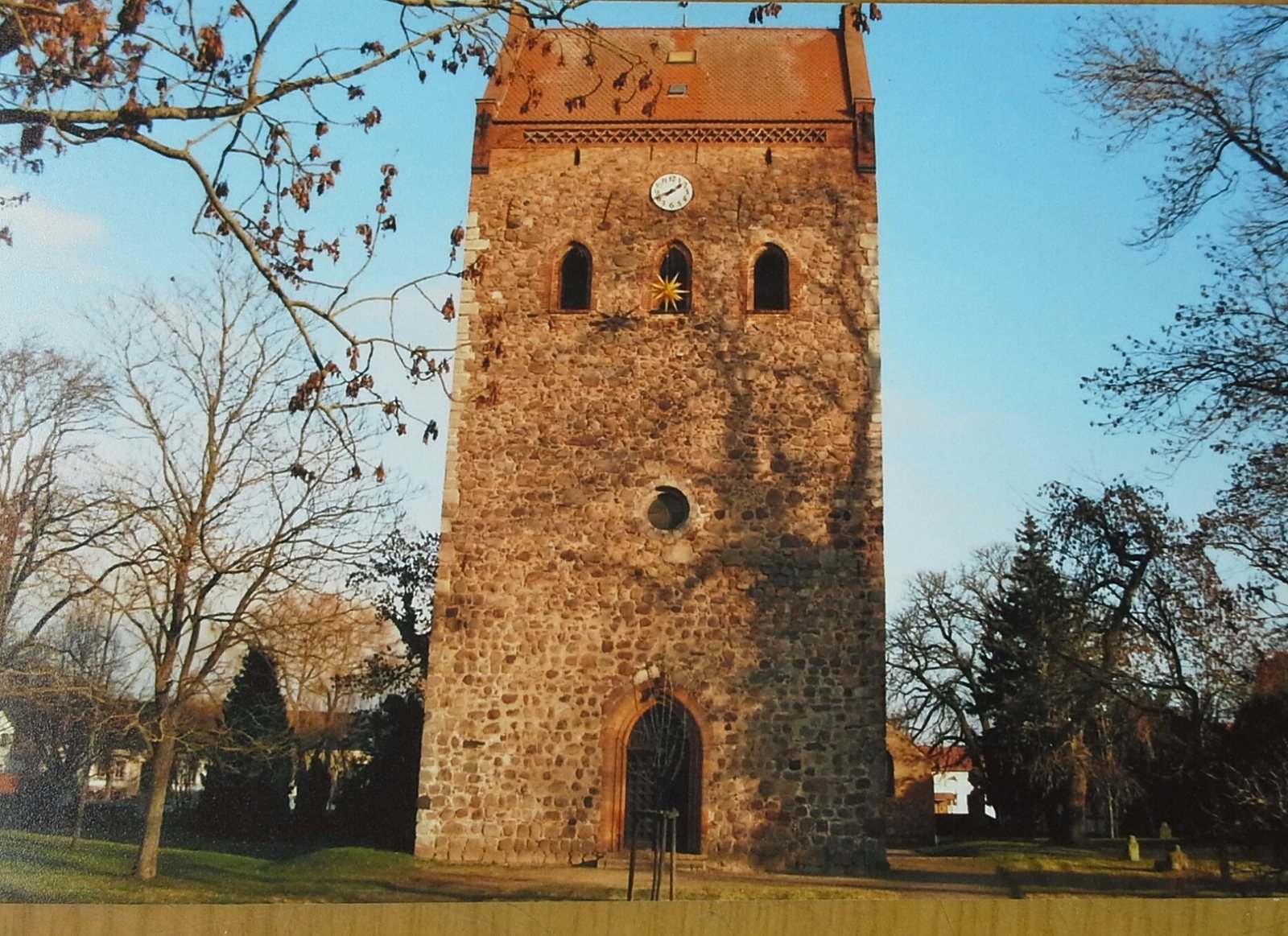
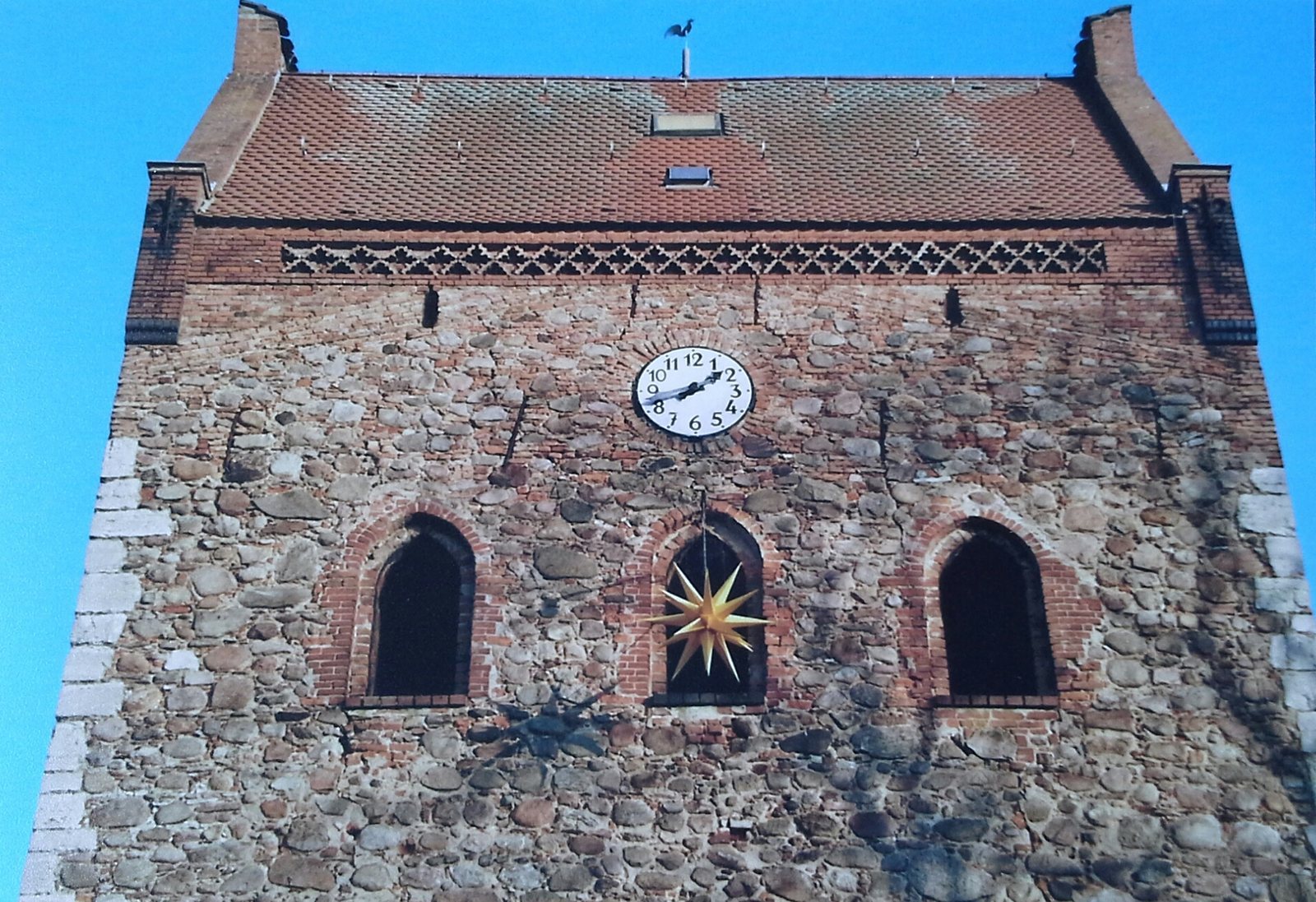
The church is formed by a fieldstone building with a long, set-back rectangular choir and a high western transverse tower. The tower rises above the nave walls and has light-colored ashlar blocks at its corners. Its present gabled roof, positioned between brick gables, dates from 1937. The pointed opening connecting the nave with the tower has been walled up except for a doorway.
Portals and windows
The southern portal has a broad, sharply pointed opening framed in profiled brick and dates from the fifteenth century. The west portal, made in similar forms, belongs to the restoration of 1878–81. Only the central east window dates from the fifteenth century. The arches of the original three-window group remain visible, while the other openings have been blocked. The windows opened during the early-sixteenth-century vaulting were enlarged in 1878–81.
Vaults and interior arrangement
Two-aisled nave
Three round pillars divide the nave along its central axis into two aisles. The space is covered by a cross-rib vault, a vaulted ceiling supported by intersecting structural ribs. The ribs have pear-shaped profiles and end in consoles bearing male busts. Their attributes identify the figures as apostles, and the sculptures probably came from a Berlin workshop active around 1520.
Choir vault
A sharply pointed triumphal arch separates the nave from the choir, which has a two-bay cross-rib vault. Its consoles are shaped as animal heads and masks, while the round bosses at the intersections carry reliefs of the sun and moon. Fragments of the early-sixteenth-century wall painting of Saint Mark survive in the western part of the choir vault.
Patron’s box and organ
The former patron’s box, created from the southern sacristy in 1724 and associated with a crypt, is now obstructed by the organ. The instrument, built by Schuke Orgelbau in 1963, has 13 stops, two manuals, and a pedal.
Paintings, tombstones, and memorials
Portrait paintings
Five portrait paintings preserve connections with members of Brandenburg noble families. They include a 1596 oil painting on wood of Reimar von Winterfeldt, oil portraits of the von Löben couple from 1666, and an oval oil portrait of Baron von Canitz, who died in 1699. In the choir, a life-size painting depicts Ehrengard Maria von Hagen, born von Schulenburg, together with portrait medallions of her three deceased husbands. Emanuel Dubuisson painted it in oil on copper in 1730, and its frame contains 32 alabaster coats of arms.
Tombstones and epitaphs
A late Romanesque inscribed tombstone dated 1296 was reused for Katarina von Krummensee, née Mörner, who died in 1596 and was the wife of Hans von Krummensee. The epitaph of Philipp Ludwig von Canstein, who died in 1708, shows trophies, the allegorical figure Fama representing fame, and the deceased’s bust above a sarcophagus. It is in the manner of Johann Georg Glume the Elder, although its upper sections were replaced by a plaster copy. Theodor Fontane later treated the epitaph in Walks through the March of Brandenburg.
A sandstone epitaph for Heinrich Julius von Goldbeck, who died in 1818, and his wife, who died in 1816, bears marble relief medallions of their heads. Johann Gottfried Schadow made the monument in 1820. Two inscribed tombstones dated 1734 and 1744 are set into the exterior of the sacristy, while the late-eighteenth-century urn monument to Carl Wilhelm Börger stands on the south side of the church.