Santa Maria in Piazza: A Renaissance Catholic Church in Fondi


Site at a Glance
- Rating
- 4.6
- Popularity
- Low
- Country
- Italy
- Primary era
- Medieval
- External website
- Open
- Eras represented
- Medieval, Early Modern
- Civilizations
- Kingdom of Naples
- Site type
- Religious
- Remains
- Church
On this page11 sections
History
Santa Maria in Piazza is a Renaissance Catholic church in Fondi, Italy, dedicated to the Virgin Mary and belonging to the Archdiocese of Gaeta. Its late-fifteenth-century rebuilding was commissioned by Onorato II Caetani d’Aragona, Count of Fondi, on the site of an earlier church known since 1126.
The Caetani rebuilding
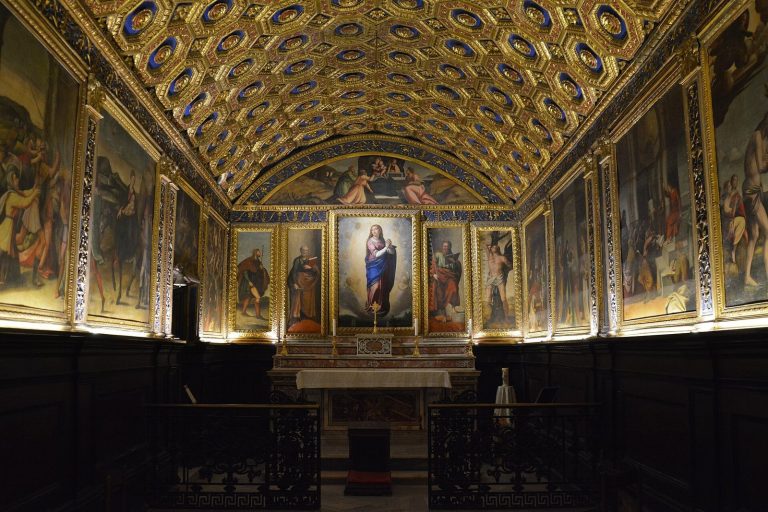
Reconstruction began in 1487. An inscription beside the main entrance states that the church was completed in 1490. By the end of that year, Giacomo Pignetore of Naples had also finished the coffered ceiling of the central nave and transept. A coffered ceiling is formed from recessed panels, while the nave is the principal lengthwise space of a church.
The building continued to receive architectural finishing and furnishings after 1490. In 1491, a marble tabernacle relief was completed, and Onorato II commissioned Cristoforo Scacco to paint the high-altarpiece, probably depicting the Death and Assumption of the Virgin. A tabernacle is a repository associated with the Eucharist.
Consecration and later history
Although the church was usable by 1491, Bishop Nicola Pellegrino consecrated it on 30 April 1508. The interval followed the death of Onorato II on 25 April 1491 and difficulties concerning his heir, Onorato III Caetani d’Aragona. Onorato III definitively lost the County of Fondi in 1497, when it was assigned to Prospero Colonna.
Later additions continued to shape the church. The left transept chapel dates from the end of the sixteenth century, while Beatrice Ottinelli, a noblewoman from Naples, commissioned the right-hand chapel in 1613. The church suffered substantial damage during the bombing of Fondi in the Second World War. Its Mascioni opus 785 pipe organ was built between 1958 and 1959.
Remains
Forecourt and exterior
The church stands behind a forecourt raised about two metres above the street. Nine basalt steps lead up to this platform. The facade follows a Renaissance design, with a roofline that rises toward the centre and a wall faced with stone blocks. Its rose window and the splayed surrounds of the two side windows are made of peperino, a volcanic stone widely used for architectural elements in central Italy.
Three marble portals correspond to the church’s three interior naves. The architrave of the central entrance, attributed to Tommaso Malvito, carries a relief of five winged cherubs. Additional reliefs on the doorjambs include the arms of the Caetani d’Aragona. Above the portal, a round-headed lunette shows the enthroned Madonna with the Child at the centre, Saint Catherine of Alexandria on the right, and Count Onorato II on the left, kneeling in prayer and wearing his count’s robe.
Bell tower
The bell tower rises to the left of the facade and ends in a pyramidal spire. On the side facing the piazza, each level has one window. The lowest is a Romanesque single-light opening, while the two upper levels contain pointed-arch windows divided into two openings. These upper windows have twisted columns.
Church plan and architectural structure
The interior follows a Latin-cross plan, with a long central axis crossed by a transept, the transverse arm of a church. Three naves are separated by pointed peperino arches resting on piers. Each nave ends in an apse, a rounded or polygonal termination of a church space. The central nave and transept have trussed roofs formed by connected structural beams, while the side naves are covered by pointed cross-vaults, made from intersecting vaulted surfaces with pointed arches.
Central nave and choir furnishings
At the end of the central nave stand two matching marble pulpits on columns. Their balustrades are carved in relief, and the pair is attributed to the workshop of Tommaso Malvito, a sculptor and workshop master active in Naples during the fifteenth century. Surviving stalls from the fifteenth-century wooden choir, made by German craftsmen working in Naples, are now installed in one of the naves.
Transept chapels
Two peperino chapels stand against the rear walls of the transept. The left chapel, dating from the end of the sixteenth century, contains the polychrome marble tabernacle made in Tommaso Malvito’s workshop and commissioned by Onorato II. The relief on the tabernacle is dated 1491.
Beatrice Ottinelli commissioned the right chapel in 1613. Its altar is dedicated to the Assumption of the Virgin and supports a niche containing the polychrome wooden statue Madonna of Heaven between Two Angels. Aniello Stellato, a sculptor from Naples, made the statue in 1611 for the Municipality of Fondi.
Apse and high altar
The apse contains the large altarpiece Death and Assumption of the Virgin, dated 1534 and attributed to the workshop of Giovanni Filippo Criscuolo. The central apse also houses the Mascioni opus 785 pipe organ in two opposing sections on either side of the high altar. Built in 1958 and 1959, the instrument has electric transmission, two keyboards of 61 notes each, and a concave-radial pedalboard of 32 notes. Mascioni is an Italian organ-building firm, and the opus number identifies this particular instrument in its catalogue.
Altars and paintings
The altar of the first chapel on the left side of the nave was erected by the Fondi nobleman Albino Saratti and dedicated to the Holy Spirit. It carries the 1569 polyptych Trinity between Saints James and John by Gabriele da Feltre. A polyptych is a painted or carved work made from several adjoining panels.
Other paintings connect the church with several artistic traditions and periods. They include the Raphael-inspired Transfiguration and Disputation of the Sacrament, along with a Pieta and the three-panel work Nativity of Jesus by Giovanni da Gaeta. Sebastiano Conca is represented by Madonna of the Rosary and Virgin with the Child among Angels. The church also contains an authentic replica of Giulio Romano’s Madonna with the Child among Angels and Saints.
Several further paintings have unidentified authors. They are Baptism of Jesus, Saint Leonard, Saint Lawrence and Saint Stephen, and Jesus Crucified with the Souls in Purgatory. Together with the altars, chapels, sculpture, choir stalls, and organ, these works form the surviving interior furnishings of the church.