Hohenschönhausen Castle: A Baroque Manor House in Berlin


Site at a Glance
- Rating
- 3.9
- Popularity
- Very Low
- Country
- Germany
- Primary era
- Early Modern
- External website
- Open
- Eras represented
- Early Modern
- Civilizations
- Holy Roman Empire, Margraviate of Brandenburg
- Site type
- Domestic
- Remains
- Manor House
On this page7 sections
History
Hohenschönhausen Castle is a small Baroque former manor house in Berlin, Germany, built around 1690 and shaped by several later alterations. The present building stands on a site with earlier medieval activity and is listed on Berlin’s monument register.
Medieval Origins and the Manor
The first building on the present castle site was erected between the thirteenth and fifteenth centuries. The area was probably occupied by a family of village reeves, local officials responsible for managing a settlement or estate. At the end of the fifteenth century, the noble von Röbel family established a manor there.
The present Baroque manor house dates to around 1690. In this context, a manor house was the principal residence associated with an agricultural estate, rather than necessarily a royal or princely residence.
Private Ownership, 1736–1929
On 2 July 1736, the merchant Adam Ebersbach acquired the manor. It remained with him and his heirs until 1816. The following year, the Prussian state councillor and reformer Christian Friedrich Scharnweber bought the property. Scharnweber was a close associate of Karl August, Prince von Hardenberg, the Prussian State Chancellor, a senior head of government administration. Scharnweber and his heirs retained the estate until 1890.
In 1890, the property was sold to the land-development company of the Aachen banker Henry Suermondt, who later subdivided the estate. In 1893, the building, by then known as a castle, passed to the factory owner and merchant Gerhard Puchmüller. He commissioned numerous alterations and had the entrance hall decorated with paintings.
The inventor and industrialist Paul Schmidt was the last private owner. He held the former manor from 1910 until 1929, after which it passed to the City of Berlin in 1930.
Municipal Use and Cultural Renewal
After entering municipal ownership, the building initially served as a social institution. From 1945 to 1989, it was used as a clinic for changing medical specialties, including obstetrics. Following the political transition, ownership passed to the Berlin Senate, which planned to convert the property into a local-history museum in 1993 and 1994. The plan did not proceed because financing could not be secured.
The Förderverein Schloss Hohenschönhausen, a support association formed to preserve, restore, and give cultural use to the building, was founded in 1998. It acquired the manor and its associated land in February 2008 and subsequently used the building for exhibitions, readings, lectures, and concerts. Cultural events also involved Christine Errath, Peter Ensikat, Dieter Hildebrandt, and Johanna Beisteiner, who is an honorary member of the association.
Roof-renovation work took place from 2003 to 2006, followed by the reconstruction and public opening of four upper-floor rooms in 2009. Further renovation and reconstruction between 2015 and 2018 concentrated mainly on the exterior parts of the structure. In November 2021, the housing cooperative NEUES BERLIN eG acquired the former manor from the association and began a comprehensive renovation in coordination with the Berlin State Monuments Office. A topping-out ceremony, traditionally marking completion of a building’s structural framework, took place on 12 May 2025.
The building was formerly called Schloss Hohenschönhausen or Bürgerschloss Hohenschönhausen. The name KulturGut 44 was adopted in connection with its new use. The former manor remains listed on Berlin’s monument register.
Remains
Baroque Manor House
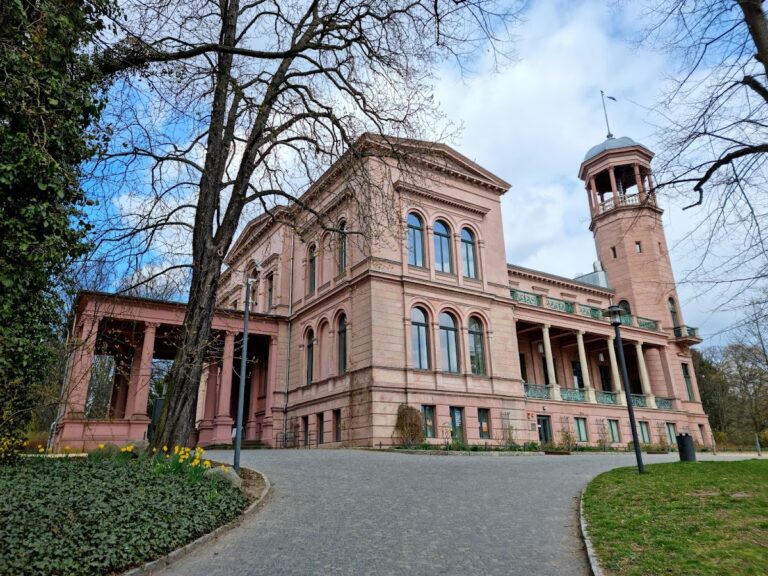
Hohenschönhausen Castle is a compact Baroque building with a footprint of about 360 square metres and a height of approximately 17 metres. Baroque architecture is associated with formal composition, elaborate ornament, and dynamic decorative treatment, especially in the seventeenth and eighteenth centuries. The manor’s present form reflects its construction around 1690 together with later alterations.
The entrance hall, or vestibule, retains the significance of the changes commissioned by Gerhard Puchmüller, who had it decorated with painted artwork. The building also has a balcony with a restored balustrade, a protective or decorative row of posts supporting a rail. The balcony and balustrade were documented in 2017.
Roof and Conservation Work
The roof was renovated during the 2003–2006 campaign, and four rooms on the upper floor were reconstructed for public use in 2009. The later work from 2015 to 2018 focused chiefly on the building envelope, meaning the external parts such as the walls and roof, while the interior remained in poor condition during that phase.
The comprehensive renovation begun after 2021 required every building component to be examined in consultation with the Berlin State Monuments Office. As part of this work, the wooden roof structure was rebuilt using historical models.
Nearby sites