Vesunna, Gallo-Roman Museum: The Archaeological Remains of Roman Périgueux


Site at a Glance
- Rating
- 4.6
- Popularity
- Medium
- Country
- France
- Primary era
- Classical
- External website
- Open
- Eras represented
- Classical
- Civilizations
- Roman
- Site type
- Museum
On this page16 sections
History
Vesunna, Gallo-Roman Museum in France presents the remains of the Roman city founded by the Romans at the site of Périgueux between approximately 25 and 16 BC. Built in the province of Aquitania, Vesunna became the Roman capital of the Celtic Petrocorii and developed into the predecessor of modern Périgueux. Its name came from Vesunna, a local protective goddess associated with healing waters, and the city became one of Aquitania’s twenty-one cities as its population rapidly adopted Roman customs.
Before Roman Vesunna
The Isle valley was occupied by Ligurians between approximately 700 and 500 BC before Iberian groups from the south displaced them. By about 200 BC, the Petrocorii, a Celtic people whose territory lay in the region later known as Périgord, had established themselves between the Dordogne and Vézère rivers and on the left bank of the Isle.
Before the Roman conquest, the Petrocorii maintained a fortified settlement on the hills of Écorneboeuf and Boissière, in the area of present-day Coulounieix-Chamiers. Known as the Camp of Caesar or La Curade, this stronghold was abandoned when Roman Vesunna was founded on the opposite bank. Between the two hills, the sacred spring of Jameaux was probably dedicated to Vesunna or to a related mother goddess who protected healing waters.
In 52 BC, the Petrocorii sent 5,000 warriors to support Vercingetorix, the Arvernian leader who organized a major Gallic coalition against Julius Caesar during the Roman conquest of Gaul. Their participation placed the community within the wider conflict that preceded the creation of the Roman provincial order.
Foundation and urban growth
During Augustus’ reorganization of Gaul in 27 BC, Vesunna was placed within Aquitania. Augustus, the first Roman emperor, ruled from 27 BC to AD 14. Roman public authority supported the new settlement, which stood on the right bank of the Isle in a river bend and occupied a crossing that had been navigable in antiquity.
Vesunna reached its greatest urban prosperity during the first century AD. Its public center included a forum, the civic and commercial heart of a Roman city, as well as an amphitheater for public spectacles and baths. During the second century, the urban structure was consolidated through additional domus, substantial Roman houses arranged around internal courtyards and reception rooms, together with new roads.
The population of the ancient city is estimated at approximately 20,000. The Petrocorii were also associated with intensive ironworking. The geographer Strabo specifically described them as working extensively with iron, placing local industry within the economic life of the Roman city.
The city villa and Roman society
During the reign of Claudius, from AD 41 to 54, a prestigious domus was built for a member of the local elite. The house was enlarged and remodeled repeatedly. Its remains, including outstanding wall paintings, were discovered in 1959 and 1960 beneath the modern museum.
The house provides the archaeological foundation for the museum’s interpretation of Vesunna. Its presentation examines the city’s urban form, Romanization through religion, trade, domestic life, heating, food, writing, gardens, reception spaces, and baths. Together, these themes place the residence within the broader social and economic development of the city.
Contraction and late Roman defenses
Vesunna contracted substantially after approximately 275 to 276, probably as a result of Alemannic incursions. Around 290, a new settlement was established north of the earlier city on an area of 5.5 hectares. The population withdrew behind new fortifications, and the late Roman settlement became known as Civitas Petrucoriorum, meaning “city of the Petrocorii.” It was later called simply Civitas or La Cité.
By this period, the population had adopted Christianity at an early stage, and the former name of the Celtic protective goddess was no longer used for the settlement. The new defenses were built partly from material taken from earlier monuments and houses, including the amphitheater. This process altered the ancient city physically while preserving parts of its earlier building material within the late Roman walls.
Visigothic rule and medieval Périgueux
In the early fifth century, the Visigoths, a Germanic people who established a kingdom in parts of the former Western Roman Empire, devastated Vesunna, particularly its religious buildings, and settled there. In 407, resistance was organized by Pégase, the holder of the episcopal see.
Around 465, the Visigothic king Euric martyred the bishop, prohibited Catholic worship, closed places of worship, and abolished the bishopric. From 506 onward, Bishop Chronope restored Christian worship and the churches.
La Cité later became the city of the counts and bishops of Périgord. In the eleventh century, the collegiate church of Saint-Front was founded several hundred metres to the east, giving rise to the neighboring medieval town of Puy-Saint-Front. In September 1240, La Cité and Puy-Saint-Front were united to form Périgueux.
Discovery and museum creation
The Roman city villa was uncovered in 1959 and 1960, and its remains became the archaeological foundation of Vesunna, Gallo-Roman Museum, which opened in 2003. The building was designed by Jean Nouvel as a glass-and-metal structure above the Roman foundations. Its circulation route passes over the ancient masonry, allowing the remains to be presented with minimal intervention in the surviving fabric.
Remains
Vesunna occupied a bend of the navigable Isle on the river’s right bank, while the earlier Petrocorian fortified center stood on the left bank. The museum is built above the foundations of a Roman city villa and combines the preserved remains with portable archaeological material, wall paintings, funerary reliefs, and a statue of Mercury. Seventeen interpretive stations connect the villa to the wider city, its monuments, water system, religious practices, defenses, and domestic life.
The Roman city and major monuments
Forum, amphitheater, and baths
The first-century urban complex included a forum, an amphitheater, and baths. Roads and additional domus were added as the city expanded during the second century. The amphitheater was among Vesunna’s major monuments and is described as the largest amphitheater of its time. Its surviving traces are preserved in the Jardin des Arènes, while part of its northwestern half was incorporated into the later city defenses.
Tour de Vésone
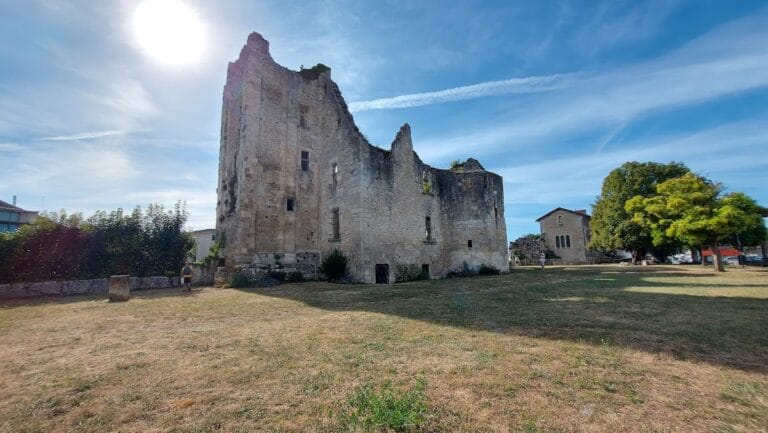
The Tour de Vésone is the substantially preserved ruin of a circular temple tower dating from the second century AD. Approximately 24 metres high, it stands in the Parc de Vésone and combines Celtic and Roman architectural elements. The tower is generally interpreted as a temple dedicated to Vesunna, the protective goddess whose name was given to the city.
Late Roman walls and gates
The late Roman settlement was enclosed by a limestone-block wall approximately 950 metres long. The defenses incorporated reused material from earlier buildings and monuments and included twenty-four towers, twenty-three curtain walls, and four gates. Two gates survive, the Porte Normande and the Porte de Mars. The wall therefore preserves both the organization of the later settlement and material taken from the earlier urban landscape.
The city villa
Foundations and circulation route
The museum stands above the foundations of the prestigious villa built during the reign of Claudius for a member of the local elite. The house was repeatedly enlarged and remodeled, and its remains form the core of the museum exhibition. A modern walkway passes above the archaeological remains, while the glass-and-metal structure limits direct intervention in the ancient masonry.
Paintings and domestic interpretation
Outstanding wall paintings survived from the villa and are displayed alongside evidence for domestic life. The museum’s presentation includes wall painting, heating systems, the kitchen, a reconstructed dining room, food, the garden and reception room, and the baths. A three-dimensional film supplements the surviving remains with an animated reconstruction of the ancient rooms.
Water supply and portable finds
Vesunna had an advanced water-supply system. Among the archaeological finds is a combined pressure-and-suction pump operating on the principle associated with Ktesibios, the Hellenistic Greek engineer linked with early hydraulic devices.
Portable material displayed by the museum includes vessels and other everyday objects, funerary reliefs, and a statue of Mercury, the Roman god associated especially with commerce, travel, communication, and trade. Other interpretive stations address the model of ancient Vesunna, the temple, column monuments and fragments, funerary cult, trade, written evidence, Romanization through religion, and the city walls.