Vaxholm Fortress: Sweden’s Maritime Defense of Stockholm


Site at a Glance
- Rating
- 4.3
- Popularity
- Medium
- Country
- Sweden
- Primary era
- Modern
- External website
- Open
- Eras represented
- Modern
- Civilizations
- Swedish
- Site type
- Military
- Remains
- Fort
On this page9 sections
History
Vaxholm Fortress is a Swedish fortification on Vaxholmen, established to control the maritime approaches to Stockholm, inspect passing vessels, and collect customs duties. Its history begins in the sixteenth century, when Sweden strengthened its national defenses under Gustav Vasa, king from 1523 to 1560. The first installation was built around 1548–1549, after Gustav Vasa personally selected the location.
Sixteenth- and early seventeenth-century defenses
A fortification on Vaxholmen had already been associated with the regent Svante Sture in the early sixteenth century. Gustav Vasa’s national defense plan, adopted in 1544, included the site. The first fort was a simple wooden blockhouse. During the reign of Johan III, who ruled Sweden from 1569 to 1592, it was replaced by a round stone defensive tower.
The fortifications were expanded in 1604. After the defenses repelled a Danish attack in 1612, protective earthworks and other measures were added around the tower. Further construction was undertaken in 1623 and 1632 in anticipation of attacks from Poland, but these works were left unfinished and had fallen into disrepair by 1636. Vaxholm then functioned mainly as a customs post.
The great seventeenth-century rebuilding
Plans for renewed strengthening were prepared in 1652. In 1656, a proposal was made for an irregular pentagonal fortification with bastions around the existing tower. Work began that year, and the outer defenses were completed by 1658. Ravelins, detached defensive works placed outside the main fortification, were added as part of the scheme.
In 1660, the authorities decided to rebuild the defenses in stone. Construction began in 1661, and the reconstruction was completed in 1674. The fortress was placed under the Admiralty in 1662 and returned to the War College in 1679. After the military engineer Erik Dahlbergh criticized the defenses in 1677, additional work began in 1678. It was halted after peace with Denmark in 1679. Further construction based on plans by Dahlbergh and Carl Magnus Stuart took place from 1703 to 1710.
Wars and changing strategic importance
Vaxholm Fortress was repaired during the Russo-Swedish War of 1741–1743 and again during the war of 1808–1809. Russian troops crossed into Finland on 1 February 1808. The Treaty of Fredrikshamn, signed on 17 September 1809, transferred Finland and Åland from Sweden to Russia, increasing the strategic importance of Vaxholm.
A complete rebuilding began in 1833 under the direction of the Swedish officer Carl Fredrik Meijer and was completed in 1863. The old fortification and round tower were demolished and replaced by an entirely new complex. Its design was influenced by the fortification theories of the French military engineers Marc René Montalembert and Lazare Carnot, whose systems emphasized artillery protected inside casemates, fortified chambers designed to shield guns and their crews. The new complex was also influenced by the design of Karlsborg Fortress.
By the time this rebuilding was complete, advances in artillery were already making the fortress increasingly obsolete. In a test conducted in 1872, a newly armed armored vessel fired on the walls and its projectiles penetrated them. Larger ships could no longer use the narrow channel in front of Vaxholm. The previously obstructed Oxdjupet channel was therefore dredged, and a new fortress, Oskar-Fredriksborg, was built along the diverted route. These changes reduced Vaxholm Fortress’s military importance.
Prison, coastal defense, and preservation
During the nineteenth century, the fortress was also used as a prison. Its prisoners included the publicist Magnus Jacob Crusenstolpe and the general Georg Carl von Döbeln. The fortress later formed part of the Vaxholm defensive line from 1916. This line extended from Värmdö through Rindö, Vaxholm Fortress, Vaxö, and Edholma to Lillskär.
When Sweden began establishing coastal artillery in 1902, the fortress was again placed under naval authorities. From 1942, Vaxholm Fortress became the collective name for the defenses guarding the approach to Stockholm. The fortress also served as an intermediate station on the optical telegraph line between Söderarm and Stockholm Palace. An optical telegraph transmitted messages by visible signals between stations, and a control device operated by Abraham Niclas Edelcrantz is preserved in the museum.
Vaxholm Fortress was designated a state architectural monument in 1935. A fortress museum founded in 1947 at Oskar-Fredriksborg Fortress moved to Vaxholm Fortress in 1964. Since 1993, the site has been administered by the Swedish National Property Board. The museum presents Sweden’s coastal defense, life in the fortress, its prison, and archipelago preparedness during the Second World War. Vaxholm Fortress is no longer an active military installation. The site is occupied by the Himmelstrand family and houses the Vaxholm Fortress Museum.
Remains
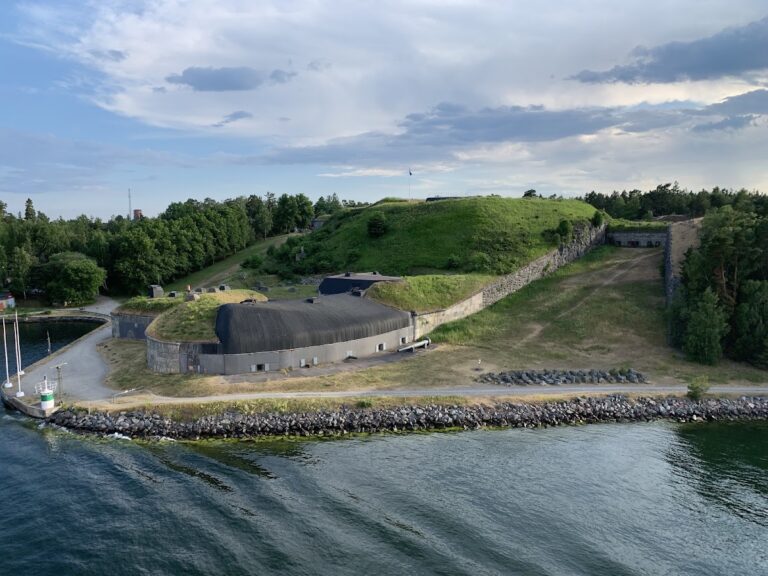
Vaxholm Fortress occupies the island of Vaxholmen in the Stockholm archipelago, between Vaxön and Rindö, in the Kodjupet channel. This narrow, winding waterway was one of the principal maritime approaches to Stockholm. The islet is entirely covered by the fortress, whose present form chiefly reflects the complete rebuilding carried out between 1833 and 1863.
The central tower and northern line
The nineteenth-century complex is organized around a central tower and several multi-storey buildings. The masonry is 2.20 metres thick, and guns were installed in protected casemates. The central tower rises five storeys and forms part of the northern line, a group of elongated buildings that provided barracks for a garrison of approximately 1,200 men. Its neoclassical design recalls Carl Fredrik Meijer’s work at Karlsborg Fortress.
Outer defensive works
Outer works stood in front of and beside the central tower. They included donjons and caponiers, with a caponier being a covered defensive work projecting into a ditch or another exposed area. Parts of the defenses were built as redoubts, enclosed or detached defensive fortifications comparable to the northwestern fortress on Rindö. Earlier phases of the site included an irregular pentagonal enclosure, bastions, earthworks, and ravelins, while the original wooden blockhouse and later round stone tower were replaced during the nineteenth-century rebuilding.
Channels and communications equipment
The fortress’s position was defined by the surrounding channels. Kodjupet is narrow and winding, while Oxdjupet lies on the far side of Rindö. Oxdjupet had earlier been artificially reduced in depth and was later dredged so that the main shipping route to Stockholm could pass through it. This change in the waterway contributed to the decline of Vaxholm’s military role.
The fortress museum preserves a control apparatus for the optical telegraph operated by Abraham Niclas Edelcrantz. The device represents the communications role that linked Vaxholm with the station at Söderarm and with Stockholm Palace.
Nearby sites