Kastro Gramvousas: A Venetian Fortress in Greece




Site at a Glance
- Rating
- 4.7
- Popularity
- Medium
- Country
- Greece
- Primary era
- Early Modern
- Eras represented
- Early Modern, Modern
- Civilizations
- Venetian
- Site type
- Military
- Remains
- Fort
On this page8 sections
History
Kastro Gramvousas is a Venetian fortress in Greece, built between 1579 and 1584 to defend against Ottoman attack during the period when the Republic of Venice controlled Crete and nearby fortified positions. The construction proposal came from Sofianos Evdemonogianis, while the plans were supervised by Latino Orsini, a Venetian official and military engineer responsible for fortification work in Crete and the surrounding islands.
Venetian construction and rebuilding
In 1588, lightning struck the powder magazine and ignited 350 barrels of gunpowder. The resulting explosion destroyed the fortress. It was rebuilt in 1630 and remained under Venetian control even after the Ottoman conquest of Crete in 1669. During this period, Souda and Spinalonga also remained in Venetian hands. In 1692, however, the Venetian commander surrendered Kastro Gramvousas to the Ottomans after accepting a bribe.
Revolutionary occupation
During the Greek War of Independence, the nineteenth-century revolt that established the modern Greek state and challenged Ottoman rule in Greek lands, 15 Cretan fighters reportedly from the Sfakia region seized the fortress on 2 August 1824. Kastro Gramvousas became the seat of the Revolutionary Committee of Crete and a base for attacks on the Ottoman administration. Its capture made Gramvousa the first part of Crete to be liberated from Ottoman rule.
From 1825 to 1828, about 3,000 fighters used the island and fortress as a base. A Turkish blockade and shortages of food contributed to attacks on shipping, giving the island the reputation of the “Pirate Island.” The community established a school for children, taught by Bishop Ignatios of Ardameri, and built a church. Money obtained through piracy helped purchase the ship Pericles, associated with Iakovos Tombazis.
End of the rebel base
On 19 January 1828, combined Anglo-French forces, with Greek involvement, captured the fortress in an operation intended to suppress piracy in the region. Kastro Gramvousas then came under joint Greek, British, and French control. With piracy suppressed, revolutionary control ended, and the fortress was abandoned in the early 1830s. The operation against the pirates was undertaken with the support of Ioannis Kapodistrias, the first president of Greece.
Remains
Fortifications and setting
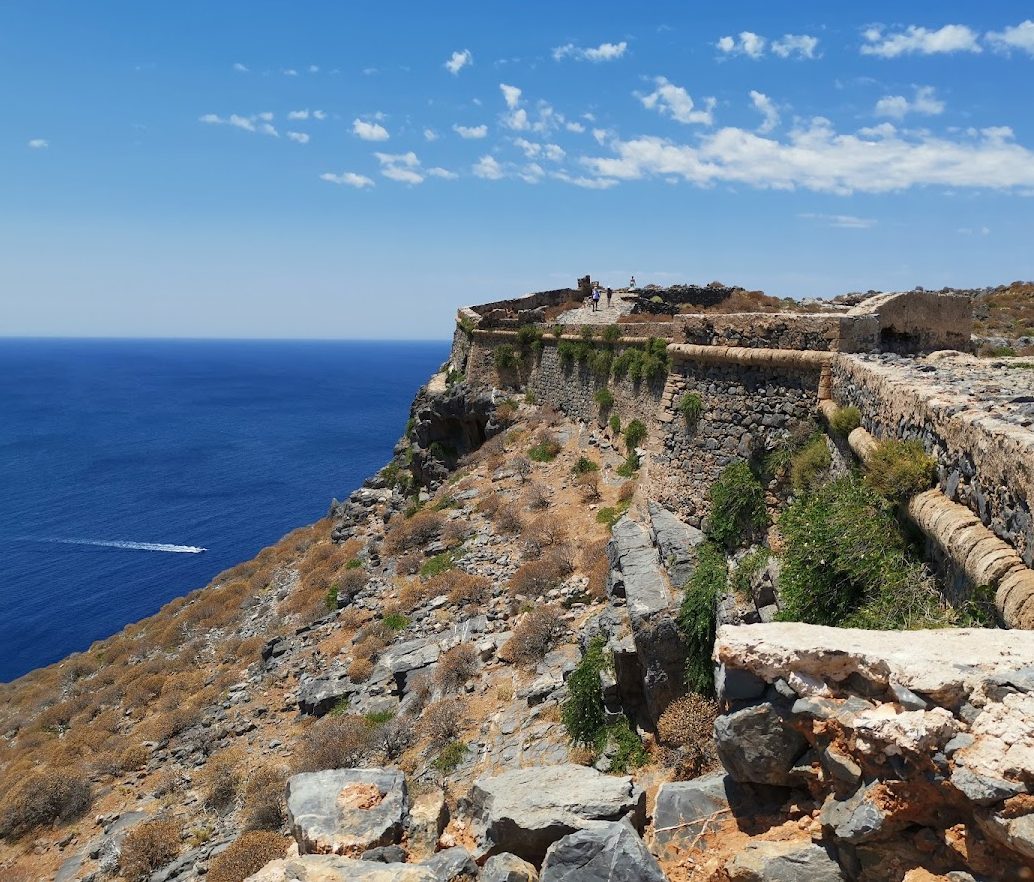
The fortress occupies the highest part of Imeri Gramvousa, on a relatively level hill about 137 metres above sea level and beside steep cliffs. The island’s natural harbour lies to the east. The plan forms an irregular triangle, with limestone walls and small bastions protecting the accessible sides. A bastion is a projecting part of a fortification designed to provide defensive fire along adjoining walls. A natural cliff protects the remaining side, while the walls extend for approximately 272 metres in total.
The entrance lies on the eastern side and is reached from the sea by a path. It consists of a gate with a vaulted porch made from carved sandstone. The fortress had 24 cannons in 1588, while the Ottoman period brought the number to 66.
Garrison buildings and water storage
Inside the walls are the foundations and ruins of garrison buildings, including barracks, headquarters, and other structures. Two large cisterns survive for collecting rainwater. A cistern is a tank used to collect and store water, commonly rainwater. An ammunition or powder store and other remains also survive within the enclosure. When the powder magazine exploded in 1588, the fortress water supply included two wells and five cisterns.
Church of the Annunciation
A church dedicated to the Annunciation survives inside the fortress. The Annunciation, or Evangelismos, is the Christian event in which the angel Gabriel announces to Mary that she will bear Jesus. The building is also associated with the title Panagia Kleftina, with Panagia being an Eastern Christian title for the Virgin Mary. During the Ottoman period, the church was used as a mosque.
Nearby sites