Castro Fortress: Vigo’s Historic Defensive Stronghold


Site at a Glance
- Rating
- 4.6
- Popularity
- Medium
- Country
- Spain
- Primary era
- Early Modern
- External website
- Open
- Eras represented
- Early Modern
- Civilizations
- Spanish
- Site type
- Military
- Remains
- Fort
On this page9 sections
History
Castro Fortress is a historic fortification in Vigo, Spain, on Monte del Castro. A medieval castle occupied the site as part of Vigo’s defensive system, which also included San Sebastián Fortress and a fortification or city wall linking the two. Plans to strengthen Vigo’s defenses date from the sixteenth century, when repeated attacks, particularly by English forces, prompted concern about the city’s security.
Seventeenth-century fortification
Major works began in 1665 during the Portuguese Restoration War, the conflict in which Portugal fought to regain its independence from the Spanish monarchy. After a siege that year, the captain general of Galicia, a senior military and civil governor, ordered the fortifications to be completed. In 1666, Colonel and engineer Fernando de Gourannanbergue and Maestre de Campo Diego Arias Taboada, a senior military commander, prepared an extensive plan to strengthen Vigo and connect Castro Fortress with San Sebastián Fortress.
Contemporary assessments considered the defensive system ineffective. The fortifications stood relatively far from the sea, could not prevent landings elsewhere along the coast, and allowed attackers to climb toward the summit without being detected. When the war with Portugal ended three years later, the walls lost much of their military importance.
Wartime history
On 23 and 24 October 1702, Castro Fortress witnessed the Battle of Vigo Bay, a naval action in the War of the Spanish Succession, the European conflict over the Spanish throne. A combined English and Dutch fleet defeated French and Spanish naval forces. British forces later captured Vigo and the fortress on 10 October 1719 during the War of the Quadruple Alliance.
French Imperial forces occupied the fortress from 31 January to 28 March 1809 during the Peninsular War, the part of the Napoleonic Wars fought in the Iberian Peninsula. Vigo residents and Spanish forces reconquered it on 28 March after an uprising. In 1810, the city received the honorific title “Faithful, Loyal and Courageous City of Vigo.”
Twentieth century and public preservation
During the Spanish Civil War and the first years of the Franco regime, the authoritarian dictatorship led by Francisco Franco from 1939 to 1975, the fortress became a site of executions. Between August 1936 and April 1942, 136 people were executed by the insurgent side beside the southern wall of the first enclosure. A commemorative monolith was erected at the location in 2010.
The Municipality of Vigo owns the fortress, which is integrated into Castro Park as a landscaped public space and viewpoint. It is protected under the generic declaration established by the decree of 22 April 1949 and under Spain’s Historical Heritage Law 16/1985. In late 2013, municipal authorities ordered the demolition of the crenellated stone building that had housed the El Castillo restaurant. This exposed a section of fortification wall concealed for decades.
Remains
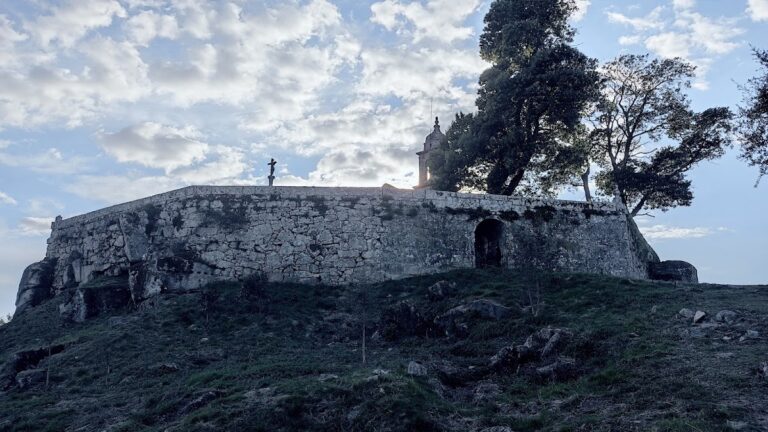
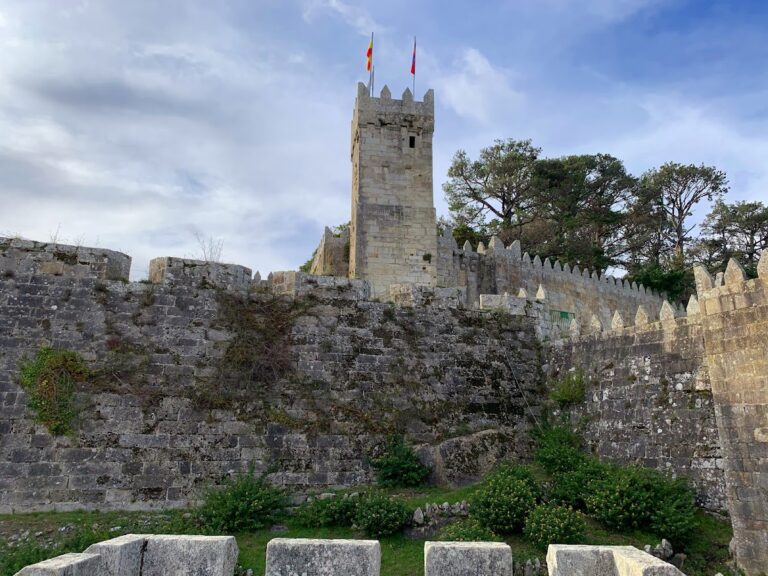
Castro Fortress is a polygonal granite fortification built on the summit of Monte del Castro. Its defenses were arranged in three walled enclosures. The first enclosure and part of the second survive, while the third, identified with Vigo’s city wall, has disappeared. The walls follow an irregular plan shaped by the terrain and included several gates and three bastions, projecting defensive platforms designed to cover adjoining walls and approaches. The highest part contained the San Sebastián stronghold.
Enclosures and surviving defenses
First enclosure
The upper fortress corresponds to the first enclosure and now functions as a viewpoint. Its southern wall also contains the memorial monolith erected in 2010 for the 136 people executed there between 1936 and 1942. The fortification wall exposed during the 2013 demolition of the former El Castillo restaurant provides another visible part of the surviving defensive fabric.
Second enclosure
The second enclosure was associated with San Sebastián Fortress. Its area is now occupied by Plaza del Rey and Vigo’s town hall, linking the surviving fortress remains with the broader defensive system that once extended across the city.
Passages and landscaped grounds
Passages and tunnels linked the fortifications with one another and with the city. Local tradition also claims that tunnels extended toward the historic center and Monte de A Guía, more than three kilometers away, although the full extent of this network remains uncertain. Tunnel remains have been visible at San Sebastián Fortress, and further remains were found in nearby Celso Emilio Ferreiro Street.
The interior and exterior are now landscaped as part of Castro Park. The grounds contain a botanical route with exotic species, several sculptures, a stone cross, open spaces, and a formal garden. In the upper area, the garden includes a fountain and the 1969 sculpture honouring “Vigo’s Impetus,” made by Camilo Nogueira Martínez. The upper viewpoint overlooks the Vigo estuary.
Nearby sites