Švamberk Castle: A Medieval Fortress and Family Seat in Czechia

Site at a Glance
- Rating
- 4.6
- Popularity
- Low
- Country
- Czechia
- Primary era
- Medieval
- External website
- Open
- Eras represented
- Medieval, Early Modern, Modern
- Civilizations
- Holy Roman Empire, Kingdom of Bohemia
- Site type
- Military
- Remains
- Castle
On this page13 sections
History
Švamberk Castle, also known as Krasíkov or Schwamberg, is a medieval castle ruin in Czechia, founded by the lords of Švamberk in the second half of the thirteenth century. It stands above the Krasíkov farmstead near Kokašice in the Tachov District. The hill had already been inhabited in prehistoric times, and finds made during excavation for an electrical line in 2007 show a Late Hallstatt-period settlement.
Foundation and the Švamberk family
The castle is traditionally associated with Ratmír of Skviřín, who is said to have named it Švamberk after Schwanberg, a German name meaning “Swan Mountain.” A witness list from 1252 may refer to Ratmír, probably then the burgrave of Přimda. A document from 1254 names John of Švamberk, a prior of the Strakonice Knights Hospitaller, a medieval religious and military order with communities and charitable institutions in Central Europe.
The Švamberk family retained the castle almost continuously until the end of the Thirty Years’ War, apart from the years 1544 to 1569. During the fourteenth century, the family divided into several branches, including the line descended from Bohuslav of Bor. Bohuslav II of Švamberk held the castle in the early fourteenth century and joined a delegation sent to Henry of Luxembourg in 1310. In 1342 he gave the village of Lomy and other property to the Augustinians, a Catholic religious order. The deed expressly mentioned Švamberk and the Chapel of Saint George in the outer bailey.
After Bohuslav II died, his son Bohuslav III inherited the estate. He held high offices, including provincial chamberlain, an official connected with royal finances, and greatly increased the family’s possessions. In 1379 he paid a royal tax of 88.5 marks of silver, more than 20 kilograms, for Krasíkov, Bor, and other estates. After his death around 1379 or 1380, his widow Anna administered the property for their sons, who were still minors.
Conflict and the Hussite Wars
Bušek and Bohuslav V later held Švamberk jointly. Bušek served as burgrave of Vyšehrad in 1388 and bailiff of Cheb in 1394 and 1395. Bohuslav was a provincial judge between 1390 and 1402. In 1394 the brothers attacked and looted Toužim, and in 1395 they captured a delegation returning from the king to Strasbourg. Bušek probably died without children. After Bohuslav’s death in 1402, their brother John administered the estate for Bohuslav’s underage sons. John abandoned his ecclesiastical career and was beheaded on the king’s direct order in 1409 or 1410, probably because he helped prepare a revolt.
Bohuslav V’s sons, Bohuslav VI, Hynek Krušina, and John, resisted the monarch after their uncle’s execution. A royal army besieged Švamberk in 1413, although the outcome is unknown, and the dispute was settled in 1414. In 1415 Bohuslav and John of Lestkov became administrators responsible for peace and order in the Plzeň region. They formed a provincial peace league, a regional alliance of nobles created to maintain public order and mutual security. In 1420 Sigismund of Luxembourg allowed its members to retain the estates of their enemies, strengthening the family’s financial position.
During the Hussite Wars, a religious and political conflict in fifteenth-century Bohemia between the reforming Hussites and royal and Catholic forces, the brothers became leading Catholic representatives. Bohuslav commanded Catholic forces defeated by Jan Žižka at Nekmíř in 1419. He controlled Plzeň in 1420 and captured Zelená Hora, where Hussites under Mikuláš of Hus had gathered. He was rewarded with the property of the destroyed Nepomuk monastery and the Manětín commandery.
In early 1421, Žižka abandoned his siege of Stříbro after learning that Bohuslav had reached Švamberk with a small retinue. Žižka’s Táborite forces, the more radical Hussite faction based at Tábor, captured the rocky Ridge before the castle on the first day. On the next day they took the tower and bridge, and Bohuslav surrendered. Petr Zmrzlík the Elder of Svojšín arranged the departure of the garrison and its burgrave, Ancha of Veselé. Bohuslav probably remained a prisoner at Švamberk until Zmrzlík’s death, after which he was moved to Příběnice. He eventually joined the Calixtines, the moderate Hussite faction associated with communion under both kinds, and became a Hussite commander.
Hynek Krušina succeeded Bohuslav in the provincial peace league and besieged the Hussite garrison at Švamberk in 1421. Žižka brought supplies to the castle, but Jindřich Plavenský’s cavalry forced him to withdraw. Hynek failed in a second attempt to capture the castle in 1422. He later bought it from the Hussites with imperial assistance for 700 kopas of groschen. The payment date is uncertain, but Hynek controlled Švamberk by 1424. Bohuslav died during the siege of the Austrian town of Retz in 1425. Hynek remained aligned with the Catholics and helped relieve Plzeň, which Hussite forces besieged, in 1431 and 1434.
Fire, rebuilding, and changing ownership
As regional governor, Hynek captured Skála Castle in 1441 and hanged its allegedly predatory garrison. In November 1443, a fire that began in the chambers of his wife, Markéta of Plavno, destroyed almost the entire castle except for the food stores and armoury. The damage was valued at 500 kopas of groschen. Hynek and his family moved to the newly built Zelená Hora, but Švamberk was probably repaired. An altar in a new castle chapel was consecrated on 27 October 1454, while the older chapel was thereafter used as a storehouse.
After Hynek’s death, the estate passed to Bohuslav VII Krušina of Švamberk. He married Ludmila, daughter of Oldřich II of Rožmberk, in 1452. In 1473 he bought Milevsko and Zvíkov Castle from the Rožmberks and made Zvíkov the principal family seat. From 1476 he served King Matthias Corvinus as supreme military commander, but Matthias imprisoned him after Bohuslav refused to surrender some of his castles. Bohuslav’s son Hynek then occupied Zvíkov, Švamberk, Bor, and Rožmberk for King Vladislaus. Bohuslav was later released and supported Vladislaus. Švamberk was subsequently managed by officials rather than functioning as the family’s main residence.
Jindřich of Švamberk inherited the family’s remaining major estates after Bohuslav Krušina died in 1490. Although he lived mainly at Zvíkov, he rebuilt Švamberk in the Late Gothic style between 1510 and 1513. The work included a new palace and a well reportedly about 90 metres deep. Jindřich died childless in 1523, and his nephew Kryštof I of Švamberk inherited the estate.
Peasant unrest caused by rising labor obligations broke out around Švamberk in 1525. Zdeněk Lev of Rožmitál, the supreme burgrave of Prague, urged Kryštof to keep the castle well guarded. In 1529 Kryštof arranged the extensive documentary archive kept at Švamberk, although some documents had already become too old and decayed to read. Renaissance alterations probably began in 1528 under Jan Holý, a builder from Plzeň.
Kryštof died at Švamberk on 9 January 1534 while preparing a large hunt in the surrounding woods. His eldest son, Jindřich III the Elder, initially administered the property, but divided it with his five brothers in 1540. Švamberk went to Ratmír of Švamberk, who exchanged it in 1544 for half of Zvíkov and moved there. On 10 October 1544, Jindřich sold the castle to Wolfgang the Younger Krajíř of Krajk at Točník for 28,000 Meissen groschen.
Wolfgang lived at Švamberk, but surrendered the estate to King Ferdinand I after joining the Bohemian Estates’ revolt of 1547, a rebellion by regional estates against Habsburg rule. In 1548 Ferdinand exchanged the castle for other property with Hieronymus Šlik of Holíč. After Hieronymus died in 1556, his youngest son Šebestián Šlik inherited the estate. Financial difficulties forced Šebestián to sell it in 1569 to the brothers Jindřich, Zdeněk, and Jáchym of Švamberk for 37,300 Meissen groschen.
Švamberk went to Jáchym when the brothers divided their property. He had sons Jiří Petr, Jan Šebestián, and Arnošt Kašpar with his wife Anežka Šliková, and another son with his second wife, Sibyla Šliková. Jáchym died in 1574 and was buried with his first wife in the family crypt at Švamberk. Jiří Petr later owned the castle and died in 1608, leaving it to his underage children. Their uncle Jan Šebestián administered the estate until his death in 1615. Anna Marie then became guardian, but died in 1619 at the age of 28. Jan Šebestián’s death in 1624 left the whole estate to Jan Bedřich.
Destruction and abandonment
Jan Bedřich probably took only a limited part in the Estates’ revolt and was fined 1,200 Rhenish florins. Imperial troops at least partly looted Švamberk soon after the Battle of White Mountain in 1620, the defeat that ended the rebellion and brought imperial confiscations, fines, and tighter Habsburg control. In 1639, fearing the Swedish army, Jan Bedřich kept a garrison of musketeers at the castle, although he probably lived at Trpísty.
A major fire began at Švamberk on 7 February 1644. It was reportedly started when the watchman’s wife ignited overheated fat while baking doughnuts. The entire rear castle and part of the outer bailey, including its chapel, burned. Reports from November and December 1643 had already described the castle as almost entirely burned, so the exact sequence of the damage remains uncertain. The castle received temporary roofing after the fire but was never restored.
In August 1646, the Swedish general Carl Gustav Wrangel occupied Švamberk with 300 cavalrymen, who plundered the surrounding area. Imperial Colonel Lanow lured the garrison out on 14 August and defeated it. After nearby Třebel Castle was demolished on the orders of Emperor Ferdinand III in 1647, Švamberk remained among Jan Bedřich’s large residences. It was then abandoned and fell into ruin.
In 1654 Jan Bedřich built a new Chapel of Saint Mary Magdalene at Švamberk, using a former bastion as its foundation. Unable to finance repairs, he dismantled parts of the castle walls for building stone to repair the demesne farmstead below. Jan Bedřich died on 10 January 1659 as the last member of his branch and was buried in the chapel. His widow, Marie Magdalena, later sold the estate to Count Jan Kryštof Ferdinand of Heisenstein. Švamberk has been protected as a cultural monument since 1964. The castle slopes are also protected as the Krasíkov Nature Monument for their heat-loving plant communities.
Remains
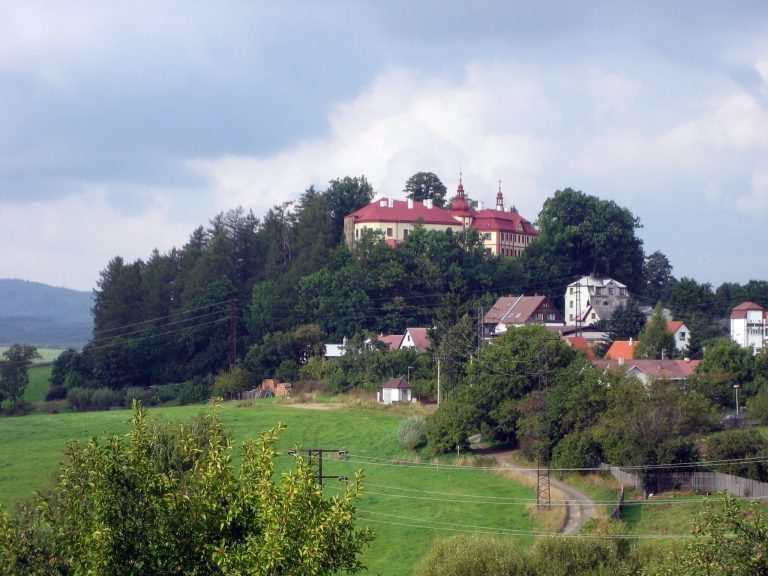
Švamberk occupies Krasíkov Hill at an elevation of 636 metres above the Hadovka stream. The ruin has a two-part plan consisting of an outer bailey and a castle core, and the hilltop fortress forms a long triangle. An earthwork and ditch once surrounded most of the perimeter. The earthwork crest was probably reinforced with a dry-stone wall, much of which disappeared when the castle was dismantled for building material.
Approach and outer defences
A road ascending the hillside was protected first by an earthwork and higher up by a wall. A rectangular bastion, a projecting fortification for defensive fire, extended from the rocky formation known as the Ridge and controlled the road. A tower drawn where the road curves around the Ridge on Vojtěch Král’s 1905 plan probably never existed. After passing the Ridge, the road entered the outer bailey through two gates.
The outer bailey was initially lightly fortified. Beyond it lies a neck ditch about 16 metres wide and up to 6 metres deep, with a basalt block at the bottom that served as a bridge pier. Around the middle of the fourteenth century, the ditch that had protected only the castle core was extended around the outer bailey, while walls closed the approaches to the older neck ditch. A tower gate on the southeastern side then provided access. It has disappeared, but it may have been the tower mentioned during Jan Žižka’s capture of the castle.
After the Hussite sieges, the Ridge was incorporated into the defences. A new access road was probably created, with a gate opposite the Ridge and a platform carrying a defensive structure. The structure measured about 6 by 11 metres and had a stone foundation with a timber superstructure. The castle’s commanding position probably meant that a more active artillery-defence system was unnecessary.
Outer bailey buildings
Church of Saint Mary Magdalene
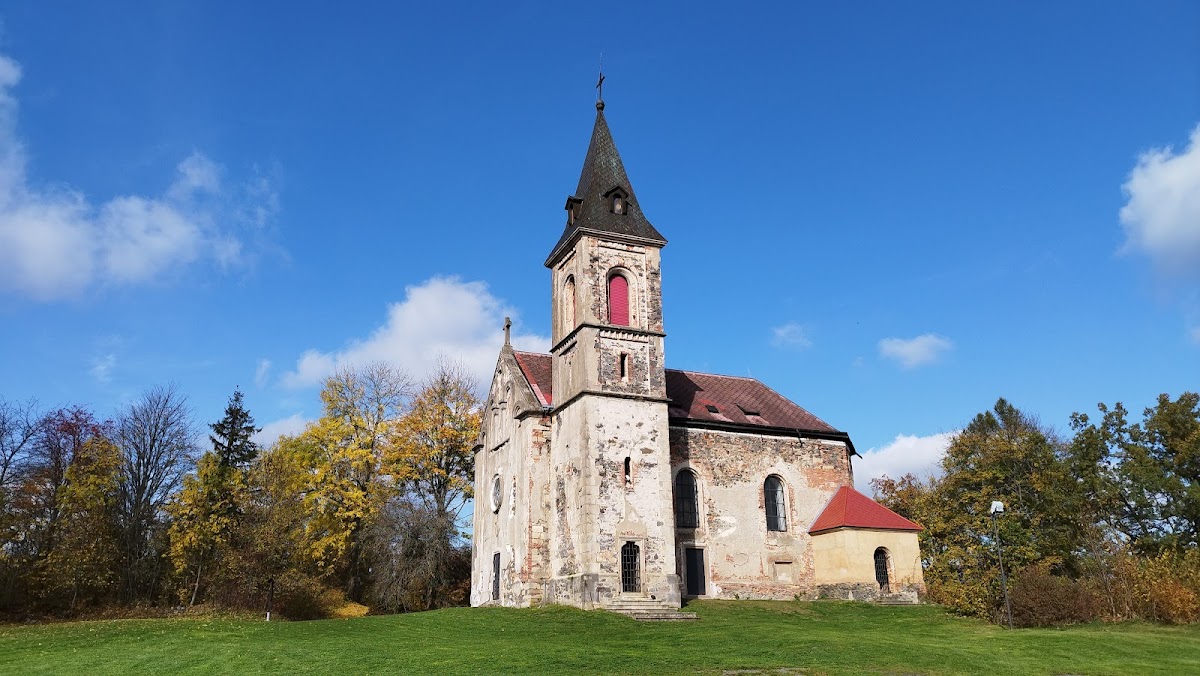
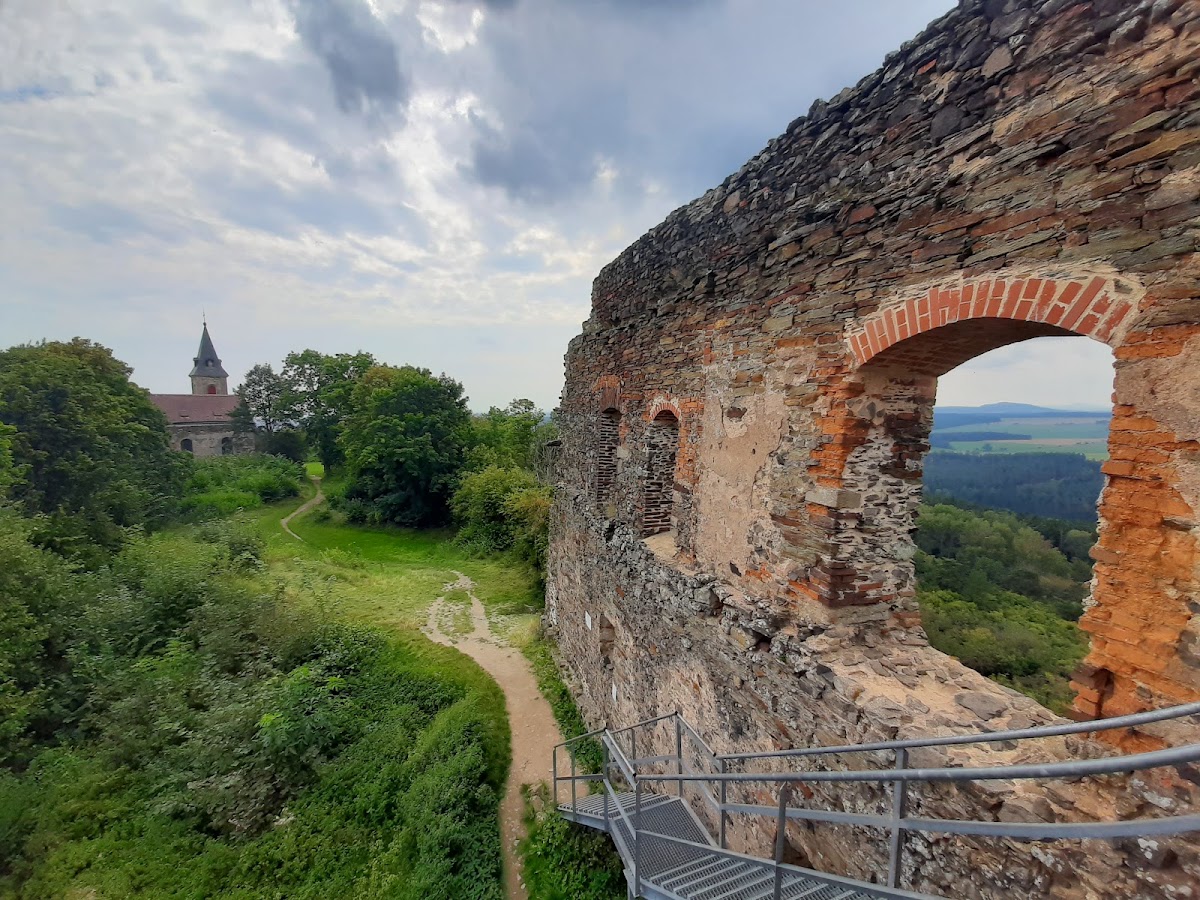
The Church of Saint Mary Magdalene dominates the outer bailey. Its presbytery stands on a Late Gothic artillery bastion whose keyhole-shaped gun loops survive. The church is associated with the burial place of the lords of Švamberk. It was renewed in 1707, and its bell tower dates from 1880. The chapel erected in 1654 used a former castle bastion as its foundation, and Jan Bedřich was buried there in 1659.
Farm buildings
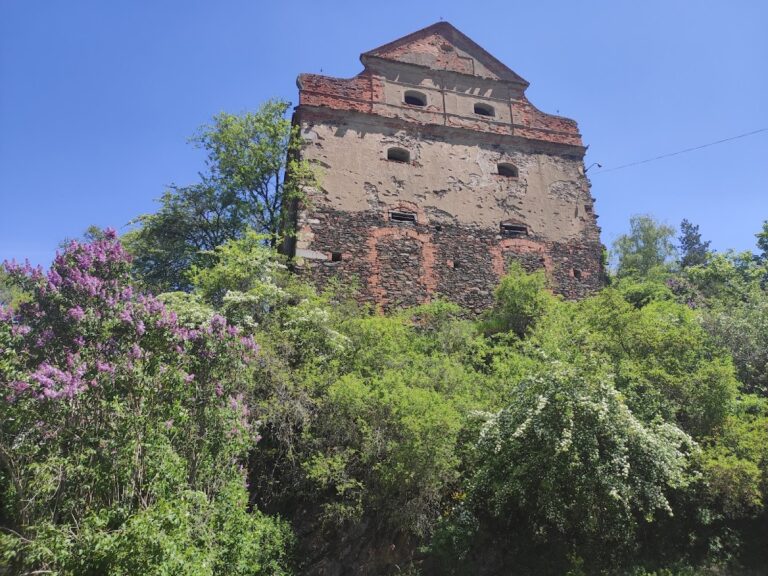
Several farm-building torsos remain in the outer bailey. The best-preserved is commonly identified as a brewery. The ruin to its east is the remains of a house formerly occupied by the church sexton. These structures stand within the area that also contains the church and the Baroque bell tower.
Castle core
The castle core was entered through a screen-like gate in a front wall 2.2 metres thick. A three-metre-wide zwinger, a defensive space between an inner wall and an outer barrier, lay before the wall. Foundations of a long building run along the western side of the core, while another building probably stood opposite. The original small palace, with a basement, occupied the northwestern part of the enclosure.
Round tower and palace
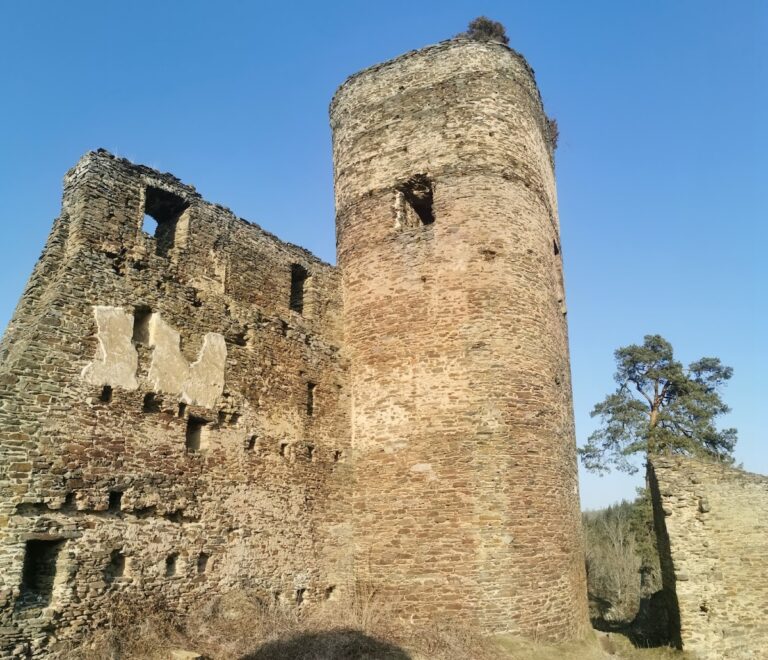
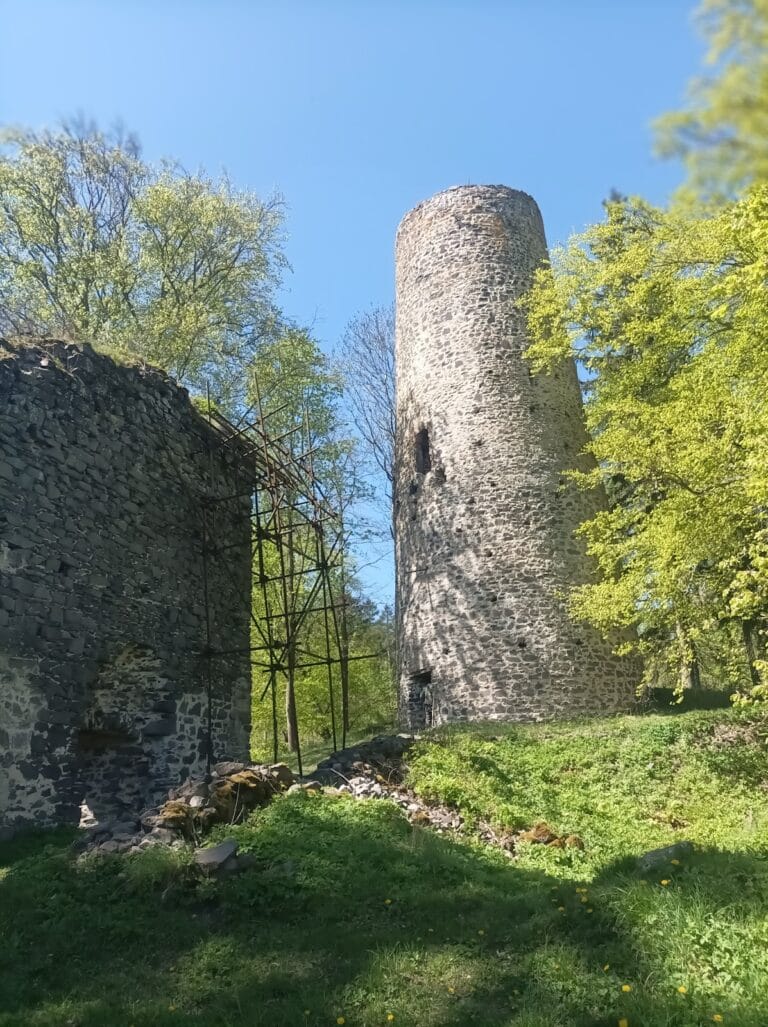
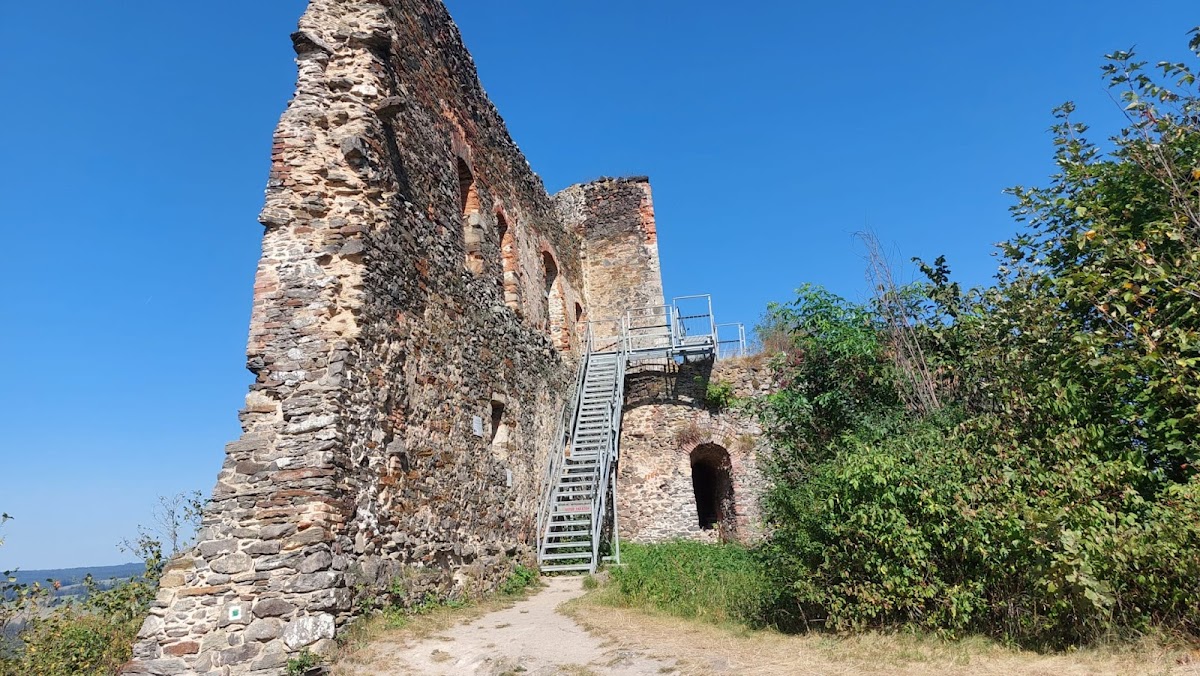
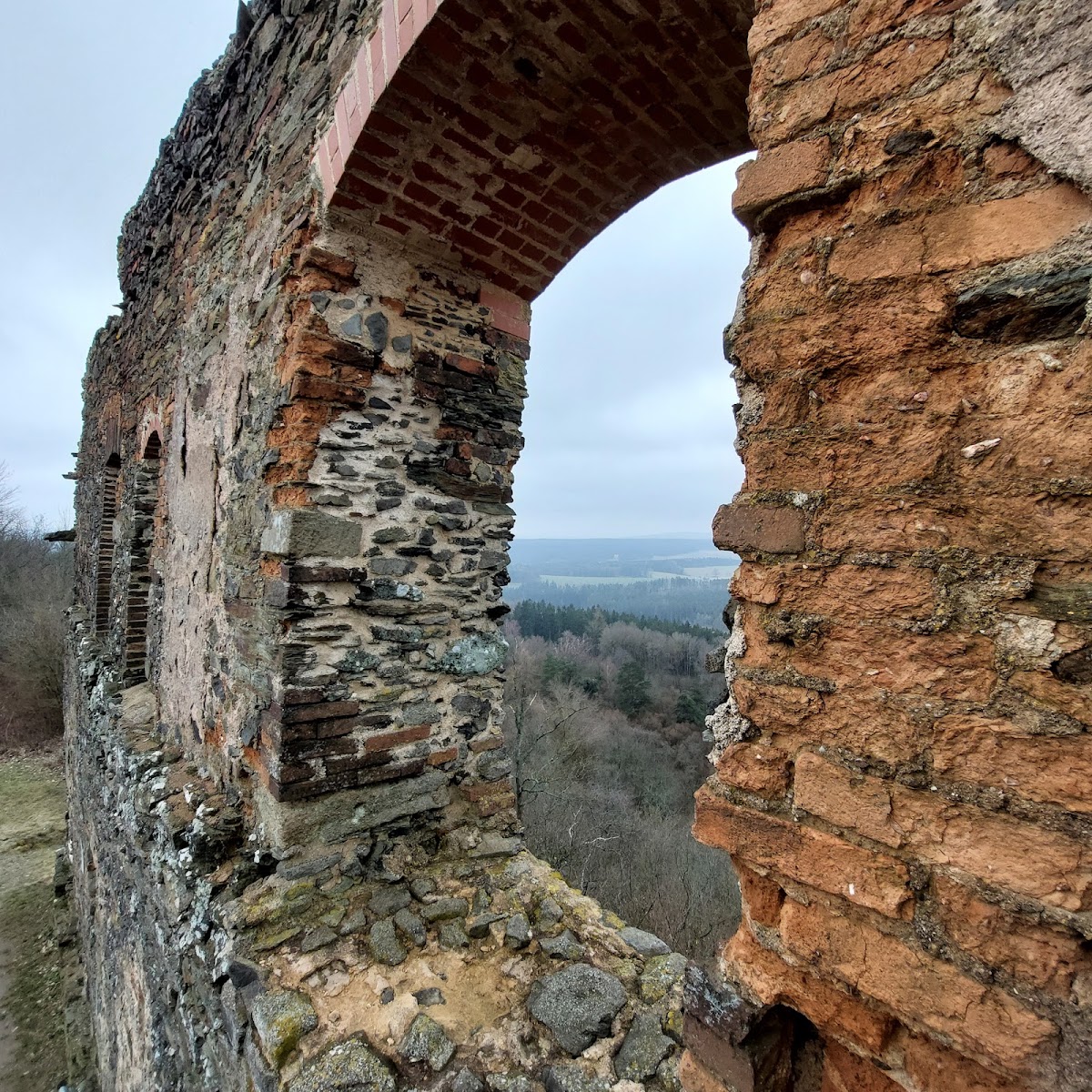
A fragment of a round bergfried, a fortified defensive and observation tower, stands on a rocky spur at the northern tip of the core. Its position on the best-protected point of the castle is unusual. A footbridge from one of the palace’s upper floors provided access to the tower. The round tower, part of the adjoining palace, and a vaulted basement room are the principal specifically identified remains of the core. A steel viewing platform was installed on the tower remains in 2012.
Late Gothic and Renaissance transformation
During the first half of the sixteenth century, the castle core was rebuilt as a chateau. The former entrance was closed, and a new gate was opened approximately midway along the front wall. A probably tower-like structure with internal dimensions of about 6 by 7 metres stood to its right. New buildings along both side walls narrowed the former courtyard to roughly six metres. The eastern fortifications were strengthened by a bastion, later used as the foundation of the church presbytery. Renaissance masonry elements from this rebuilding survive in several structures within the ruin and in nearby buildings.