Vadstena Abbey: Sweden’s Bridgettine Motherhouse and Pilgrimage Church


Site at a Glance
- Rating
- 4.5
- Popularity
- Low
- Country
- Sweden
- Primary era
- Medieval
- External website
- Open
- Eras represented
- Medieval
- Civilizations
- Swedish
- Site type
- Religious
- Remains
- Monastery
On this page13 sections
History
Vadstena Abbey is a medieval monastic complex in Sweden, founded in 1346 by Saint Bridget of Sweden with the support of King Magnus IV and Queen Blanche. Their foundation received ten farms, including Vadstena farm in Dal Hundred, Östergötland, and the town of Vadstena grew around the abbey. The monastery became the principal motherhouse of the Bridgettine Order, a Catholic religious order established by Bridget and organized as a double monastery for both nuns and monks.
Foundation and Early Community
Pope Urban V approved Bridget’s monastic plan in 1370. After Bridget died in Rome in 1373, her daughter Saint Catherine arrived at Vadstena the following year with her mother’s relics and became leader of the small community. Catherine died in 1381, and the Bishop of Linköping formally blessed the abbey in 1384. In 1388, Bridget’s granddaughter Ingegerd Knutsdotter was installed as the first officially recognized abbess.
Bridget was canonized in 1391, and her remains were translated to the abbey church in 1394. These events increased Vadstena’s fame and wealth. The abbey became Sweden’s spiritual center, attracted royal and aristocratic patronage, and served as a burial place for numerous noble families. In 1400, Queen Margaret invested Duke Eric of Pomerania at Vadstena as king of Denmark, Norway, and Sweden. The abbey also received the burial of his wife, Queen Philippa, and of Catherine, queen consort of King Carl II of Sweden.
The Bridgettine Motherhouse
Vadstena remained the motherhouse of the Bridgettine Order from 1346 to 1595. Its influence extended to Bridgettine communities in northern and eastern Europe, including Reval, Nådendal, Bergen, and Danzig. Vadstena inspected affiliated monasteries and supplied them with nuns and monks. In 1415, members left the abbey to establish the community that became Syon Abbey in England.
The community combined a female section of 60 nuns with a male section of 25 monks. A general confessor governed the monks, while a prioress led the nuns. The whole community was directed by an abbess elected by both groups. The abbey also managed a hospital and a retirement home, both documented from 1401. It supported Beghards and Beguines, religious communities whose members were ordered to leave in 1412 but were not expelled from Vadstena until 1506.
Vadstena’s religious life also included periods of controversy. In 1419, an investigation accused the abbess and nuns of accepting personal gifts and receiving male guests at inappropriate hours. In 1436, the bailiff Jösse Eriksson sought asylum at the abbey, but he was forced out and arrested. The monastery was also a center of writing. Its religious literature included Swedish translations of biblical passages and saints’ legends. Abbess Margareta Clausdotter wrote about Saint Bridget’s family during her tenure from 1473 to 1486, while Nicolaus Ragvaldi, the general confessor from 1476 to 1514, composed several works. A printing press was installed at Vadstena in 1495.
Reformation and Dissolution
The Swedish Reformation brought royal control over monastic life and property. In 1527, King Gustav Vasa prohibited the acceptance of novices without special royal permission. Vadstena was exempted from the general ban because of its international reputation and royal connections, but members were allowed to leave, including to marry. In 1544, the monarch specifically prohibited the abbey from preventing such departures.
In May 1540, a local Evangelical-Lutheran bishop visited Vadstena, and Lutheran worship replaced Catholic Mass in the abbey church. The Crown inventoried the abbey’s valuables and confiscated most of its books and valuables in 1543. Private donations remained possible on the condition that the monks cease public Catholic preaching. Most monks were ordered to leave in 1549, and the male community was formally dissolved in 1555, leaving Vadstena as an exclusively female community.
Danish soldiers looted the abbey during the Northern Seven Years’ War, a conflict between Denmark-Norway and Sweden, in 1567. Only 18 nuns were recorded at Vadstena in 1568. Under King John III, who ruled Sweden from 1569 to 1592, the abbey was restored and enriched. John again permitted unrestricted admission of novices in 1575, while his Catholic queen, Catherine Jagellon, supported the community and renewed its contacts with Rome.
In 1580, the Jesuit and papal legate Antonio Possevino reformed the community. The abbess and prioress took the Tridentine Oath, a profession of adherence to Catholic reforms associated with the Council of Trent, and the nuns renewed their vows. The first Catholic solemn Mass at Vadstena since the Reformation was celebrated in 1587 during a visit by the king and crown prince. A seminary for Catholic priests was founded in 1592, and the Catholic King Sigismund placed the abbey under his protection at his coronation in 1594.
Later that year, Duke Charles, subsequently Charles IX of Sweden, seized power and ordered the abbey’s dissolution. In 1595, most of the remaining 11 nuns left with their abbess. After spending the winter in Söderköping, they sailed in spring 1596 to the Bridgettine Abbey of Marienbrunn in Danzig. Of the three nuns who remained at Vadstena, one married and another became a lady-in-waiting. Karin Johansdotter stayed to care for the gardens until 1605. Magnus Vasa, Duke of Östergötland, died and was buried in the abbey church in 1595.
Later Uses and Modern Religious Life
After Karin Johansdotter left in 1605, the former monastery buildings stood empty for almost 40 years. Plans to establish a university there did not succeed. From 1641, the former nuns’ wing housed a home for retired and disabled soldiers and their families, together with a school for soldiers’ children. This institution closed in 1783.
From 1795, the former male and female sections housed a hospital for venereal diseases. From the 1840s, it also treated other illnesses and became a public hospital before moving to modern facilities in 1909. The former nuns’ section served as a prison from 1810 to 1825 and later formed part of the Vadstena asylum until 1951.
Substantial remains of a thirteenth-century royal palace were revealed in 1956 during preparations to convert the northern building. A thorough restoration followed, and the building became the Vadstena Monastery Museum in 2003. Bridgettine religious life also returned to Vadstena. Sisters arrived in 1935 under Saint Elisabeth Hesselblad and established a convent outside the former abbey grounds. In 1963, a new convent called Saint Bridget’s Convent of Pax Mariae was established near the abbey church by a Dutch community of the original branch of the order. It became an autonomous abbey in 1991 and has eight nuns.
Vadstena Abbey Church remains an active Evangelical-Lutheran parish church in the Diocese of Linköping. Mass and the Divine Office, the traditional cycle of daily Christian prayers, are celebrated there daily, and the church receives both Evangelical-Lutheran and Roman Catholic pilgrims. The Feast of Saint Bridget is held annually on 23 July with Mass, a church procession, and homage to her relics. Pilgrims travel to the church along the Saint Birgitta Ways and use the Pilgrim’s Prayer Book, a small breviary containing the canonical hours. Its prayers at 8 a.m., noon, and 4 p.m. correspond to the first three prayers in the book.
Remains
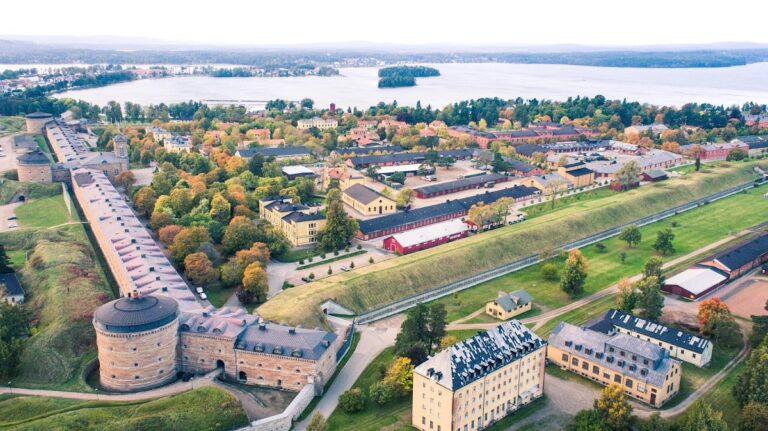
Vadstena Abbey is a historical building complex beside Lake Vättern. The surviving group includes the abbey church and former monastery buildings arranged around the remains of the medieval foundation. The northern building preserves the former nuns’ chapterhouse and dormitory and incorporates substantial remains of a thirteenth-century royal palace. Two other former monastery buildings also survive and have been converted into a hotel and a restaurant.
Abbey Church and Churchyard
The Blue Church
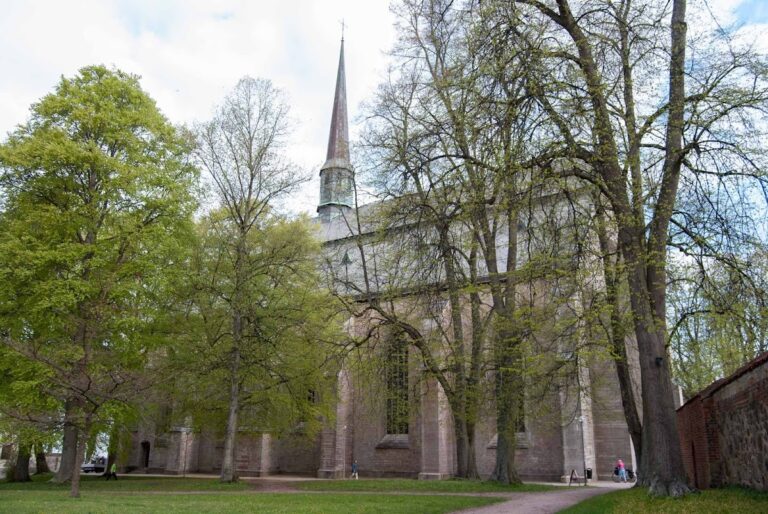
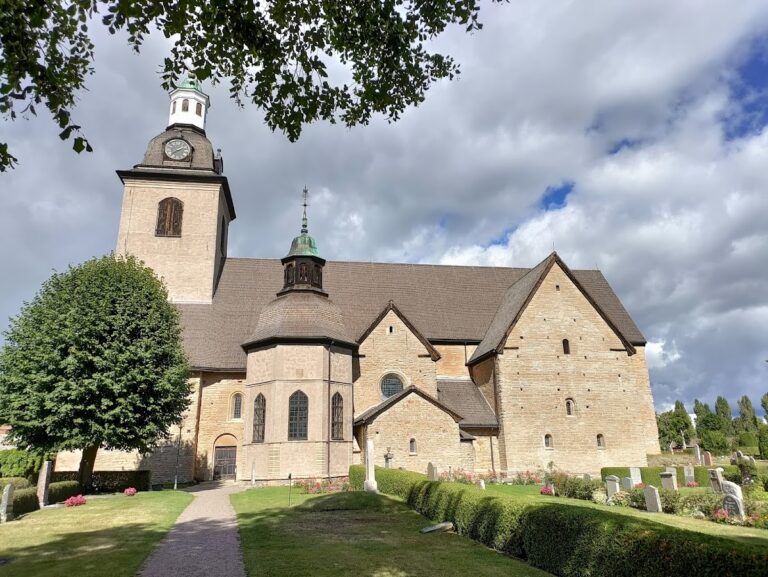
The abbey church began as a wooden building that burned in 1388. It was rebuilt toward the end of the fourteenth century under Saint Bridget’s direction and was consecrated on 16 February 1430. Foundation tradition held that Bridget received Christ’s instructions for its construction, while her preference was for simple furnishings. Known also as the Blue Church, it contains Saint Bridget’s relics in a red casket, memorials to her, and medieval sculptures of Saint Bridget, Saint Anne, and the Blessed Virgin Mary. Relics associated with Saint Ingrid of Skänninge are also kept in the church.
Royal Sarcophagus
The visible sarcophagus of Magnus Vasa, Duke of Östergötland, remains in the abbey church. He died and was buried there in 1595, during the final year of the monastery’s existence as a functioning Bridgettine community.
Churchyard
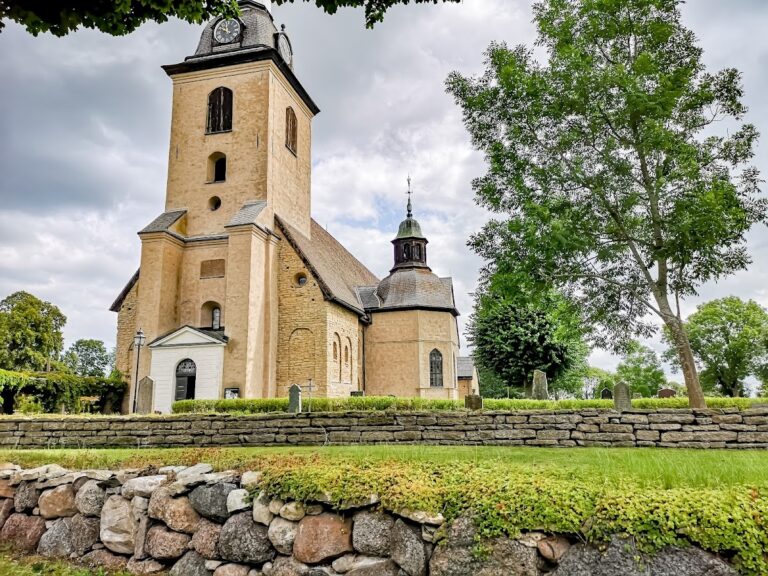
The churchyard lies immediately east of the abbey church. Its weathered gravestones and monuments are made from stones ranging from limestone to more acidic materials. Mature deciduous trees, including Scots elm, ash, and horse chestnut, stand among the burial features. A 2013 lichen survey recorded 120 taxa, including lichen-dwelling fungi and several locally uncommon species. It also recorded Lecanora semipallida for the first time in Östergötland, linking the churchyard’s lichen diversity to its varied stone surfaces and mature trees.
The old churchyard contains the burial of Erik Acharius, the Swedish physician and lichenologist, although the exact location of his grave is no longer known because burial plots were reused.
Former Monastery Buildings
Northern Building
The northern building contains the former nuns’ chapterhouse and dormitory. It is the best-preserved of the surviving former abbey buildings and incorporates substantial remains of a thirteenth-century royal palace. After the remains were revealed during planned conversion work in 1956, the building underwent thorough restoration. It now houses the Vadstena Monastery Museum.
Other Surviving Buildings
Two additional former monastery buildings survive alongside the abbey church and museum building. Their later conversion into a hotel and a restaurant preserves their place within the historical complex while giving them uses different from those of the medieval abbey.
Nearby sites