Monastery of San Pedro de Eslonza: A Benedictine Monastery in León


Site at a Glance
- Rating
- 4.1
- Popularity
- Low
- Country
- Spain
- Primary era
- Early Modern
- External website
- Open
- Eras represented
- Medieval, Early Modern
- Civilizations
- Crown of Castile, Kingdom of León, Spanish
- Site type
- Religious
- Remains
- Monastery
On this page14 sections
History
The Monastery of San Pedro de Eslonza is a former Benedictine monastery in Spain, near Santa Olaja de Eslonza in the municipality of Gradefes, León. King García I of León founded it in 912 under the dedication of Saint Eulalia and Saints Peter and Paul. The monastery belonged to the alfoz of León, a medieval territorial jurisdiction linked to a town or administrative centre, and became the province’s second most important monastery after San Benito de Sahagún.
Foundation and medieval rebuilding
Almanzor, the military and political ruler of the Caliphate of Córdoba, attacked and destroyed the monastery in 988. Infanta Urraca of Zamora, a Leonese royal princess and daughter of Ferdinand I of León, rebuilt it in 1099 and made numerous donations. That same year, she gave the Church of San Juan de Berbío in Infiesto, Asturias, to San Pedro de Eslonza.
Sancha Raimúndez later affiliated the monastery with Cluny, the influential medieval Benedictine reform movement and monastic network centred on the Abbey of Cluny in Burgundy. This connection placed San Pedro de Eslonza within a wider religious and institutional framework extending beyond León.
Rebuilding from the sixteenth century
By the sixteenth century, the monastic complex had fallen into a ruinous condition. A major rebuilding began in 1547 and continued into the eighteenth century. The work included three Renaissance portals and a large cloister, with Juan de Badajoz, a Spanish Renaissance architect and builder, and Fray Pedro Martínez, a Benedictine monk associated with San Pedro de Cardeña, among those who participated.
The monastery also had associations with prominent Spanish intellectuals. Gaspar Melchor de Jovellanos, an Enlightenment statesman and writer, spent a period there as a pasante, a supervised assistant or trainee. Benito Jerónimo Feijoo, a leading Benedictine thinker and essayist, was also present at the monastery.
Confiscation, dispersal, and protection
The Ecclesiastical Confiscation of Mendizábal, a nineteenth-century Spanish state program that seized and sold substantial church property, severely disrupted the monastery’s life in 1836. It was sold at public auction for 40,000 reales, changed hands afterward, and was eventually dismantled and sold piece by piece. Repeated looting followed, dispersing or destroying much of its artistic and liturgical heritage.
San Pedro de Eslonza was declared a National Historic-Artistic Monument on 3 June 1931. The declaration did not prevent the site’s ruin, although the remaining monastic vestiges continue to be treated as an Asset of Cultural Interest in the monument category.
Between 1944 and 1970, during the episcopate of Luis Almarcha Hernández, surviving architectural elements were acquired and dismantled for incorporation into the Church of San Juan y San Pedro de Renueva in León. The combined dedication referred to Saint John and the former parish church at Renueva, as well as Saint Peter and Eslonza. The monastery’s remaining ruins were later ceded by the heirs of the Álvarez-Estrada family to the Municipality of Gradefes. With institutional assistance, the municipality fenced the remains and installed an explanatory sign, while efforts were also made to recover religious objects dispersed among nearby villages. The former monastery is now a ruin and is no longer used for worship.
Remains
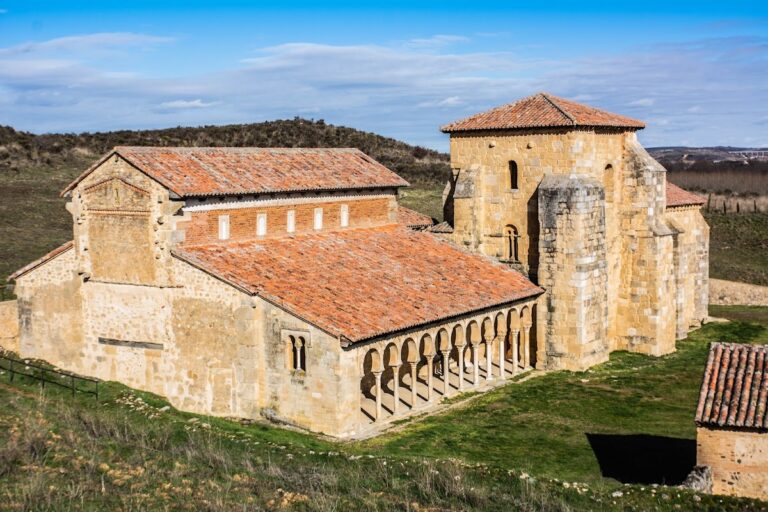
The monastery stood across the Eslonza River from Santa Olaja de Eslonza, between the Esla and Porma rivers and about 22 kilometres from León. Its surviving remains combine Mozarabic, Romanesque, Renaissance, and Baroque elements. The sixteenth- and eighteenth-century rebuilding shaped the complex visible in historical descriptions, including its Renaissance portals and large cloister, while later dismantling dispersed architectural pieces and furnishings among other buildings.
Monastic buildings and façade
Church and cloister
The surviving complex is described as a church in ruinous condition, with architectural fabric representing several periods of construction and alteration. Its Renaissance rebuilding produced three portals and a large cloister. These elements formed part of the expanded monastic complex created from the sixteenth century onward, when earlier structures were substantially renewed.
Baroque principal façade
The principal façade was built in the Baroque style, a period associated with more elaborate and dynamic decoration. Its lower niches held Saint Adrian and Saint Natalia, while Saint Bernard and Saint Benedict occupied the upper niches around an image of Saint Peter holding a book and the keys of heaven. The surviving Saint Peter image is now preserved in the tower of the church at Villanueva del Condado.
Dispersed architectural elements
Capitals and column pieces
Several carved elements from Eslonza were reused in local churches. Two capitals from the repopulation period are incorporated into the Church of the Assumption at Rueda del Almirante. A Corinthian capital thought to belong to the monastery’s earlier building serves as a holy-water stoup beside the western door of Santa María de Sandoval. Another capital, carved with leaves recalling Greek acanthus, is used as a holy-water stoup at Valdealcón. It is 36 centimetres high and has one plain face intended for attachment to a wall. A further capital from Eslonza forms the base of the pulpit in the church at Mellanzos.
Marble shaft and square bases
A white-marble shaft from the monastery serves as a corner guard post in a side street at Mansilla de las Mulas. Broken into two pieces, it measures 26 centimetres in diameter and exceeds 3 metres in height. Its surface is decorated with almond-shaped forms and ends in an astragalus, a narrow bead-like moulding, with Byzantine-type ovolos, or repeated egg-shaped forms.
Several carved-stone column bases from Eslonza were placed in the arcades of Villamañán’s Main Square. During renovation work, concrete nearly covered them. A resident’s complaint to the provincial heritage commission led to their recovery, although one base was damaged by a pneumatic hammer.
Furnishings and liturgical objects
Paintings, altarpieces, and fittings
The monastery’s dispersed furnishings included paintings by disciples of Velázquez, altarpieces, the pulpit, choir stalls, a tower clock, and bells. The major altarpiece, clock, bells, pulpit, and choir are preserved in Villamañán, where they retain a material connection with the dismantled monastic complex.
Reliquary chest
An approximately 40-centimetre silver reliquary chest is preserved at the Monastery of Santa María de Carbajal in León. Made of wood covered with a heavy chased-silver sheet, it contains relics of Saint Adrian and Saint Natalia and bears scenes from the lives of the two martyr saints.