Marienkirche: Anklam’s Medieval Brick Gothic City Church


Site at a Glance
- Rating
- 4.6
- Popularity
- Very Low
- Country
- Germany
- Primary era
- Medieval
- External website
- Open
- Eras represented
- Medieval, Modern
- Civilizations
- Duchy of Pomerania, German, Holy Roman Empire
- Site type
- Religious
- Remains
- Church
On this page15 sections
History
Marienkirche is a medieval city church in Anklam, Germany, whose construction probably began around the middle of the thirteenth century. First documented in 1296, it began as a Romanesque building before being rebuilt in the Gothic style. As the older of Anklam’s two large medieval churches, it preserves evidence of the town’s development from the Romanesque period through the late Middle Ages and into the modern era.
Romanesque origins and Gothic rebuilding
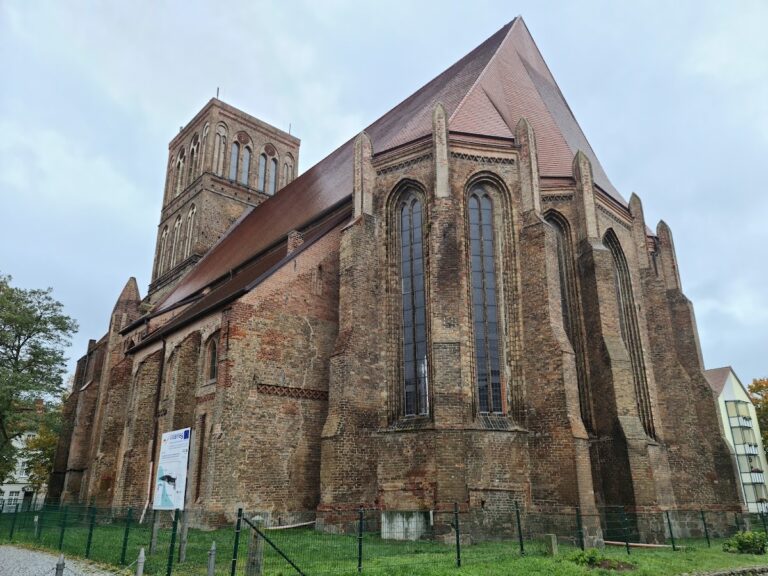
The original church had a two-tower arrangement and was built in the Romanesque tradition, an earlier medieval style known for massive forms and rounded arches. Its surviving tower can still be recognized within the masonry of the later Gothic successor. During the fifteenth century, builders planned a Gothic twin-tower design modeled on Lübeck’s Marienkirche, but the second tower was never completed. A chapel was constructed in its intended position instead, leaving the existing tower asymmetrical in relation to the nave. By the end of the fifteenth century, the church had acquired its present overall form.
Protestant worship began at Marienkirche in 1535, during the Reformation, when Lutheran church structures were being established across northern Europe. The church suffered major damage during the Brandenburg siege of Anklam in 1676 and 1677. It was rebuilt with assistance from the elector, a prince entitled to participate in the election of the Holy Roman Emperor.
Changes from the eighteenth to the nineteenth century
During the Napoleonic occupation in 1806, Marienkirche was used as a storehouse for hay and straw. A new organ was installed in 1814. Two years later, the tower’s pointed roof, damaged by fire, was replaced with a lower pyramidal roof.
Lightning caused the lower tower roof to burn in 1884. The tower gables were then rebuilt substantially higher and crowned with a Gothic spire. Completed in 1888, the new spire reached approximately 100 metres and resembled the spire of Anklam’s Nikolaikirche, the town’s younger large medieval city church.
War damage and postwar recovery
Marienkirche suffered severe damage during the Second World War, particularly in the bombing of 9 October 1943. The spire and parts of the vaults over the southern aisle were destroyed. The church survived the war considerably better than Nikolaikirche and returned to use in 1947. Rebuilding continued through the 1950s, and the church was reconsecrated in 1957.
Much of the church inventory had been moved to the Schwerinsburg estate for protection. When the estate burned in 1945, a large part of the stored furnishings and artworks was lost. The principal surviving element from the former high altar is a large late-fifteenth-century statue of the Virgin Mary.
Conservation and continuing use
Conservation work in 1936 and 1937 uncovered exceptionally well-preserved medieval paintings on the pillars and transverse arches. They are generally dated to the first half of the fourteenth century and may have been made around 1350. Marienkirche is recognized as a monument of national importance, particularly for these wall paintings, and is protected as an architectural heritage monument in Mecklenburg-Vorpommern.
The Evangelical Lutheran congregation of Anklam continues to use the church for worship and events. It belongs to the Pasewalk provostship and the Pomeranian Evangelical Church District of the Evangelical Lutheran Church in Northern Germany. The building also hosts the Anklam summer concert series.
Remains
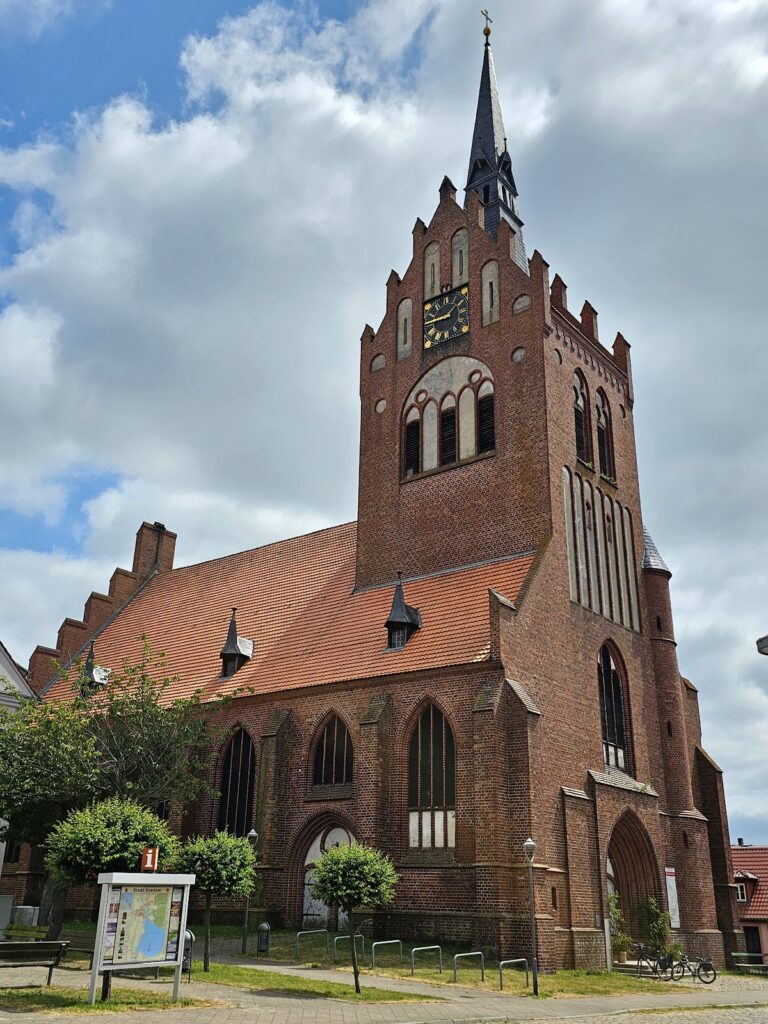
Marienkirche is a three-aisled brick Gothic hall church. In a hall church, the side aisles are approximately as high as the central nave, creating a broad, unified interior. The building also includes a late Romanesque choir, a sacristy, and a single four-storey tower. Large gabled roofs cover the nave, choir, and smaller sacristy. The tower stands off-center because the planned second tower was replaced by a chapel. Its present simple gabled roof has two gables, and the tower reaches 64 metres.
Church fabric and chapels
Southern chapels
Chapels along the southern side of the nave were built during the second half of the fifteenth century for side altars. In the eighteenth century, wealthy families and their relatives were buried there. The chapels retain wooden walls painted with allegories and biblical narratives, including the Parable of the Good Samaritan. Their brick surfaces also preserve numerous shallow abrasions, cup marks, and grooves. These marks have been associated with warfare, folk medicine, pilgrimage, contracts, and local attachment. Since they date to around 1500, one tentative interpretation is that women took brick dust for use as a remedy when they had insufficient milk or no children.
Marian Chapel
The chapel built where the second tower had been intended is the Marian Chapel, which serves as a winter church for the congregation. It contains the surviving late-fifteenth-century wooden statue of the Virgin and Child from the former high altar, placed in the northwestern part of the church. The statue is the principal surviving element of that altar ensemble.
Medieval paintings and furnishings
Wall paintings
Floral and geometric designs cover the octagonal pillars of the nave. The paintings were executed partly as fresco, applied to wet plaster, and partly as fresco-secco, applied after the plaster had dried. Together they preserve an unusually complete impression of the medieval interior. The inner faces of the nave arcade arches contain 24 saints set within detailed architectural frames, although some figures cannot be identified with certainty. Paintings resembling altar ensembles on the pillars include Crucifixion scenes and saints, and their style is closely related to paintings in St. Nicholas Church in Stralsund.
Choir and chancel furnishings
The baptismal font is made of Gotland limestone and dates from around 1330. Cheek panels from the choir stalls, made in the early fifteenth century, came from Nikolaikirche. They include an unusual griffin, the heraldic animal traditionally associated with Pomerania. The present high altar combines four panels from Nikolaikirche’s former high altar with a Late Gothic crucifix. The early-sixteenth-century panels show scenes from the life of the Virgin Mary. The chancel also contains a pulpit and Renaissance and Baroque funerary epitaphs. A memorial plaque to the church reformer Johannes Bugenhagen is located in the northern aisle.
Organs and bell
Main organ
The principal organ was built by Alexander Schuke Potsdam Orgelbau under Hans-Joachim Schuke as Opus 326 between 1962 and 1970. It has mechanical action, meaning that physical linkages connect the keys with the valves controlling the pipes. The instrument contains 30 stops, or selectable groups of pipes, 2,214 pipes, two hand-played keyboards, and a pedal division operated with the feet. Schuke built a five-stop positive organ for the Marian Chapel in 1972, and a chest organ was added there in 2016.
Apostelglocke
The tower contains the Apostelglocke, a Gothic-rib bell cast in 1450 by the northern German bell founder Rickert de Monkehagen. Its name comes from twelve shoulder medallions depicting the Twelve Apostles. The bell originally belonged to Nikolaikirche’s five-bell peal. It is the largest surviving medieval bell in Mecklenburg-Vorpommern and the third-largest bell in Western Pomerania.
The bell has diameters of approximately 1,824, 1,820, and 1,790 millimetres. Its sound bow is 139.5 millimetres thick, its slant height to the upper fitting is 1,336 millimetres, and its height without the crown is 1,645 millimetres. It weighs approximately 4,500 kilograms.
The Apostelglocke escaped wartime requisition because of its art-historical importance, along with two other medieval bells from Nikolaikirche. In autumn 1945, however, it fell from Nikolaikirche’s damaged and burning tower when the tower gables collapsed. The crown broke away, and heat deformed the bell and caused tin to exude from its metal. Its tone was impaired, although it retained notable sound quality.
After the war, the bell was hung in Marienkirche. Two replacement bells were cast at Apolda from the metal of its destroyed companion bells, but both were removed from service in 2014 because of their poor sound quality. One remains in the tower as a memorial, while the metal of the larger bell was reused for a new peal.
In 2014, the bell installation and frame were renovated, and five new bells were cast by the Bachert foundry in Karlsruhe. The Apostelglocke received a straight wooden yoke and a new clapper and was placed in its own frame on the level below the former bell chamber. After decades of silence caused by an unsuitable offset yoke, it rang again on major church holidays following its inauguration on 5 October 2014.