Abbey of Saint Gall: A Medieval Monastic and Cultural Center in Switzerland
Site at a Glance
- Rating
- 4.7
- Popularity
- Medium
- Country
- Switzerland
- Primary era
- Early Modern
- External website
- Open
- Eras represented
- Early Modern
- Civilizations
- Holy Roman Empire
- Site type
- Religious
- Remains
- Monastery
On this page17 sections
History
The Abbey of Saint Gall in Switzerland, in the city of St. Gallen, developed from a Christian hermitage founded around AD 612 by Gallus, an Irish monk and companion of Columbanus, beside the Steinach. Its early development combined a seventh-century religious foundation with Carolingian monastic organization, and the site later became one of the leading centers of Western European culture during the early Middle Ages.
From Gallus’s hermitage to a monastery
After Gallus died, his followers continued to live beside his cell, turning the place into a destination for pilgrims. Otmar, who had been trained and ordained at the episcopal see of Chur, is regarded as the monastery’s first abbot and principal institutional founder. Around AD 719, Waltram of Thurgau appointed him to lead the Gallus cell and create a regular monastic community. The foundation is also associated with AD 720, 747, or the middle of the eighth century in different traditions.
Otmar enlarged the original hermitage and established a monastery influenced by Carolingian practice. The Carolingian period was the age of the Frankish dynasty founded by Charlemagne, when monastic reform promoted common religious discipline, education, manuscript copying, and planned communities. The earliest monks included Rhaetians, while local Alemannic noble families became increasingly represented. Gifts brought the monastery extensive estates in Thurgau, Zurichgau, Alemannia, and as far as the Neckar. By around AD 900, these lands covered approximately 160,000 Jucharten.
After the Alemannic leadership was suppressed at Cannstatt in AD 746, Frankish authorities imposed the Benedictine Rule on Saint Gall in the following year. This rule, associated with Benedict of Nursia, regulated communal prayer, work, discipline, and monastic organization. When Otmar tried to appeal to the king in AD 759, he was arrested and exiled to a Rhine island near Eschenz. The monastery was then placed under the Bishopric of Constance and functioned in practice as an episcopal proprietary monastery.
Imperial protection and the early medieval flowering
Under Abbot Gozbert, Saint Gall gained an immunity privilege from Louis the Pious in the early ninth century. This placed the monastery directly under the king or emperor rather than an intervening territorial lord. Louis the German confirmed the privilege in AD 833 and allowed the monks to elect their own abbot. In AD 854, the monastery achieved full autonomy when it was released from paying tithes to the Bishop of Constance.
From approximately AD 816 until the Magyar attack of AD 926, the monastery experienced a cultural flowering sometimes called its Golden Age. The Magyars, also known as Hungarians in this medieval context, conducted raids across central Europe during the tenth century. Before that disruption, Saint Gall maintained close relations with imperial and royal courts while expanding its library, manuscript-copying center, school, medical services, and infirmary. Otmar also established a separate hospice for people with leprosy between AD 720 and 759.
The monastic school and intellectual community included Notker the Stammerer, Notker Labeo, Tuotilo, and Hartker. Hartker was associated with the development of antiphonal liturgical books for Saint Gall. The monastery’s scholarship, manuscript production, music, and teaching helped make it a major cultural center in Western Europe during the early Middle Ages.
Raids, destruction, and the fortified settlement
Magyar raids between AD 924 and 933 forced the community to move students, elderly people, and the sick to the monastery’s water castle near Lindau. Monks and valuable liturgical objects were taken to a refuge in the Sitterwald, while many manuscripts were hidden at Reichenau. During the attack of AD 926, the settlement was plundered, buildings and altars were damaged, and its wooden houses were burned. The monks and inhabitants later returned and rebuilt the damaged structures.
Wiborada, a religious recluse associated with Saint Gall, chose to remain in the walled church of St. Mangen. The attackers removed the church roof and killed her after failing to enter her sealed cell. She was formally canonized by the Holy See in AD 1047 and is traditionally regarded as the first woman canonized by the Holy See.
A fire on 26 April AD 937 destroyed much of the monastery and the adjoining settlement, although the library survived. Defensive walls were begun around AD 954 and completed around AD 971 to 974. The settlement outside the walls subsequently developed into the town of Saint Gall.
An imperial ecclesiastical principality
The monastery’s estates and jurisdiction gradually became a territorial ecclesiastical state, meaning that its abbot exercised both religious and secular authority. In AD 1180, Frederick I Barbarossa converted the monastery’s advocacy and high jurisdiction into an imperial advocacy. In AD 1207, Abbot Ulrich of Sax was raised to the rank of Imperial Prince. Saint Gall thereafter held scattered possessions and rights across southern Germany, together with a more concentrated territory in the Fürstenland, the Appenzell region, and the Rhine Valley.
Political and military conflicts repeatedly challenged the abbey during the thirteenth and fourteenth centuries. From 1282 to 1301, Abbot Wilhelm I of Montfort disputed with Rudolf of Habsburg, the monastery’s advocate and later German king. Rudolf established a rival town and castle near Wil and installed a rival abbot. The town of Saint Gall and the Appenzell territories gradually escaped the abbey’s control. Appenzell rebelled in the Appenzell Wars of 1400 to 1429, conflicts in which Appenzell and its allies resisted the abbey’s territorial rule. Saint Gall supported the rebels and became an imperial city, while Appenzell became independent.
In AD 1451, the monastery and the town were admitted as associated places of the Swiss Confederation, an alliance of territories that later developed into the Swiss state. Saint Gall became formally free from the abbot’s rule in AD 1457. The abbey nevertheless remained legally connected to the Holy Roman Empire, a political union of central European territories whose rulers were elected emperors, and retained a restricted political relationship with the Confederation.
Reorganization and conflict in the early modern period
Abbot Ulrich Rösch restored much of the abbey’s political position with support from Zurich, Lucerne, Glarus, and Schwyz. He consolidated older legal claims, acquired the County of Toggenburg in AD 1468, and reorganized courts and offices. These measures helped transform the former lordship into an early modern territorial state. In AD 1486, the abbey relinquished its advocacy over the Rhine Valley to Appenzell.
Rösch planned to move the monastery to Rorschach to free it from Saint Gall’s influence. In AD 1489, Saint Gall, Appenzell, and subjects of the abbey formed the Waldkircher League and destroyed the monastery buildings then under construction. The sponsoring cantons intervened militarily in AD 1490. Saint Gall subsequently accepted a peace settlement that restricted its powers and imposed penalties and reparations.
The town adopted the Reformation in the middle of the 1520s, while the abbey remained Catholic. The Reformation was the sixteenth-century religious movement that produced Protestant churches and divisions within Western Christianity. The monastery was suppressed and its abbot expelled in AD 1527, but the defeat of the Reformed cantons in the Second War of Kappel allowed the abbey to return in AD 1532. Under Abbot Diethelm Blarer von Wartensee, the restoration halted the institution’s decline and expanded its schools and library.
Through laws and administrative mandates, the abbey imposed Catholic observance throughout the Old Landscape by AD 1572. The Old Landscape was the core territory of the former Prince-Abbey, whose Benedictine abbot exercised secular as well as religious authority. By the end of the sixteenth century, the Fürstabtei St. Gallen had become a centralized early modern territorial state.
During the seventeenth century, the abbey regained possessions in the Breisgau, including direct rule over Ebringen and Norsingen in AD 1621. Its increasingly independent policy toward the Swiss Confederation contributed to the Kreuzkrieg and the Toggenburg War of 1712 to 1718. The latter conflict arose from tensions between the abbey and the Reformed population of Toggenburg. Swiss forces plundered the abbey in AD 1712 and carried many books and manuscripts to Zurich and Bern. The monastery then sought protection from the townspeople of Saint Gall, who had once been its subjects but had gained increasing political power.
Suppression and the modern institution
The abbey’s secular authority disappeared during the political upheavals that followed the French Revolution. In AD 1798, subjects of the Fürstenland founded the Republic of the Old Landscape of Saint Gall, while Toggenburg also separated from the abbey. The Helvetic Republic incorporated the former territories, and the Fürstenland became part of the Canton of Säntis.
Abbot Pankraz Vorster, the last prince-abbot of Saint Gall, briefly returned in May 1799 with Austrian support but withdrew after the French victory. The newly created Canton of Saint Gall assumed territorial sovereignty in AD 1803, and the canton’s Grand Council formally suppressed the abbey on 8 May 1805. Vorster continued unsuccessful efforts to restore it until his death in exile in AD 1829. The establishment of the Diocese of Chur-Saint Gall by Pope Pius VII in AD 1823 marked the definitive end of those efforts, although the papal bull did not strictly abolish the monastery in canon-law terms. The former abbey church became the cathedral of the Diocese of Saint Gall in AD 1848.
The abbey also held the right to mint coins, granted by Otto I in AD 947 and used increasingly from the twelfth century. Its coins commonly showed Saint Gall or the Lamb of God bearing a cross-banner. A mechanical cotton-spinning mill established in the monastery in AD 1801 was the first modern factory in Switzerland, alongside the developing embroidery industry of eastern Switzerland.
The abbey precinct was inscribed on the UNESCO World Heritage List in AD 1983 as a great example of a Carolingian monastery. The former monastic complex remains part of an active Roman Catholic institution centered on the cathedral and former abbey buildings.
Remains
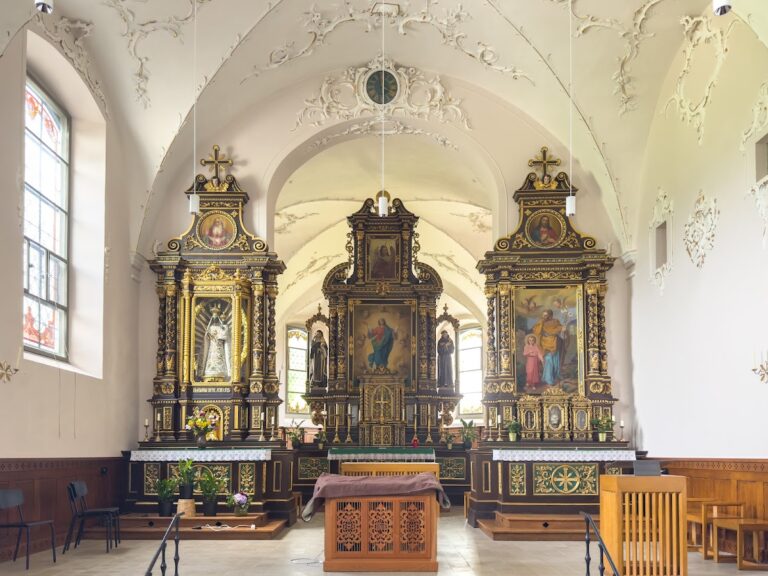
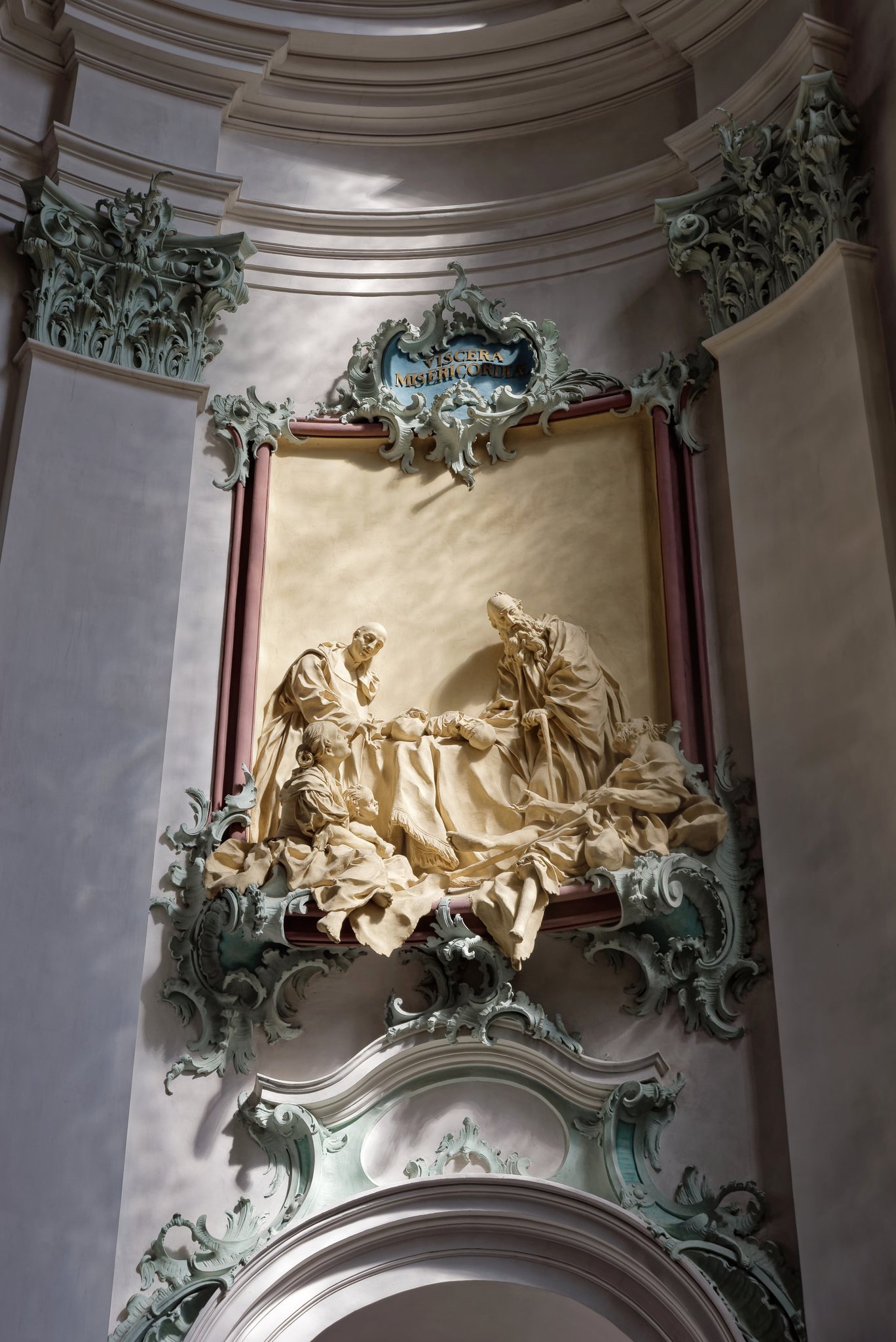
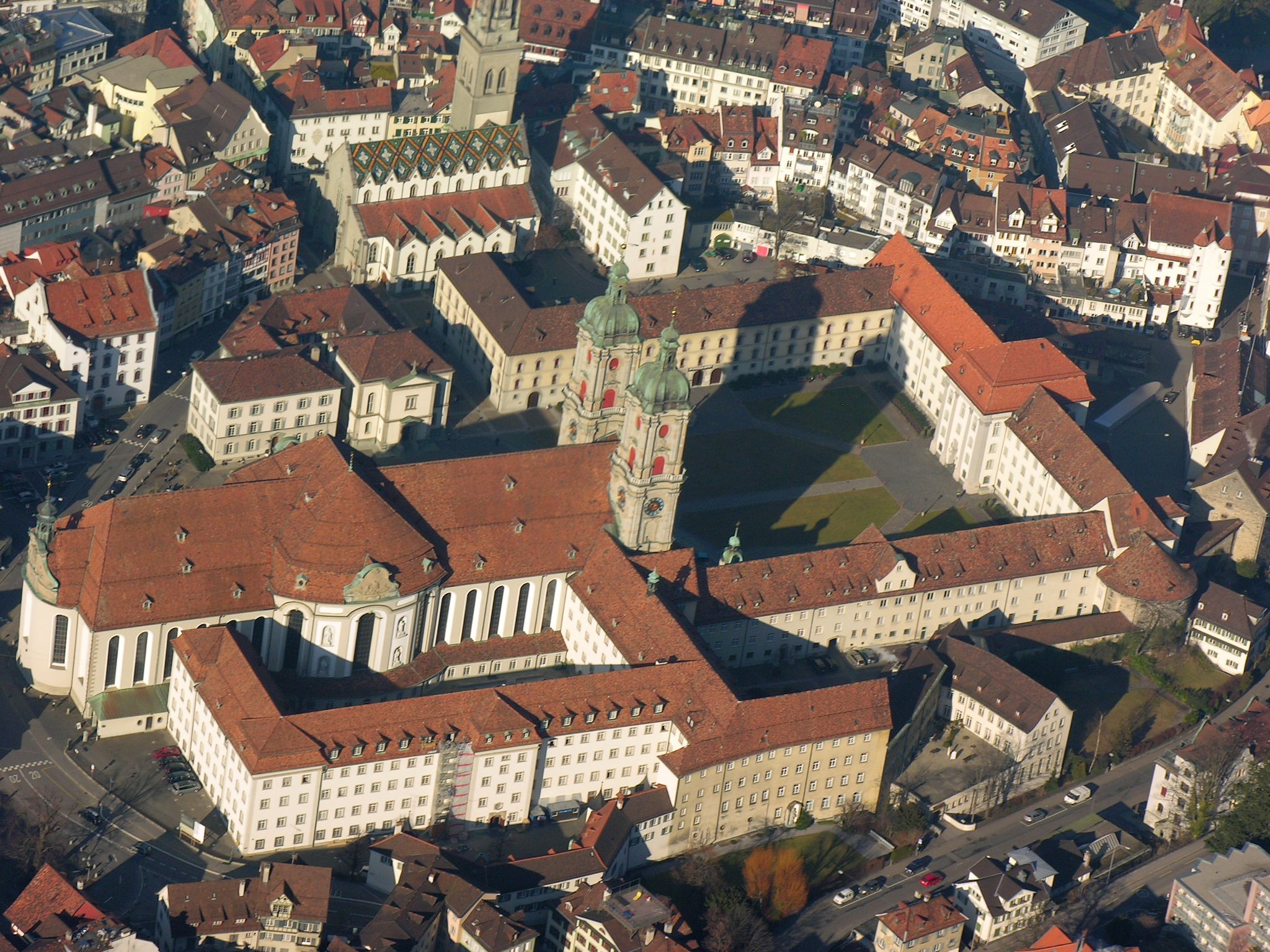
The surviving complex combines a late Baroque monastery with the cathedral, a princely palace, and the abbey library. Most of the present buildings date from a rebuilding campaign carried out between AD 1755 and 1768, which replaced much of the medieval monastery. The complex preserves the physical setting of an institution that developed from Gallus’s cell into a large religious, educational, and administrative center.
Late Baroque complex
Cathedral and former abbey church
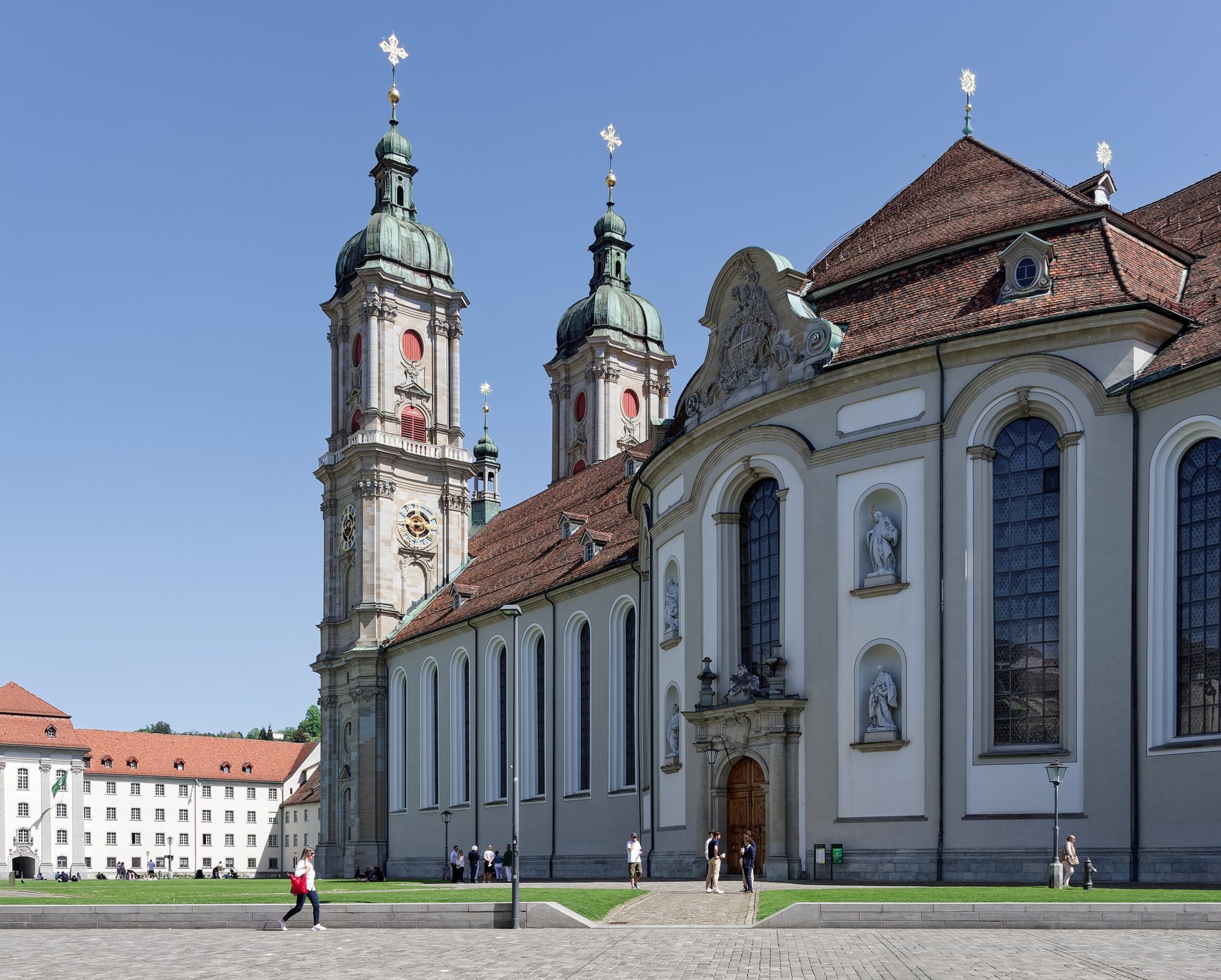
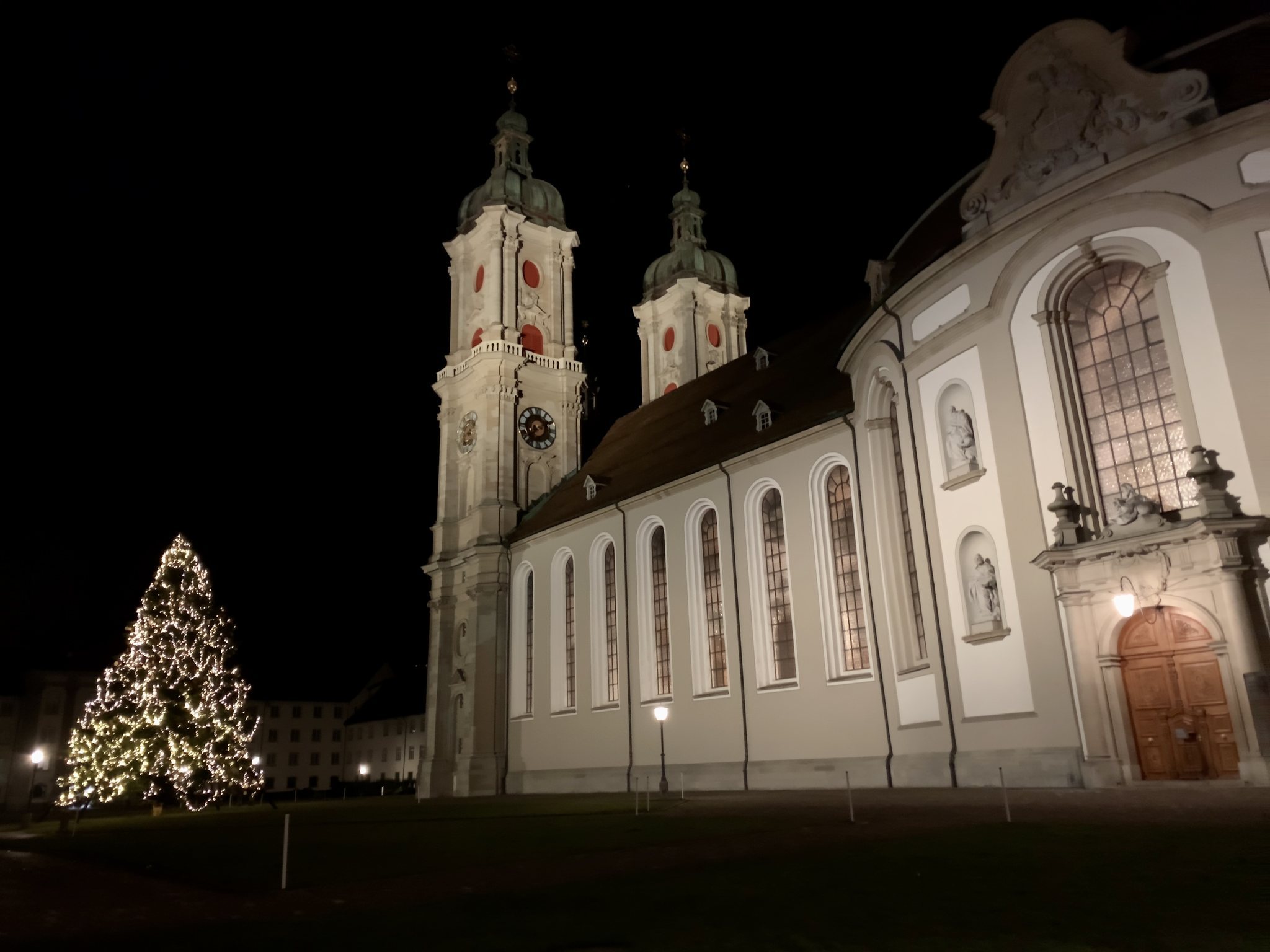
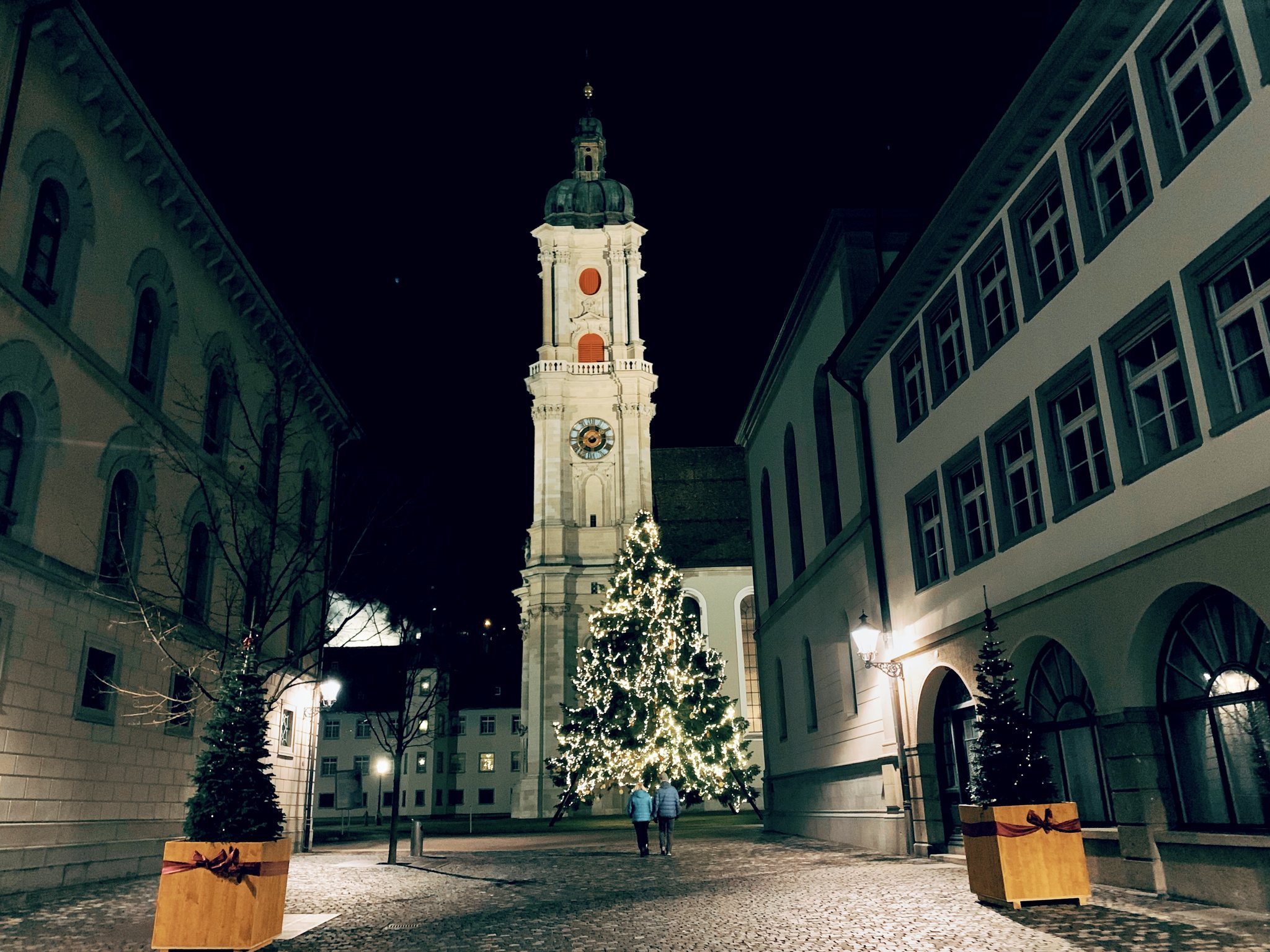
The former abbey church now serves as Saint Gall Cathedral, the church of the Roman Catholic Diocese of Saint Gall. It belongs to the late Baroque complex and has one dome and two towers, each rising approximately 68 metres. The church formed part of the rebuilding scheme designed by Peter Thumb until AD 1761, after which Johann Michael Beer and Johann Ferdinand Beer continued the work.
Princely palace
A princely palace was built as a suitable residence for the ruling abbots. Together with the church, it expresses the late Baroque character of the surviving complex and reflects the abbots’ former position as rulers who combined ecclesiastical office with territorial authority. Part of the former monastic complex is now used by the bishop.
Abbey library
The Stiftsbibliothek, or abbey library, is one of the world’s oldest monastic libraries and one of the most important collections of early medieval books in the German-speaking part of Europe. In 2005 it contained more than 160,000 books, including approximately 2,100 handwritten volumes. Nearly half of the manuscripts dated from the Middle Ages, and about 400 were more than 1,000 years old.
Its holdings include the Folchard Psalter, the Saint Gall Psalter, the Psalterium Aureum, and the Evangelium Longum. The collection also preserves the Gesta Caroli Magni, produced by Notker of Saint Gall in AD 883, and Hartker’s antiphonal liturgical manuscript. The library interior was designed by Peter Thumb in the Rococo style, using carved and polished wood, stucco, and painted decoration in an ornamented hall.
Manuscripts, drawings, and musical notation
Plan of Saint Gall
The library preserves the ninth-century Plan of Saint Gall, a large architectural drawing made around AD 820 to 830. It was never built. Instead, it presents an idealized, fully equipped monastery associated with reforms discussed at Aachen during the early reign of Louis the Pious.
Illustrated and literary manuscripts
A late ninth-century drawing of Saint Paul addressing a crowd survives in a copy of the Pauline Epistles produced at the monastery. The collection also includes a copy of Priscian’s Institutiones grammaticae containing a poem written in Old Irish. More than 400 manuscripts from the ninth-century cultural flowering remain in the monastic library.
Early musical notation
Saint Gall preserves some of the earliest surviving examples of neume notation. A neume was an early sign used to record musical melodies before the development of the modern five-line staff system. The oldest surviving examples date from the ninth or tenth century. The collection later became the subject of a digitization project, and by December 2009, 355 documents had been made available through the Codices Electronici Sangallenses project.
Earlier monastic organization
The medieval monastery grew around Gallus’s hermitage and was enlarged by Otmar into a Carolingian-style complex. A larger church was built during the ninth century. The institution included a school, a scriptorium for copying and producing manuscripts, a library, medical facilities, and a large infirmary. A separate hospice for people with leprosy stood outside the monastery and was built between AD 720 and 759.
Defensive walls surrounded the monastery and adjoining settlement from approximately AD 954, with completion around AD 971 to 974. These defenses belonged to the period after the Magyar attack and the fire of AD 937, when the community rebuilt its damaged structures. The settlement outside the walls later developed into the town of Saint Gall.