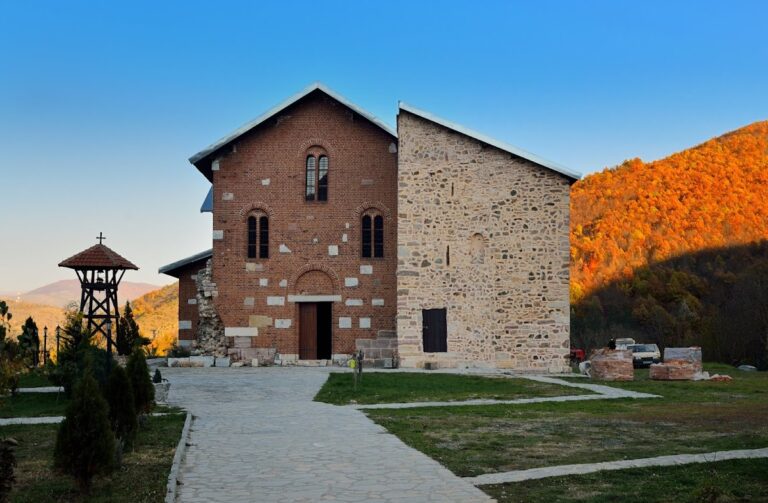
Crna Reka Monastery: A Serbian-Byzantine Monastic Complex in Serbia


Site at a Glance
- Rating
- 4.9
- Popularity
- Low
- Country
- Serbia
- Primary era
- Medieval
- Eras represented
- Medieval, Early Modern, Modern
- Civilizations
- Ottoman, Serbian
- Site type
- Religious
- Remains
- Monastery
On this page21 sections
History
Crna Reka Monastery is an active male monastery of the Serbian Orthodox Church in Serbia, near Ribariće in the Tutin municipality. Generally associated with the thirteenth century, it developed as a Serbian-Byzantine monastic complex in the gorge of the Crna Reka, although its exact foundation date and founder remain uncertain.
Origins and Ascetic Tradition
Proposed dates for the monastery’s establishment range from the early thirteenth century to the fourteenth or fifteenth century, while some interpretations place its foundation in the late fifteenth or early sixteenth century. Traditions connect it with the Nemanjić period, the medieval era associated with the Serbian Nemanjić ruling dynasty, and variously name Archbishop Danilo, Saint Joanikije of Devič, the period after the 1389 Battle of Kosovo, and Milica Hrebeljanović, the consort of Prince Lazar. The different attributions reflect the uncertainty surrounding the monastery’s beginnings.
The monastery is mentioned in the Prologue Life of Saint Joanikije of Devič, a religious biography probably composed soon after his death and preserved in copies from the eighteenth century. Joanikije probably came to Crna Reka toward the end of the fourteenth century. He lived there as an ascetic and instructed younger monks before moving to the region of Devič.
In the fifteenth century, Saint Joanikije lived at Crna Reka with his monks. Saint Peter of Koriša, a thirteenth-century Serbian Orthodox hermit and ascetic, also stayed there for a short period. The monastery’s secluded gorge provided a setting for eremitic life, and other hermits used caves in the surrounding area.
Church, Manuscripts, and Relics
The monastery church is dedicated to the Holy Archangel Michael, although manuscript records also refer to the Holy Archangels Michael and Gabriel. Its iconostasis, the screen of icons separating the sanctuary from the nave, was completed in 1601 during the tenure of the hieromonk-abbot Genadije. Monks and ktetors, meaning founders or principal donors, took part in the work. The church’s frescoes were probably completed at approximately the same time.
Crna Reka became an important center of manuscript copying. A menaion, a liturgical book arranged by calendar month, was copied there in 1709, and a panegyric, a collection of sermons and feast-day texts, was copied in 1714. The monastery possessed liturgical manuscripts, printed books, the Sopoćani memorial book, and works received from other monasteries and churches. A memorial book is a liturgical record used to commemorate the living and the dead in prayer. Many of the monastery’s books were later damaged, removed, or dispersed.
Between 1687 and 1696, the relics of Stefan the First-Crowned, Serbia’s first crowned king from the Nemanjić dynasty, were kept at Crna Reka after being transferred from Studenica for safety. They were later returned to Studenica. The Sopoćani memorial book was probably brought to Crna Reka with the relics and is now held in a library in Saint Petersburg. Other manuscripts once associated with Crna Reka are preserved at Studenica, Dečani, and other churches.
The monastery’s principal shrine is the relics of Saint Peter of Koriša, and Crna Reka is often called by his name. They were certainly at the monastery before 1709 and were recorded there in 1763, but the date of their transfer from Koriša remains uncertain. Suggested dates include the late seventeenth century, an earlier period, and 1840, while the possibility of two separate transfers has also been proposed.
Traditions relate that villagers from Brnjak in the Kolašin area brought the relics from Koriša after discovering them there or deliberately removing them for protection. Accounts also differ over whether the relics were originally incomplete and over the extent of the remains that survive today. The monastery celebrates Saints Peter and Paul on 12 July, a feast that became a major regional gathering associated with veneration of Saint Peter. His death is commemorated on 18 June.
Eighteenth-Century Revival and Attacks
During the early eighteenth century, Abbot Maksim Dobrojević organized a substantial spiritual and economic revival. A school for monks and priests operated under his leadership, while a copying workshop continued the monastery’s literary work. In 1714, he built a watermill and a fulling mill, a water-powered installation used to clean and thicken cloth.
The monastery was attacked in 1731 and again at Christmas in 1763. During the later assault, two attackers were killed and Abbot Maksim was wounded five times. He fled to Mount Athos, the major Orthodox monastic center in northern Greece, and the monastery was subsequently described as deserted. The church was also burned during the eighteenth-century Ottoman attacks.
Maksim nevertheless worked on the restoration of the monastery in 1763. His work included the cells, refectory, and a structure for the monastery’s signaling instrument. The attacks and later dispersal of books affected both the material fabric of the complex and the continuity of its institutional life.
Nineteenth-Century Institutions
Crna Reka was restored in 1874 under the hieromonk Ananije Milovanović. The repairs included the church, residential quarters, and bridge, while a storage structure for books was also built. During the nineteenth century, the monastery served at various times as a base for Russian, Serbian, and Montenegrin consular representatives.
Ottoman authorities authorized a school at the monastery in 1891, and it probably began operating in 1898. The boarding school occupied a newly built guesthouse and combined general education with agricultural instruction. It remained active into the early twentieth century.
Modern Monastic Revival
Monastic life declined again after the Second World War. It was revived in 1978 by the hieromonk Artemije Radosavljević, who repaired the monastery buildings and helped establish a renewed community. After his election as bishop of the Raška–Prizren Eparchy in 1991, the Orthodox diocesan jurisdiction administered by a bishop, the monastery had fifteen monks and became a major symbol of the eparchy’s revival.
In June 2010, the abbot Nikolaj Nikolić and most of the monks left without authorization in protest against Artemije’s removal from leadership of the Raška–Prizren Eparchy. One monk and two novices remained. The monastery continues as an active institution of the Serbian Orthodox Church.
Crna Reka also commemorates Saint Peter of Koriša, the Holy Archangel Michael, and King John Vladimir. The feast of the Holy Archangel Michael is held on 21 November, while King John Vladimir is commemorated on 4 May. Another important shrine is the grave of Hariton, once a member of the Crna Reka community and later a monk of the Monastery of the Holy Archangels near Prizren. He was killed near Prizren on 15 June 1999.
The monastery is designated a cultural monument of great importance and is included among Serbia’s monuments of exceptional importance. Its protection is administered by the regional cultural-heritage conservation authority.
Remains
Crna Reka is built in and around a large natural cave above the bed of the Crna Reka. Masonry additions occupy the cave and produce a four-level Serbian-Byzantine complex. It stands against the left bank of the gorge, with a wooden bridge linking it to the opposite side. High rock faces and dense century-old forests surround the complex, while the river passes underground immediately above the monastery and re-emerges several hundred metres farther on.
Levels and Monastic Rooms
Entrance and Lower Level
The bridge reaches the second level and the entrance. From there, stairs descend to the first level, while wooden stairs connect the upper levels. The first level contains a room formerly used by sick people seeking healing through Saint Peter. Known as the hospital or “madhouse,” it formed part of the monastery’s devotional life. A corner niche contains a built-in earthen pot, now broken, which probably served as a hiding place.
Cells and Corridor
The second level contains three rooms and a corridor. Two of the rooms served as monastic cells. One is small and trapezoidal, while the other is larger and more regular in plan. All three rooms have windows, and their arrangement shows how the cave was adapted for communal and individual monastic use.
Refectory and Service Rooms
The fourth level contains the refectory, kitchen, and bakery. These rooms open onto a balcony and occupy the upper part of the complex. Their position above the church and cells reflects the vertical organization imposed by the cave.
Cave Church and Painted Decoration
Church Structure
The third level contains the church, a vestibule, and a cell probably used by the abbot. The church is a single-nave structure with a semicircular apse, the rounded eastern end containing the altar area, on both its interior and exterior. Its irregular plan measures approximately 7.00 metres in length and 3.20 metres in width.
A semicircular barrel vault made of tufa covers the nave. Projecting pilasters and a reinforcing arch separate the altar area from the nave, while two broad arches on the southern wall reduce the span of the vault above the nave. The southern wall continues eastward by the depth of the apse. The church floor lies below the narthex, the entrance or vestibule area, whose form follows the narrowing passage of the cave.
Frescoes and Iconostasis
The church frescoes were painted between 1591 and 1602 by Longin, a Serbian Orthodox zograph, or church painter working in the tradition of icon and fresco painting. Their date is inferred from a damaged inscription and from the completion of the related iconostasis by 20 March 1601. Longin’s assistants worked on the backgrounds of figures and scenes and on ornamental decoration.
The small church limits the scale of the fresco program, which centers on the Passion of Christ and the Great Feasts. Painted scenes include the Last Supper, the Washing of the Feet, Christ’s Prayer in Gethsemane, the Betrayal of Judas, Christ before Pilate, Peter’s Denial, the Mocking of Christ, the Carrying of the Cross, the Entombment, the Annunciation, the Nativity, the Presentation, the Baptism, the Raising of Lazarus, the Transfiguration, the Ascension, the Crucifixion, and the Dormition of the Virgin.
Other subjects include the Archangels Michael and Gabriel, the Virgin Mary, John the Baptist, Saint Stephen the Protomartyr, holy warriors, Saints Sava and Simeon, and several representations of Christ. The decoration also includes the Adoration of the Lamb, the Communion of the Apostles, the Vision of Saint Peter of Alexandria, and the Miracle at Chonae. Rich colour, technical quality, and the preservation of Serbian mural-painting traditions during Ottoman rule characterize the surviving work.
A nearly life-sized donor portrait of Nikola, a wealthy nobleman, occupies the western wall of a niche. He points toward a section of sky containing the hand of God and toward a donor inscription. The composition differs from the customary presentation of a donor before Christ or the Virgin.
Sacred Features and Water
Water of Saint Michael
Inside the cave, a hollow in the stone gathers water drop by drop. Believers regard it as healing, especially for diseases of the eyes, and call it the “water of Saint Michael.” The feature remains part of the devotional landscape formed by the natural cave and the church dedicated to the archangel.
Saint Peter’s Shrine and Hariton’s Grave
The relics of Saint Peter of Koriša form the monastery’s principal shrine. A relic is a bodily remain or other material object venerated because of its association with a saint. The monastery also contains the grave of Hariton, whose life connected the Crna Reka community with the Monastery of the Holy Archangels near Prizren.
Bridge, Mills, and Library
Bridge and Riverbed
The monastery once had a movable wooden bridge over a dry section of the riverbed known as Suvovar. Its earlier form may have been capable of being raised during danger, making access to the complex difficult. The bridge repaired in the nineteenth century formed part of the physical connection between the monastery and the opposite side of the gorge.
Watermills
Foundations of several old watermills survive near the monastery. One may be the watermill built by Abbot Maksim in 1714. The complex also had a fulling mill, linking its economic activity with the processing of cloth as well as with the use of waterpower.
Library and Manuscripts
The former library held roughly thirty manuscripts and probably at least as many printed books in the nineteenth century. Its contents included menaions, service books, octoechos, and books written on parchment and leather. Moisture, fire, plunder, and removal damaged or dispersed many volumes.
A Crna Reka miscellany now in Saint Petersburg includes seven leaves from a work associated with Dečani. The Sopoćani memorial book is held in the same library, while other manuscripts formerly connected with Crna Reka are preserved at Studenica, Dečani, and other churches. Together, these surviving books reflect the monastery’s former role as a place of copying, preservation, and liturgical learning.
Nearby sites