Stuplje Monastery: A Serbian Orthodox Monastic Complex in Bosnia and Herzegovina


Site at a Glance
- Rating
- 4.9
- Popularity
- Low
- Country
- Bosnia and Herzegovina
- Primary era
- Medieval
- Eras represented
- Medieval, Modern
- Civilizations
- Serbian
- Site type
- Religious
- Remains
- Monastery
On this page10 sections
History
Medieval origins
Stuplje Monastery is a Serbian Orthodox monastery in Bosnia and Herzegovina, dedicated to the Archangel Michael and belonging to the Banja Luka Eparchy, the diocesan jurisdiction serving the Banja Luka region. It probably originated before 1450 in the medieval Serbian architectural tradition known as the Raška style, and monastic life is documented from the middle of the fifteenth century. The monastery stands in Gornji Vijačani near the Manastirica stream, where the municipalities of Prnjavor, Čelinac, and Teslić meet.
Local tradition attributes the foundation of Stuplje to King Stefan Dragutin of the Nemanjić dynasty, the ruling house of medieval Serbia. This attribution remains a historical tradition rather than a firmly established fact. Stuplje first appears in a written record from the second half of the fifteenth century. Its later history is also preserved in seventeenth-century monastic rule books associated with Abbot Georgije, Metropolitan Isaija, and Patriarch Pajsije. The texts dated to 1629 preserve rules followed by monks and clergy in the surrounding churches.
The monastery in the seventeenth century
During the seventeenth century, Stuplje had a scriptorium, a workshop where religious manuscripts were copied. Manuscripts produced there were later preserved at Orahovica Monastery in Slavonia, together with monks who fled to Orahovica after Stuplje and nearby Liplje Monastery were destroyed. Written records repeatedly associate the two monasteries, indicating that they were historically closely connected and situated relatively near one another.
Stuplje was burned and abandoned during the Great Turkish War, the conflict of 1683 to 1699 between the Ottoman Empire and a European coalition. The destruction probably occurred in 1690. An Orahovica record from 1696 states that Stuplje and Liplje had been completely burned and deserted. Early twentieth-century records also connected books from Stuplje with Abbot Isaija in 1691. Another reference appeared in the memorial book of Dobrun Monastery, which had been preserved in the National Library before its destruction in 1941.
Rediscovery and revival
After its destruction, Stuplje disappeared from the landscape and survived mainly as a historical name whose exact location was uncertain. During the twentieth century, it was sought in the wider Teslić and Liplje area. In 1994, local residents identified buried walls at the Crkvište site and informed the Banja Luka Eparchy. Archaeological investigation began in 1994 and 1995, while more extensive work in 1997 confirmed the foundations of the church and the monastic buildings.
Reconstruction was initiated by the Republic of Srpska Institute for the Protection of Cultural, Historical, and Natural Heritage with the support of Bishop Jefrem of Banja Luka. The rebuilt monastery was consecrated in late 2008. The decision to rebuild was accompanied by an argument that the excavated foundations should instead have been conserved in place and protected from disturbance, reflecting a debate over how the archaeological remains should be preserved.
Monastic life resumed in November 2008, when Bishop Jefrem appointed Hieromonk Danilo Gavranović from Moštanica Monastery as the first superior and first serving priest at Stuplje in approximately 320 years. Nun Efrosinija from Gomionica Monastery and the novice Miroslav, later Hieromonk Georgije, also joined the community. Since August 2015, Archimandrite Platon Jović has served as superior. An archimandrite is a senior monastic title traditionally associated with leadership of a monastery or group of monasteries. Under his direction, construction continued, a substantial publishing program began, and the monastery maintained a large library and regular Orthodox services.
Stuplje is registered by the Republic of Srpska Institute for the Protection of Cultural, Historical, and Natural Heritage as a Category II cultural monument of the Republic of Srpska.
Remains
Medieval archaeological remains
The medieval monastery stood at the Crkvište site beside the Manastirica stream and near a hill called Kaluđersko Brdo. The names of these places, associated respectively with a church site, a monastery, and a monk’s hill, helped guide the archaeological search. The excavated area covers approximately 600 square metres and includes the foundations of the church, the monastic building north and west of it, the brotherhood’s quarters, and other former monastery buildings.
Medieval church
Archaeologists uncovered the foundations of a single-nave basilica, meaning a church with one principal lengthwise space. The building was approximately 14 metres long and 7.5 metres wide and followed the Raška style, a medieval Serbian church tradition combining a long basilica-like plan with distinctive forms at the eastern sanctuary. Its layout included rectangular side choir spaces enclosing the prothesis and diakonikon, the two rooms beside an Orthodox sanctuary used respectively for preparing Eucharistic offerings and handling liturgical objects. A broad semicircular apse formed the eastern end.
Recorded measurements give more than 14 metres from the west wall to the main apse, more than 5 metres across the nave before the choir area, 7.5 metres across the choir area, and 4.44 metres across the altar apse. The upper course of foundation stones lay about 30 centimetres below ground level. One excavated section exposed a row of stones without visible bonding material, while burned debris lay inside and around the foundations. The medieval church also had numerous decorative elements and a cut-stone facade.
Monastic buildings
Foundations uncovered in 1997 extend north and west of the church and include the brotherhood’s quarters and other buildings belonging to the former monastery. Their substantial size indicates that Stuplje once supported an important monastic community. Together with the church foundations, these remains establish the physical extent of the medieval complex at Crkvište.
Rebuilt monastery
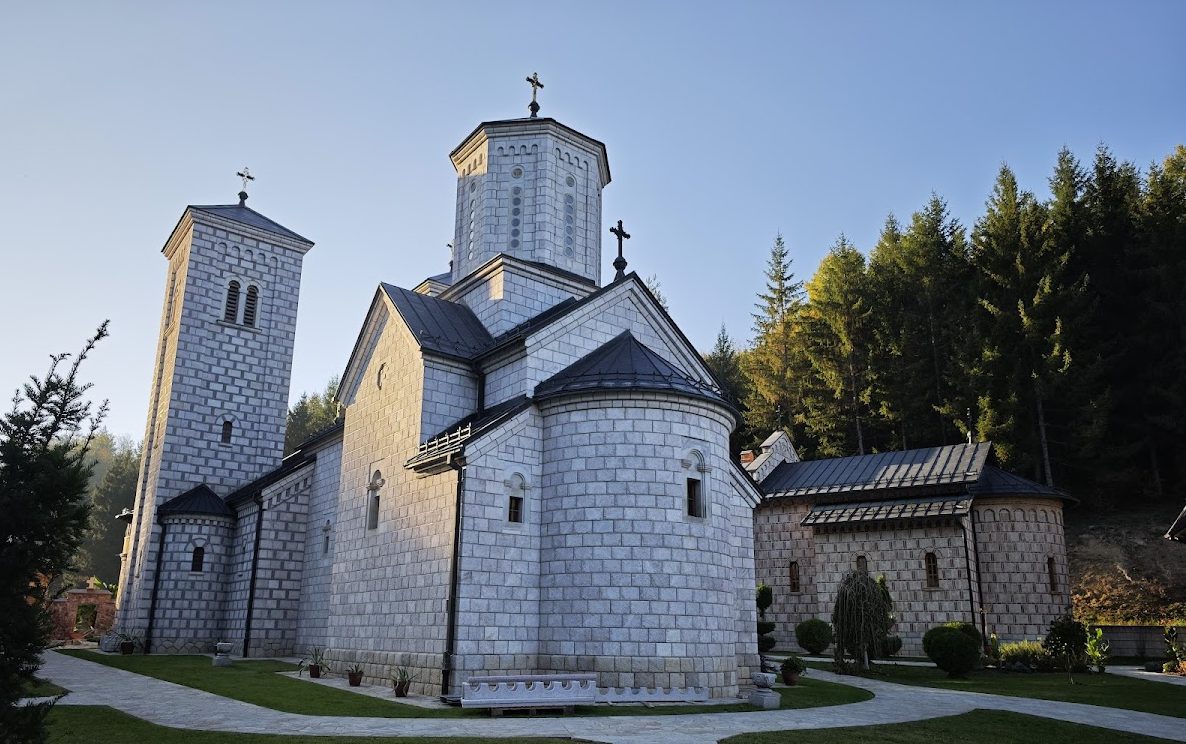
The present complex includes the Church of the Holy Archangel Michael and reconstructed monastic quarters. The church was completed in 2014, while the quarters, which include a chapel dedicated to Saints Peter and Paul, were completed in 2008. The present church contains an iconostasis, a screen separating the sanctuary from the main worship space, executed in the Byzantine style by the diocesan iconographer Father Velimir Klincov.
Residential and communal buildings
A further residential building was completed in 2020. It contains a communal refectory, or dining room, and a room for burning candles. These buildings form part of the revived monastery alongside the reconstructed church and the earlier monastic quarters.