Visoki Dečani: A Medieval Serbian Orthodox Monastery in Serbia


Site at a Glance
- Rating
- 4.9
- Popularity
- Medium
- Country
- Serbia
- Primary era
- Medieval
- External website
- Open
- Eras represented
- Medieval, Early Modern, Modern
- Civilizations
- Serbian
- Site type
- Religious
- Remains
- Fortified Monastery
On this page15 sections
History
Visoki Dečani is a medieval Serbian Orthodox monastery in Serbia, in a valley beside the Dečanska Bistrica beneath the Prokletije mountain range. The monastery was founded in the first half of the fourteenth century, and its principal church, built in the Raška tradition with Byzantine, Romanesque, and Gothic elements, was constructed between 1327 and 1335. It belongs to the Eparchy of Raška and Prizren of the Serbian Orthodox Church and became one of the most important centres of Serbian medieval religious and artistic life.
Foundation and royal patronage
The foundation tradition states that Saint Sava selected and marked the site before construction began. Saint Sava, the first archbishop of the autocephalous Serbian Church, died before the building work could start. King Stefan Uroš III Dečanski then established the monastery and its church, which was dedicated to Christ Pantocrator, an Orthodox title depicting Christ as Almighty ruler of creation, and to the Ascension of the Lord.
Construction of the church began in 1327. Stefan Dečanski issued a richly endowed foundation charter in 1330, placed the cornerstone, and served as the principal patron. After his death in 1331, his son Stefan Dušan continued the project and brought it to completion in 1335. Archbishop Danilo II supervised the work and assembled a large body of skilled craftsmen. The principal master builder was the Franciscan friar Vito of Kotor, assisted by other craftsmen connected with the Adriatic coast.
Stefan Dečanski was buried in the unfinished monastery after his death. Serbian princess and Bulgarian empress consort Ana-Neda was also buried in the church. The relics of Saint Stefan Dečanski and Saint Jelena Dečanska continue to be venerated there. The church’s great size and height gave rise to the popular name Visoki Dečani, meaning “High Dečani.”
Frescoes and the medieval monastery
The interior was painted during the mid-fourteenth century over approximately fifteen years. Several groups of leading painters from the empire of Stefan Dušan worked on the fresco programme, which includes twenty major cycles, more than 1,000 compositions, and several thousand portraits. The paintings provide a broad visual record of religious subjects, dynastic history, rulers, saints, and aspects of fourteenth-century life.
The Nemanjić dynasty, the medieval Serbian ruling house descended from Stefan Nemanja, is represented by a genealogical tree on the eastern wall of the narthex, or entrance vestibule. It contains twenty-two figures, beginning with Stefan Nemanja and continuing to Stefan Uroš V. The narthex also contains portraits of Stefan Dušan, his wife, and their son, together with a scene showing the lord Đorđe Pepkala being led by Saint George toward Christ. Portraits of the principal donors, Stefan Dečanski and Stefan Dušan, are positioned near the main entrance.
The western part of the church contains an image of Christ the Judge surrounded by angels. The frescoes were made using the fresco, or al fresco, technique, in which pigment is incorporated into wet lime plaster. Their colours and intensity remain well preserved. An inscription above the western doors names Arsenije, the first abbot, while the chapel of Saint Demetrius contains the signature of the painter Srđa Grešni.
Ottoman rule and changing jurisdictions
During the Ottoman conquest and the centuries that followed, the monastery survived under difficult conditions. After the restoration of the Peć Serbian Patriarchate in 1557, Visoki Dečani remained under its jurisdiction until the patriarchate was abolished in 1766. The region then came under the Patriarchate of Constantinople. Over its long history, the monastery’s ecclesiastical administration also passed through the Eparchies of Prizren and Hvosno, while its enduring institutional identity remained Serbian Orthodox.
From the second half of the sixteenth century through the seventeenth century, the treasury, library, and other monastic buildings were enlarged and enriched. The scriptorium, the monastery’s book-copying workshop, produced liturgical and theological manuscripts. The monks also held formal falconry privileges under Ottoman rule, requiring them to renew those rights and bring falcons to the sultan’s court. In 1557, Abbot Toma obtained a sultan’s decree against the spahi Topči Oğlu Nuh. In 1577, Abbot Nikolaj secured another decree from Sultan Murad III prohibiting spahis, Ottoman cavalrymen who commonly held land-based military fiefs, from harassing the monastery.
The monastery was plundered by Ottoman forces during the Great Migration of the Serbs under Patriarch Arsenije III Čarnojević. This late-seventeenth-century movement carried Serbian populations northward, including toward Habsburg-controlled territories, and left the monastery’s brotherhood facing severe hardship. Even so, the institution continued to produce and preserve religious books and objects. Abbots associated with its later Ottoman-era history included Gregory Tsamblak, a Bulgarian writer who served around the turn of the fifteenth century and wrote the Life of Stefan Dečanski, as well as Toma, Nikolaj, Atanasije, Meletije Kaludranin, Zaharije, and others.
Education, renovation, and nineteenth-century pressures
A Serbian school operated at the monastery from the eighteenth century without interruption. During the nineteenth century, the monastic buildings were renovated. Prince Miloš Obrenović built a residential guest building, or konak, in 1836, and Prince Aleksandar Karađorđević donated a reliquary for the relics of Stefan Dečanski in 1849. The relics were last redressed in 1964 by the then bishop, who later became Serbian Patriarch Pavle.
The second half of the nineteenth century brought attacks and the loss of income. Armed groups expelled Serbian inhabitants from the monastery estate at Ljubožda and seized the property, including its agricultural revenues. After the First Balkan War, the monastery came under the administration of the Kingdom of Montenegro, and King Nikola I placed much of the surrounding land under its jurisdiction.
Threats and protection before the Second World War
In 1900, Albanian raiders attacked the monastery on 15 August, 27 August, and 20 September. Ottoman authorities stationed a yuzbashi, a mulazim, and 100 soldiers there. These Ottoman military ranks formed part of the force that repelled the attacks, although the raiders set fire to hay. Following a major attack on 9 September 1902 and further threats, Abbot Simeon Đorđević left for Niš in early 1903.
On 1 February 1903, Russian monks entered the monastery to prevent its destruction, and Cyril from the Mount Athos monastery of Saint John became abbot. Their administration prompted a Serbian public campaign known as the “Dečani question,” which demanded the return of the monastery to Serbian monks. A fire affected the complex later that year, while local Albanian groups helped prevent its destruction. Plans were made to rebuild walls that had been demolished in earlier attacks.
During the First World War, Austro-Hungarian forces occupying Serbia from 1915 to 1918 plundered the monastic treasury. In 1925, King Alexander decided that the monastery should receive a bell, an elaborate vestment for the abbot, and plans for a fountain at a mineral-water spring near the complex.
War, confiscation, and modern protection
During the Second World War, the monastery lay within the Italian-controlled Albanian Kingdom. In 1941, the Albanian nationalist Balli Kombëtar and Italian Fascist blackshirts targeted it for destruction, and the Royal Italian Army sent soldiers to protect the complex.
Communist authorities confiscated approximately 700 hectares of monastic land in 1946. The monastery came under Serbia’s legal protection in 1947. During the Kosovo War of 1998–1999, the monks sheltered refugees of different ethnicities. Serbian residents of Deçan sought refuge there after violence in May 1998, while Albanian civilians and later Roma also used the monastery as a sanctuary during and after the conflict.
Since 1999, an Italian KFOR unit and subsequently other KFOR forces have guarded the monastery because of repeated attacks. KFOR, the NATO-led Kosovo Force established in 1999 to provide security in Kosovo, prevented an Albanian mob from attacking the complex with Molotov cocktails during the unrest of March 2004. The monastery was also struck by mortar fire in February and June 2000, and several mortar rounds were fired at it in March 2004.
On 30 March 2007, a grenade fired from a nearby hill struck a medieval boundary wall rather than the church. Jeton Mulaj was sentenced to three and a half years in prison in 2009. On 13 October 2014, graffiti associated with ISIS and the KLA, including the words “Caliphate is coming,” appeared on the exterior walls, but the perpetrators were not found. On 31 January 2016, four Kosovo Albanians were arrested near the monastery with weapons, explosives, and literature indicating possible links to ISIS.
UNESCO inscribed Visoki Dečani in 2004 as part of the World Heritage property “Medieval Monuments in Kosovo.” The inscription recognized the monastery’s exceptional cultural importance, its frescoes as an important example of the Palaiologan Renaissance, and their evidence for fourteenth-century life. The Palaiologan Renaissance was a late Byzantine revival of artistic and intellectual activity associated with the Palaiologan dynasty. The property was added to the List of World Heritage in Danger in 2006. In 2021, Europa Nostra included Visoki Dečani among the seven most endangered cultural heritage sites in Europe.
A long legal dispute over land associated with the monastery concluded in 2016 when Kosovo’s Constitutional Court upheld its ownership of approximately 24 hectares and ordered their registration in the cadastre. Five years later, the decision had still not been implemented. Later abbots included Leontije Ninković, Makarije Popović, Justin Tasić, Teodosije Šibalić, and Sava Janjić, who is recorded as abbot from 2011 onward.
Remains
Church and monastic layout
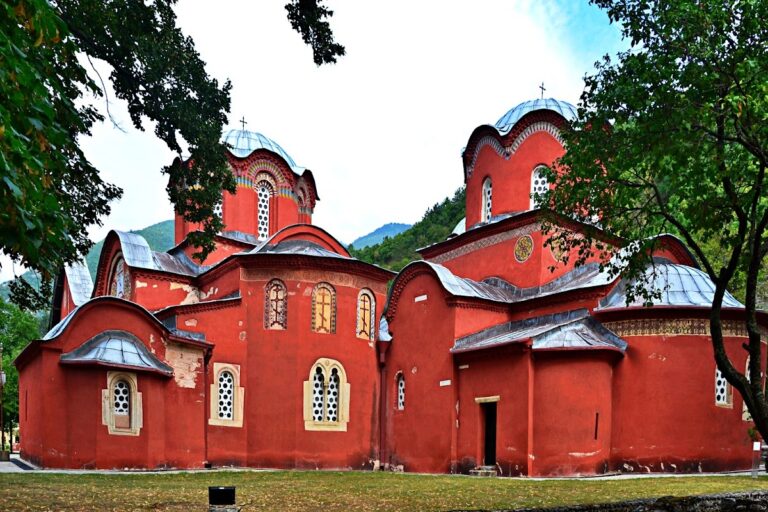
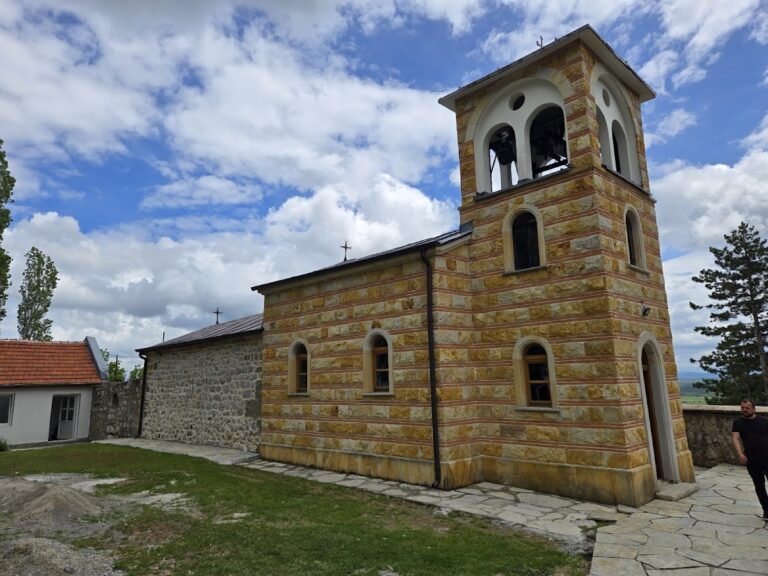
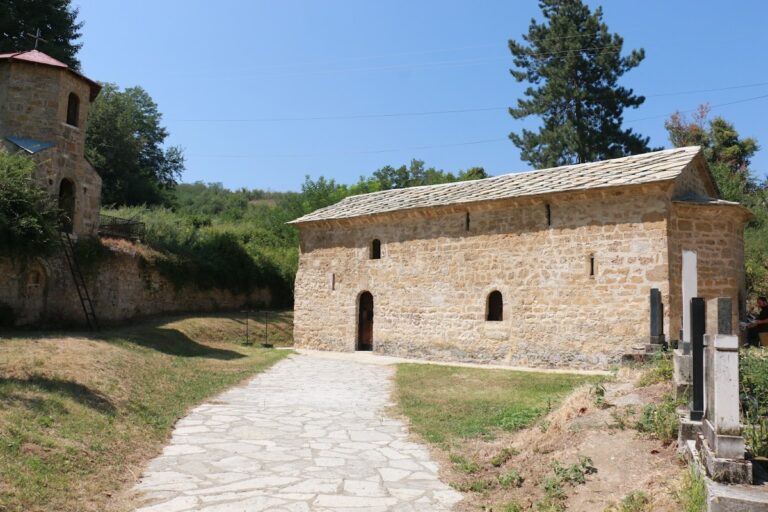
The monastery complex covers approximately 4,000 square metres in the valley beside the Dečanska Bistrica. Its central church is a five-nave, cross-shaped basilica with a dome carried on four piers. The building follows the Raška architectural tradition, a medieval Serbian form combining Byzantine planning with western, especially Romanesque, elements. Its design also incorporates Gothic features associated with the Adriatic coast, creating an unusually complex combination of eastern and western forms.
The church measures approximately 36 metres in length and 30 metres in height. Its dome and upper structure continue the Raška practice of placing the dome on a raised cubic base. Carefully cut marble blocks, arranged in alternating white and pink tones, form the walls. The portals, windows, consoles, capitals, and façades carry extensive carved decoration, predominantly Romanesque in character with Gothic elements. Inside, the floor is laid with square slabs of different kinds of stone, including stones corresponding to those used on the principal façade.
Entrance and supporting buildings
The church includes a three-part iconostasis, the screen separating the sanctuary from the main body of an Orthodox church, and a three-nave parvis, an enclosed entrance space. A former baptistery stands on the west side. The south chapel is dedicated to Saint Nicholas, while the north chapel is dedicated to Saint Demetrius. Of the original buildings surrounding the central church, the entrance tower and the western refectory survive. The other visible monastery buildings were constructed later.
Frescoes and liturgical furnishings
Painted decoration
The church preserves twenty major fresco cycles, more than 1,000 compositions, and several thousand portraits. The western section shows Christ the Judge surrounded by angels. In the narthex, the frescoes include members of the Nemanjić dynasty, the donor portraits, the scene of Đorđe Pepkala led by Saint George toward Christ, and the dynastic tree extending from Stefan Nemanja to Stefan Uroš V. The colours and intensity of the paintings remain well preserved.
An inscription above the western doors identifies the first abbot, Arsenije. The chapel of Saint Demetrius contains the signature of Srđa Grešni, the only identified signature among the painters described here. The frescoes’ extensive historical and artistic content contributed to their recognition as an important example of the Palaiologan Renaissance.
Icons and sacred objects
The monastery preserves approximately ninety portable icons dating from the fourteenth century to the end of the seventeenth century. Many were painted at the monastery and are placed on the iconostases of the church and chapels, on chandeliers, or used by the brotherhood during religious feasts. Five fourteenth-century icons on the church iconostasis represent Christ, the Virgin Mary, the Archangel Gabriel, Saint John the Baptist, and Saint Nicholas.
The Serbian monk, painter, and hymnographer Longin produced many icons during the final decades of the sixteenth century. One shows Saint Stefan Dečanski enthroned and surrounded by seventeen scenes from his life. Longin painted his icons on both sides and sometimes included the miracle of Saint Nicholas restoring Stefan Dečanski’s sight in images of Saint Nicholas.
A fourteenth-century carved wooden sarcophagus decorated with leaves and flowers holds the relics of Saint Stefan Dečanski. The church also preserves a stone throne associated with Emperor Stefan Dušan. A bronze chandelier carries reliefs of double-headed eagles and griffins. Empress Milica donated it and two large candlesticks positioned on either side of the royal doors.
Treasury, manuscripts, and water supply
The treasury began to be assembled before the complex was completed. Its holdings included books, crosses, icons, liturgical vessels, lamps, censers, fans, candlesticks, vestments, altar coverings, and objects decorated with gold, silver, pearls, and precious stones. Repeated raids and plundering reduced the original holdings, while the surviving ecclesiastical and manuscript collections remain rich.
The manuscript collection is one of the most important and extensive Serbian collections, ranking immediately after that of Hilandar. It contains liturgical and theological books copied in the monastic scriptorium. A water-supply system was built from the Dečanska Bistrica in 1613 under Abbot Atanasije.
Foundations and associated land
The church foundations were originally about half a metre wider than the walls and were covered externally with lead. After that covering was removed, water, snow, wind, and frost seriously damaged the exposed stone. Beginning in spring 1882, Archimandrite Rafailo directed the progressive replacement and strengthening of the foundations with larger stone sealed with molten lead. A nearby quarry beside the Bistrica supplied stone for the work, and approximately 3,840 kilograms of lead were used.
Approximately 24 hectares of land are directly associated with the monastery. This area formed part of a larger historical monastic holding and became the subject of a prolonged legal dispute. Its ownership was upheld by Kosovo’s Constitutional Court in 2016, alongside an order for registration in the cadastre.
Nearby sites