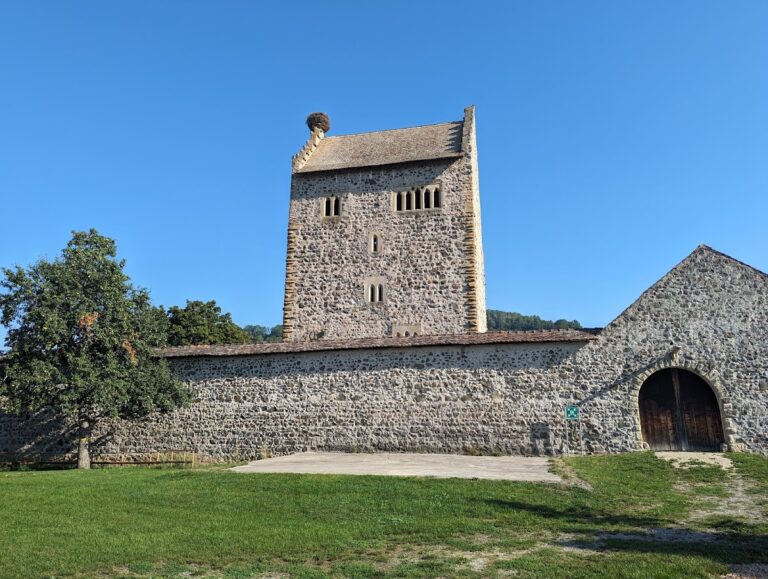
Unterhof Castle: A Medieval Castle and Former Seat of Authority in Switzerland


Site at a Glance
- Rating
- 4.7
- Popularity
- Very Low
- Country
- Switzerland
- Primary era
- Medieval
- External website
- Open
- Eras represented
- Medieval
- Civilizations
- Holy Roman Empire
- Site type
- Military
- Remains
- Castle
On this page9 sections
History
Unterhof Castle is a medieval castle in Diessenhofen, Switzerland, originating in the twelfth century. Its builder is unknown, but the castle first appears in records in 1185. It later became the seat of the Truchsessen of Diessenhofen, a noble family whose members held an administrative office connected with the town.
The Truchsessen of Diessenhofen
The Truchsessen were active from the thirteenth to the fifteenth century and descended through a branch of the Lords of Hettlingen. Their bailiwick, an administrative district governed by a bailiff, was Diessenhofen, while the family’s burial place was the local church. Heinrich, the first known member of the family, appears between 1241 and 1290. From 1247, he served as steward of the County of Kyburg at Diessenhofen, a medieval territorial lordship in the region of present-day Switzerland. His connections with Salem Abbey and other evidence indicate a marriage into the nobility of the Hegau region.
After Hartmann IV of Kyburg, the last member of the Kyburg dynasty, died, the castle passed to Rudolf of Habsburg in 1264. The Habsburgs were a major European ruling dynasty that acquired extensive territories during the late Middle Ages. Rudolf took the Truchsessen of Diessenhofen into his service, reinforcing the family’s connection with the castle and its administrative role.
Expansion and loss of administrative function
By 1399, Unterhof had been enlarged with a two-part eastern wing and a principal residential building, while its defensive wall had been strengthened. In 1408, the impoverished last descendant, Hans Molli, sold the property in separate parts. When the Swiss Confederates took control of Diessenhofen in 1460, the Truchsessen’s administrative mandate ended and Unterhof lost its function as the seat of authority.
The property later passed to the Lords of Randegg in 1474 and to the Knights of Schellenberg, who held it from 1627 to 1725. In 1725, Junker von Greuth sold the castle to the city of Diessenhofen. The city created apartments in the building and soon sold the property onward. Unterhof was later used for other purposes, including an eye clinic.
Renovation and later use
AXA Insurance acquired Unterhof Castle in 1990. Archaeological and building investigations took place between 1988 and 1991, and the building was thoroughly renovated. From 2002, the renewed complex operated as a seminar hotel, with archaeological finds displayed inside. Seminar operations ended in 2014. The property was then sold to a real-estate company based in Schaffhausen, which created apartments in the hotel complex. Unterhof Castle is a Swiss heritage site of national significance. The old castle section continues to operate as a restaurant.
Remains
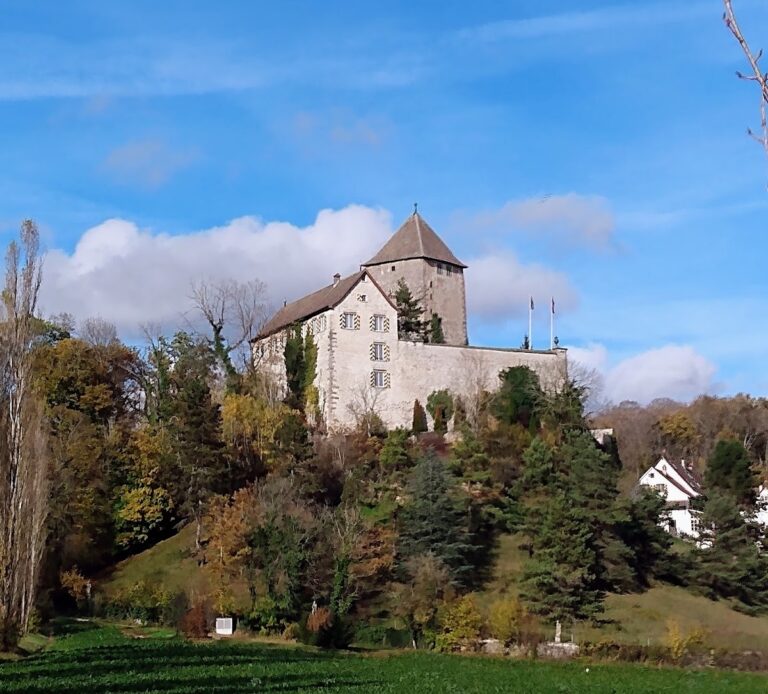
Unterhof Castle is a lowland castle on the Rhine, built on relatively level terrain. Its complex combines the former castle section with the later hotel complex and apartments. A prominent tower forms the northwestern end of the old city of Diessenhofen. The surviving arrangement includes the eastern wing, the palas, a principal residential and representative building, and the defensive wall.
Castle complex
Eastern wing
The eastern wing consists of northeast and southeast sections. It formed part of the enlargement completed by 1399 and remains within the castle complex’s later architectural arrangement.
Palas and defensive wall
The palas was added by 1399 and served as the castle’s principal residential and representative building. By the same date, the defensive wall had been strengthened. These elements now belong to the renovated former castle section and its later uses.
Later complex and archaeological displays
The renovated complex incorporates the former castle section, the hotel complex, and apartments created during later adaptations. Archaeological finds are exhibited within the building, bringing material recovered from the site into the present architectural setting.