Oka Misanzai Kofun: A Keyhole-Shaped Burial Mound in Japan


Site at a Glance
- Rating
- 3.9
- Popularity
- Very Low
- Country
- Japan
- Primary era
- Classical
- External website
- Open
- Eras represented
- Classical, Medieval, Modern
- Civilizations
- Yamato
- Site type
- Burial
- Remains
- Burial Mound
On this page14 sections
History
Oka Misanzai Kofun is a keyhole-shaped burial mound in Japan, located in Fujiidera, Osaka, and probably built in the late fifth century during the middle Kofun period, the era of monumental burial-mound construction from about the third to the seventh century. Its builders created a mound whose exceptional size distinguished it from contemporary tombs. The site stands at the western edge of the Furuichi Kofun Group, which extends across Fujiidera, Habikino, and Matsubara and forms part of a UNESCO World Heritage cultural property.
Construction and royal identification
The mound marked a change from earlier kofun in more than scale. It was probably built without the stone surfacing known as fukiishi, and its form has led to the possibility that it contained a horizontal-entry stone chamber, a burial chamber reached through a passage cut into the mound. The person buried there remains a matter of debate.
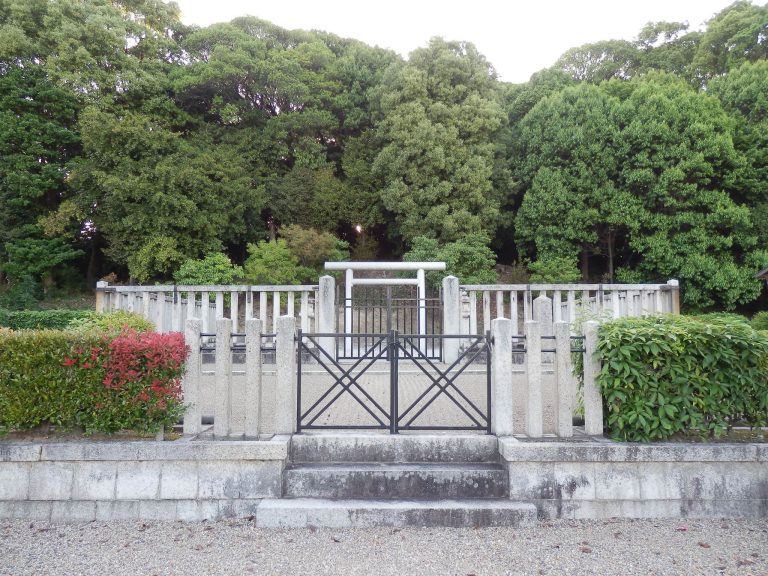
The Imperial Household Agency designates Oka Misanzai Kofun as the mausoleum of Emperor Chuai, the traditionally numbered fourteenth emperor of Japan. Its formal designation is Ega Nagano Western Mausoleum. Historical records place Emperor Chuai’s mausoleum in the Nagano area of Kawachi under several different place names. The Engishiki, a tenth-century compilation of regulations and court practices, lists an Ega Nagano Western Mausoleum in Shiki District, Kawachi Province. It gives the mausoleum an area measuring two cho from east to west and two from north to south, with one household assigned to it and four households responsible for its guard service.
The location tradition was later lost. During a search for Emperor Chuai’s tomb in the Genroku period, a mound at Uehara Village and Nakatsuyama in Sawada Village were considered, and the former was selected. In 1863, during the late Edo-period restoration of imperial mausoleums, Oka Misanzai Kofun was designated as Emperor Chuai’s mausoleum. Restoration followed in 1864 and 1865, and the designation continues today.
This identification creates a chronological problem. The mound belongs to the late fifth century, while Emperor Chuai’s traditionally assigned period is earlier, and his historical existence is particularly uncertain. Archaeological interpretations instead strongly favor Emperor Yuryaku, the traditionally numbered twenty-first emperor, or Wa King Bu, one of the rulers called the Five Kings of Wa in Chinese historical records. Bu is often identified with Yuryaku.
The proposed connection with Yuryaku relates the mound’s date to the ruler named Wakatakeru in a fifth-century inscription on an iron sword from Inariyama Kofun and to the 478 embassy record in the History of the Song, a Chinese dynastic history describing diplomatic contacts with the Japanese archipelago. The identification remains debated because historical locations assigned to the mausoleums of Chuai and Yuryaku have not been securely matched with archaeological sites. Some scholars also question whether Bu should be equated with the reading Takeru.
Medieval military use
From the medieval period, the kofun was adapted for use as a castle. One interpretation places the main enclosure on the round rear mound and a tower platform on the square front mound. A lateral moat at the front may have formed a sortie enclosure, while several vertical ditches were cut into the mound.
Another hypothesis places a Toyotomi stronghold here during the Battle of Domyoji and Konda in the Osaka Summer Campaign of 1615, the phase of the conflict in which Tokugawa forces defeated the Toyotomi regime. Under this interpretation, the eastern line of the Furuichi Kofun Group served as a defensive position against Tokugawa forces. The medieval castle use substantially altered the mound and its surrounding earthworks.
Investigation and preservation
William Gowland, a British engineer and archaeologist who lived in Japan from 1872 to 1888, surveyed and photographed the mound. Kōsaku Hamada made a field inspection and observation report in 1900, possibly the site’s first academic report, and Sueji Umehara published an investigation report in 1934. A boundary stone was installed in 1925. The Imperial Forestry Bureau prepared a survey in 1926, and the drawing was completed in 1928.
The Imperial Household Agency’s Department of the Archives and Mausolea investigated the site in 1973 and 1975. An emergency investigation followed partial mound collapse in 1983, and the Fujiidera Municipal Board of Education identified a large ditch on the eastern outer bank in 1987. Excavation before bank-protection work in 1996 revealed extensive alteration linked to the medieval castle phase. A new survey plan was prepared in fiscal year 2011 during efforts to secure World Heritage registration for the Mozu and Furuichi Kofun Groups. The Imperial Household Agency now manages the mound as Emperor Chuai’s mausoleum, while archaeological investigations have also been conducted by the Osaka Prefectural Board of Education and the Fujiidera Municipal Board of Education.
Associated mounds
Hachizuka Kofun, a smaller keyhole-shaped mound north of Oka Misanzai’s rear mound, is regarded archaeologically as a possible subsidiary mound, meaning a smaller burial mound associated with a principal kofun. It is believed to date from the same period. Rakuzuka Kofun, formerly positioned in front of Oka Misanzai’s square front mound, has also been proposed as a subsidiary mound. Warizuka Kofun and Oka Kofun, near the eastern corner of the front mound, are regarded as earlier mounds rather than subsidiary mounds belonging to Oka Misanzai’s phase.
William Gowland’s record of about 1877 mentioned seven mounds in the surrounding area, including Hachizuka, Rakuzuka, Warizuka, and Oka. Rakuzuka disappeared around 1965 without archaeological investigation. The details of three other mounds in Gowland’s record are no longer clear. The number of subsidiary mounds associated with Oka Misanzai’s phase was markedly lower than the more than ten associated with the earlier Ichinosan Kofun phase.
Remains
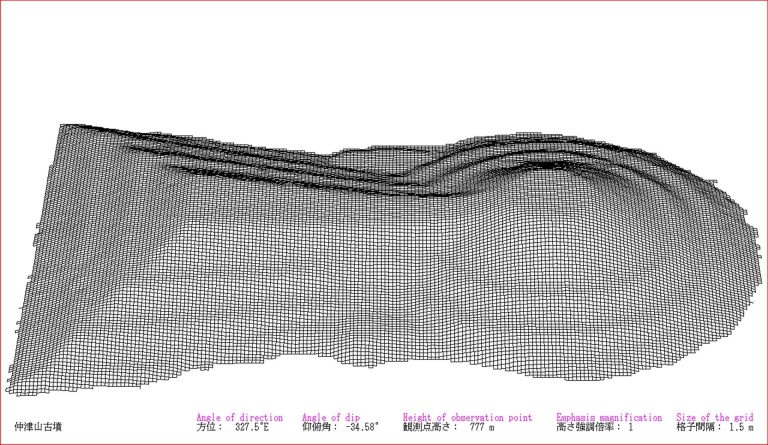
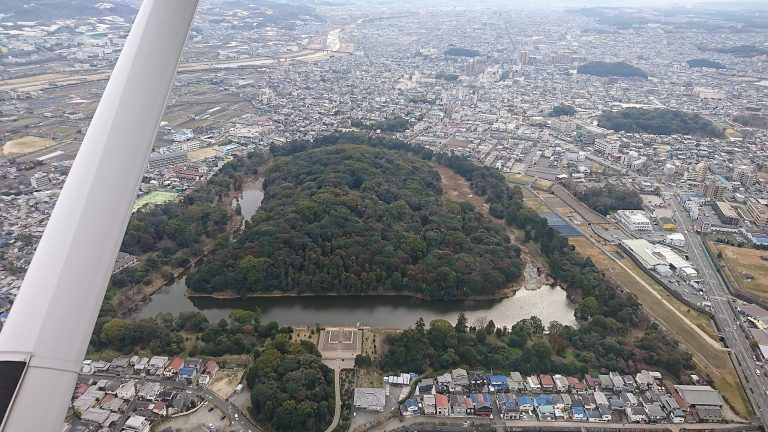
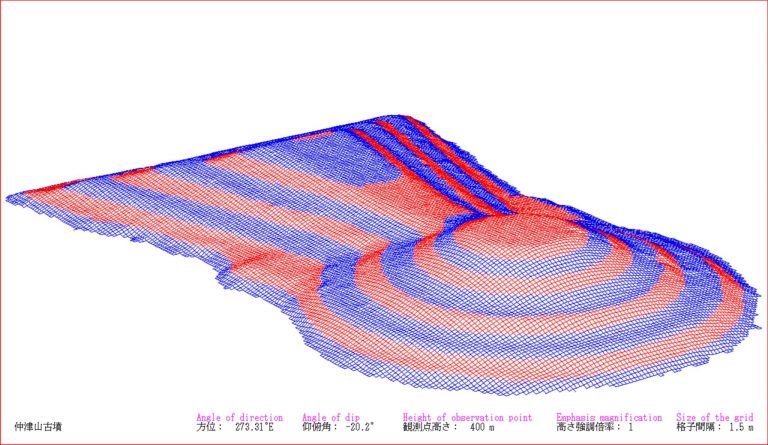
Oka Misanzai Kofun is organized as a large keyhole-shaped earthwork, with a rounded rear section joined to a roughly square front section. It measures approximately 245 meters in total length, making it the third-largest mound in the Furuichi Kofun Group and the sixteenth-largest in Japan. Its length is about half that of Daisenryo Kofun. The square front section points south-southwest, while the round rear section measures about 150 meters in diameter and rises approximately 20 meters high. The front section is about 180 meters wide and 16.6 meters high. These measurements come from the 2011 survey plan, while the mound’s original edges have not been fixed precisely through excavation.
Principal earthwork
Mound form and surface
The mound was probably first built in three stages. The nineteenth-century restoration of the mausoleum altered it to five stages. Fragments of haniwa, clay funerary objects placed on or around burial mounds, have been found on the mound surface. The eastern side of the junction between the round rear and square front sections has a projecting platform. The corresponding western side has not been established.
Moat and outer bank
A broad moat surrounds the mound and measures approximately 50 meters across along the central axis. Beyond it lies an outer bank about 20 meters wide, carrying a row of cylindrical haniwa that formed a boundary around the burial mound. The bank follows the original ground plan, although later periods raised it by approximately 0.6 to 2.5 meters.
Excavation identified a large ditch crossing the eastern side of the outer bank at right angles. It is interpreted as a drainage installation that carried spring water produced during excavation of the moat beyond the terrace edge. The ditch was backfilled before the kofun was completed. Cylindrical haniwa and figural examples representing houses, shields, quivers, umbrella-shaped objects, and people were recovered from it.
Burial arrangement
The mound’s shape has raised the possibility of a horizontal-entry stone chamber, reached through a passageway cut into the earthwork. The chamber’s position and the objects placed with the burial have not been established.
Nearby kofun
Hachizuka Kofun
Hachizuka Kofun lies north of the rear-mound side of Oka Misanzai. It is a keyhole-shaped mound approximately 60 meters long, with its square front section facing west. A surrounding moat is now buried, and the mound forms part of the group of smaller earthworks considered in relation to Oka Misanzai’s construction phase.
Rakuzuka Kofun
Rakuzuka Kofun was a circular mound approximately 20 meters in diameter. It stood in front of Oka Misanzai’s square front section and was proposed as a possible subsidiary mound. It disappeared around 1965.
Warizuka and Oka kofun
Warizuka Kofun and Oka Kofun stood beside the eastern corner of Oka Misanzai’s square front section. Warizuka is a designated historic site, while Oka Kofun has disappeared. Both are regarded as earlier kofun rather than subsidiary mounds of Oka Misanzai.