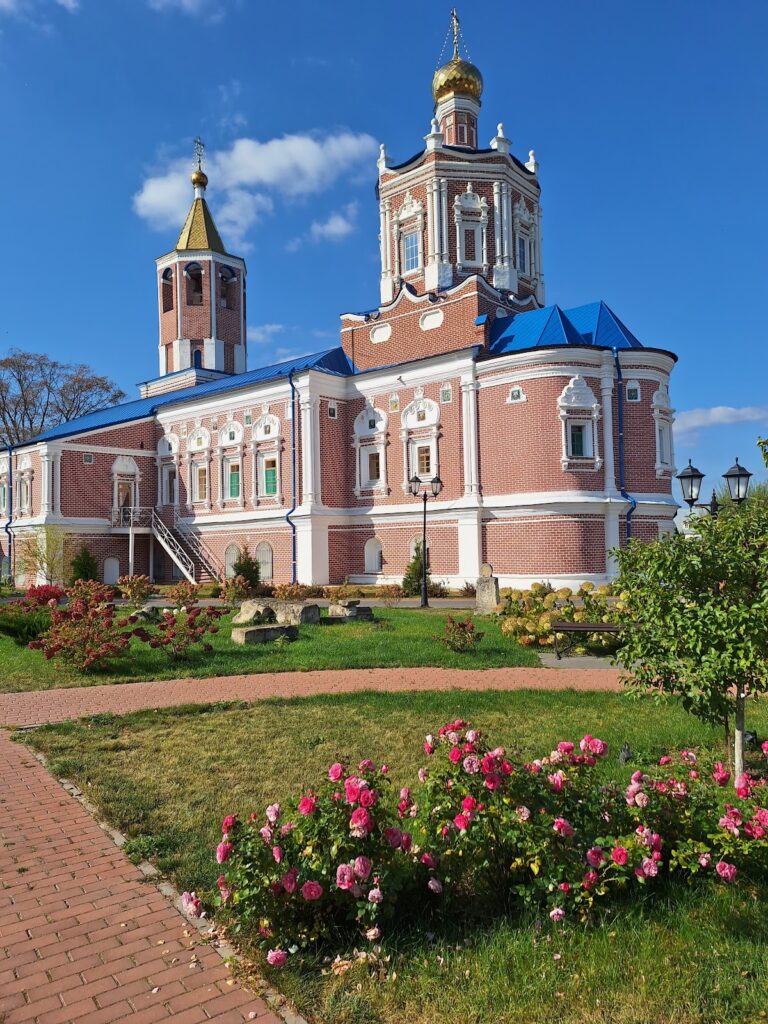
Church of Saints Boris and Gleb: An Orthodox Cathedral in Ryazan


Site at a Glance
- Rating
- 4.6
- Popularity
- Low
- Country
- Russia
- Primary era
- Early Modern
- External website
- Open
- Eras represented
- Early Modern, Modern
- Civilizations
- Russian
- Site type
- Religious
- Remains
- Cathedral
On this page9 sections
History
The Church of Saints Boris and Gleb is an Orthodox church in Ryazan, Russia, dedicated to Boris and Gleb, the princely brothers of Kievan Rus who became saints of the Eastern Orthodox tradition. A seventeenth-century Book of Degrees, a historical compilation of rulers and the Russian lands, states that a church dedicated to the two princes was built here in 1152. The present building belongs chiefly to the late seventeenth century and preserves features of Moscow Baroque architecture.
Medieval episcopal church
From the episcopate of Saint Basil of Ryazan, between 1288 and 1522, the church served as the seat of the Ryazan bishops. An episcopal see is a bishop’s official seat and administrative center. Saint Basil was buried here in 1295, strengthening the church’s association with the medieval Ryazan hierarchy.
In 1522, Bishop Jonah II found the church in poor condition after a Tatar attack on Ryazan. He transferred the episcopal see to the better-protected Assumption Cathedral within the Kremlin, now known as the Cathedral of the Nativity of Christ. The Church of Saints Boris and Gleb then remained connected with the Bishop’s House, the institution associated with the bishop’s residence and administration.
Rebuilding and destruction
In 1568, Bishop Jonah built a new church on the site of the earlier building. Because the structure stood dangerously close to the bank of the Trubezh River, it was moved slightly inland. Saint Basil’s burial place consequently lay outside the new church.
In the early seventeenth century, Archbishop Feodorit of Ryazan and Murom recovered Saint Basil’s relics and transferred them to the protected Assumption Cathedral, now the Cathedral of the Nativity of Christ. The Church of Saints Boris and Gleb was severely damaged in 1618 when Zaporizhian Cossacks under Petro Sahaidachny attacked Ryazan. It collapsed two years later and was replaced by a wooden church.
The present building
Construction of a fourth church began in 1685. The project was initially intended to produce another wooden building, but it was changed to stone and included a refectory, a church extension traditionally connected with a communal dining building. The present church was built in 1686 and 1687 by Yakov Bukhvostov, with a stone bell tower attached to the refectory church.
Further alterations continued during the nineteenth century. A hoard containing approximately 80 kilograms of silver was found in the cathedral area in 1828. A new iconostasis, the screen separating the sanctuary from the main worship space, was installed in 1829, and the altars and walls were painted in 1830. A new refectory church was built in 1840 and 1841. The refectory and bell tower were dismantled in 1870, a new refectory was erected on the former site, and the present bell tower was built in 1873. The church was repainted in 1915.
Burial memory and twentieth-century history
In 1836, a monument to Saint Basil was erected south of the church at the place of his original burial. It consisted of a cast-iron pyramid beneath a canopy supported by four Corinthian columns, a classical column form known for ornate capitals. The monument has not survived. A new monument was erected at Saint Basil’s grave in 1948.
In 1922, silver church vessels weighing 8 poods and 27.5 pounds were confiscated under the stated policy of providing aid for famine relief. The cathedral closed in 1935 and reopened in 1946. It served as the cathedral of the Ryazan Diocese, an administrative jurisdiction of the Russian Orthodox Church, from 1946 to 2002. In 1947, its key-keeper was Pimen, who later became Patriarch of Moscow and All Rus.
In 1948, the Palekh artists, brothers named Blokhin, repainted the vaults and walls. A late-nineteenth-century faience iconostasis from the church in the village of Izhevskoye was installed in the north chapel. A baptistery dedicated to Joachim and Anna was built in the churchyard, and a new monument was placed at Saint Basil’s grave. A chapel dedicated to Blessed Prince Roman of Ryazan and Saint Seraphim of Sarov was consecrated in 1969.
The church has remained open since 1946 and continues to function as a place of Orthodox worship. It is a nationally protected cultural-heritage monument of federal significance in Russia. Once situated near the bank of the Trubezh River, its grounds were separated from the river by the construction of a residential complex in 2015.
Remains
Main church and Moscow Baroque design
The principal building preserves the compact geometric composition and carved ornament associated with late-seventeenth-century Moscow Baroque. Its plan takes the form of an equal-armed, or Greek, cross. The lower square volume, known as a chetverik, has three apses, which are projecting sanctuary ends, divided by pilasters. Beneath the cornice runs a series of false kokoshnik zakomaras, curved ornamental forms derived from traditional Russian architecture. Relief surrounds frame the windows and portals.
An octagonal upper structure rises from the main cube. White-stone carving, eight decorative niches resembling blocked windows, and tympana with spiral volutes enrich its surfaces. Half-columns stand between the niches and at the corners of the octagon. A double row of porebrik, a pattern made from projecting bricks, runs below the cornice. Above, a drum, the polygonal stage supporting the dome, carries arcaded decoration and is crowned by an onion dome and cross. The main church and the refectory church are roofed with iron.
Altars and refectory church
The church’s historical altars were dedicated at different times to the Great Martyr Paraskeva Pyatnitsa, the hieromartyr Autonomus, the Prophet Elijah, the Korsun Icon of the Mother of God, Joachim and Anna, the Great Martyr John the New, the Bogolyubskaya Icon of the Mother of God, and Saint Basil of Ryazan. The present supplementary altar is dedicated to Blessed Prince Roman of Ryazan and Saint Seraphim of Sarov.
The south chapel of the refectory is dedicated to the Bogolyubskaya and Korsun Icons of the Mother of God. Its north chapel is dedicated to Saint Basil the Wonderworker and John the New. The north chapel also contains a late-nineteenth-century faience iconostasis transferred from the church at Izhevskoye. The baptistery on the south side of the cathedral is dedicated to Joachim and Anna.
Burial places, relics, and icons
A venerated burial place associated with Saint Basil of Ryazan lies south of the church’s altar, near the location of his original interment. The church also contains a shrine with the relics of Archbishop Feodorit of Ryazan and Murom. An ark, a small reliquary container, holds relics associated with Bishop Meletius of Ryazan and Zaraysk, the hieromartyr Thaddeus of Tver, Saints Nilus of Stolobensk and Sabbas of Vishera, and the locally venerated saints Sophronius of Iberdsk and Basil of Kadom.
Among the church’s venerated images are icons and icon lists, meaning revered copies of particularly honored icons, of the Bogolyubskaya, Feodorovskaya, Kazan, Sorrowful, Three-Handed, and Feodotyevskaya Icons of the Mother of God. The collection also includes a venerated icon of Saint Basil of Ryazan and an icon of Saint Demetrius of Rostov containing a particle of his relics.