Tyre World Heritage Site: Phoenician Maritime Metropolis in Lebanon



Site at a Glance
- Rating
- 4.6
- Popularity
- Medium
- Country
- Lebanon
- Primary era
- Classical
- External website
- Open
- Eras represented
- Bronze Age, Iron Age, Classical, Medieval
- Civilizations
- Ancient Greek, Byzantine, Kingdom of Macedon, Phoenician, Roman
- Site type
- City
On this page25 sections
History
Tyre World Heritage Site in Lebanon preserves the remains of the ancient Phoenician port city of Tyre, traditionally founded around 2750 BCE. Its early history reaches back even further, since finds from Al Ma’shook hill predate the traditional foundation date. Tyre became a major maritime power, commercial center, and religious city before passing through Assyrian, Babylonian, Persian, Hellenistic, Roman, Byzantine, and Arab rule.
Bronze Age origins and Phoenician expansion
Tyre appears in second-millennium BCE records, including the Amarna Letters and the Epic of King Keret. Egyptian records from the reign of Sety I refer to the region, while a stele found at Tyre commemorates a victory by his successor Ramesses II. When Herodotus visited in the fifth century BCE, local tradition held that Tyre and its temple of Melqart were already 2,300 years old.
At the beginning of the Iron Age, Tyre replaced Sidon as the leading city of the region. The Phoenicians were maritime city-states along the eastern Mediterranean coast, linked by shipping, overseas settlements, and commerce. Tyre became a major force in this expansion and was associated with the establishment of Kition, Carthage, Utica, Lixus, and Gades. The tradition that Tyre founded Lepcis Magna is less secure.
Tyre’s wealth rested on several connected resources. Its ships carried goods through an extensive Mediterranean network, while warehouses held products arriving from overseas settlements. The city also drew on agricultural resources from the mainland and became famous for purple pigment, traditionally believed to have been discovered at Tyre. A narrow coastal strip, about two kilometres wide, supported settlements, sanctuaries, and farms beside the island city.
Kingship and the cult of Melqart
King Hiram and the earlier ruler Abiba’al are traditionally linked with Tyre’s expansion during the tenth century BCE. Hiram is associated with close relations with David and Solomon, the supply of materials and an architect for the Temple of Solomon in Jerusalem, naval expeditions, and the promotion of the city’s principal god, Melqart. Some details of Hiram’s career depend on biblical and later literary traditions and may be legendary.
Melqart, whose name means “king of the city,” became Tyre’s chief god during the Iron Age, increasing in importance over older cults such as that of Asherah. Greek writers identified Melqart with Heracles, although this was an interpretation of the Tyrian deity rather than a reference to the Greek hero of the Twelve Labors. The sanctuary of Melqart was already regarded as extremely ancient in Herodotus’s time and ranked among the principal sanctuaries of the ancient Mediterranean.
Assyrian pressure and Babylonian siege
Tyre paid tribute to Assyria while preserving much of its maritime and commercial autonomy. Under rulers including Ashurnasirpal II, Shalmaneser III, Adad-Nirari III, Tiglath-pileser III, Sennacherib, Esarhaddon, and Ashurbanipal, the city’s mainland possessions were threatened, taxed, looted, or placed under pressure. The island city itself was not permanently captured.
Tyrian rulers sometimes also governed Sidon. Ithoba’al I was associated with a famine and with the colonies of Bathrun and the unidentified Libyan city of Auza, although these connections partly depend on later historical traditions. Lulli, also called Eulaeus, faced conflict involving Kition and Assyria, while Ba’al I accepted an Assyrian official at his court.
After Assyria fell, Nebuchadnezzar II of Babylonia besieged Tyre, probably beginning in 598 or 597 BCE. Tradition gives the siege a duration of thirteen years. Tyre eventually accepted a permanent Babylonian official at court, and food-supply records refer to Tyrian hostages held in Babylon. The long conflict weakened Tyre’s western colonial network and helped Carthage become its leading surviving power.
Persian rule and resistance to Alexander
Under Persian rule, Tyre retained a degree of autonomy and took part in the Achaemenid naval system. Its merchants were involved in expeditions to Egypt and in a claimed circumnavigation of Africa. Tyrian ships served Persian kings including Cambyses, Xerxes, Artaxerxes I, and Darius II. King Mattan IV is recorded as taking part personally in Xerxes’ campaign.
Tyre was temporarily captured by Euagoras of Salamis during his revolt against Persia, probably with assistance from Egypt, Caria, and Athens. The Persians defeated Euagoras in 386 to 384 BCE and probably reoccupied the city. By the middle of the fourth century BCE, Tyre had adopted weights, measures, and coinage based on Athenian standards.
After the battle of Issus in 333 BCE, Tyre was the only major Phoenician city to resist Alexander of Macedon. The immediate dispute concerned Alexander’s demand to sacrifice in the temple of Melqart during a festival. The required ceremonies could be performed only by Tyre’s king, Azemilk, while the city’s continuing favorable relationship with Persia also encouraged resistance.
Alexander began the siege in January 332 BCE. His forces built a mole across the straits to connect the mainland with the island. In July, Phoenician fleets joined Alexander, allowing an assault from three directions through the Egyptian harbor, the Sidonian harbor, and against the walls. After roughly seven months, Tyre fell. About 6,000 Tyrians were killed in the fighting, and Alexander ordered approximately 2,000 others crucified on the beach. He then repopulated the city with Greek settlers and loyal Phoenicians and installed a permanent Macedonian garrison.
Hellenistic transformation
After Alexander’s death in 323 BCE, Tyre changed hands during the wars of the Diadochi, the generals and successors who fought over his empire. Attalus seized the city in 320, Ptolemy took it later that year, and Antigonus captured it after a siege that began in 315. Ptolemy recaptured Tyre in 290.
Tyre became a Greek city with magistrates, a council, and a popular assembly, and its urban plan was redesigned. During the Fifth Syrian War of 202 to 195 BCE, the city passed from Ptolemaic to Seleucid control. Under the Seleucids it remained a commercial and naval center, traded with Greek cities, held an official festival every five years, and minted its own coins. Tyre later declared itself independent, and its independent coinage became a standard currency in the eastern Mediterranean for almost two centuries.
Roman prosperity and provincial capital
Rome entered Tyre’s political sphere in 64 BCE, when Pompey subdued the remaining Seleucid territories. Tyre remained an independent allied city, and Marcus Aemilius Scaurus was honored as its patron. During the Roman civil wars, the city served as the headquarters of Quintus Caecilius Bassus and later resisted the Parthians. Mark Antony excluded Tyre from the territories he granted to Cleopatra.
Roman rule brought commercial prosperity and urban expansion. Tyre continued to be associated with purple production, depended partly on Galilee for food, and maintained connections with Jewish communities. Herod built monuments in the city. Jesus is reported to have visited Tyre, and Paul later visited its Christian community.
In the civil war of 193 to 194, Tyre supported Septimius Severus against Pescennius Niger and was sacked by Niger’s Moorish troops. After his victory, Severus made Tyre the capital of the enlarged province of Syria Phoenice and granted it colonial status. A colonia was a settlement given formal Roman colonial standing. Veterans of the Third Legion Gallica were settled there. Heliogabalus briefly revoked some privileges, but Severus Alexander restored them.
The main Roman building program dates chiefly to the second century CE and included the hippodrome, baths, palaestra, honorific arch, and Mosaic Road. A hippodrome was a large venue for chariot racing and other public spectacles. Hadrian visited the eastern cities around 130 or 131 and awarded Tyre the title of metropolis, a major or “mother” city. The Square Building was rebuilt in the third century.
Christianity and Late Antiquity
Christianity became increasingly important in Late Antiquity. During the persecutions under Decius and Diocletian, the Christian teacher Origen was imprisoned at Tyre, Bishop Tyrannion was martyred, and five Egyptian Christians were executed in the city’s circus. After Galerius ended the persecutions in 311, Bishop Paulinus built a large church. Bishop Zeno attended the Council of Nicaea in 325, and the Synod of Tyre deposed Athanasius of Alexandria in 335.
Tyre continued to prosper during the fourth century, with purple production possibly organized as a state enterprise. A major natural disaster, perhaps the tsunami of 365, damaged the city. Further instability followed invasions and the division of the province into Phoenice Maritima and Phoenice Libanesia. A severe earthquake in 501 probably caused the abandonment of the southern Egyptian harbor, although Tyre later recovered and remained associated with silk and textile production.
At the beginning of the seventh century, the Sasanian king Khusrau II invaded Syria and destroyed many cities. Tyre was affected by the upheaval, although the circumstances surrounding the construction of the so-called Tower of Hiram remain uncertain. Arab forces captured Tyre after the Byzantine defeat at the Yarmuk River. Under the Umayyad caliphs, the city became a naval base and its walls were repaired. Tyre flourished while Damascus was the Umayyad capital, then declined after the Abbasid capital moved to Baghdad.
In 1291, the Mamluk sultan Al-Ashraf Khalil captured and destroyed Tyre. Its historical importance declined sharply thereafter. The World Heritage Site was inscribed in 1984 under criteria (iii) and (vi), recognizing the city’s importance as a Phoenician commercial metropolis and its association with major cultural and historical developments.
Archaeology, protection, and threats
Large-scale excavations of the Roman and Byzantine necropolis began in 1957 under Emir Maurice Chéhab and continued until 1967. Their publication was never completed, and the location of much excavation documentation and many finds is unknown. Spanish-led work at Al-Bass resumed in 1997 and continued for eleven years, exposing about 500 square metres of Iron Age cremation graves.
Tyre is protected under Lebanon’s Antiquities Law No. 166/1933 and Law No. 37/2008 on the Protection of Cultural Property. The Directorate General of Antiquities controls construction and restoration permits. A protection and enhancement plan was being prepared, while an approved town master plan sought to limit development pressure. Boundaries had not been formally approved in the 2009 assessment, and parts of the aqueduct and buried areas of the necropolis lay outside the protected area. Incomplete archaeological prospection also leaves the full extent of the property uncertain.
Uncontrolled urban development during the Lebanese Civil War of 1975 to 1991 led to tower construction near archaeological zones. The site was also used for military purposes or as a refugee camp during periods of conflict, and clandestine excavations in the late 1980s and 1990s removed antiquities. Bombardment of a nearby building during the 2006 Lebanon war damaged frescoes in a Roman funerary cave. Conservation assessments later identified the damage, while inadequate maintenance and continuing development pressure remained threats. The property was inscribed on the List of World Heritage in Danger in 2026.
Remains
The surviving property consists of two principal areas: the ancient city on the former island and headland, much of which is submerged, and the Al-Bass necropolis on the mainland. Alexander’s mole, built in 332 BCE, was approximately 1,000 metres long. Silt accumulated along both sides over later centuries, creating a permanent land connection and burying parts of the former coastal landscape and Phoenician graves beneath clay and sand.
Harbors and the former island city
The northern and southern harbors
The northern Sidonian harbor has been in use for at least about four millennia, although it is smaller than in the past. The southern Egyptian harbor began as a sandy beach or anchorage and was enlarged progressively by Tyrian engineers. Its surviving mole is about 750 metres long and has a wide central entrance. Ancient building remains are visible in the water. The harbor was probably submerged during the earthquake of 501 CE.
The City Baths and palaestra
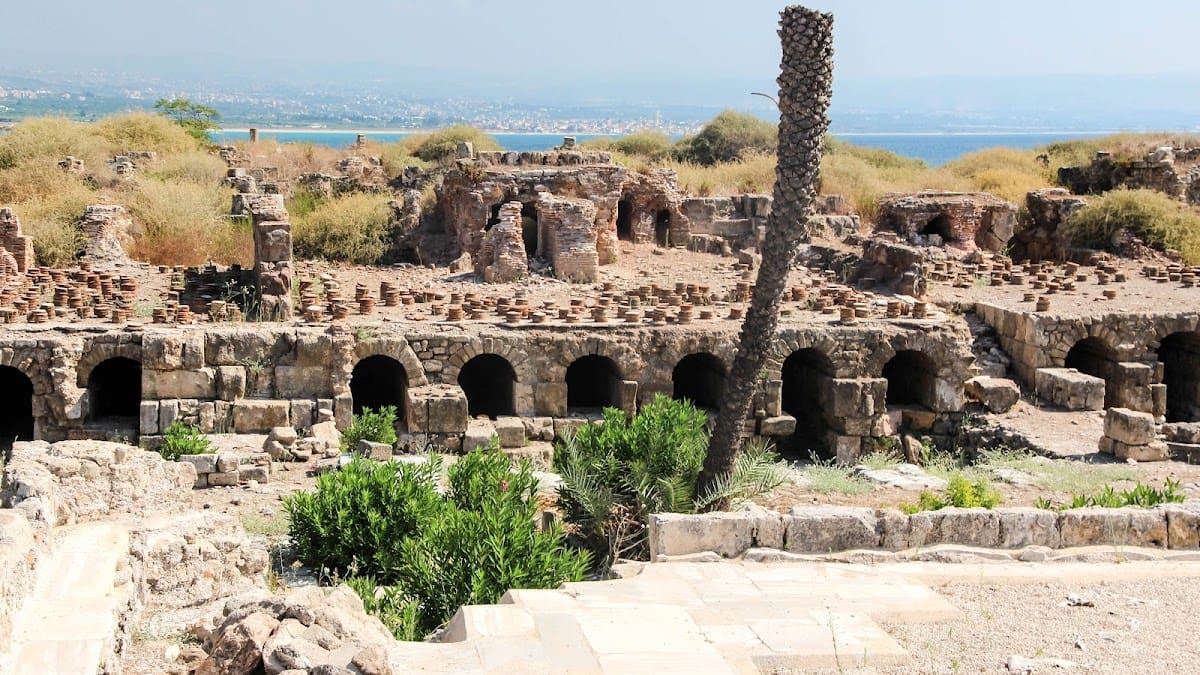
Near the Mosaic Road, the City Baths, or thermae, were built in the second century CE and rebuilt in the third. The complex contained cold, tepid, warm, and hot bathing rooms, together with a palaestra, an exercise and training area associated with baths. Because the island soil was humid, the baths were raised on arcades. A hypocaust, a Roman under-floor heating system in which hot air circulated beneath raised floors, was constructed above them. The baths were built over the ancient Phoenician wall, the clearest visible remains linked with the city captured by Alexander.
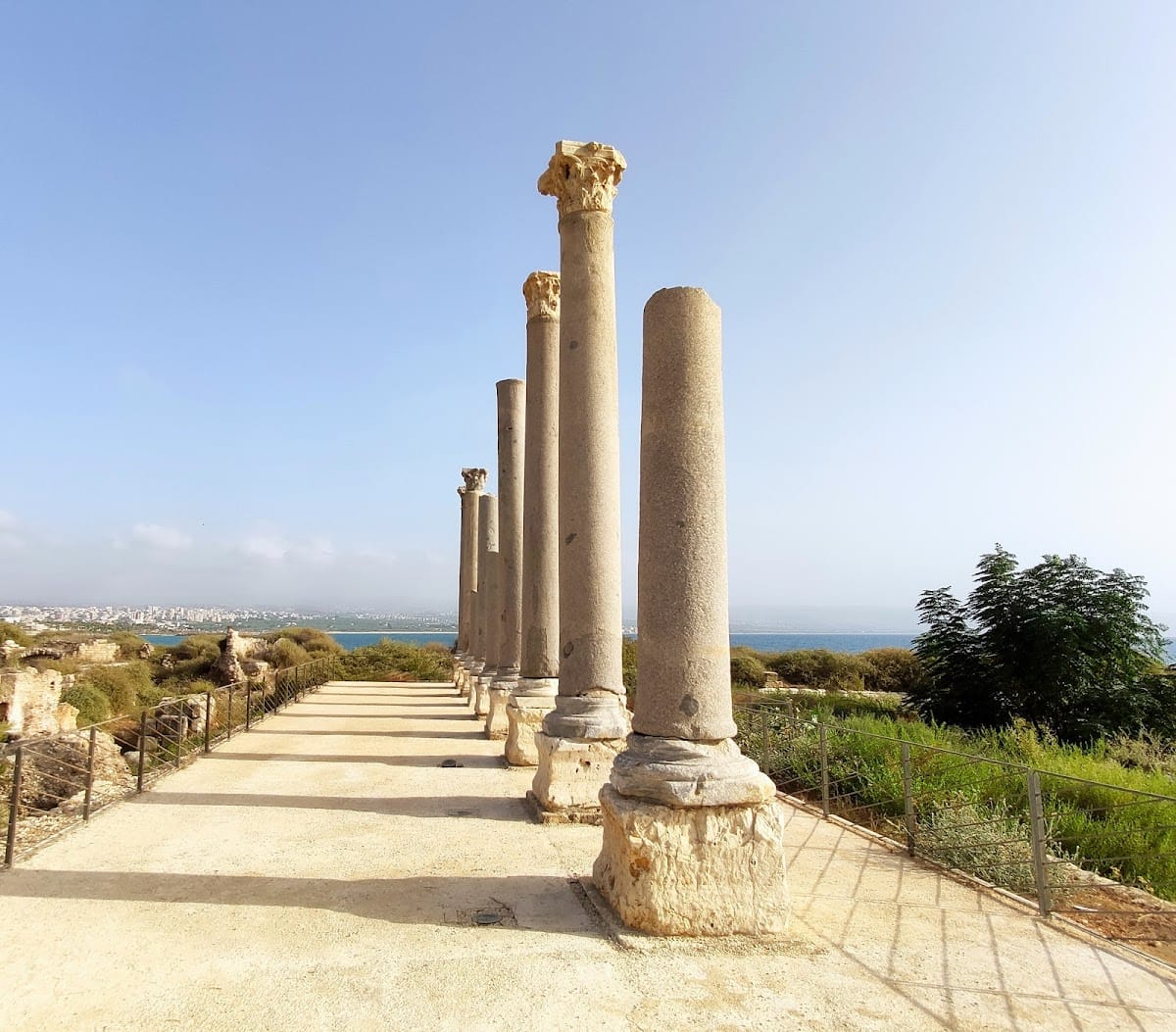
Immediately south of the baths, the palaestra measured about 30 by 30 metres. Nine Egyptian-granite columns remain standing. Beneath the structure are two parallel sandstone walls bearing traces of fire. They may be the walls destroyed during Alexander’s capture of Tyre in 332 BCE.
The Mosaic Road and Square Building
The Mosaic Road was a Roman colonnaded main street used for processions and monumental display. Its central passage, like its sidewalks, was paved with mosaics, an unusual treatment among comparable streets. The pavement was probably laid in the late second century, possibly after Tyre supported Septimius Severus during the civil war of 193 to 194, and it was renewed during the Byzantine period.
The Square Building, also called the Rectangular Arena, stands along the Mosaic Road. Originally constructed in the Hellenistic period, it reached its present form in the fourth century CE. The local-limestone building measures about 45 by 35 metres and has seating on all sides for approximately 2,000 people. Its function remains uncertain. It may have housed Tyre’s city council, the council of the Roman province of Phoenicia, or an arena for martial arts.
Other civic and religious structures
An octagonal building contains a small inner structure surrounded by a portico with Corinthian capitals. The portico includes Egyptian-style decoration, including uraei. The temple of Melqart was one of the ancient Mediterranean’s principal sanctuaries, but almost none of its original structure survives. Herodotus described rich furnishings, numerous votive offerings, and two notable columns, one of gold and another of emerald-colored stone. Their exact function is unknown. Two Egyptian-style columns were later reused in a Crusader church built near the presumed temple site, although the temple’s precise location has not been identified.
The Tower of Hiram
The so-called Tower of Hiram is a strong military tower on the former island. It may date from the early seventh century CE, although its relationship to Khusrau II’s Sasanian invasion is uncertain. A staircase inside the tower reached a freshwater spring, which the building protected. The tower stood near the point where the mainland road reached the former island, and a possible earlier fountain structure has been suggested at the same location. The well remained in use into the early twentieth century.
Al-Bass necropolis and ceremonial approach
The Phoenician cremation cemetery
Al-Bass formed the principal ancient entrance to Tyre and occupies the mainland opposite the island city. Its Phoenician necropolis was established by the end of the tenth century BCE on a coastal beach. The Iron Age cremation cemetery was excavated across about 500 square metres and contained roughly 320 urns. Graves were cut 30 centimetres to one metre into the sand. They commonly held paired urns containing ashes and bones, accompanied by jugs, bowls, perfume or incense vessels, scarabs, jewellery, and occasionally inscribed funerary stelae.
Imported Cypriot vessels and Greek cups sometimes served as urns. The cemetery continued in use into the fifth or fourth century BCE. Some graves were arranged in pairs, and vessels were broken over the burial. Differences in the accompanying objects point to economic and social distinctions within otherwise restrained funerary customs.
The Roman and Byzantine cemetery
The Roman and Byzantine burial grounds extend for more than a kilometre along both sides of the main avenue. A substantial cemetery was discovered in 1962, after a sarcophagus had been unearthed by French soldiers in 1940. Hundreds of stone and marble sarcophagi were found, including about 300 recorded examples dating mainly from the second to the fifth or sixth centuries CE.
The tombs range from marble sarcophagi decorated with reliefs to chapel-shaped tombs with niches, monumental structures as large as small villas, and more modest burials. Many were looted or reused. Greek inscriptions on several tombs identify their owners or occupations, including a wealthy manufacturer of purple dye. Other sarcophagi carry reliefs and frescoes with Homeric scenes, especially Achilles receiving Priam’s ransom for Hector. Frescoes also decorated several funerary caves, including examples damaged during the 2006 war.
Funerary chapel and tower tomb
A sixth-century funerary chapel consists of a small courtyard with a fountain, a semicircular marble-paved chamber, a mosaic-paved forecourt, niches, and pools. The deceased was buried behind the fountain, while mosaic-paved baths lay to the south. On the opposite side of the Byzantine road stands a tower-shaped tomb dating from the second century.
Roads, waterworks, and the hippodrome
The Al-Bass avenue and arches
The Al-Bass avenue was a wide monumental road used during the Roman and Byzantine periods. A later Byzantine section measured about 400 metres long and 4.5 metres wide and was paved with limestone. The avenue contains the Arch of Hadrian, a smaller arch about 315 metres to its east, and a Byzantine arch at the eastern entrance.
The Arch of Hadrian is a second-century honorific monument probably erected after Hadrian’s visit to Tyre in 130 or 131 CE. It stands about 21 metres high and has a sandstone core that was formerly covered with plaster. Traces show that the surface was painted in several colors. Smaller pedestrian gates flanked the central opening, while walls above them probably held statue niches. Large rooms on either side probably served as guardrooms, one retaining a stone pavement and the other mosaic remains. Their presence suggests that the arch marked the official outer boundary of the city.
The small Byzantine Arch at the eastern entrance is heavily restored and probably dates from the Byzantine period. It marked the easternmost monument of the ancient city and gave access to the main road through the necropolis.
The aqueduct
The Al-Bass aqueduct ran beside the main road and passed the hippodrome. Its arches may have formed an arcade opening onto shops. The conduit drew water from Al-Ma’shook and from Ras el-Ain and Al-Rashidiyeh, where the original source basin survives. It extended for just over seven kilometres. Sections of the aqueduct remained uncleared and buried outside the formally protected area.
The hippodrome
The Al-Bass hippodrome dates from the second century CE. It measures about 480 metres long and 90 metres wide and could hold roughly 40,000 spectators. Built for chariot racing, it had a central granite obelisk, turning points, starting facilities, and team clubhouses on both sides. The clubhouses associated with the Blues and Greens, organized supporter groups linked to rival racing teams, contained mosaics and baths.
The hippodrome also hosted other sports and probably some events of the Tyrian Games. It may have been the place where five Egyptian Christians were tortured during the persecution under Diocletian. The fourth-century Expositio Totius Mundi praised Tyre’s hippodrome and theater.
Objects from the necropolis
Important finds from Al-Bass include sarcophagi now held at the National Museum in Beirut. The Sarcophagus of the Drunken Cupids retains statues of the deceased and is decorated with cupids and griffins. The Achilles Sarcophagus depicts scenes from the Iliad, including Hector’s body and Priam’s ransom. Another sarcophagus shows a fighting scene with Hermes and the washing of Patroclus’ body. Funerary vessels, inscribed stelae, jewellery, and other burial objects were also recovered from Tyre. Some excavated obelisks are displayed at the Nabu Museum in El-Heri, Lebanon.