Owari Ōkunitama Shrine: The Sōja of Owari Province in Japan


Site at a Glance
- Rating
- 4.3
- Popularity
- Medium
- Country
- Japan
- Primary era
- Early Modern
- External website
- Open
- Eras represented
- Medieval, Early Modern
- Civilizations
- Ashikaga shogunate, Tokugawa
- Site type
- Religious
- Remains
- Sanctuary
On this page18 sections
History
Owari Ōkunitama Shrine is a Shinto shrine in Inazawa, Japan, traditionally associated with the spiritual powers of Owari Province and said to have been founded in the seventh year of Emperor Sujin. Shinto is Japan’s indigenous religious tradition, centered on reverence for kami, sacred powers associated with deities, ancestors, natural features, and places. The shrine’s original construction date is otherwise unknown, but its later history is closely connected with the former provincial capital of Owari.
Origins and the provincial shrine system
The shrine is thought to have formed part of the Owari provincial government complex, known as the kokuga, and became the sōja when the provincial capital was established. A sōja was the principal shrine of a Japanese province, where the province’s kami were collectively venerated. Owari Ōkunitama Shrine appears in the Engishiki Jinmyōchō, the shrine register of the tenth-century Engishiki administrative and ritual compilation, completed in 927. It is listed there as a minor-ranking Shikinaisha, a shrine recognized in that register.
The principal deity is Owari Ōkunitama-no-kami. The deity is understood as the spiritual power of the land cultivated by the ancestors of the people of Owari. Another interpretation identifies the deity with Ōkuninushi, a major kami associated in later tradition with the land and its ordering, but that identification remains uncertain. The shrine was also known by several names, including Fuchū-no-miya, Taka-no-miya, Hikari-no-miya, and, in later records, Kōnomiya.
In 853, the shrine entered the system of officially recognized state shrines. Historical records call it Fuchū-no-miya and identify it as the provincial sōja in documents dated 1225, 1238, and 1239. In 1261, Emperor Kameyama granted it the title Sōja Daijingū, which continued to appear in early-modern shrine records. The shrine’s two associated branch shrines, Ōgoryō Shrine and Munakata Shrine, were also listed as minor-ranking Shikinaisha and entered the recognized state-shrine system in 853. Together with the main shrine, they are known as the Kōnomiya Three Shrines.
Ranks, land, and medieval administration
The shrine’s recorded divine rank rose through a long sequence of promotions. It held Junior Fourth Rank, Lower Grade, in 771, followed by Junior Fourth Rank, Upper Grade, in 853 and Senior Fourth Rank, Lower Grade, in 859. The rank advanced to Senior Fourth Rank, Upper Grade, in 940, Senior Third Rank in 1141, Junior Second Rank in 1180, Senior Second Rank in 1185, Junior First Rank in 1186, and Senior First Rank in 1201. A 1364 colophon to the Owari Province Register of Deities calls the shrine’s deity Senior First Rank Kunitama-no-kami, while another version gives Junior First Rank.
Land grants and allocations supported repairs and construction. In 1225, Owari provincial governor Ono Narimasa assigned twelve chō of rice land for repairs. In 1238, land held by the manor administrator Shami Jōren included 41 chō and three tan designated for shrine construction. In 1337, shrine priest Hisada Motomasa held land allocated for repairs. These records connect the shrine’s maintenance with the administrative and landholding structures of medieval Owari.
The shrine’s rice fields later became involved in competing systems of military and territorial control. In 1402, its Isshiki rice fields were included among lands controlled by the Shiba Yoshishige faction in the former provincial-government domain. In the following year, they were recorded as seized by a retainer of the provincial military governor. The shrine received five tan of donated rice land in 1560.
Warring States and early-modern patronage
During the sixteenth century, Oda Nobunaga sponsored kagura and sarugaku performances, as well as repairs, in 1561. Kagura refers to ritual performances offered to the kami, while sarugaku was a form of performance that contributed to the development of later Japanese theatre. Nobunaga issued the shrine a vermilion-seal document in 1571. Toyotomi Hidetsugu donated 70 kanmon from nearby revenues in 1590 through his elder retainer Tanaka Yoshimasa. Toyotomi Hideyoshi donated 105 koku of rice land in Kōnomiya village in 1595, and Murakami Kyūbei donated land in front of the torii, the gateway marking the approach to a Shinto sacred precinct, in the same year.
Patronage continued under the Owari branch of the Tokugawa family. In 1608, Matsudaira Tadayoshi increased the shrine’s holdings by approximately 39 koku in Masuda village, three koku in Kōnomiya village, and two koku in Yoshifuji village. After land surveying by Ina Tadatsugu, the total was 45 koku. In 1621, Tokugawa Yoshinao, lord of Owari, donated 150 koku in Kōnomiya village and issued a black-seal document. Successive Owari lords confirmed this grant. Further grants in 1670 amounted to about 17 koku}, while the black-seal grant remained fixed at 150 koku.
A 1694 record gives the shrine’s associated land as 10 chō, eight tan, four se, and 25 bu, together with one tan, three se, and 15 bu of ritual rice land in Takamikado village. The record reflects the continuing material basis of the shrine’s ceremonies and upkeep during the early-modern period.
Modern status and continuing rites
The shrine was classified as a village shrine in 1873 and elevated to prefectural-shrine status in 1876. In 1907, it was designated a shrine receiving state offerings of food, silk, and cloth. In 1940, it became a National Shrine of the Third Rank, or kokuhei-shōsha, a pre-1945 category of nationally ranked shrines supported through the imperial state’s system of shrine offerings. In 1948, it was included among the Beppyo shrines of the Association of Shinto Shrines, a postwar institutional category for prominent shrines.
The annual Naked Festival, or Hadaka Matsuri, is traditionally held on the thirteenth day of the first lunar month. A man selected by lot as the shin-otoko is believed to absorb the misfortune of participants when they touch him. During the night ceremony, misfortune is transferred to a large black rice cake made from rice and ashes left by the burning of protective amulets from the previous year. The cake is then buried at an undisclosed place in a nearby forest. Women took part for the first time in 2024, when 41 women performed a minor role.
The annual festival on May 6 includes the Plum-Wine Ceremony, which reenacts a rite associated with the shrine’s settlement at its present location. A boy of about ten acts as the divine representative, and plums are offered as food for the deity. Known in the Edo period as the Shindai or Katashiro ritual, the ceremony preserves a tradition tied to the shrine’s historical setting.
The May festival also includes the dedication of horses. The practice is said to have begun in 1626, when farmers from Takamikado village presented horses during a drought while praying for abundant crops. Horses are ridden in procession to Munakata Shrine and Ōgoryō Shrine. The ritual also includes offerings at the former administrative site southeast of the shrine, archery with a peach bow and thorn arrows, and the presentation of sacred sake. Tea gatherings are held as the Sanshō Tea Gathering, with the Matsuo, Omotesenke, and Urasenke schools taking turns. The three schools also conduct a seasonal tea-offering ceremony, while the Matsuo school holds the separate Naoiden Tea Gathering.
Remains
Precinct setting and arrangement
The precinct lies in Kōnomiya, in the former Nakashima District of Owari Province, approximately one kilometre west of Inazawa’s city centre. It is near the former Inaba post station on the Mino Road, about four kilometres southwest of the Owari Kokubunji ruins, and close to the Ōe irrigation channel and the Miyake River. The shrine is concentrated within the former provincial-capital area.
Recorded measurements vary according to period and according to whether the approach roads were included. In 1798, the area inside the gate measured approximately 127.27 metres from east to west and 90.91 metres from north to south, or about 11,570 square metres. A late Edo-period measurement gave about 11,193 square metres. Later records list areas of approximately 18,526, 23,861, 24,516, 27,709, and 27,778 square metres.
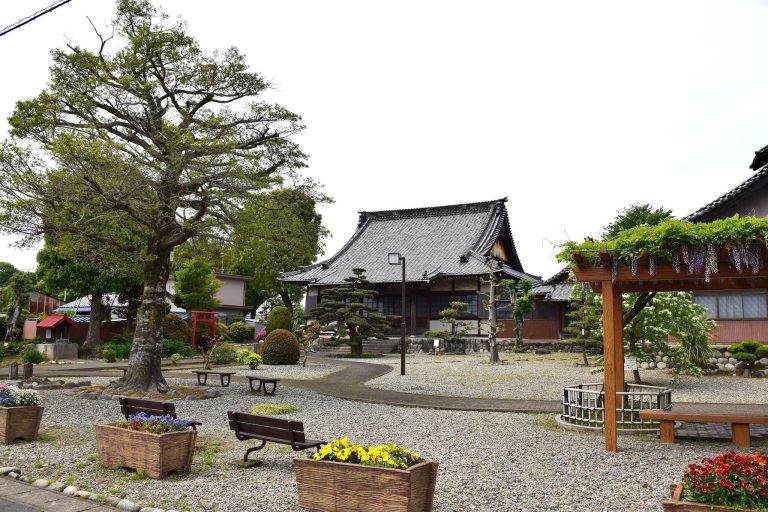
The shrine’s defining architectural arrangement is Owari-zukuri, a regional form in which the sanctuary and worship spaces are linked by intervening halls, passages, and corridors. Five natural stones set in a circle beside the main sanctuary form an iwakura, a sacred stone arrangement regarded as a primitive place of ritual and divine presence that predates shrine buildings. The precinct also contains a garden, an approach road, and an assembly hall used for shrine rites and wedding receptions. The approach road has hosted the Inazawa Plant Festival and is bordered by the Nakō Memorial Hall.
Main shrine buildings
Main sanctuary and connected buildings
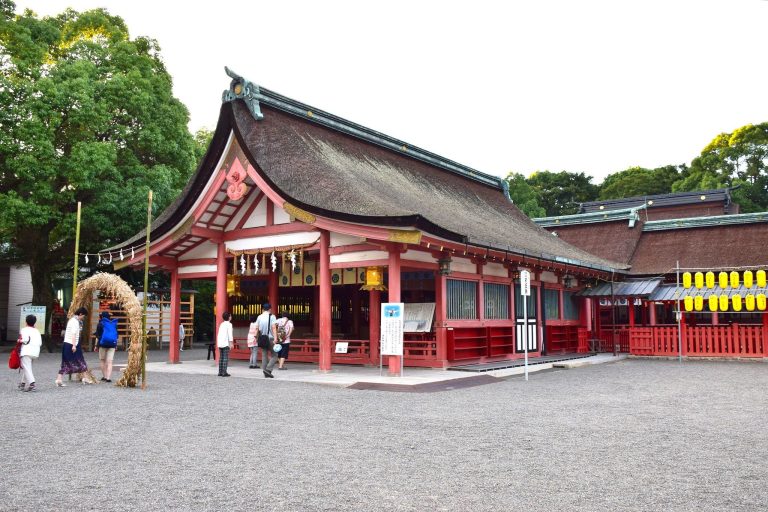
The main sanctuary was rebuilt on October 21, 1939. It is built in the nagare-zukuri style, whose main roof extends forward over the entrance, and covers approximately 39.67 square metres. The sanctuary forms an integrated Owari-zukuri composition with a connecting passage, ritual-text hall, eastern and western corridors, and worship hall. This linked sequence gives the central complex its characteristic regional arrangement.
Worship hall
The worship hall dates from the early Edo period. It has a gabled kirizuma-zukuri form and a roof covered with hinoki bark. The building measures five ken, approximately 9.09 metres, in length and three ken, approximately 5.45 metres, in width. Its principal gate and worship hall are Important Cultural Properties of Japan.
Two-storeyed gate
The two-storeyed gate is thought to date from 1423, while its upper storey was rebuilt in 1646. It uses the irimoya-zukuri form, which combines a gabled roof with hipped sections, and has a hinoki-bark roof. The upper storey covers approximately 35.57 square metres and the lower storey approximately 27.47 square metres. Its stated dimensions are approximately 4.45 metres in length, 7.79 metres in width, and 9.77 metres in height.
Torii and later buildings
The first torii was built in 1921, the third in 1938, and the second in 1949. A large torii on the western approach was added in 1976. The assembly hall was completed in 1989 and renovated in 2009. The Naoiden, built in 1962, is used for ritual purification before the Naked Festival. The shin-otoko spends three days and three nights there before the ceremony.
Branch and subsidiary shrines
Munakata Shrine
Munakata Shrine stands in the northeastern part of the precinct and covers approximately 1,329 square metres. It enshrines Tagorihime-no-mikoto. Historical deity registers identify it as Junior Second Rank Munakata Tenjin. Its association with the main shrine forms part of the Kōnomiya Three Shrines.
Ōgoryō Shrine
Ōgoryō Shrine stands in the southwestern part of the precinct and covers approximately 919 square metres. It enshrines the Ōgoryō deity, described as a child of Ōtoshi-no-kami. Historical deity registers identify the shrine’s deity as Senior First Rank Mitama-no-kami.
Six subsidiary shrines occupy the southeastern area of the precinct. Shigū Shrine is dedicated to Sarutahiko-no-kami, Inari Shrine to Ukanomitama-no-mikoto, and Sanjo Shrine to Tagorihime-no-mikoto, Tagitsuhime-no-mikoto, and Ichikishimahime-no-mikoto. Hakusan Shrine honors Kukurihime-no-mikoto, Imori Shrine honors Susanoo-no-mikoto, and Shinmei Shrine honors Amaterasu Ōmikami.
Tea houses and associated objects
Hanjōan
Hanjōan was formerly the residence of Ozaki Tōbei, a retainer of the Owari domain. It was moved into the shrine precinct when a road was widened and is thought to date from the Genroku era. The kirizuma-zukuri building has a tiled roof and measures approximately 1.83 by 1.82 metres. Its shingle-roofed eave is 0.23 metres wide, and its water room measures approximately 1.82 by 2.73 metres. Hanjōan is also a sukiya-style tea house and has municipal cultural-property status.
Kanshōtei and Sanshōtei
Kanshōtei was built in 1950, while Sanshōtei was built in 1954. Sanshōtei is a sukiya-style tea house designed by Fusen-sai Sōshō, head of the Matsuo school. Its name derives from a three-sided image of Daikoku among the shrine treasures. The Naoiden Tea Gathering held by the Matsuo school includes the distribution of an ema-shaped confectionery container, a Naoiden cloth, and a large mirror-shaped rice cake.
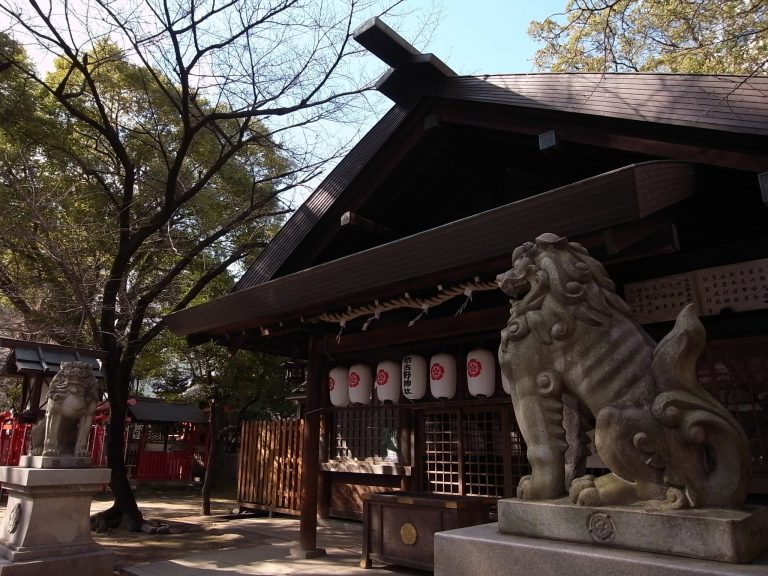
Wooden and ceramic guardian-lion figures, a wooden lion head, and a large iron ritual bell are among the shrine-associated cultural-property objects. The Naoiden ritual is designated an intangible folk cultural property of Aichi Prefecture, while Hanjōan and several objects have municipal cultural-property status.