Kōryū-ji Temple: An Early Shingon Buddhist Temple in Kyoto


Site at a Glance
- Rating
- 4.3
- Popularity
- Medium
- Country
- Japan
- Primary era
- Medieval
- Eras represented
- Medieval, Early Modern
- Civilizations
- Unclassified
- Site type
- Religious
On this page16 sections
History
Kōryū-ji Temple is a Shingon Buddhist temple in Kyoto, Japan, traditionally regarded as Kyoto Prefecture’s oldest temple and associated with the period before the establishment of Heian-kyō. Its principal image is a statue of Prince Shōtoku, the imperial prince traditionally linked with the promotion of Buddhism and the creation of early Buddhist institutions.
The Hata Clan and the Temple’s Foundation
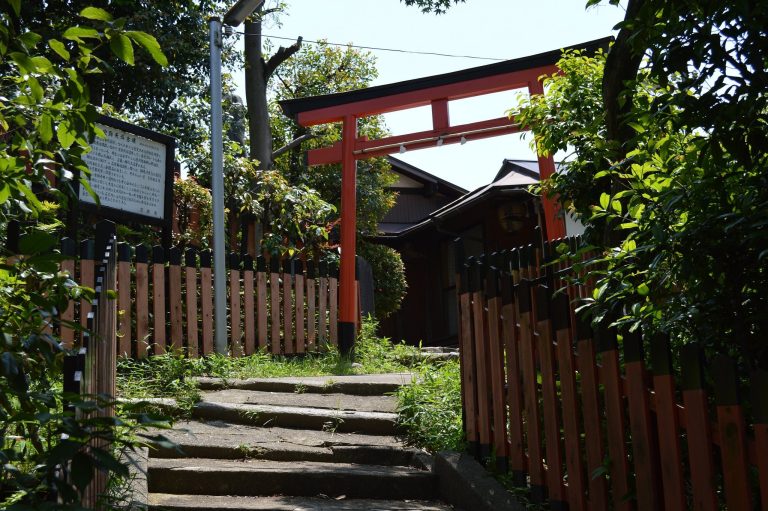
Kōryū-ji was the family temple of the Hata clan, an immigrant group associated in tradition with Han China, Silla, or Baekje. Based in the Kadono area, the Hata were known for sericulture, weaving, sake brewing, and water management. Hata-related religious sites included Kijima-za Amaterasu Mitama Shrine, Umenomiya Taisha, and Matsuo Taisha. The nearby Ōsake Shrine was once within the temple grounds but was moved to its present location during the Meiji-period policy that separated Buddhist and Shinto institutions.
The Nihon Shoki states that Prince Shōtoku gave a revered Buddhist image to Hata no Kawakatsu in 603, after which Kawakatsu founded Hachioka-dera. Hata no Kawakatsu was an early court figure traditionally identified as the temple’s founder and as a leader of the Hata clan. Two later records give a different date. The Kōryū-ji Engi, compiled in 838, and the Kōryū-ji Inventory Change Record, compiled around 890, place the foundation in 622, as a memorial to Prince Shōtoku after his death in that year.
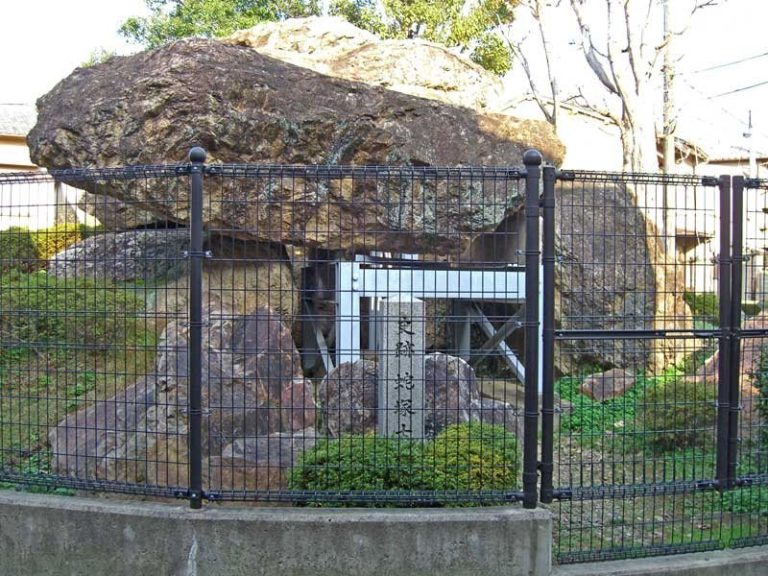
These dates may represent a temple begun in 603 and completed in 622, or the later joining of Hachioka-dera with another institution founded in 622. The original site is also uncertain. The prevailing theory places it near present-day Hirano Shrine, at the Kitano Temple ruins, where objects from the first half of the seventh century have been found. The temple is thought to have moved to Uzumasa around the foundation of Heian-kyō, although the joining of two temples has also been proposed. The Kōryū-ji Engi names earlier locations at Kujo Kawahara and Arami, followed by a move to Gojo Aramaki.
Another tradition, preserved in a biography of Prince Shōtoku, places the temple at his Kaede-no-betsugū detached palace. It tells of a dream involving a sacred maple grove, five hundred arhats, and a dead katsura tree. This story became associated with the origin of the Katsura-no-miya-in.
Religious and State Functions
Kōryū-ji appears among the seven great temples attributed to Prince Shōtoku in the Jōgū Shōtoku Hōō Teisetsu. Its early worship centered on Maitreya Bodhisattva, the future Buddha. Around the time of the temple’s relocation, Yakushi Nyorai, the Buddha associated with healing, became its principal image, and the institution later emphasized both Yakushi and Prince Shōtoku.
Tradition also holds that the court reorganized the temple as a state institution called Jōjū-ji, or Noderā, after the capital was transferred. The delayed construction of Tō-ji and Sai-ji had left the court without enough facilities for required Buddhist rites. This role is thought to have declined after those temples were developed between 810 and 824.
A fire completely destroyed Kōryū-ji in 818, taking its ancient records with it. Dōshō, a disciple of Kūkai who became head priest in 836, directed the rebuilding of the halls, pagodas, and Buddhist images and is remembered as the temple’s restorer. A second fire destroyed the complex in 1150. Reconstruction followed relatively quickly, and a dedication ceremony for its various halls took place in 1165. The present Lecture Hall is regarded as the successor of a building completed during that reconstruction, although it has since been extensively altered.
Records, Patronage, and Later History
The Kōryū-ji Inventory, compiled in 873, lists the temple’s buildings, Buddhist images, land, and assets. The later inventory change record reviewed that register and added subsequent changes. Together, the two documents provide an important picture of the temple during the ninth century, and the later record helps reconstruct several dozen opening lines lost from the earlier inventory.
Toyotomi Hideyoshi confirmed Kōryū-ji’s income from an estate assessed at 600 koku, a historical measure of agricultural yield. In 1663, during the enthronement of Emperor Reigen, the temple was added to the system of seven great temples institutionalized by Emperor Go-Mizunoo and participated in state-sponsored prayers. During the Meiji period, its temple lands were reduced and several subtemples were abolished.
Kōryū-ji suffered damage during the 1995 Great Hanshin-Awaji Earthquake, whose strong shaking was also recorded in Kyoto, including broken sections of Buddhist statues. In 2009 and 2010, proposed demolition of the adjacent former Ukyo Ward Office for an international-student dormitory became the subject of a dispute. Vibrations were said to have caused more than ten cracks in the walls of the Jizō Hall and Yakushi Hall. Demolition above ground resumed in February 2010 after changes intended to reduce vibration, despite the temple’s opposition.
The temple remains associated with Prince Shōtoku pilgrimage traditions as the twenty-fourth site among the Prince Shōtoku sacred places. Its buildings, documents, and Buddhist images include National Treasures and Important Cultural Properties, Japanese legal categories that protect cultural heritage, with National Treasure being the higher designation.
The Uzumasa Bull Festival
The Uzumasa Bull Festival, one of Kyoto’s three unusual festivals, was held before the Meiji period at Ōsake Shrine when the shrine stood inside the temple grounds. It took place on the night of the twelfth day of the ninth lunar month. The festival was suspended in 1877, revived in 1887, and later held on October 12 according to the Gregorian calendar, though interruptions continued. It has generally been suspended since 2003 and is now held irregularly.
Tradition attributes the rite to Eshin Sōzu, also known as Genshin, who supposedly received a dream command from Matarajin, a Buddhist guardian deity, during the reign of Emperor Sanjō. The ritual was intended to avert yearly calamities, secure peace, prolong the sovereign’s life, and promote the people’s welfare. A traditional description recounts a procession led by a masked priest riding a bull and carrying a ritual staff, followed by four other masked priests and torch-bearing attendants. Near the Founder’s Hall, a ritual text was read.
Remains
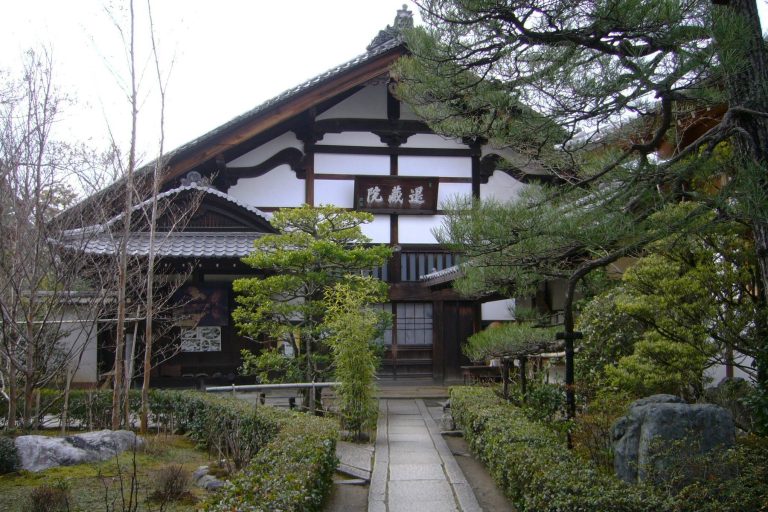
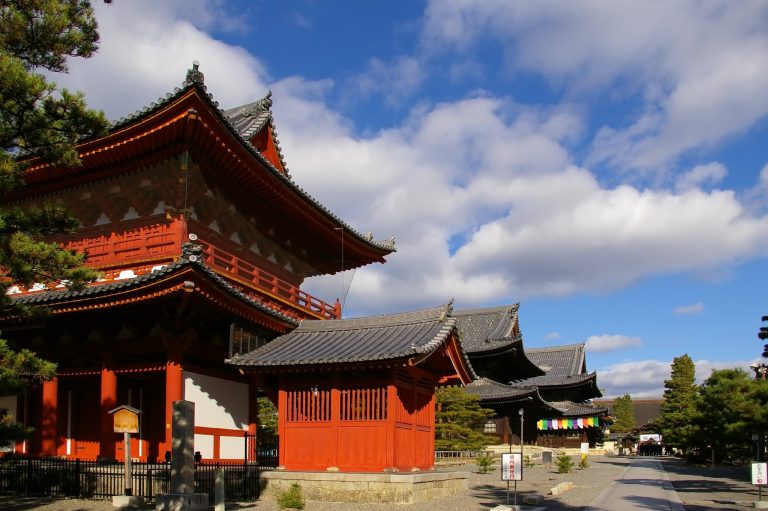
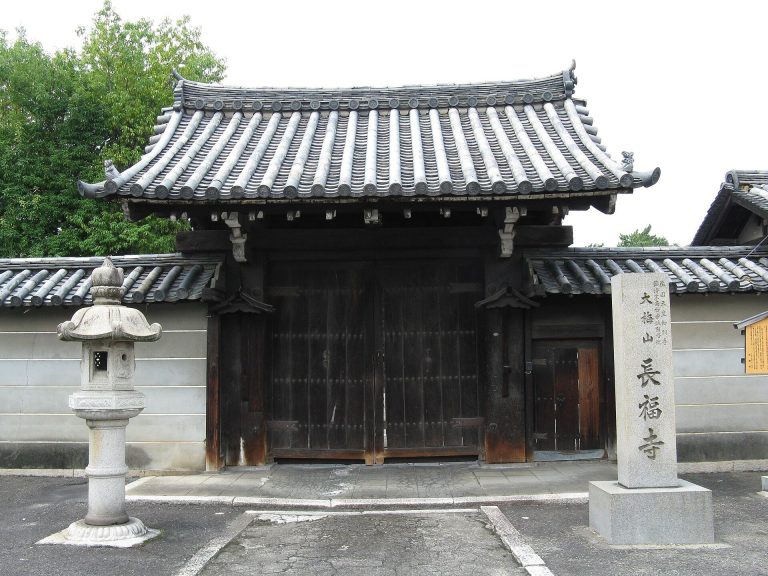
The precinct is entered through a two-story gate. A processional avenue runs toward the Jōgūō-in Taishiden, the present main hall, with the Lecture Hall on the right and the Yakushi Hall on the left. The Uzumasa Hall, which enshrines Hata no Kawakatsu, stands to the right before the main hall. The Study lies to the west, the Reihōden Treasure Hall to the north, and the Katsura-no-miya-in Main Hall west of the Study.
Principal Buildings
Lecture Hall
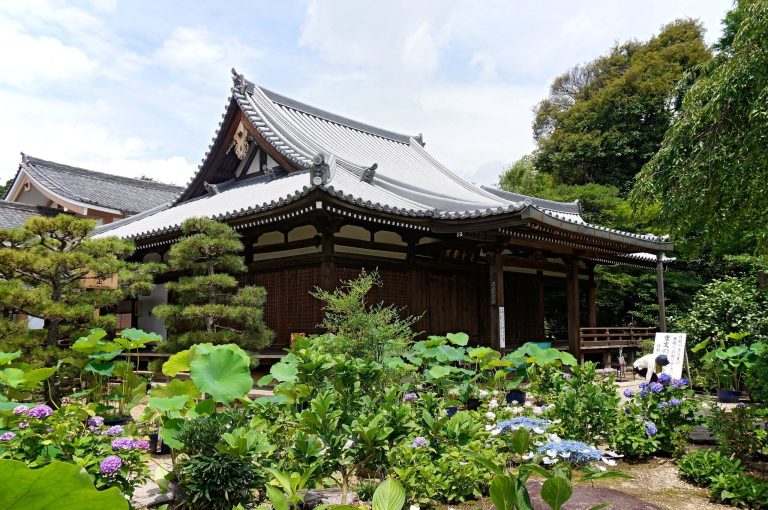
The Lecture Hall is an Important Cultural Property, a five-by-five-bay building with a hipped tiled roof. A bay is the structural interval between two columns. Tile inscriptions and early-modern drawings identify it as the former Kondō, or Main Hall, while its present name reflects its later function. It is often regarded as one of Kyoto’s surviving Heian-period buildings, but major remodeling between 1558 and 1570 and later repairs have left little early material visible on the exterior and eaves.
Inside, the building retains a Heian-period character. It has a tiled earthen floor, three open central bays at the front, and earthen end walls fitted with arched windows. Two tiers of rainbow beams, board frog-leg brackets, and an exposed attic without ceiling boards survive within the structure. The inner sanctuary contains a seated Amida Nyorai in the center, with seated Jizō Bosatsu on the right and seated Kokuzō Bosatsu on the left.
Katsura-no-miya-in Main Hall
The Katsura-no-miya-in Main Hall is a Kamakura-period National Treasure in a walled area on the western side of the precinct. Its octagonal form is comparable to the Dream Hall at Hōryū-ji, and tradition connects it with Prince Shōtoku’s Kaede-no-betsugū detached palace. The precise construction date is unknown, but a surviving fundraising document dates to 1251.
An octagonal shrine inside the hall belongs to the same period and is included as an accessory to the National Treasure. The hall’s former principal image, a Kamakura-period half-seated statue of Prince Shōtoku, was moved to the Reihōden. The hall is generally closed to the public.
Other Precinct Buildings
The Jōgūō-in Taishiden serves as the present main hall and contains the principal image of Prince Shōtoku. The precinct also includes the Yakushi Hall, Jizō Hall, Study, Uzumasa Hall, Reihōden, Founder’s Hall, and the wider Katsura-no-miya-in complex. These buildings form the architectural setting for the temple’s continuing Buddhist and commemorative functions.
National Treasure Sculptures
Crowned Maitreya
The central display in the new Reihōden is the Crowned Maitreya, a National Treasure wooden half-seated image. It measures 123.3 centimeters including the lowered left foot and 84.2 centimeters in its seated height. The figure was carved from one piece of Japanese red pine. Maitreya sits with one leg lowered and lightly touches the cheek with the right hand, a contemplative pose associated with half-seated images.
Traces of original gold leaf remain on the lower abdomen and elsewhere. The right index and little fingers, both foot tips, and parts of the face have been repaired or replaced. The sculpture is generally dated to the seventh century. Its style has encouraged the prevailing view that it came from the Korean Peninsula, although Japanese manufacture, including carving in Japan from imported sacred wood, has also been proposed.
Hōkei Maitreya
The Hōkei Maitreya, conventionally called the Weeping Maitreya, is another National Treasure in the Reihōden. It is 90 centimeters high including the lowered foot and 66.4 centimeters high when seated. The camphor-wood sculpture uses a pose similar to that of the Crowned Maitreya. It is generally regarded as a Japanese work of the late seventh or early eighth century, though other interpretations have been advanced. Its subdued expression and hand-to-cheek gesture account for its conventional name.
The connection between either Maitreya and the revered image Prince Shōtoku gave to Hata no Kawakatsu in 603 remains unproven because the Nihon Shoki does not identify that image as Maitreya. A later record describes a gilded-bronze half-seated image brought from Silla in 616. The Nihon Shoki also records images brought by envoys from Silla and Mimana in 623 and installed at Kadono Hata-dera. These images have been proposed as possible antecedents of the two wooden Maitreyas, but the identification has not been established.
Amida and Kannon Images
The Lecture Hall’s principal image is a 261.5-centimeter seated Amida Nyorai, a National Treasure. Both hands are raised before the chest in the preaching mudra, a symbolic hand gesture representing the act of teaching. The sculpture is identified with an image commissioned by Lady Nagahara, a consort of Emperor Junna, and listed in the ninth-century inventories. It dates to around 840. The head and main body were carved from one large hinoki cypress and covered with a thick layer of wood-pulp lacquer. Its double circular halo and draped pedestal retain original elements alongside later additions.
The Reihōden also houses a 313.6-centimeter standing Fukūkensaku Kannon, a National Treasure dated from the late eighth to early ninth century. It is identified with the Fukūkensaku Bodhisattva image said to have been installed before the fire of 818. A second National Treasure, a 266-centimeter standing Senjū Kannon, dates to the ninth century. The two images formerly stood in the northeastern and northwestern corners of the Lecture Hall’s outer sanctuary.
Other Images and Sacred Objects
The Reihōden contains twelve National Treasure standing images of Heavenly Generals, each between 113 and 123 centimeters high. Tradition attributes the set to the sculptor Chōsei in 1064, but the figures fall into several stylistic groups, so it is uncertain whether all twelve were made by him. One figure, Antira, is especially notable for the carefully rendered gesture of closing one eye while adjusting an arrow.
An Important Cultural Property standing Yakushi Nyorai is a hidden Heian-period image opened only on November 22. Unlike conventional representations of Yakushi, it takes the form of Kichijōten. Tradition says that a miraculous Yakushi image associated with Mukōjinja was brought from Otokuni District in 797 to serve as the temple’s principal image. The present statue is regarded as a reconstruction made after the 818 fire.
Other Important Cultural Property sculptures include a Nara-period seated clay Maitreya Buddha; two Heian-period seated Dainichi Nyorai images; a Heian-period standing Amida Nyorai formerly in the Katsura-no-miya-in Main Hall; and seated images of Monju Bosatsu, Kokuzō Bosatsu, and Fudō Myōō. The collection also includes standing figures of Shō Kannon, Bishamonten, Zaō Gongen, Bodhisattva, Jizō Bosatsu, and Nikkō and Gekkō Bosatsu, as well as a seated Senjū Kannon dated to 1012 and a half-seated Nyoirin Kannon formerly in the Katsura-no-miya-in Main Hall.
The Reihōden further preserves Heian-period guardian figures of Jikokuten, Zōchōten, Komokuten, and Tamonten, together with five standing Kichijōten images ranging from 106.8 to 184.5 centimeters. A Kamakura-period half-standing Prince Shōtoku, two standing Zaō Gongen images, a Heian-period wooden deity attributed to Hata no Kawakatsu, and a Heian-period seated wooden goddess attributed to his wife also belong to the temple’s protected holdings.
Paintings, Documents, and Archaeological Evidence
The temple’s Important Cultural Property paintings include the Heian-period silk painting of the Three Thousand Buddhas and Kamakura-period silk paintings of the Twelve Devas and Cundī Buddha Mother. The Three Thousand Buddhas painting is more than three meters high and wide. It presents Buddhas of the past, present, and future within a moonlight halo, surrounded by three thousand smaller Buddhas. The work served as the principal image for the Butsumyō-e repentance ceremony, which involved reciting Buddha names with sacred imagery.
An iron bell dated to 1217 is also an Important Cultural Property. The National Treasure inventory and inventory change record preserve administrative information about the temple’s buildings, images, lands, and assets. With the exception of the seated Kokuzō Bosatsu and Jizō Bosatsu, the temple’s Important Cultural Property Buddhist statues are housed in the Reihōden.
The Crowned Maitreya received National Treasure designation on June 9, 1951, with the registry number “Sculpture No. 1.” This explains why it is often called the “first National Treasure,” although many other properties received the designation on the same date. Its image appeared on a proposed 100-yen note in 1945 and on postage stamps issued in 1967 and 1981.
Archaeological material connected with the temple and its proposed former site includes roof tiles, molded Buddhist heads, and clay-sculpture fragments excavated at the Kitano Temple ruins, along with a roof tile found at Kōryū-ji. These materials are displayed at the Tokyo National Museum and the Kyoto City Archaeological Museum, while the temple itself preserves the buildings, images, paintings, bells, and records that express its long history.