Trematon Castle: A Norman Motte-and-Bailey Stronghold in Cornwall


Site at a Glance
- Rating
- 4.2
- Popularity
- Very Low
- Country
- United Kingdom
- Primary era
- Medieval
- External website
- Open
- Eras represented
- Medieval, Modern
- Civilizations
- British, English, Norman
- Site type
- Military
- Remains
- Castle
On this page11 sections
History
Trematon Castle is a ruined Norman motte-and-bailey fortress in the United Kingdom, near Saltash in Cornwall, established soon after the Norman Conquest on the site of an earlier Roman fort. It became the caput, or principal seat, of the feudal barony of Trematon and occupied an elevated position overlooking the Lynher River.
Before and After the Norman Conquest
The site predates the Norman Conquest. Historical traditions have described it as an earthwork fortress of the earls of Cornwall, an ancient palace of the Cornish kings built before 959, and a residence of Condor of Cornwall and the earlier earls. Condor is remembered in Cornish tradition as an early ruler or earl, but these associations remain traditions rather than securely established phases of the castle’s history.
The castle was probably established by Robert, Count of Mortain, a Norman nobleman and half-brother of William the Conqueror, the king who established Norman rule in England after 1066. Another tradition says that William granted the site to Robert. By the time of the Domesday Book in 1086, the great survey of landholding and taxable resources commissioned by William, Trematon belonged to Robert, and Reginald de Vautort was its lord.
Cadoc of Cornwall may have regained the earldom after Robert’s son William rebelled in 1104. Cornish tradition also connects Cadoc with Trematon, where he may have lived and died, although this account is uncertain. The Vautorts remained lords of Trematon in 1166. They held 59 knight’s fees from the Earl of Cornwall, each assessed as land sufficient to support a knight’s military service, together with one fee held directly from the principal lord.
The Vautorts and the Earls of Cornwall
From the Norman Conquest until 1270, the Vautorts controlled the ferry rights between Saltash Passage on the Plymouth side of the River Tamar and Saltash. Roger de Vautort later sold Trematon Castle and its manor to Richard, Earl of Cornwall. The associated rent had reached nearly £7 sterling by the thirteenth century.
Richard purchased the castle for £300 in 1270. A member of the English royal family and a major territorial lord in Cornwall, he made Trematon part of the estates that remained with the Earls and Dukes of Cornwall. Before the Duchy of Cornwall was created in 1337 as a hereditary royal estate traditionally held by the heir to the English throne, Trematon was one of the four principal residences of the earls of Cornwall, alongside Launceston, Restormel, and Liskeard castles.
Later Uses and Ownership
In 1542, John Leland described Trematon as a great and ancient stronghold on a rocky hill. He noted that substantial parts of the castle, particularly the keep, were still standing. The ruins were then being used as a prison, and the castle retained extensive liberties.
In 1580, after Francis Drake returned from his circumnavigation, Queen Elizabeth’s court ordered that the treasure he had brought back should be stored at Trematon. The hoard included gold, silver, and precious stones, principally emeralds, taken through piracy from Spanish ships along the west coast of South America. It was temporarily kept aboard the Golden Hinde before being transferred to the Tower of London.
In 1961, the Duchy of Cornwall offered Trematon on a 21-year full-repairing lease. The castle later became the Cornish home of Hugh Foot, Lord Caradon, while his son Paul Foot spent part of his youth there. Julian and Isabel Bannerman leased the castle and grounds in 2012 and created a garden. In 2019, interior designers Frieda Gormley and Javvy M Royle acquired the lease, operated the castle as a pop-up hotel, and redesigned its interiors.
Trematon Castle has been a scheduled monument since 1960. This is a legal designation for a protected archaeological or historic site. Higher Lodge at Trematon Castle received Grade II* listed status in 1982, a national designation for a historic building of particular importance and more than special interest.
Remains
Trematon Castle occupies an elevated sentinel position about 1.5 miles south-east of Trematon village, overlooking the Lynher River. It is a motte-and-bailey castle, combining a raised earthwork mound with an enclosed defensive court. A stone shell keep, meaning a defensive enclosure built around the edge of an earlier mound, stands on the motte. Although the castle as a whole is ruined, substantial sections of its Norman walls survive, making the original form of the castle and keep clear.
Defensive Core
Oval Shell Keep
The keep has an oval plan, with walls about 10 feet thick and 30 feet high. Its internal diameter is approximately 21 metres. Built as a stone shell around the earlier motte, it preserves the defensive core of the Norman castle. The keep remains in good condition in comparison with the ruined state of the wider site, and its surviving masonry makes its original form readily understandable.
Thirteenth-Century Gatehouse
A rectangular gatehouse was built in 1270. It has two floors and a portcullis, a vertically sliding fortified gate lowered through grooves in the entrance. The gatehouse, like the keep, is described as being in good condition despite the overall ruinous character of Trematon Castle.
Courtyard and Associated Buildings
Georgian House
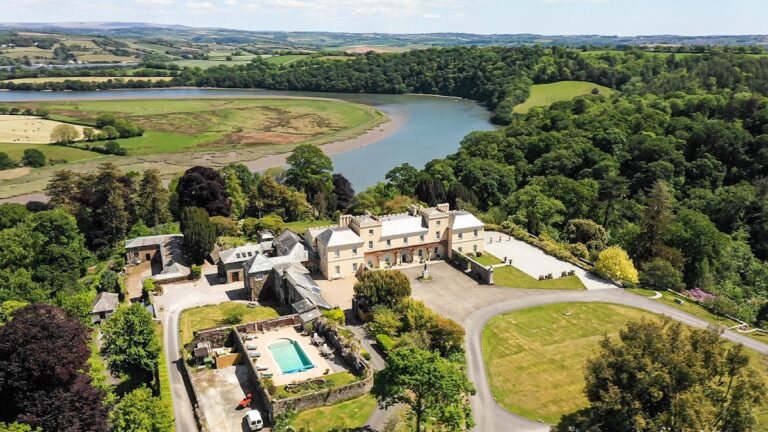
A Georgian house stands within the castle courtyard. Built about 1808, it contains four reception rooms, six main bedrooms, and servants’ quarters. Its construction altered the medieval enclosure: part of the original castle wall was demolished to give the house a view across the surrounding countryside.
Higher Lodge
Higher Lodge is a building associated with Trematon Castle and is a Grade II* listed building. Its protected status reflects the importance of the surviving historic structure within the castle’s later architectural setting.
Nearby sites