Crownhill Fort: A Victorian Royal Commission Defence Fort in Plymouth


Site at a Glance
- Rating
- 4.5
- Popularity
- Low
- Country
- United Kingdom
- Primary era
- Modern
- External website
- Open
- Eras represented
- Modern
- Civilizations
- British
- Site type
- Military
- Remains
- Fort
On this page9 sections
History
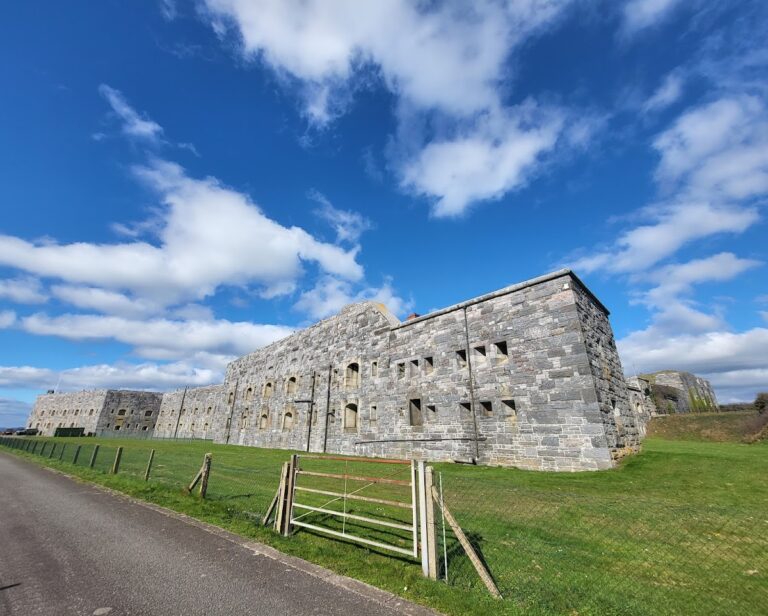
Crownhill Fort is a Victorian Royal Commission fort in Plymouth, United Kingdom, built during the 1860s as part of Lord Palmerston’s programme of land defences. It occupied a key position in the north-eastern approach to the city and helped protect Plymouth and the Royal Dockyard at Devonport from a possible French attack during the leadership of Napoleon III.
Construction and Victorian defence
The fortifications around Plymouth began from about 1860 between the River Tamar and Cattewater. Their development followed the work of the Royal Commission on the Defence of the United Kingdom, a nineteenth-century body that assessed Britain’s coastal and land-defence needs. Crownhill Fort was designed by Captain Edmund Frederick Du Cane, and construction began in April 1863. It was completed by about 1872.
Crownhill Fort was the largest of Plymouth’s eleven-fort defensive ring and was regarded as one of its most important elements. The fort was considered at the cutting edge of Victorian fortress design, although its seven-sided plan followed the standard polygonal pattern used by contemporary forts. In 1864, the Russian commander General Todleben was shown the building works and complimented them.
The building contractor George Baker became bankrupt after a strike in 1866, after which the Royal Engineers completed the work. The Royal Engineers then became the fort’s first occupants. Construction cost £76,409. The completed fort was intended to carry 32 guns on its ramparts and six mortars, while the Director of Artillery and Stores recommended in 1881 that Crownhill and Fort Widley at Portsmouth should receive complete peacetime armaments.
Military service
Advances in artillery and warfare soon made many Victorian forts obsolete. Crownhill Fort never took part in combat, but it remained in military use for more than a century and retained its physical integrity. During the First World War, it served as a recruitment and transport centre for troops sent to fronts in Turkey and Africa. It later became a demobilisation depot and a base for the newly established Royal Signals Corps.
The fort was armed again during the Second World War, when anti-aircraft guns were installed within it. In the 1950s, a Gun Operations Room was built on the parade ground, incorporating part of the officers’ barracks. Crownhill Fort remained a Ministry of Defence site until 1986, while 59 Independent Commando Squadron, Royal Engineers, continued to use it as a base until 1983. During the Falklands War, the unit dispatched 647 troops and 1,897 tonnes of war material.
Restoration and reuse
After military use ended, the Landmark Trust acquired and restored the fort with assistance from grants associated with the European Committee, English Heritage, and the Heritage Lottery Fund. The former fort is protected as a Scheduled Monument. Its reuse includes small businesses, museums, exhibitions, and a holiday apartment, while the Landmark Trust’s interpretation includes guided tours and demonstrations of Victorian artillery.
Conservation has addressed threats to the surviving fabric. Mature trees were removed from the ramparts in 2010 because their roots endangered structures beneath them, and a three-year project completed in 2014 cleared self-seeded saplings from the counterscarp walls. Victorian storm drains were cleared in 2017 to reduce flooding on the lower decks. In 2018, concrete fence posts added outside the fort in the 1920s were restored and their wiring replaced. Work was also planned to bring the derelict Royal Artillery Store back into use as a workshop.
Remains
Crownhill Fort occupies approximately 6.5 hectares on a wooded hill and natural rocky outcrop. Its heptagonal, or seven-sided, plan was designed for defence in all directions. The fort stands about 400 metres in front of the defensive line now incorporated into Crownhill Road. Massive ramparts surround the site, while a deep dry ditch cut into the bedrock protects each of its seven sides. About 200,000 tonnes of material were moved to form the ditch, which is approximately 10 metres deep and 30 feet wide.
Ditch defences
Six three-storey caponiers project into the ditch. A caponier is a covered defensive structure from which defenders could fire along the ditch. The northern example is a full caponier, covering two directions, while the other five are demi-caponiers, each covering one direction. Their first floors were intended for infantry, and their second floors contained gun casements for smooth-bore breech-loading guns, which were loaded from the rear. The third floors connected with the protected defensive walkway around the fort, known as the Chemin de Ronde.
Ramparts and inner court
The polygonal inner court is enclosed by earth-covered accommodation blocks and magazines, which were regarded as bombproof when constructed. The entrance lies on the south side. Around 350 rifle loopholes were incorporated into the fort, and two mortar pits to the southwest and northwest of the parade ground were intended to hold the planned six mortars.
The ramparts contain emplacements for 17 guns, including five Haxo casements and two Moncrieff pits. A Haxo casement is a protected gun position built into a rampart, with an opening for artillery fire. A Moncrieff disappearing gun used a counterweight to raise the weapon above the parapet for firing and then lower it behind cover. The fort’s replica Moncrieff gun is maintained in working order and is described as one of only two working examples.
Artillery collection
Fifteen gun positions lie in the caponiers. The original armament has not survived, but several comparable pieces have been reinstated. Two 13-inch mortars lent by the Royal Armouries were designed to fire 200-pound explosive shells and are believed to have been used in the Crimean War against Russia.
The collection also includes two 32-pounder smooth-bore breech-loading guns from the 1880s, designed to fire case shot, and four replica 32-pounder guns made in 1997. Two replica Armstrong seven-inch rifled breechloaders represent a type first issued to the Navy in 1858. Because these weapons were considered insufficiently powerful for naval use, guns of this type were installed on the ramparts of land fortifications such as Crownhill.
Two muzzle-loading 32-pounder guns were rescued from Tregantle Fort in Cornwall, where they had been reused as bollards. The collection also contains a muzzle-loading two-pound cannon dating from the 1790s. A carronade made by Bailey, Pegg and Company of Staffordshire points towards the countermining gallery. A carronade is a short, large-bore cannon intended for relatively short-range fire.
Underground spaces and later structures
Underground rooms and passages form a labyrinthine system beneath the fort. The parade ground contains the twentieth-century Gun Operations Room, which incorporated part of the officers’ barracks. The site also includes the Royal Artillery Store and the Victorian storm-drain system.
Restoration exposed the old defensive walkways and removed twentieth-century additions and installations. Vegetation clearance from the ramparts and counterscarp walls helped protect the surviving structure, while the restoration of the storm drains reduced flooding on the lower levels.
Nearby sites