Torre del Oro: An Almohad Watchtower in Seville
Site at a Glance
- Popularity
- Very High
- Country
- Spain
- Primary era
- Medieval
- Eras represented
- Medieval, Early Modern
- Civilizations
- Almohad, Crown of Castile, Spanish
- Site type
- Military
- Remains
- Tower
On this page9 sections
History
The Torre del Oro is an Almohad military watchtower on the eastern bank of the Guadalquivir in Seville, Spain, built in 1220–1221 to control river access to the city. The Almohads, a North African Muslim dynasty that ruled parts of Iberia, constructed it during the final phase of a defensive system around the Alcázar, Seville’s fortified royal palace. Their works strengthened earlier fortifications built under the Almoravids, a preceding North African dynasty.
Almohad tower and Castilian conquest
The tower was called Bury al-Dahab, meaning “Tower of Gold.” Its golden appearance came from lime mortar mixed with pressed straw. Gold arriving from the Americas was handled elsewhere, at the Casa de la Contratación, which administered that trade, and the Casa de la Moneda, the mint. Later stories placed treasure in the tower, including a tale that Peter I of Castile kept gold and silver there. The medieval chronicler Pedro López de Ayala repeated the story, which is generally treated as legend. Another tale attributed the tower’s original appearance to gold tiles; the dome received golden tiles during restoration in 1760.
During the 1248 siege of Seville by Ferdinand III of Castile, Ramón de Bonifaz led the Castilian fleet that broke the floating bridge between Seville and Triana, cutting the city’s principal supply route. The tower’s defenders were said to have shot arrows at the passing ships. The chain Bonifaz broke secured the boats forming the bridge. A separate story that a chain stretched from the tower across the river developed later. Images of a ship breaking chains near the tower became part of the arms of Cantabria and of towns including Avilés, Santander, Laredo, Santoña, Comillas, Castro-Urdiales, and San Vicente de la Barquera.
After Seville’s conquest, the tower took on religious and custodial uses. In 1253, Alfonso X granted an oven to a man named Nicolás “de la Torre del Oro,” a title that may indicate he had charge of the tower. A royal letter of 1271 records an annual celebration of Saint Ildefonso’s feast there. The building later held prisoners, including nobles in the early fifteenth century. During the fourteenth-century reign of Peter I of Castile, a second level was added.
Damage and repair, 1504–1757
An earthquake near Carmona damaged the tower on 5 April 1504. Ferdinand the Catholic sought repairs that October, but in July 1505 Queen Juana described the work as inadequate and the building as being at risk of collapse. Earthquakes in 1522 and 1531 added to concerns. Around 1535, workers encircled the tower with an iron band to keep it from spreading further; they replaced the band in 1538. In 1597, the Real Audiencia, the royal high court, imprisoned Seville’s chief justice and 24 municipal jurors in the tower and at Triana Gate. They had removed a woman from jail to have her whipped. The officials were later released and fined.
A severe windstorm damaged the tower on 28 April 1680, prompting repairs by the city’s master builder, Acisclo Burgueño. An earthquake on 9 October that year caused further damage, and workers added an iron brace to the second level. The Lisbon earthquake of 1 November 1755, combined with earlier flooding that had harmed the foundations, left the building in poor condition. The Marquis of Monte Real proposed demolition to improve access to the Triana bridge. Sevillians appealed to the king, who opposed the proposal. An inspection in 1756 led Pedro de San Martín, Ignacio Moreno, and Francisco Sánchez de Aragón to assess the tower. Their repair estimate exceeded 55,000 reales, a historical Spanish currency unit. In 1757, Sánchez de Aragón proposed either demolishing the tower or keeping only its lowest level.
Restoration, new uses, and preservation
In 1758, the king appointed Sebastián Van der Borcht to oversee the tower. Restoration began on 17 March 1760, repairing damage and adding a circular upper lantern. The work also changed the ground floor and the arrangements for entering the building. Further restoration followed in 1809. The Guadalquivir Navigation Company used the tower from 1815, and in 1821 the city rented it from the Crown for 150 duros a year, another historical Spanish monetary unit. Port-captaincy offices and a dockside tax checkpoint were installed in 1822. Tomás Escacena directed repairs from 1822 to 1827, while Manuel María Morales designed arches in 1825 to improve passage through the wall between the Alcázar and the tower.
Repairs supervised by Juan Manuel Caballero during the 1850s were completed on 14 May 1860. Isabella II suspended a proposed sale in 1866. During Spain’s 1868 Revolution, decorative panels were torn from the walls and sold, but the tower was preserved. The Navy took over its use in 1870 for command and port-captaincy offices. A demolition proposal the following year met opposition from the architect Demetrio de los Ríos and the Royal Academy of Fine Arts of San Fernando, and the tower survived. The Academy’s campaign for national-monument status was fulfilled in 1931, when the tower was declared a historic-artistic monument. It remains protected as a Spanish cultural heritage monument.
A lightning conductor was installed in 1887–1888. From September 1899 to March 1900, naval engineer Carlos Halcón directed restoration work, with advice from José Gestoso, who disagreed with some of his decisions. Gestoso recovered an original capital from the rubble; it is now in Seville’s Archaeological Museum. The tower also housed the Port Works Board and port-captaincy offices in 1899. A rehabilitation project prepared in 1935 led to plans for a maritime museum, but the Civil War prevented the 1936 decision from being carried out at the time. Rehabilitation took place from 1942 to 1944, and the Maritime Museum opened on 24 June 1944 under its first director, Julio Guillén Tato. About 400 objects were transferred from Madrid’s Naval Museum.
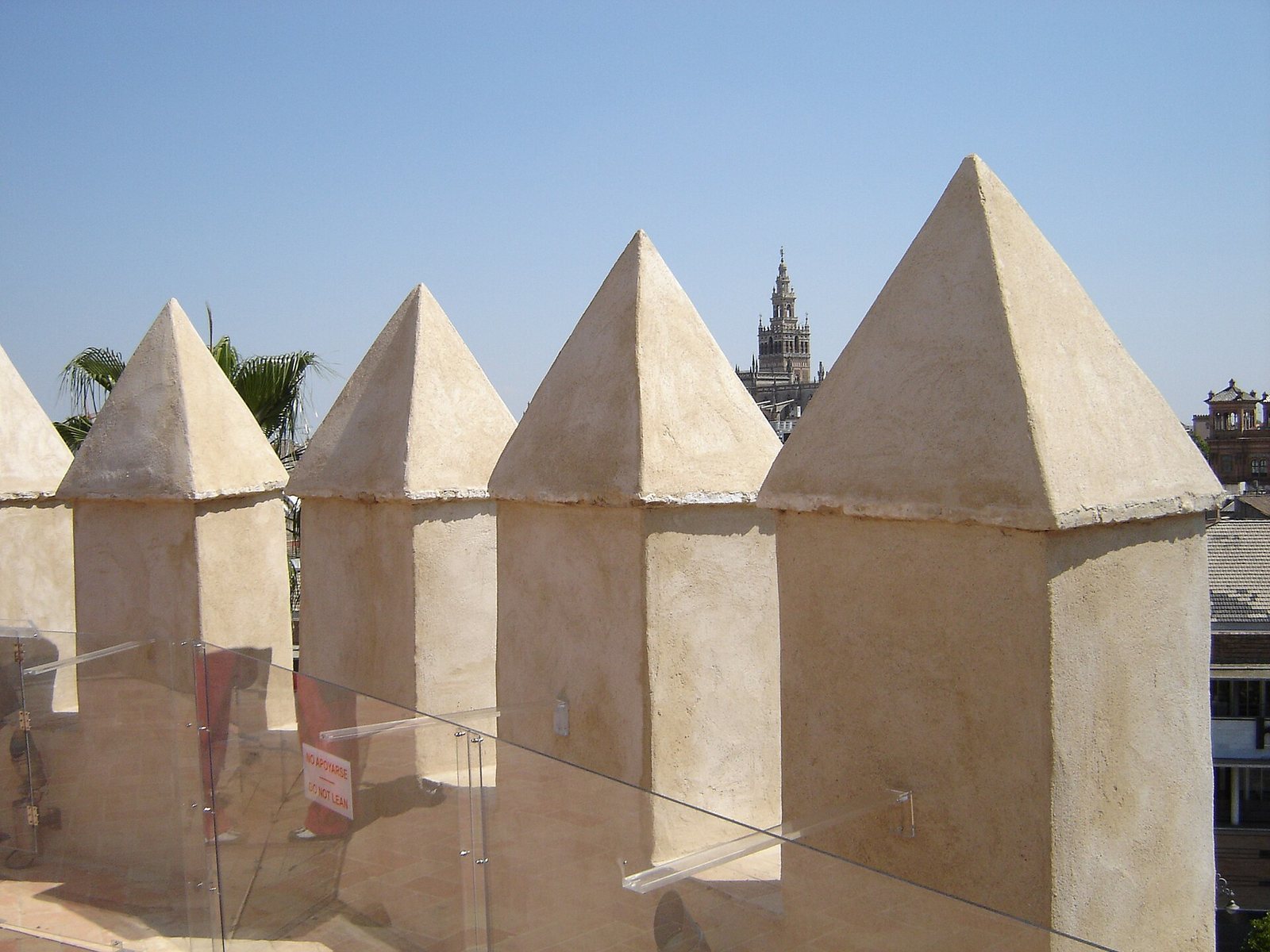
Restoration in 1991–1992 replaced the terrace parapet blocks and waterproofed the terraces; further work followed in 1995 and 2005. On 13 August 1992, during the Seville Universal Exposition, the Torre del Oro was formally twinned with Lisbon’s Tower of Belém.
Remains
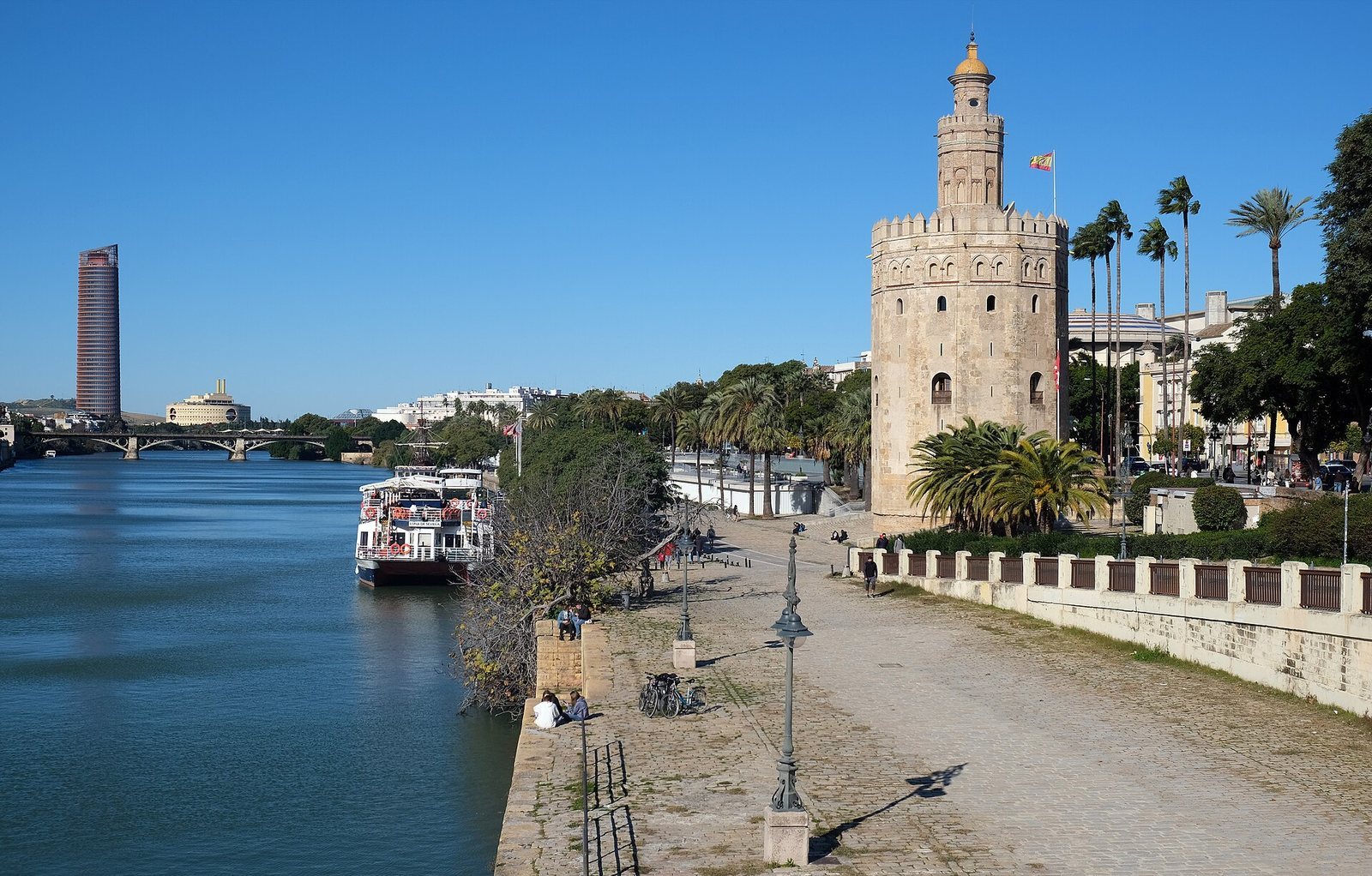
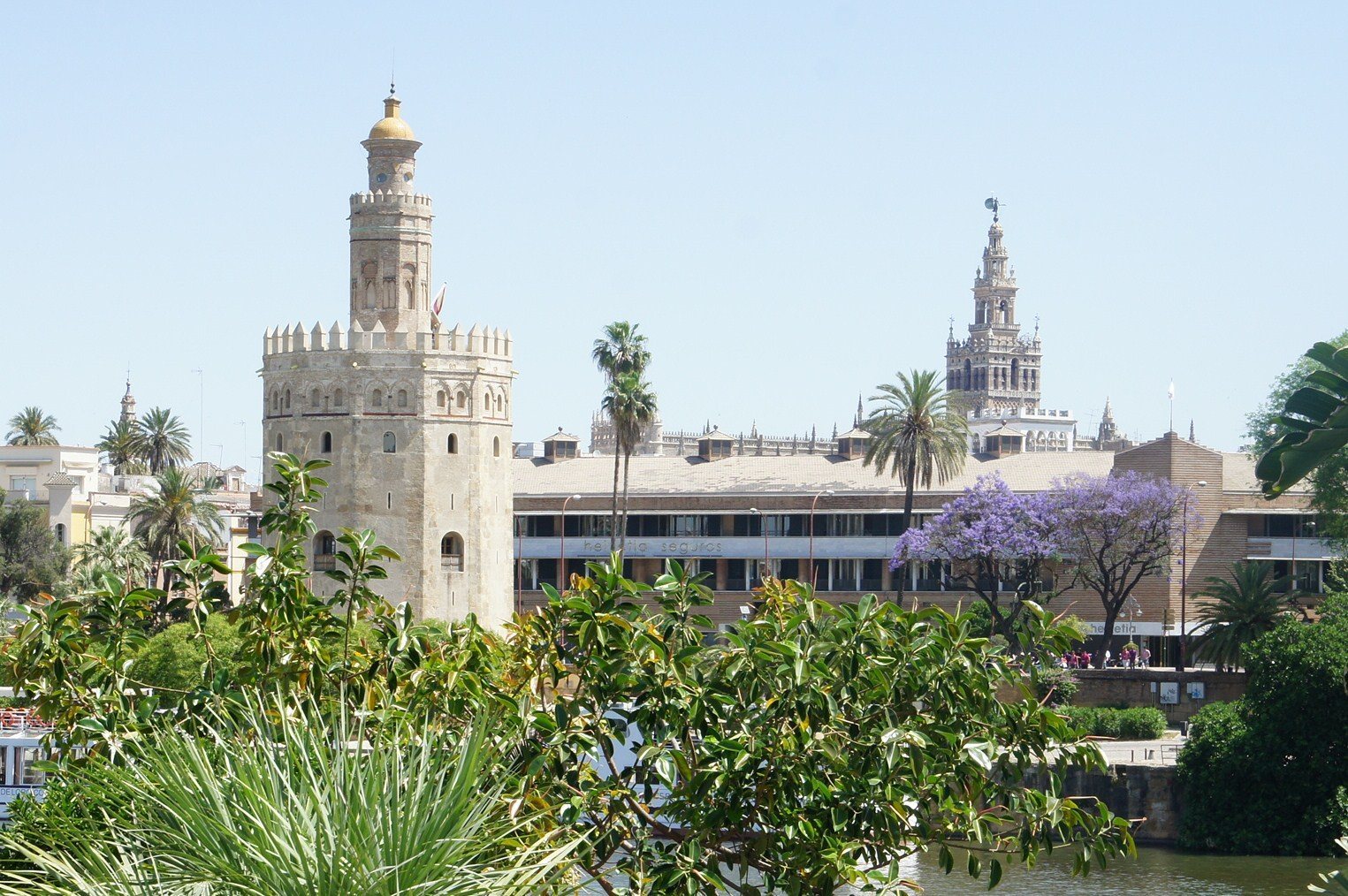
The tower stands beside the channel now known as the Alfonso XIII Canal, in Seville’s Arenal district. Its three levels comprise a twelve-sided lower body, a twelve-sided middle level, and a circular upper lantern. The base is about 15.2 metres in diameter, and the tower rises about 36 metres. It stood outside the main defensive enclosure and was connected to the fortifications by a projecting wall. That wall, which also linked it with the nearby Torre de la Plata, was demolished in the early nineteenth century. The Torre de la Plata is octagonal and is believed to date from the same period.
Structure and foundations
The tower’s foundation is a lime-concrete slab about five metres thick, extending from elevation +3 metres to elevation −2 metres. Soft alluvial ground near the river was reinforced with pine timber. In 1760, filling the ground floor added about six metres to the foundation, bringing its depth to roughly eleven metres. The middle level is in the Mudéjar style, an architectural tradition in Christian-ruled Iberia that used forms associated with Islamic art.
Terraces, openings, and flood markers
The terrace of the first level has a parapet of alternating raised blocks and gaps. The circular lantern has round, porthole-like windows and a dome covered in golden tiles. During the 1760 restoration, workers blocked the middle-level windows, made six large openings in the tower in August, and installed iron balconies. Three tiles on the western façade mark flood levels reached on 21 January 1856, 8 December 1876, and 10 March 1892. The lightning conductor fitted in 1887–1888 remains part of the tower’s recorded architectural history.
Historical depictions
A seal of Seville’s municipal council, dating to the thirteenth or fourteenth century, depicts the tower. The original is held by the Instituto Valencia de Don Juan in Madrid, and the city council has a copy. A model of Seville with the tower, flanked by figures of Saints Justa and Rufina, appears on the cathedral’s main altarpiece; Jorge Fernández made the model and figures around 1510. The tower also appears in a panel painting of Seville by the Master of Moguer, made around 1500, and in works by Francisco Pacheco in 1617 and Juan de Espinal around 1770–1775. Other depictions include Pedro de Medina’s 1548 drawing, a 1570 woodcut, several prints from 1585 to 1738, and two paintings by David Roberts from 1833. It also appears on the cover of Francisco María Tubino’s 1862 book about a royal visit to Andalusia.
Maritime Museum
The Maritime Museum occupies 633 square metres of the tower. During the 1942–1944 rehabilitation, two rooms were adapted for exhibitions and a third for research. Its collection includes navigation instruments, models, engravings, photographs, letters, and historical documents concerning Seville, the Guadalquivir, and maritime history. Museum inventories counted 143 objects in 1947, 418 in 1982, and 425 in 1992.