Tomb of Pennut: An Ancient Egyptian Rock-Cut Tomb at New Amada
Site at a Glance
- Rating
- 4.4
- Popularity
- Very Low
- Country
- Egypt
- Primary era
- Bronze Age
- External website
- Open
- Eras represented
- Bronze Age
- Civilizations
- Egyptian
- Site type
- Burial
- Remains
- Tomb
On this page21 sections
History
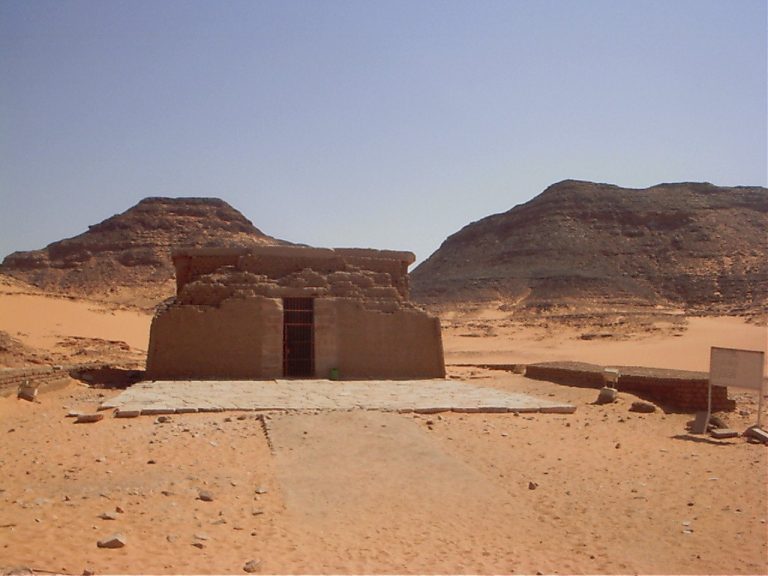
The tomb of Pennut is an ancient Egyptian rock-cut tomb at New Amada on the western shore of Lake Nasser in Egypt. It was created during the reign of Ramesses VI, dated here to 1145–1137 BC, in the later New Kingdom, the period of Egyptian imperial power traditionally dated to about 1550–1070 BC. Pennut was the deputy of the Viceroy of Kush for Lower Nubia, known in Egyptian administration as Wawat, and based his work at Miam, the ancient name of Aniba.
Pennut and the administration of Lower Nubia
Pennut was the son of the priest Herunefer. As deputy of the viceroy, he acted for the senior Egyptian official responsible for Kush and Egyptian-controlled Nubia in the region around Miam. He also administered the temple estates there. His immediate superior was probably the Viceroy Siese, an Egyptian resident in Nubia during his tenure. Pennut’s own ethnic background, whether Egyptian or Nubian, remains uncertain.
Pennut’s wife, Tacha, was the daughter of Patjauemdimonth and served as a singer in the Temple of Horus at Miam. A twenty-line inscription in the tomb records the assignment of agricultural land or an estate on the east bank of the Nile. Its income was intended to maintain offerings for a statue of Ramesses VI in the Temple of Miam, probably the temple of Horus. The inscription therefore connects Pennut’s burial monument with the administration of land, temple property, and royal cult.
Original setting and relocation
The tomb originally stood about 27 kilometers southwest of Aniba, opposite Qasr Ibrim, and about one kilometer northwest of a New Kingdom necropolis behind Miam on the west bank of the Nile. It was cut into a rocky outcrop forming the northernmost of several isolated sandstone hills on the desert plain. Its entrance faced southeast toward Miam.
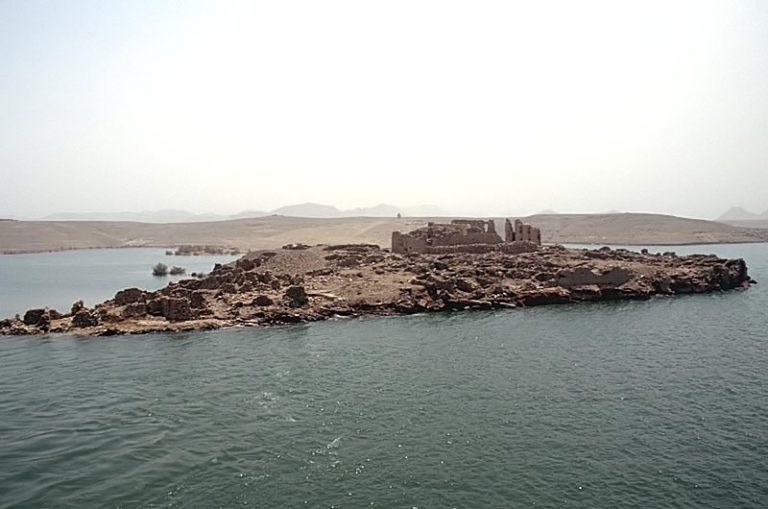
Construction of the Aswan High Dam created Lake Nasser and threatened the tomb with inundation. In 1964, the monument was completely dismantled and rebuilt at New Amada, where it now stands near the transferred temples of Derr and Amada. It was relocated as part of the rescue operations undertaken before the reservoir waters covered the original site. The tomb of Djehutihotep from Debeira East was relocated during the same period.
Study, damage, and survival
The tomb attracted the attention of travelers and Egyptologists before its relocation. Johann Ludwig Burckhardt visited it in March 1813. Hector Horeau published a short description, together with a plan and section, in 1841. Richard Lepsius examined the monument and its reliefs on 19 August 1844, when much of the wall decoration was still almost complete. He copied the large inscription and recorded the reliefs in detail.
Photographs by Félix Teynard appeared in 1858. Photographs made by Friedrich Koch during James Breasted’s Nubian expedition in 1906 were later used by Georg Steindorff in his 1937 study of Aniba. These records preserve information about the monument before extensive modern losses.
The burial chamber had already been plundered in antiquity, so it is not known whether the tomb was intended only for Pennut, for Pennut and Tacha, or for additional members of the family. Before relocation, art thieves also targeted the isolated monument. They removed large sections of its colored reliefs and attempted to place them on the European art market. In the early 1980s, some of the removed reliefs appeared in the possession of a Paris art dealer. After their illicit status was recognized, they disappeared, possibly having been destroyed. Part of the stolen material was reportedly recovered in Egypt, but the tomb remains extensively damaged.
Remains
Setting, entrance, and chapel
Relocated setting
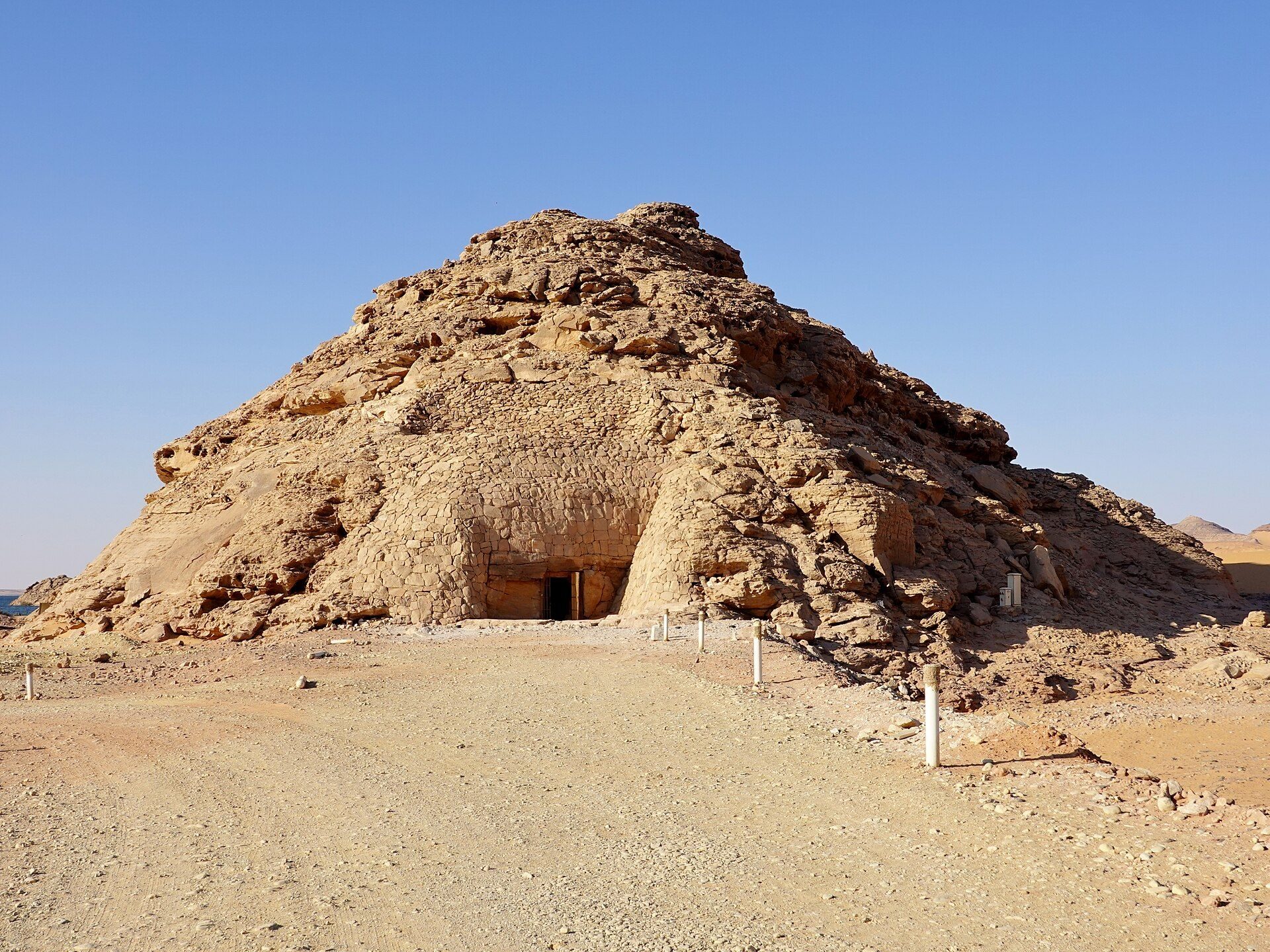
The rebuilt tomb lies beneath an artificial mound approximately 200 meters west of Lake Nasser, about 150 kilometers southwest of the Aswan High Dam and 79 kilometers northeast of the temples of Abu Simbel. The transferred Temple of Derr stands 560 meters south, while the Temple of Amada stands 700 meters south. The latter gave its name to the modern settlement of New Amada.
Forecourt and entrance
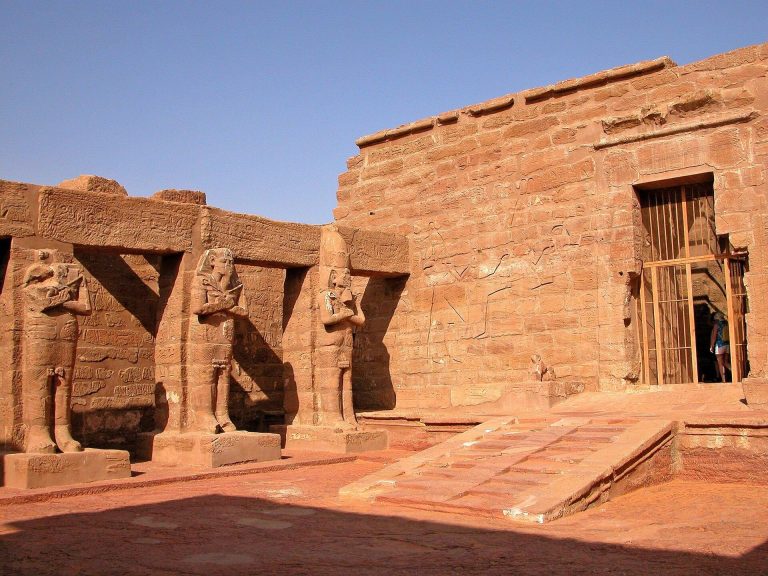
The entrance now faces exactly south, although the original opening deviated by 23 degrees from the north-south axis. A forecourt measuring 7.50 by 2.50 meters lies before it. The court contains a niche probably intended for a stele, a commemorative slab or upright monument.
Rock-cut chapel and burial shaft
The chapel is 5.90 meters wide, 2.70 meters deep, and 1.90 meters high. A rectangular burial shaft, approximately three meters deep, occupied the center of the room immediately behind the entrance. A burial chamber was cut into the western side of the shaft. During the relocation, the shaft was represented schematically and was not fully restored.
Opposite the entrance, behind the shaft, a statue niche was cut into the rock. It widens slightly toward the rear and originally held three divine figures, all now destroyed. The central figure appears to have had a cow’s head, but the original postures of the figures cannot be determined. The architrave, the horizontal member spanning the top of the niche, survives in poor condition. It shows a solar bark, the boat associated with the sun god’s daily journey, flanked by an adoring baboon on one side and a fish representing water on the other.
Eastern chapel decoration
Religious program and entrance jamb
The chapel was decorated with sunk reliefs, in which figures and inscriptions were cut into the wall surface. Many retained their original colors. The eastern half of the decoration concerns earthly life, including episodes from Pennut’s career and offerings to gods and the dead. On the western entrance jamb, Pennut and Tacha are shown leaving the tomb with raised hands in worship of the sun while also greeting visitors. The decoration on the eastern jamb has disappeared.
Endowment inscription
The southern side of the eastern section carried the long inscription about the agricultural endowment for the cult statue of Ramesses VI. Above it, Ptah and Thoth were shown on the left, while Amun, Mut, and Khonsu, the Theban triad associated with Thebes, appeared on the right. Pennut and the grain-store overseer Penre prayed toward the text. The figures and deities have disappeared, leaving about one-third of the inscription and two praying female figures from the lower register.
Family and offering scenes
About three-quarters of the eastern wall’s reliefs have been destroyed. The surviving lower register shows two offering women identified as Pennut’s wife and daughter. Above them, Pennut holds a bowl of ointment in each outstretched hand while two subordinates adorn him. An accompanying caption survives.
Other scenes showed Ramesses VI seated beneath a canopy in the Blue Crown and holding an ankh. An unnamed Viceroy of Kush presented two silver ointment vessels to Pennut. The viceroy also appeared with the estate overseer Meri before a statue of the king on a pedestal, flanked by the standards of Amun-Re and Horus.
Tacha and their daughter T-hent offered before four figures, probably Pennut’s parents and grandparents. In another scene, Pennut poured water over an offering table as a libation for his seated mother, also called Tacha, and possibly his unnamed grandmother. Ten further figures, five men and five women arranged as couples, were identified by hieroglyphs as priests and female singers. Another lower-register scene shows Pennut pouring water over a table decorated with offerings and flowers while an inscription invokes his deceased ancestors.
Northern wall family worship
East of the statue niche, the surviving upper register of the northern wall shows Pennut, Tacha, and their six sons worshipping the falcon-headed Re-Harachte, who is seated on a throne. The men hold three papyrus stems in their left hands, while Tacha holds a sistrum, a handled ritual rattle used in religious ceremonies.
The lost lower register showed Pennut and Tacha before Osiris, seated on a pedestal beneath the sign of the West and wearing the Atef crown. A lotus bearing the four sons of Horus stood between them. Farther right, eight seated ancestral figures, four men and four women, were identified as Osiris Hati, Osiris Horneakht, Osiris Pennut, Osiris Amunemipet, and their wives.
Western funerary decoration
Judgment of the dead
The western program begins on the western part of the southern wall with the Judgment of the Dead, which continues onto the west wall. The surviving scene includes the Hall of Judgment, Pennut and Tacha entering through its gate with raised hands, and Thoth, the writing god, recording the result of the weighing of the heart.
The original weighing scene showed Anubis balancing Pennut’s heart against Maat, the Egyptian principle of cosmic, social, and moral order. Ammit waited nearby to consume the heart if it proved false. The heart and much of the lower part of the scene were removed during the twentieth century.
Opening of the Mouth
The lower register of the southern wall originally contained the Opening of the Mouth, a funerary ritual intended to restore the deceased’s ability to receive and use the senses in the afterlife. Surviving fragments include half of a male figure and six mourning women identified as singers, possibly daughters of the deceased. The missing portion showed a priest holding the mummy before the kneeling widow, a Sem-priest pouring water, other ritual priests, and mourners that included three sons.
Osiris and the Book of the Dead
On the west wall, the upper scenes show the falcon-headed Harsiese presenting Pennut and Tacha to Osiris. The god sits inside a chapel with its door open and is accompanied by Isis and Nephthys. A small altar once stood before the chapel, although its image is no longer visible.
The northern part of the wall contains text from Chapter 125 of the Book of the Dead, a collection of funerary spells intended to guide and protect the dead. This chapter concerns judgment before Osiris and the deceased’s declaration of innocence. Beneath the text, the mourning Isis and Nephthys stood beside Pennut’s body on a lion-shaped funerary bed, where Anubis performed the ritual revival of the dead.
The lost lower register showed Pennut worshipping Re-Harachte, Atum, and Khepri, followed by Pennut and Tacha in prayer. Three sections on the right contained scenes from Chapter 110 of the Book of the Dead, including labor in the Fields of the Blessed.
Northern wall and central cult niche
Hathor and the western mountain
The western part of the northern wall begins with Pennut kneeling before Hathor in the form of a cow emerging from the steep slope of the western mountain. Papyrus plants surround the goddess, who is accompanied by the small hippopotamus goddess Taweret. Taweret holds a staff and a scorpion. A chapel with a pyramidal roof stands before the mountain, possibly alluding to the Theban necropolis.
Elsewhere on the same wall, Pennut and Tacha worship the enthroned, human-headed Re-Khepri. Pennut holds three papyrus stems, while Tacha holds a sistrum. In the lower register, Thoth and Anubis ritually purify the deceased with water before a chapel containing the enthroned Re-Harachte. Tacha survives at the right with her sistrum. The original scene showed her and Pennut before the seated Ptah-Sokar-Osiris, with the four sons of Horus standing before the deity on a lotus flower.
Solar bark and surviving architrave
The reliefs and captions around the central cult niche on the north wall have been lost. Its surviving architrave shows a solar bark flanked by two adoring monkeys and two fish representing water. Pennut was formerly shown praying on the missing sides, with a prayer to Re-Harachte on the left and to Atum of Heliopolis on the right.