Tomb of Daniel: A Multi-Faith Mausoleum in Susa, Iran

Site at a Glance
- Rating
- 4.3
- Popularity
- Low
- Country
- Iran
- Primary era
- Medieval
- Eras represented
- Medieval, Modern
- Civilizations
- Qajar, Seljuk
- Site type
- Religious
- Remains
- Tomb
On this page11 sections
History
The Tomb of Daniel is a religious mausoleum in Iran, located at Susa in Khuzestan Province and traditionally associated with the biblical and Islamic prophet Daniel. The present complex reflects a nineteenth-century renovation, while its distinctive stepped dome belongs to the Seljuk period, the era of a medieval Turkic dynasty that ruled large parts of the Middle East and Central Asia. Jewish and Muslim traditions identify Susa as Daniel’s burial place, although several other locations have also been associated with his tomb.
Daniel and the traditions of Susa
Daniel is described in religious tradition as having lived in Babylon and possibly visited the palace of Susa. The place of his death is not specified, but Jewish, Christian, and Muslim traditions identify him as a historical prophet. In Islam, Daniel is regarded as one of the prophets of the Israelites, while the Book of Daniel forms part of the Hebrew Bible and the Christian Old Testament. The Susa tomb is widely regarded as the strongest of the several burial-place traditions, though other claimed locations include Golpayegan and sites in Khuzestan, as well as Kirkuk, Babylon, Muqdadiyah, and Mosul in Iraq, Samarkand in Uzbekistan, and Moscow in Russia.
A Nestorian Christian tradition relates that a coffin and a mummy were seized at Susa during the Arab conquest. Some people identified the remains as Daniel’s, while others believed them to belong to the Persian king Darius. Muslims ultimately identified the remains as Daniel’s. Islamic traditions give different accounts of what happened next. One says that the grave was first at Shushtar and was transferred to Susa after the conquest of Shushtar. Another places the original burial at Susa and says that the remains were later moved to the bank of the Shavur River, where the present tomb stands.
Accounts of the coffin and its burial
Al-Baladhuri recorded that in 638 Abu Musa al-Ashari, an early Muslim commander and governor associated with the conquest of southwestern Iran, found Daniel’s coffin at Susa. The coffin was reportedly brought from Babylon during a drought so that rain might be obtained. Umar, the second caliph of Islam, ordered the coffin to be buried, and it was submerged in a nearby watercourse. Another tradition places the discovery at Tustar, the historical Arabic name for Shushtar, where the body was concealed in one of thirteen graves to prevent people from worshipping or disturbing it.
Medieval traditions gave Daniel’s remains a connection with rain and good fortune. During famine or drought, people in Susa were said to bring out the coffin and pray for rain. A Jewish practice involved circling the tomb and drawing water nearby. Benjamin of Tudela, a Jewish traveler who journeyed through Western Asia between 1160 and 1163, provided the earliest known European mention of the Susa tomb and recorded a tradition that Daniel’s remains had been found there around 640.
Benjamin also described a dispute between communities on opposite banks of the Choaspes River. The groups allegedly alternated possession of the bier until Seljuk shah Sanjar ended the practice. He was said to have ordered the bier chained to the middle of a bridge, built a chapel there for Muslims and Jews, and prohibited fishing within a mile of it. The account also associated the water beneath the bier with goldfish and described the area as dangerous for navigation.
Renovation and continuing religious use
A nineteenth-century description presents the shrine as a place where local people gathered for prayer on specified days each month. A solitary dervish, a member of an Islamic mystical tradition often associated with ascetic practice and service at shrines, reportedly lived in the building and identified the burial place beneath the mausoleum. The building itself had no date or inscription confirming that claim.
The present tomb was renovated and repaired in 1870 on the orders of Sheikh Jafar Shooshtari, a Shia scholar. Haj Mulla Hassan Memar carried out the work, and his son, Mulla Javad, later undertook further construction, including the addition of two minarets in 1330 AH. The site remains an active mausoleum associated with Christianity, Islam, and Judaism, and continues to attract religious interest among local Muslims and Iran’s Jewish community. It was registered as one of Iran’s national monuments in 1931 under registration number 51.
Modern historical interpretation has generally treated Daniel as a fictitious figure and dates the composition of the Book of Daniel to the reign of the Seleucid king Antiochus IV. This view differs from the Jewish, Christian, and Muslim traditions that regard Daniel as a historical prophet. The continuing shrine therefore preserves a religious tradition whose historical interpretation remains distinct from modern critical readings of the biblical text.
Remains
The complex is identified both as a mound and as a tomb. Its layout includes a shrine enclosure, two courtyards, a central pool in the principal courtyard, and rooms arranged around the pool for pilgrims’ rest. The tomb stands within this larger religious setting and is distinguished by a double-shell, conical, stepped dome. A double-shell dome has separate inner and outer layers, allowing the exterior form and interior space to be built as distinct structural shells.
Courtyards and shrine enclosure
Principal courtyard
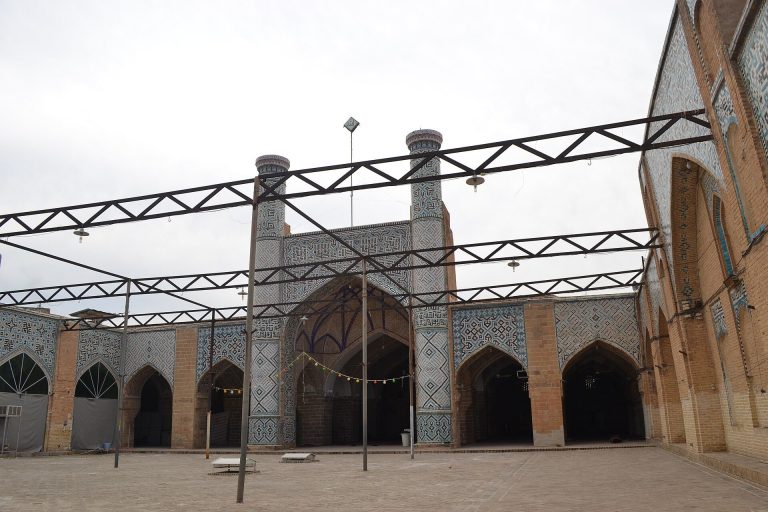
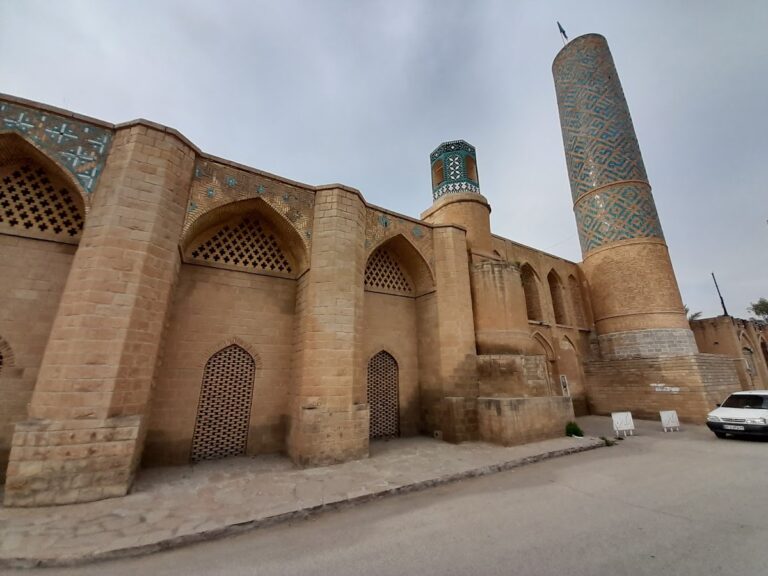
The principal courtyard contains a pool at its center, with rooms around it intended for pilgrims’ rest. The complex also includes a second courtyard and an enclosed shrine area. The walls surrounding the shrine are decorated with mirror work, while other interior surfaces carry tilework. The western side is faced with Iranian-Islamic tile decoration, giving the enclosure a varied ornamental treatment.
Dome and minarets
Stepped dome
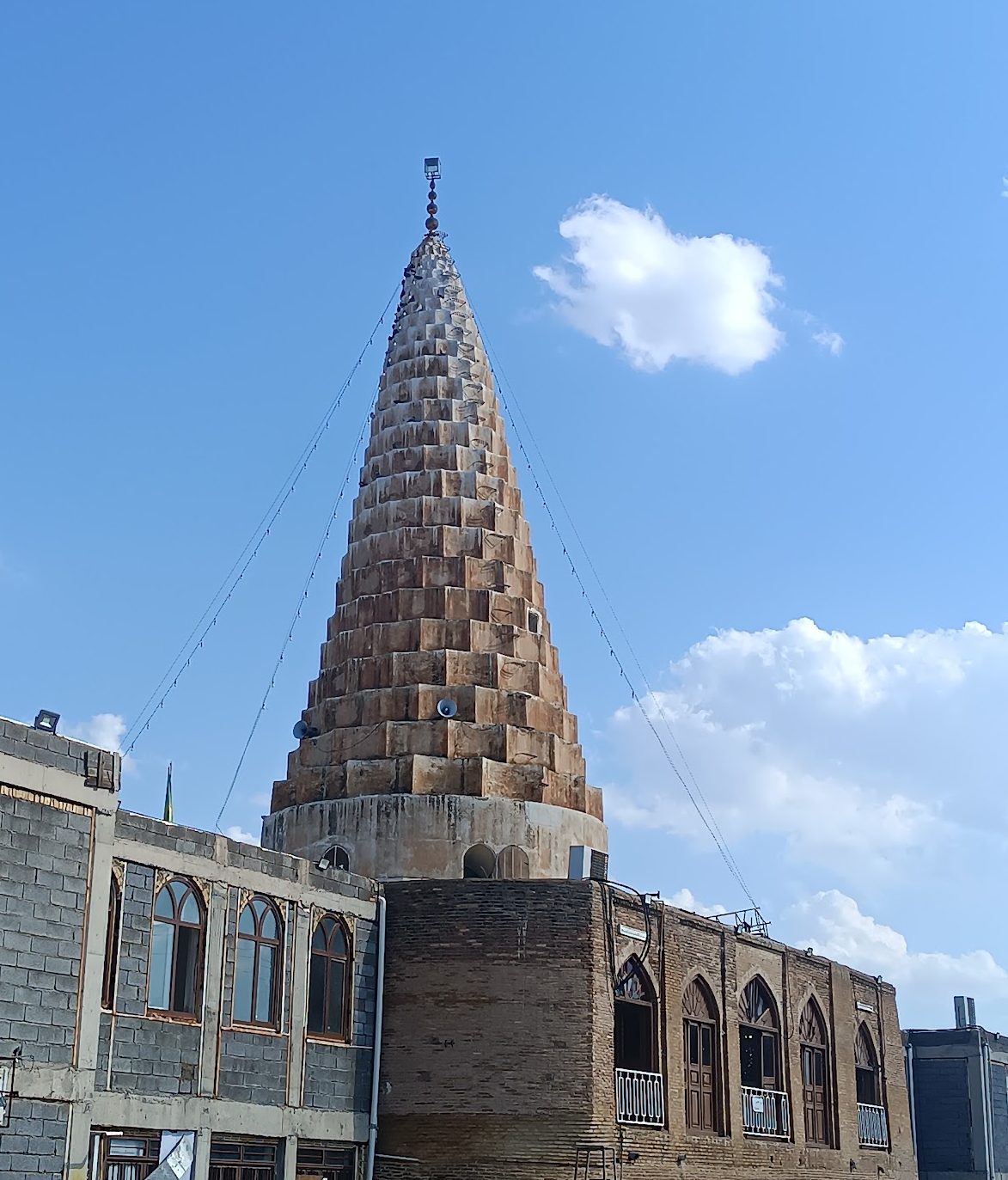
The tomb is crowned by a stepped, conical dome built during the Seljuk period. It rises approximately 20 metres and has a diameter of about 5 metres. Its inner shell helps distribute structural forces, a design intended to improve the dome’s durability. The form is architecturally similar to the stepped, conical dome of the mausoleum of Imamzadeh Abdullah at Shushtar. An imamzadeh is a shrine or mausoleum associated with a descendant of a Shi’a imam. The dome also resembles the two domes of the funerary complex at Kukherd, dated to 1149–1151 AH.
Eastern minarets
Two minarets stand on the eastern side of the complex, one on each side of the tomb. Each is approximately 10 metres high. Inscriptions on the minarets date their construction to 1330 AH. A minaret is a tower associated with a mosque or Islamic religious complex, traditionally used for the call to prayer.
Nineteenth-century description
One nineteenth-century description portrays the mausoleum as a small, simple, square brick building beneath trees beside a clear running stream called the Bellerau. The claim that the stream flowed directly over Daniel’s coffin and made it visible underwater was not confirmed by the local people questioned at the time. Historical traditions have consequently described the burial’s physical location in different ways, including beneath the mausoleum and submerged in a river or stream.