Daisen-ji Temple: A Tendai Buddhist Center on Mount Daisen


Site at a Glance
- Rating
- 4.2
- Popularity
- Medium
- Country
- Japan
- Primary era
- Early Modern
- External website
- Open
- Eras represented
- Early Modern, Modern
- Civilizations
- Japanese
- Site type
- Religious
- Remains
- Monastery
On this page15 sections
History
Daisen-ji Temple is a Buddhist temple in Japan on the slopes of Mount Daisen in Daisen, Tottori Prefecture. Its foundation date is uncertain, although tradition places its origin in 718, and it belongs to the Tendai school, a major Japanese Buddhist tradition derived from Chinese Tiantai. Jizo Bosatsu, a bodhisattva associated with protection and guidance through difficult states of existence, is its principal image. The temple is classified as a Tendai special head temple.
Mountain worship and foundation tradition
Mount Daisen was revered as a sacred mountain before Buddhism reached the area. By the seventh century, it had become a center of shugendo, a Japanese mountain-ascetic tradition that combined Buddhist practice with older local mountain worship, folk animism, Taoism, and esoteric Buddhist practices.
The temple’s traditional foundation story concerns Toshikata, the kuni no miyatsuko, or provincial governor, of Hoki Province, a historical province corresponding broadly to western Tottori Prefecture. After shooting a deer on Mount Daisen, Toshikata realized that he had struck a manifestation of Jizo. He repented, entered religious life under the name Kinren, and established a small hermitage for the worship of Jizo Bosatsu. The foundation tradition describes Daisen-ji as a Shingon Buddhist institution at first.
Tendai affiliation and pilgrimage
In 865, during the Heian period, Daisen-ji became affiliated with the Tendai sect and developed into one of the major Tendai centers in the Chugoku region. Jizo was also venerated through Daichimyokogen, a local Buddhist manifestation identified with Jizo Bosatsu.
The temple’s chief monk, or zashu, was sent from Enryaku-ji on Mount Hiei, the principal Tendai headquarters in Japan. After completing his term at Daisen-ji, he returned to Mount Hiei and could be promoted there. This arrangement connected the temple with the wider clerical career system of the Tendai institution.
Pilgrimage roads leading to Daisen-ji developed from the late Heian period. The Daisen pilgrimage route ran north and south from Okayama City and intersected the Izumo Highway, bringing both religious pilgrims and commercial traffic to the area.
Medieval patronage and Edo-period estates
During the medieval and Sengoku periods, an era of intense political and military competition among regional lords, Daisen-ji received patronage, donations, and construction support from warrior families including the Amago and Mori clans.
Under the Tokugawa shogunate in the Edo period, Daisen-ji controlled estates assessed at 3,000 koku. A koku was an Edo-period measure of an estate’s productive capacity and income, conventionally calculated through rice production. The temple remained independent of Tottori Domain, which governed the rest of Hoki Province. Nakamura Kazutada temporarily confiscated part of the estate, but in 1610 Goen, a senior monk of Saigakuin, persuaded the shogunate to confirm Daisen-ji’s full 3,000-koku estate.
Meiji disruption and reconstruction
The haibutsu kishaku movement following the Meiji Restoration severely affected Daisen-ji. This movement sought to suppress Buddhism and separate Buddhist institutions and practices from state-supported Shinto. The temple closed in 1875, its temple name was abolished, and much of its land was confiscated. Buddhist and Shinto-related assets were reorganized, while the Daichimyokogen Hall became Ogamiyama Shrine. Shinto-related assets were transferred there, and the shrine’s deity was installed in the former main hall in place of Daisen-ji’s principal image.
Daisen-ji was allowed to reopen in 1903, but only 10 of its former 42 monastic residences remained. The Dainichi-do was destroyed by fire in 1928, one of four fires that struck the complex that year. Numerous cultural treasures were lost, including the illustrated scroll history of Daisen-ji. The Dainichi-do was reconstructed in 1951.
Daisen-ji is associated with the Chugoku Thirty-Three Kannon pilgrimage, the Hoki Kannon pilgrimage, and the Izumo Shinbutsu pilgrimage. Its precincts are protected as a National Historic Site, while the Amida-do and other components are designated National Important Cultural Properties.
Remains
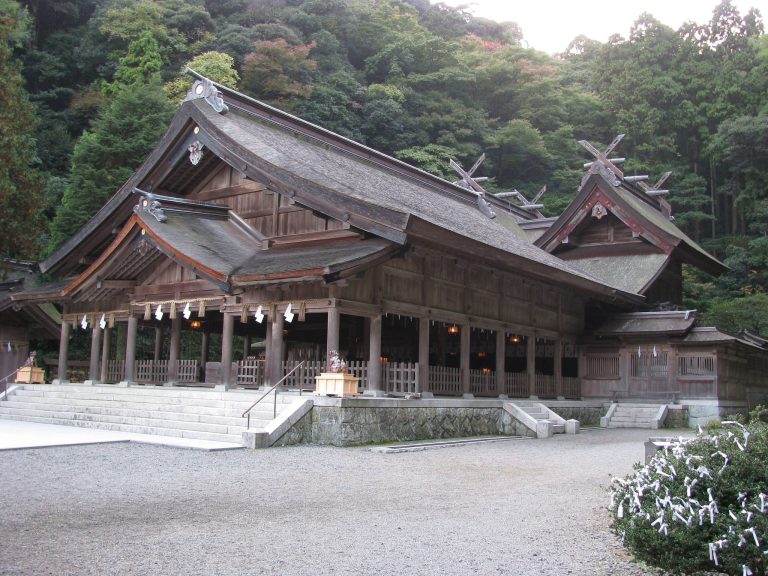
The temple complex occupies the middle slopes of Mount Daisen. Its surviving buildings are wooden structures of different dates, including the sixteenth-century Amida-do and the twentieth-century main hall and bell tower. Buddhist images, metal ritual objects, and surviving reproductions of the lost illustrated origin scroll supplement the architectural remains.
Principal wooden buildings
Amida-do
The Amida-do is a single-story wooden hall built in 1552. Its plan measures five bays by five bays, with each bay representing a structural interval between columns. The building has a hipped roof covered with kokera shingles.
Hondo-do
The Hondo-do, or main hall, is a single-story wooden structure constructed in 1951. It measures six bays by five bays.
Shoro
The Shoro, or bell tower, is a single-story wooden structure measuring one bay by one bay. It was constructed in 1950.
Buddhist images and ritual objects
Wooden Buddhist images
Among the associated Buddhist cultural properties are wooden images of Amida Nyorai with two attendants, dating from the Heian period. An inscription inside the central image gives the date as 1131 and identifies its maker.
Bronze Kannon images
The associated bronze objects include a Nara-period standing image of Eleven-Headed Kannon and a Nara-period standing image of Kannon. Two further standing bronze Kannon images are also associated with the temple, one from the Nara period and the other from the Song or Liao period.
Iron ritual objects
An iron altar from the Nara period is accompanied by three engraved iron prayer-text plates and an iron head of Jizo Bosatsu. These objects form part of the temple’s surviving material record of Buddhist ritual practice.
Origin scroll tradition
The ten-volume illustrated scroll describing Daisen-ji’s origin was destroyed in the 1928 fire. Detailed facsimiles and photographs of the scroll survive, preserving its visual and historical testimony after the loss of the original.