Thaxted Guildhall: A Late-Medieval Civic and Market Building
Site at a Glance
- Rating
- 4.8
- Popularity
- Very Low
- Country
- United Kingdom
- Primary era
- Medieval
- External website
- Open
- Eras represented
- Medieval
- Civilizations
- English
- Site type
- Civic
- Remains
- Town Hall
On this page12 sections
History
Thaxted Guildhall is a late-medieval municipal building in Thaxted, United Kingdom, associated with the town’s cutlery trade and civic life. By the late fourteenth century, Thaxted had become a local centre for cutlery production, and the Guild of Cutlers is thought to have helped pay for the building. A guild was an organised association of people practising the same trade or craft, while a guildhall could serve both the guild and the wider community.
Late-medieval origins
A listed-building description prepared in 1967 proposed that the Guildhall was completed between 1390 and 1410. Later dendrochronology, the dating of timber through its annual growth rings, indicated that much of the building’s timber came from the late fifteenth century. The evidence therefore connects the surviving structure closely with the late-medieval period while distinguishing the dates proposed for its completion from the dates of the timber itself.
Civic use and decline
The Guildhall served as a meeting place for the town. Thaxted flourished after receiving a charter from Queen Mary I in the mid-sixteenth century. Mary ruled England from 1553 to 1558. The town later declined when the charter was rescinded after the fall of King James II in the late seventeenth century. James ruled from 1685 until 1688, when he was removed during the Glorious Revolution.
School, restoration, and later interpretation
Following the town’s decline, the Guildhall was restored and converted into a school. It remained in educational use as Thaxted Grammar School until 1878. Further refurbishment, including work on the timber, took place in 1911 and again in 1975 during European Architectural Heritage Year. The building was designated a Grade I listed building on 20 February 1967 under the official name “Guildhall, Thaxted.” Grade I is the highest category of statutory protection for buildings of exceptional architectural or historic interest in England.
In 2008, the Guildhall hosted a Design Statement Exhibition intended to gather local opinions for guiding development in Thaxted. The building also contains a small museum with photographs and objects associated with the town and its development over time.
Remains
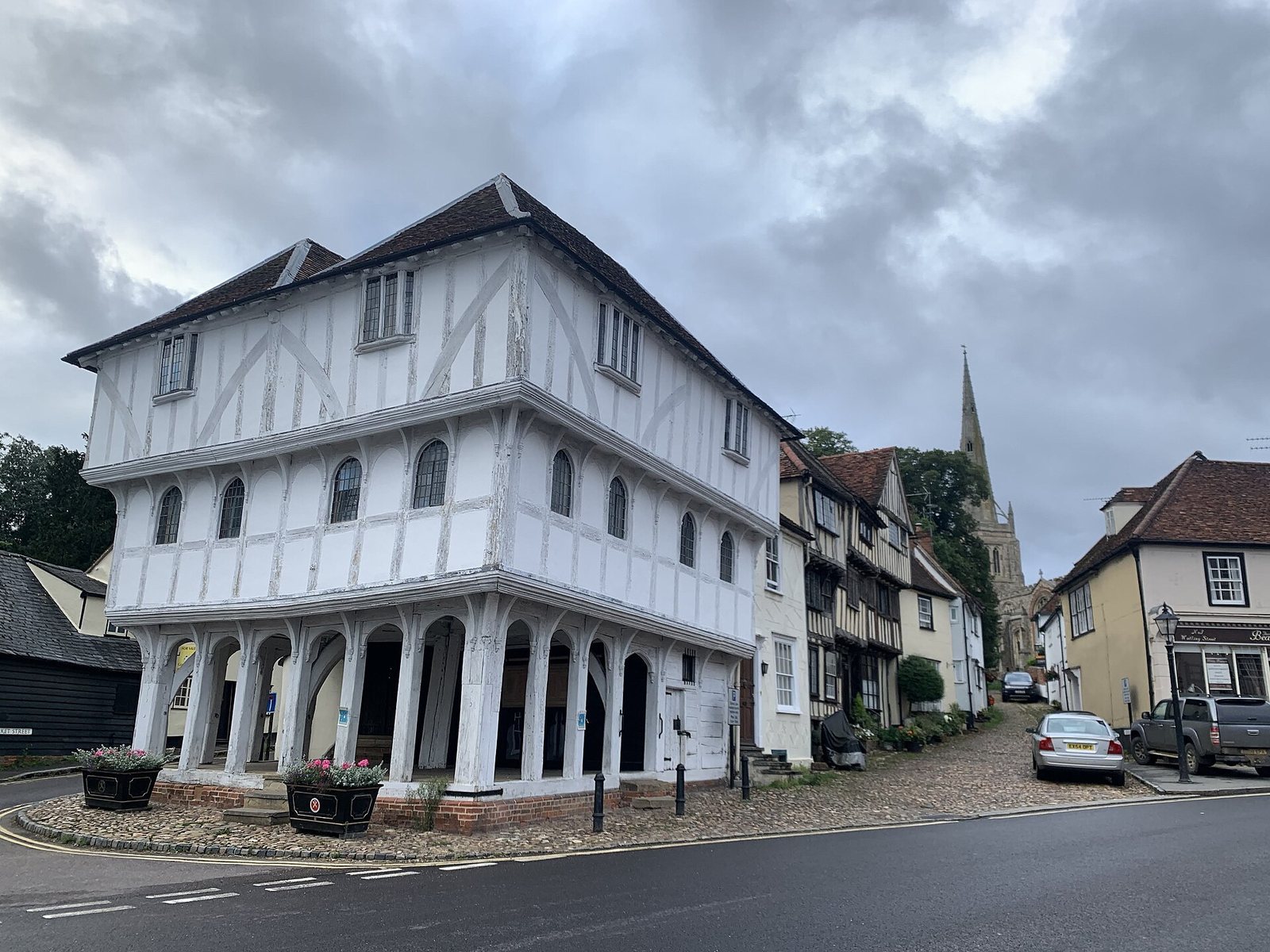
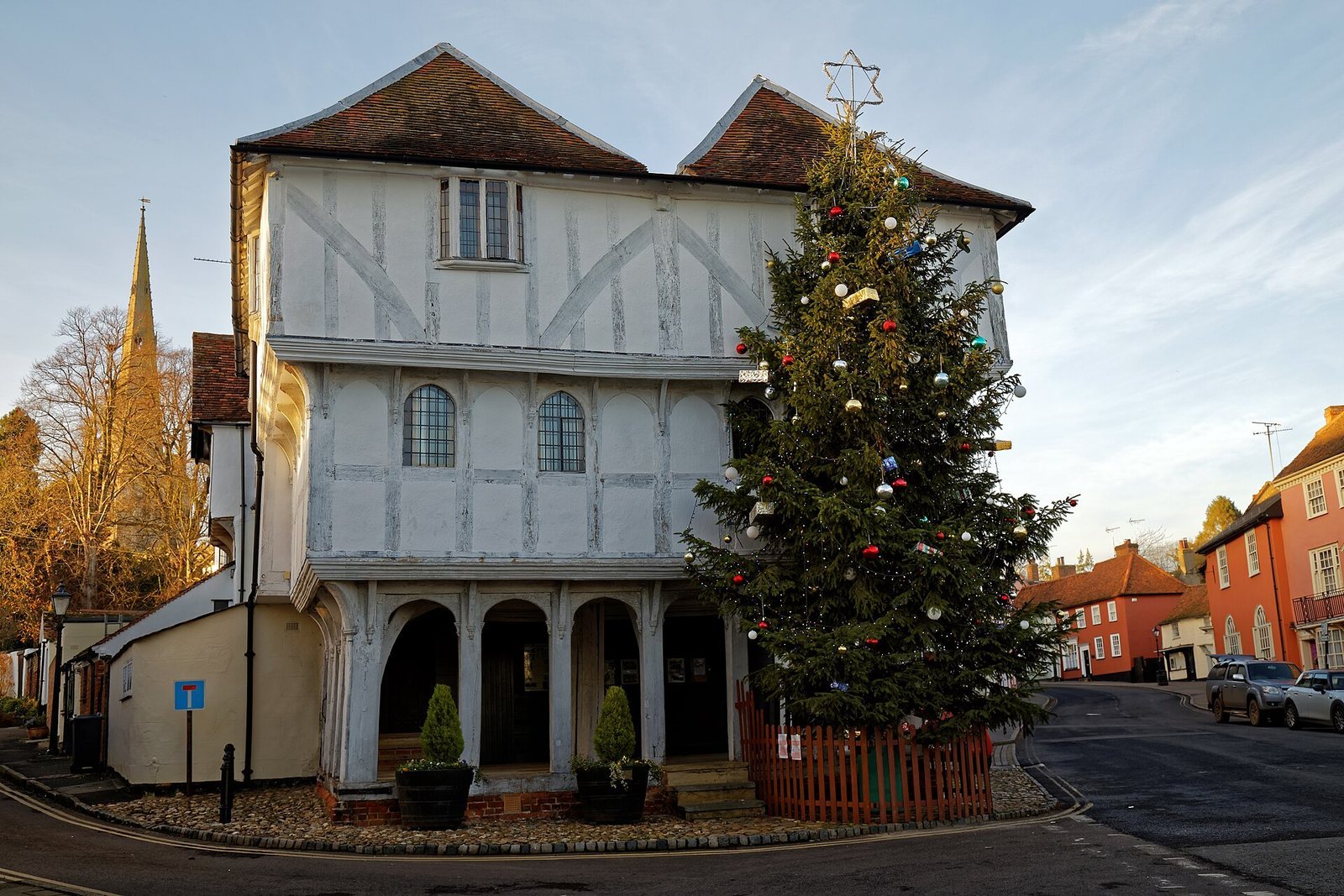
Thaxted Guildhall is a jettied timber-framed building. Jettied framing allows an upper storey to project beyond the supporting wall below, often over a street or pavement. Here, the ground floor is arcaded so that markets could be held beneath the building, while the storeys above extend progressively farther outward.
Market frontage and timber structure
Ground-floor market area
The ground floor forms an arcaded market area. A large oak post stands at its centre and supports the structure above, making the timber frame an important part of the building’s surviving physical arrangement.
Projected upper storeys
The first floor projects over the pavement on three sides and has four small Gothic windows on each side. The attic projects farther outward and contains two small bay windows on each side. Together, these projecting levels define the Guildhall’s external form.
Interior spaces
Meeting hall
The principal interior room is a meeting hall on the first floor at the front of the building. At the rear, a staircase stands on the left, while a sealed-off area known as the “old cage” is on the right.
Old cage
The old cage was probably used as a village lock-up, a small local detention space for holding people temporarily before release or further legal action. Its original ground-floor doorway and barred grates on the first-floor window survive as evidence of that probable use.
Museum and portrait
The Guildhall houses a small museum containing photographs and objects connected with the town and its development. It also contains a portrait of the Reverend Conrad Noel by Frank William Carter. Noel was an Anglican priest and prominent Christian socialist associated with Thaxted.