Saffron Walden Castle: A Norman Fortress of the Anarchy


Site at a Glance
- Rating
- 3.8
- Popularity
- Very Low
- Country
- United Kingdom
- Primary era
- Medieval
- External website
- Open
- Eras represented
- Medieval
- Civilizations
- English, Norman
- Site type
- Military
- Remains
- Castle
On this page7 sections
History
Saffron Walden Castle is a medieval castle in the United Kingdom, built by the Anglo-Norman magnate Geoffrey de Mandeville during the Anarchy, the twelfth-century civil war fought mainly over the succession to the English throne. Much of its construction took place between 1141 and 1143, when Geoffrey sought to reinforce his power across the region.
Construction during the Anarchy
The castle occupied a strong natural position and formed part of Geoffrey de Mandeville’s effort to consolidate his regional authority. Geoffrey was the hereditary Count of Essex and a powerful nobleman during the reign of King Stephen. The fortification included a square Norman keep, a fortified residential and defensive tower, together with an enclosed bailey, the area adjoining a keep.
In 1143, King Stephen arrested Geoffrey under questionable circumstances and ordered him to surrender his castles, including Walden. Geoffrey initially accepted these terms, but changed course after his release. He began a military campaign against the king’s strongholds in Cambridgeshire, attempting to reopen the route south to Walden. He died during the siege of Burwell in the following year without retaking the castle.
Royal control and demolition
After Geoffrey was dispossessed, Stephen placed the castle and its domains in the custody, rather than the possession, of Turgis de Abrinciis, also called Turgis de Avranches. Turgis was a royal official and a trusted associate of the king. In 1145, he refused to surrender the castle until Stephen surprised him while hunting and threatened to hang him in chains above the castle gate.
Henry II ordered the castle to be slighted in 1157. To slight a castle was to damage or demolish it deliberately so that it could no longer function effectively as a fortress. The keep was probably still unfinished at that time. The destruction formed part of Henry II’s wider policy of dismantling castles, and historian Sidney Painter identified Walden as one of at least 21 castles demolished on the king’s instructions.
Saffron Walden Castle is now both a scheduled monument, meaning an archaeologically or historically important site protected under United Kingdom law, and a Grade I listed building, a designation reserved in England for buildings of exceptional architectural or historic interest.
Remains
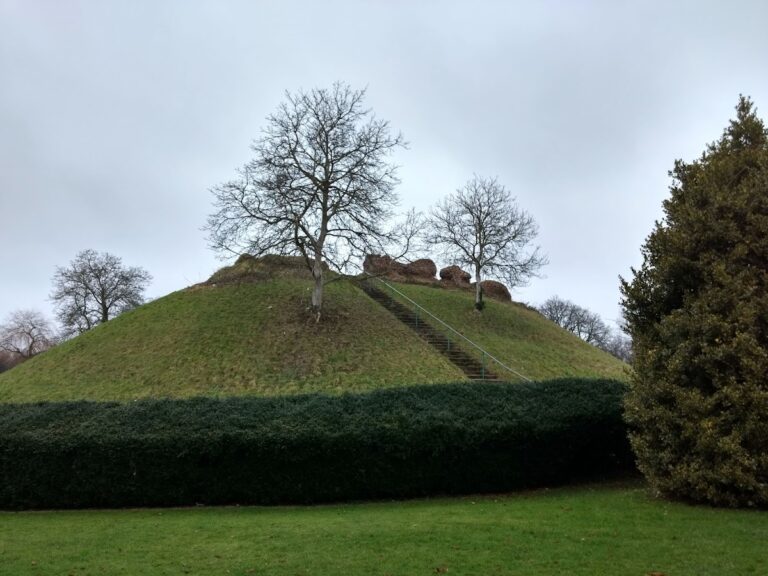
The castle stood on a natural high point within Saffron Walden, about 69 metres above sea level. Its substantial fortification consisted of a square keep and a bailey enclosed by a bailey wall. The surrounding landscape is generally flat and largely agricultural, while the former bailey’s outline continues to shape the town’s streets. The surviving remains are concentrated in the ruined core, and much of the castle’s stone was removed and reused over the centuries.
Keep and bailey
Norman keep
The square Norman keep was the castle’s principal fortified tower, combining residential and defensive purposes. It was probably unfinished when Henry II ordered the castle’s slighting in 1157. Its ruined core survives as the clearest physical remnant of the medieval fortification.
Bailey enclosure
The keep was accompanied by a bailey, an enclosed area adjoining the tower, surrounded by a bailey wall. Although the castle’s stone fabric was extensively removed and reused, the former bailey remains legible through the pattern of Saffron Walden’s streets, preserving the outline of the medieval enclosure within the modern town.