Templo Mayor: The Principal Temple of Tenochtitlan
Site at a Glance
- Rating
- 4.6
- Popularity
- Very Low
- Country
- Mexico
- Primary era
- Medieval
- Eras represented
- Medieval, Early Modern
- Civilizations
- Aztec
- Site type
- Religious
- Remains
- Temple
On this page18 sections
History
Templo Mayor is the principal Mexica temple in present-day Mexico City, Mexico, built during the Late Postclassic period of Mesoamerica from sometime after 1325. The Mexica, the Nahuatl-speaking people who founded and ruled Tenochtitlan, established the temple at the center of their island capital and its Sacred Precinct.
Foundation and successive rebuilding
Templo Mayor was the absolute center of Mexica religious life. Political, religious, mythological, and economic activities converged there. Festivals followed the tonalpohualli, a ritual calendar, while the precinct also hosted the enthronement of rulers, funerals for former rulers, the collection of sacred offerings, and the storage of funerary deposits.
The temple was rebuilt six times, producing seven principal stages. Each new structure largely covered its predecessor, and the phases became associated with the rulers responsible for them. The first temple was built after 1325, perhaps soon after Tenochtitlan was founded. Its construction used earth and perishable wood, and the high water table beneath the former lake limited the possibility of excavation, so its form is known through historical records.
The second temple existed by 1375 and was built during the reigns of Acamapichtli, Huitzilihuitl, and Chimalpopoca, approximately between 1375 and 1427. It was followed by the third temple under Itzcóatl, between approximately 1427 and 1440. A glyph associated with the year 1431 appears on a staircase from this phase.
During the reigns of Moctezuma I and Axayácatl, the fourth temple was constructed and expanded between approximately 1440 and 1481. Its major enlargement is also dated to about 1454, and this phase produced the richest group of architectural decoration and sculpture. The fifth temple belongs to the short reign of Tizoc, approximately 1481 to 1486. Its platform was resurfaced with stucco and the ceremonial plaza was paved.
Ahuízotl’s reign brought the sixth temple and major work within the Sacred Precinct. The precinct was enclosed by a wall decorated with serpent heads, and the ruler added or completed three shrines and the House of the Eagle Warriors. A commemorative stone gives the temple’s opening as 19 December 1487. The seventh temple was built or altered between approximately 1500 and 1521. It was the structure seen by the first Spaniards in 1519 and the largest and most important active ceremonial center of that period.
Religion, rulership, and sacrifice
The Sacred Precinct was traditionally described as containing 78 buildings. Alongside temples, it included schools, priestly facilities, ballcourts, skull racks, and buildings linked with particular deities, priestly groups, and conquered peoples. Templo Mayor stood above these structures as the symbolic center of the Mexica tribute network and as a sanctuary connected with military achievement.
The twin summit shrines expressed paired oppositions such as sky and earth, drought and rain, and the summer and winter solstices. The southern shrine belonged to Huitzilopochtli, the Mexica patron deity of the sun, war, and tribute. The northern shrine belonged to Tláloc, a major Mesoamerican deity of rain, water, agricultural fertility, storms, and crop destruction. Their union connected warfare and the acquisition of tribute with rain, agriculture, and fertility.
The temple was also a place of human sacrifice and autosacrifice, a bloodletting ritual intended to communicate with deities. A re-consecration under Ahuízotl in 1487 was said to have involved between 3,000 and 84,000 victims, although some historians regard the higher figure as exaggerated. The temple’s religious meaning was also tied to the story of Huitzilopochtli’s birth and his victory over his sister Coyolxauhqui and the Centzon Huitznahua, his star-associated brothers, at Coatepec. The southern sanctuary was interpreted as a representation of that sacred mountain, while the northern half was associated with Tláloc’s mountain home, Tonacatepetl.
Tradition placed the temple at the spot where Huitzilopochtli gave the Mexica their sign of the promised land, an eagle on a nopal cactus with a serpent in its beak. Its orientation was connected with the festival of Tlacaxipehualiztli. Measurements relate the east-west axis of the later phases to a sunset on 4 April, equivalent to 25 March in the sixteenth-century Julian calendar. In 1519, that date fell on the festival’s final day. Stage II had a different orientation from Stage III and the later phases. Fray Toribio de Motolinía’s statement that the sun stood “in the middle” of the Huitzilopochtli temple has therefore been interpreted as referring to this festival alignment, rather than to the astronomical equinox in its modern meaning.
Conquest and destruction
During the conquest, Pedro de Alvarado led a massacre of Mexica nobles in the Sacred Precinct while they were celebrating a religious festival. An estimated 8,000 to 10,000 Mexica nobles were killed. Later in the conflict, captured Spaniards were sacrificed at the temple.
After Tenochtitlan fell on 13 August 1521, the Spanish dismantled and destroyed Templo Mayor and other buildings in the Sacred Precinct. Their materials were reused in the colonial city, while a Spanish church, later the Metropolitan Cathedral, was built over the western part of the precinct. This destruction formed part of the political, religious, and ideological transformation of Tenochtitlan. In 1519, Hernán Cortés had ordered Mexica religious objects destroyed and a Catholic cross placed on the temple.
Rediscovery and archaeological investigation
As the colonial city covered the former Mexica center, the exact position of Templo Mayor was eventually forgotten. Archaeological and documentary investigations in the late nineteenth and early twentieth centuries gradually re-established its location. Leopoldo Batres excavated beneath the Metropolitan Cathedral in the late nineteenth century because researchers then believed that the cathedral stood directly over the temple. Later work showed that the cathedral lies southwest of Templo Mayor.
Manuel Gamio excavated part of the southwest corner of Stage III in 1913 and 1914, confirming the position of the principal Mexica ceremonial precinct. His work was interrupted in January 1915 and resumed later that year, with precautions taken to protect nearby houses and the remains. Further investigations by Emilio Cuevas in 1933, Hugo Moedano and Elma Estrada Balmori in 1948, and Eduardo Contreras and Jorge Angula in 1966 exposed a staircase, a beam, a serpent-head platform, offerings, and a chest previously examined by Gamio.
On 21 February 1978, workers excavating for underground electrical cables found a large relief disk. It was identified as Coyolxauhqui, and the discovery led to the major Templo Mayor archaeological project. From 1978 to 1982, specialists directed by archaeologist Eduardo Matos Moctezuma excavated the temple and its Sacred Precinct. Thirteen buildings, including nine constructed in the 1930s and four nineteenth-century buildings retaining colonial elements, were demolished to make the excavation possible.
More than 7,000 objects were recovered, mainly from offerings. The project brought archaeologists, restorers, chemists, geologists, biologists, and other specialists together to investigate, conserve, and interpret the remains. The Museo del Templo Mayor was built in 1987 and opened on 12 October that year to house and explain smaller and more fragile finds. The Urban Archaeology Program joined the Templo Mayor Project in 1991 to investigate the oldest areas of Mexico City around the main plaza. The archaeological site forms part of the Historic Centre of Mexico City and Xochimilco, inscribed on the UNESCO World Heritage List in 1987. Mexico’s National Institute of Anthropology and History administers the site.
Remains
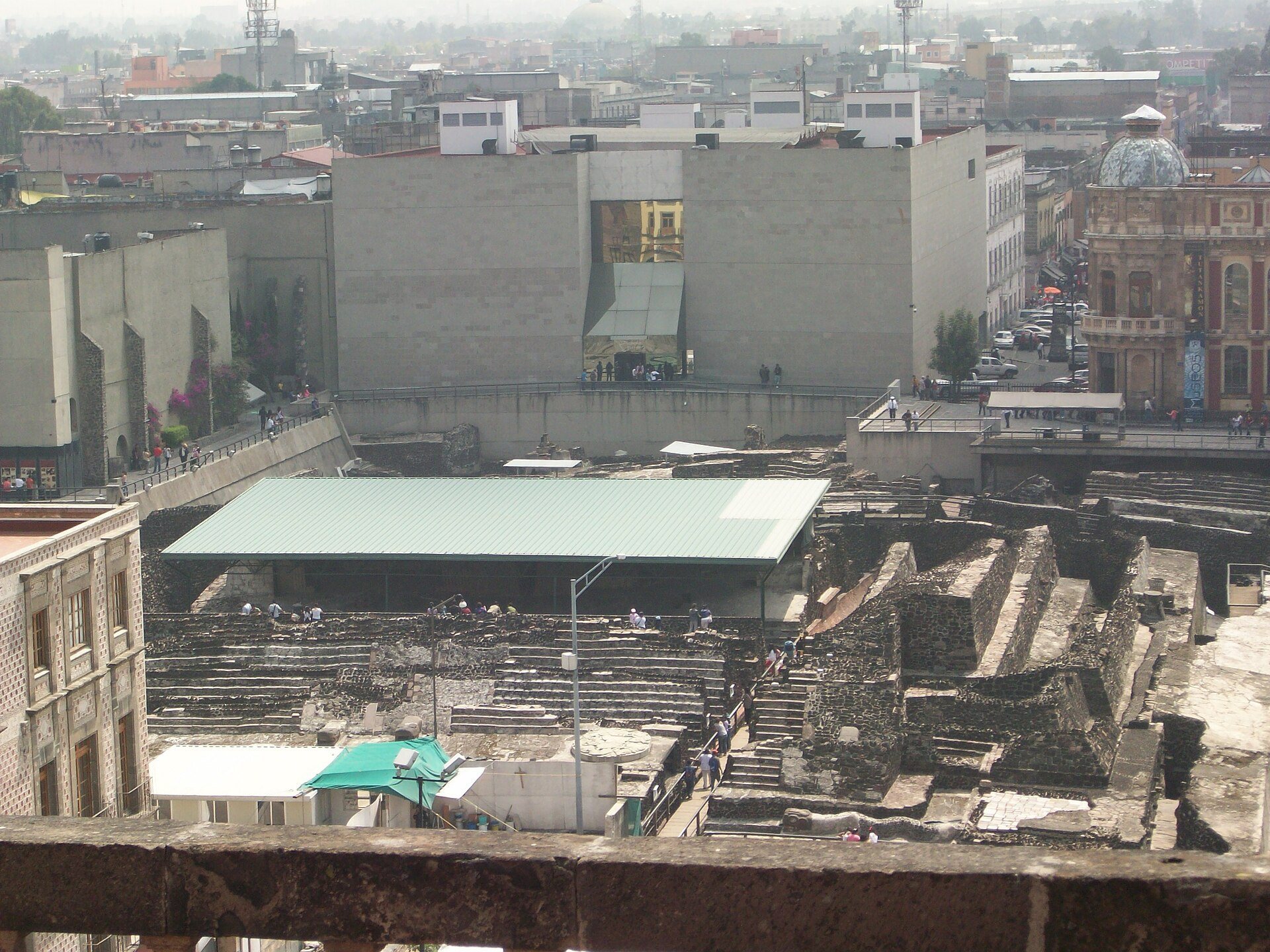
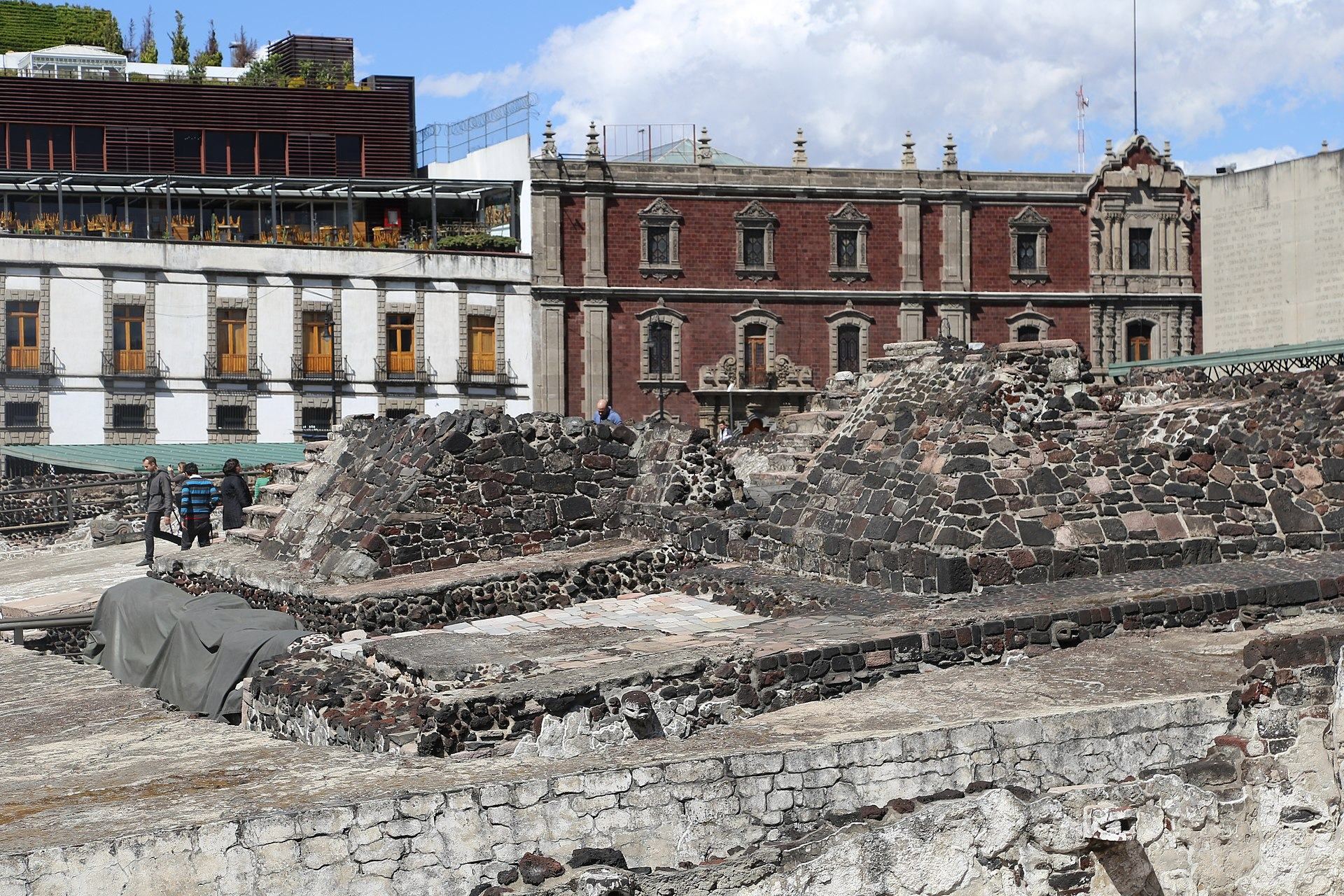
The Sacred Precinct and main temple
The Sacred Precinct stood at the center of the island city of Tenochtitlan, on the original islet associated with the city’s foundation. It formed an approximately square enclosure about 500 metres on each side, with entrances opening toward the principal causeways. The southern road led to Ixtapalapa, the western road to Tacuba, and the northern road to Tepeyac, with branches toward Coyoacán and Tlatelolco. The later enclosing wall, called a serpent wall, carried serpent-head decoration.
The double pyramid
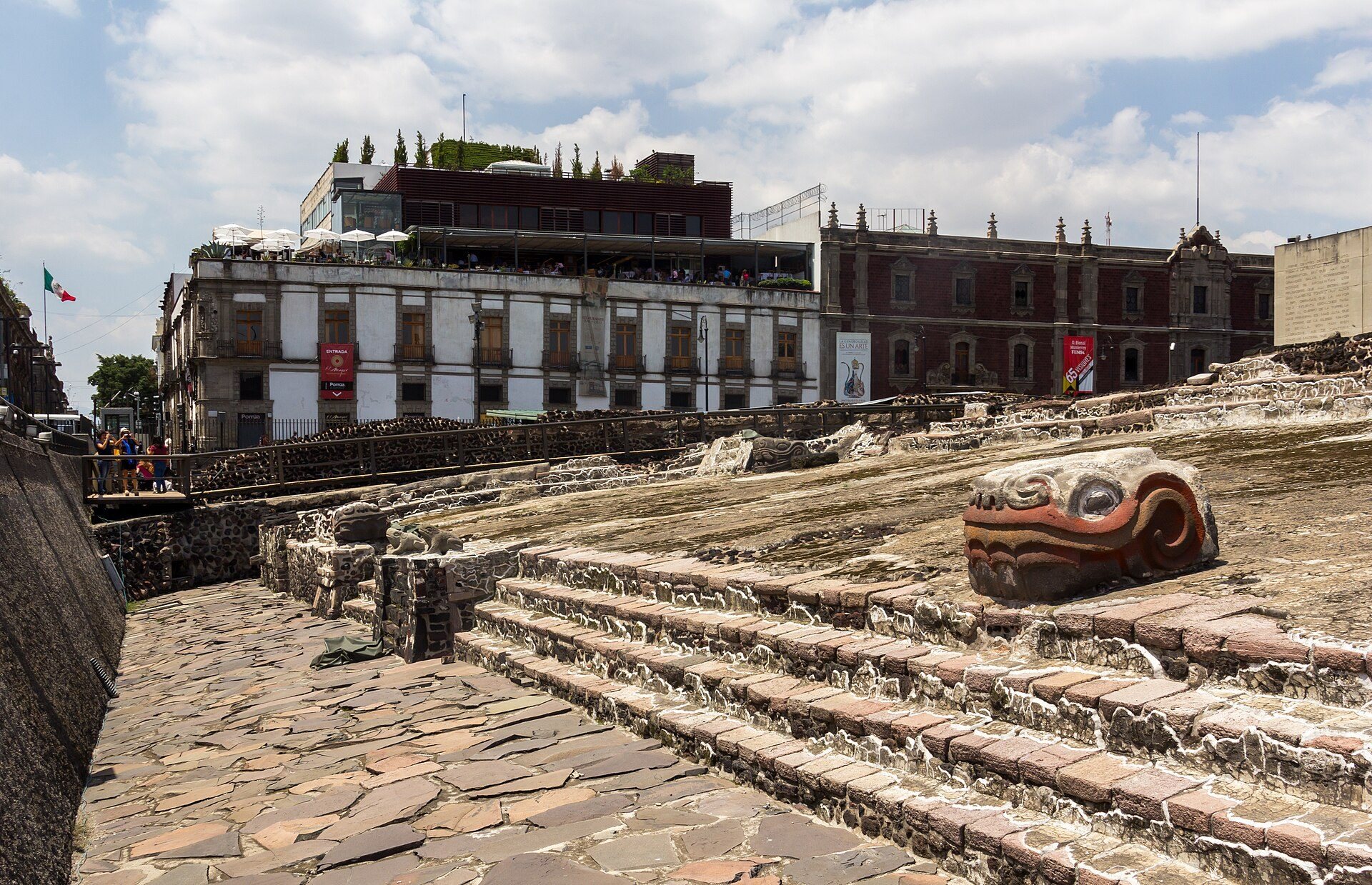
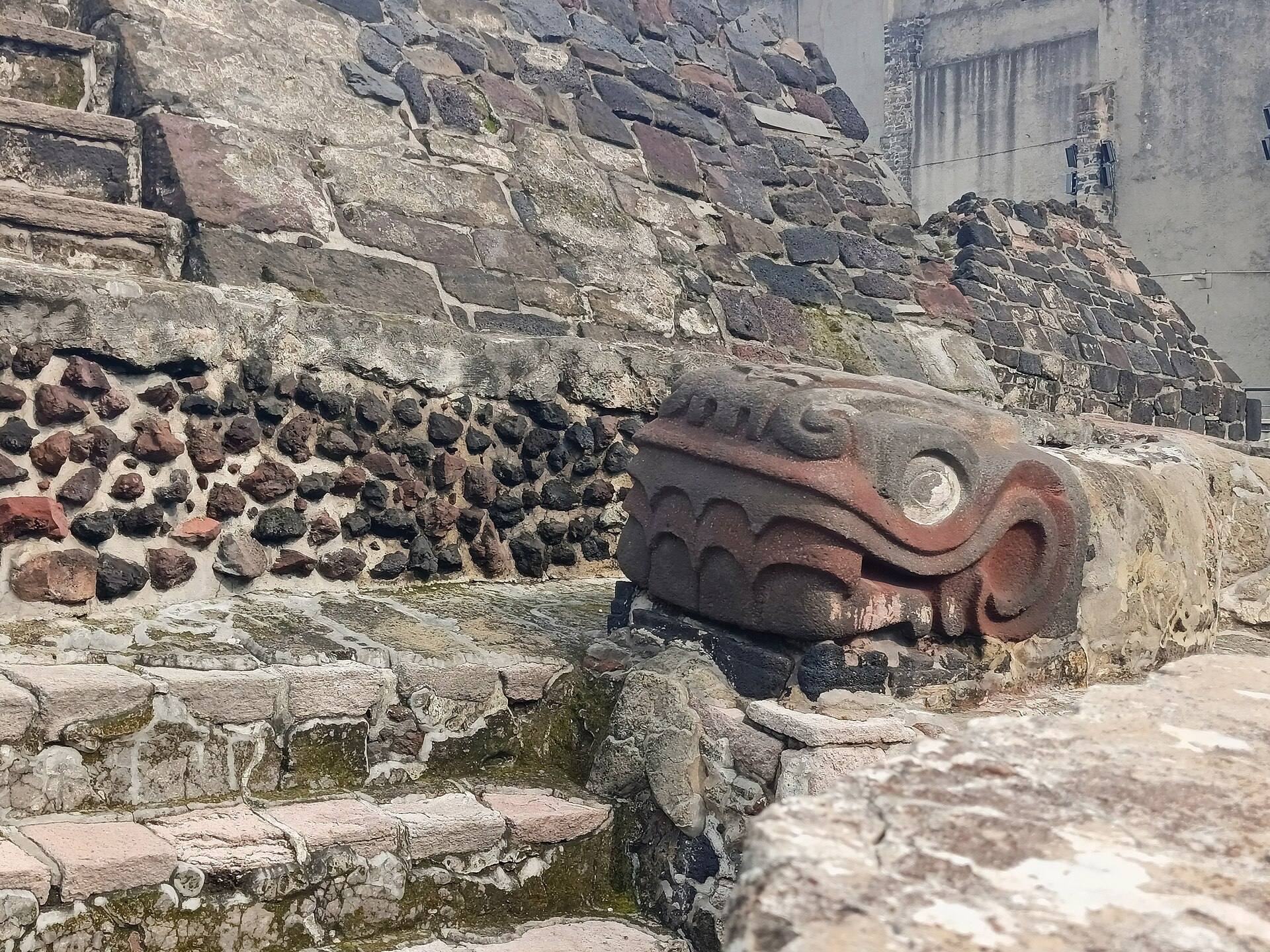
Templo Mayor was a truncated double pyramid with a base of approximately 100 by 80 metres and a height of about 42 to 45 metres. Two stairways rose to separate summit shrines, each with large braziers for sacred fires. Serpent-headed balustrades bounded the stairways, while seated male figures at the entrances supported standards and bark-paper banners. The building was covered with stucco and polychrome paint, and curtains shielded the deity images within the shrines. The Huitzilopochtli side was painted red, while the Tláloc side was distinguished by blue surfaces.
Excavated stages
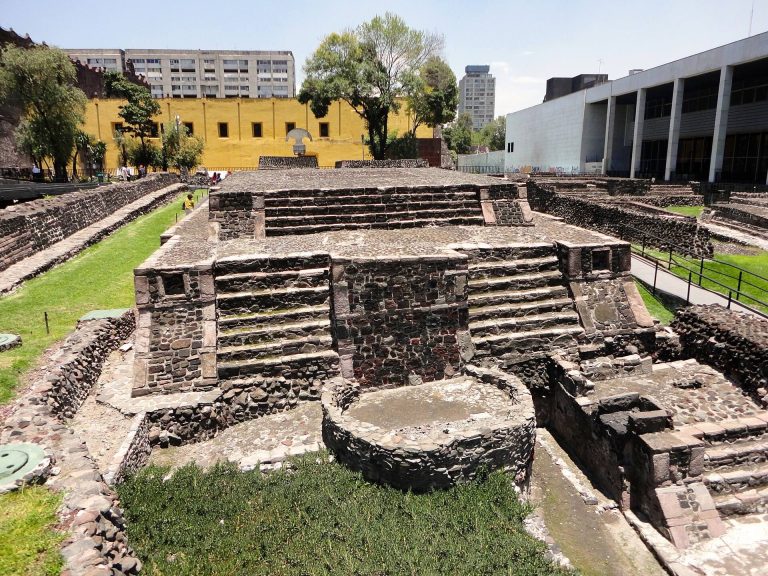
Stage II is the most intact excavated phase. Its upper section preserves two stone shrines covered with stucco, a chacmool, a reclining ritual figure with a bowl or disk on its abdomen, a sacrificial stone, a sculpted face, and painted murals in the Tláloc shrine. A glyph that may represent the numeral or date 1390 appears on the last step before the sacrificial stone.
Stage III preserves a staircase and part of the pavement. Eight stone standard-bearers on the staircase were interpreted as divine warriors guarding access to the upper shrines. Stage IV had an enlarged front platform decorated with undulating serpents. Its stairway balustrades ended in serpents, and braziers associated with Tláloc and Huitzilopochtli surrounded the platform. Some braziers were shaped as monkeys or as Tláloc. A small altar decorated with paired sculpted frogs stood at the center of the Tláloc shrine, while the circular Coyolxauhqui disk belonged to this phase.
Stage V preserves the general stuccoed platform and part of the ceremonial pavement. Stage VI retains part of the principal facade, including a wall with three serpent heads. Stage VII is represented mainly by a northern platform and part of the courtyard paving. Much of its other fabric was destroyed when the colonial city and the Metropolitan Cathedral were built.
Associated buildings
Temple of Ehécatl
The Temple of Ehécatl stood in front of Templo Mayor, between the main temple and the later Metropolitan Cathedral area. Ehécatl was Quetzalcoatl in his aspect as wind deity. The temple’s platform had a rectangular projection attached to a circular base, a single staircase of 60 steps, and a circular temple about 14 metres in diameter that may have risen to approximately 32 metres. Its conical roof had battlements, and its entrance was shaped like serpent jaws. Oriented toward the east, it may have been positioned so that sunlight passed between the two summit shrines of Templo Mayor.
House of the Eagle Warriors
The House of the Eagle Warriors, also called the Palace of the Eagle Warriors, dates to the fourth phase, around 1469. This large L-shaped complex had stairways decorated with eagle-head sculptures and an entrance guarded by two large warrior figures. Paintings covered the interior walls, while long painted benches carried upper friezes of undulating serpents in relief and lower panels showing armed warriors converging on a zacatapayolli, a bundle used in autosacrifice.
The adjoining Red Temple was associated with the Eagle Warriors. Its paintings were predominantly red, and its altar showed clear influence from Teotihuacan. The House of the Eagle Warriors also imitated features of the Burnt Palace at Tula. Two large, nearly identical ceramic sculptures of Mictlantecuhtli, the Mexica god of death and the underworld, were found there. Their fragile fragments were reconstructed and are displayed in the on-site museum.
Other temples and ritual buildings
The temple of the Ocelot Warriors, dedicated to Tezcatlipoca, lies south of Templo Mayor beneath the present building of the Secretariat of Finance and Public Credit. The Calmecac, a priestly school and residence for future priests, administrators, and politicians, was associated with the area beside present-day Donceles Street. Its curriculum included theology, literature, history, and astronomy.
The Temple of Quetzalcoatl stood west of Templo Mayor. Its circular base reflected the deity’s serpentine nature, and tradition connected its position with sunlight rising between the two main shrines at the equinox. The Temple of the Sun also stood west of Templo Mayor, with remains beneath the Metropolitan Cathedral. Work to reinforce the cathedral in the late twentieth and early twenty-first centuries exposed associated artifacts.
Ballcourt and skull rack
The sacred ballcourt, called tlachtli or teutlachtli, lay west of Templo Mayor near the twin stairways and followed an east-west orientation. Players moved a heavy ball with their hips toward stone rings. Beside it stood the huey tzompantli, a skull rack where the skulls of sacrificial victims were covered in stucco and decorated.
Offerings and sculptural remains
Offerings were placed in cavities, stone urns, and boxes made from slabs beneath floors and within platforms, architectural bodies, stairways, and temples. Their arrangement followed temporal, spatial, and symbolic patterns. The oldest excavated Mexica offerings include two urns from the second temple containing cremated bones. One urn was made of obsidian and the other of alabaster; the associated objects included a small silver mask, two gold bells, and two green-stone beads.
Other offerings contained sculptures, flint knives, vessels, beads, ornaments, minerals, plants, and animal and human remains. Objects came from the Mexica and from other Mesoamerican peoples and may represent tribute or exchange. Animal remains included turtles, frogs, crocodiles, and fish, while other deposits contained snail shells, coral, gold, alabaster, copper rattles, and decorated skulls. Tláloc-shaped clay vessels occur among the finds. Huehueteotl-Xiuhtecuhtli and Tláloc frequently appear together, probably expressing the idea of “burning water,” a metaphor for warfare.
Objects associated with autosacrifice include obsidian blades, agave needles, bone perforators, zacatapayolli bundles, ceremonial boxes called tepetlacalli, face knives decorated with eyes and teeth, skull masks, musical instruments, jewelry, and braziers for burning copal.
Coyolxauhqui disk
The Coyolxauhqui disk was found at the foot of the Huitzilopochtli stairway. This circular stone relief depicts the dismembered lunar deity from the origin myth represented by the temple. It measures more than 3.25 metres in diameter, is about 30 centimetres thick, and weighs approximately 8.5 metric tons.
Tlaltecuhtli relief
A separate monolithic relief of Tlaltecuhtli was discovered on 2 October 2006 at the corner of Guatemala and Argentina, in front of Templo Mayor. Carved from lamprobolite andesite, it measures 4.17 by 3.62 metres and weighs approximately 12 tons. The earth deity has curled hair, crescent-shaped eyes, a broad nose, cheek circles, a fleshless mouth, and prominent ears with circular ornaments. A blood-like flow runs from a circular incision on the abdomen toward the mouth. Two small sandaled feet appear within the incision and may belong to a lost image of a deity or ruler.
Museo del Templo Mayor
The Museo del Templo Mayor has eight exhibition halls and displays thousands of objects from more than 110 offerings. Its collections include sculptures, ritual objects, funerary deposits, plant and animal remains, and other materials associated with the temple and Sacred Precinct. The building has four floors, with three devoted to permanent exhibitions and one used for offices and administration. Additional departments and an auditorium occupy the basement.
The exhibitions address Coatlicue and Coyolxauhqui, ritual and sacrifice, Mexica tribute and trade, Huitzilopochtli, Tláloc, Mesoamerican plants and animals, agricultural technology and chinampas, and the archaeology and history of the site. The museum displays an Eagle Warrior sculpture, also interpreted as an “Eagle Man” representing the rising sun or a newly selected ruler, together with images of Mictlantecuhtli, Huitzilopochtli, Tláloc, and other deities. A large Tláloc vessel retains much of its original blue paint.