Tenayuca: A Chichimec and Mexica Ceremonial Center in Mexico
Site at a Glance
- Rating
- 4.6
- Popularity
- Low
- Country
- Mexico
- Primary era
- Early Modern
- Eras represented
- Medieval, Early Modern
- Civilizations
- Aztec
- Site type
- Religious
- Remains
- Temple
On this page12 sections
History
Tenayuca is a pre-Columbian Mesoamerican archaeological site in San Bartolo Tenayuca, Mexico, at the foot of Cerro del Tenayo in the Sierra de Guadalupe. The settlement became a major Chichimec and later Mexica political and ceremonial center during the Postclassic Period, the later major era of pre-Columbian Mesoamerican history before the Spanish conquest. Its name means “walled place” or “place full of walls” in Nahuatl.
Early occupation and Chichimec power
Archaeological remains indicate that the area was occupied during the Classic Period, before the traditional Chichimec foundation. Its population grew during the early Postclassic and expanded further after the fall of Tula, when Tenayuca emerged as an important regional power in the Valley of Mexico.
Tradition places the foundation of Tenayuca around 1224 and attributes it to Xolotl, a semi-legendary Chichimec ruler. The Chichimecs were diverse northern or semi-nomadic peoples who migrated into central Mexico and established political communities there. Tenayuca is regarded as the earliest Chichimec capital in the Valley of Mexico and remained the principal center of Chichimec political power until Quinatzin transferred the seat of power to Texcoco.
After Xolotl, Nopaltzin consolidated the Chichimec realm, and his son Tlotzin became lord of Tenayuca. In the late thirteenth century, Tochintecuhtli, the ruler of Tenayuca, allied with Huetzin, lord of the Acolhua of Coatlichán. The Acolhua were a major polity centered first at Coatlichán and later at Texcoco. Their combined power extended across the central Valley of Mexico as far northeast as Tulancingo.
Decline, Mexica rule, and later history
Tenayuca’s regional power declined during the fourteenth century as Azcapotzalco conquered it and replaced it as the dominant regional power. Tenochtitlan, the Mexica capital that later became the political center of the Aztec Empire, incorporated Tenayuca into the empire around 1434.
The settlement remained occupied during the Spanish conquest, and fighting took place there in 1520. Bernal Díaz del Castillo called Tenayuca the “town of the serpents.” The settlement later declined and was eventually abandoned. South of the pyramid, the Church of San Bartolomé, also called San Bartolo Tenayuca, may have begun construction in 1524 or 1525 after Franciscan friars arrived. A small church at the location appears on the 1550 Map of the Valley and City of Mexico.
Archaeological investigation and interpretation
An official observation of the mound at the settlement’s center took place in 1898, and archaeological study began in 1914. Exploration resumed in 1925 under Mexico’s archaeological authorities, leading to the discovery of the major pre-Hispanic building. Alfonso Caso described the wall inscriptions in 1928, while José Reygadas Vertiz and Ignacio Marquina took part in the first extensive excavations in 1935.
Tenayuca is considered an important early stage in the development of Aztec sacred architecture because it preserves the earliest known example of the characteristic double pyramid. After the site came under Aztec control, this form was adopted for major Aztec temples dedicated to their own deities. The pyramid is under the care of Mexico’s National Institute of Anthropology and History, the national institution responsible for archaeological research, conservation, and administration of major historical and archaeological sites. The Museo Xolotl, inaugurated beside the archaeological zone in 1985, contains ceramics, stone artifacts, human and animal remains, and circular shields from the site.
Remains
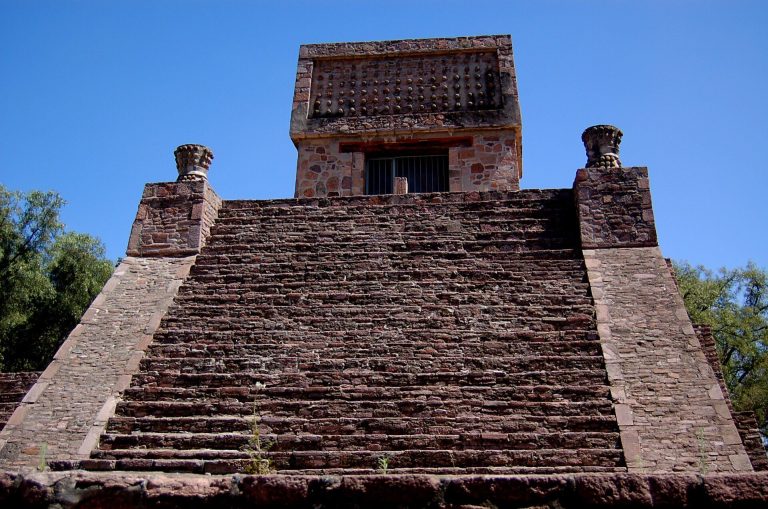
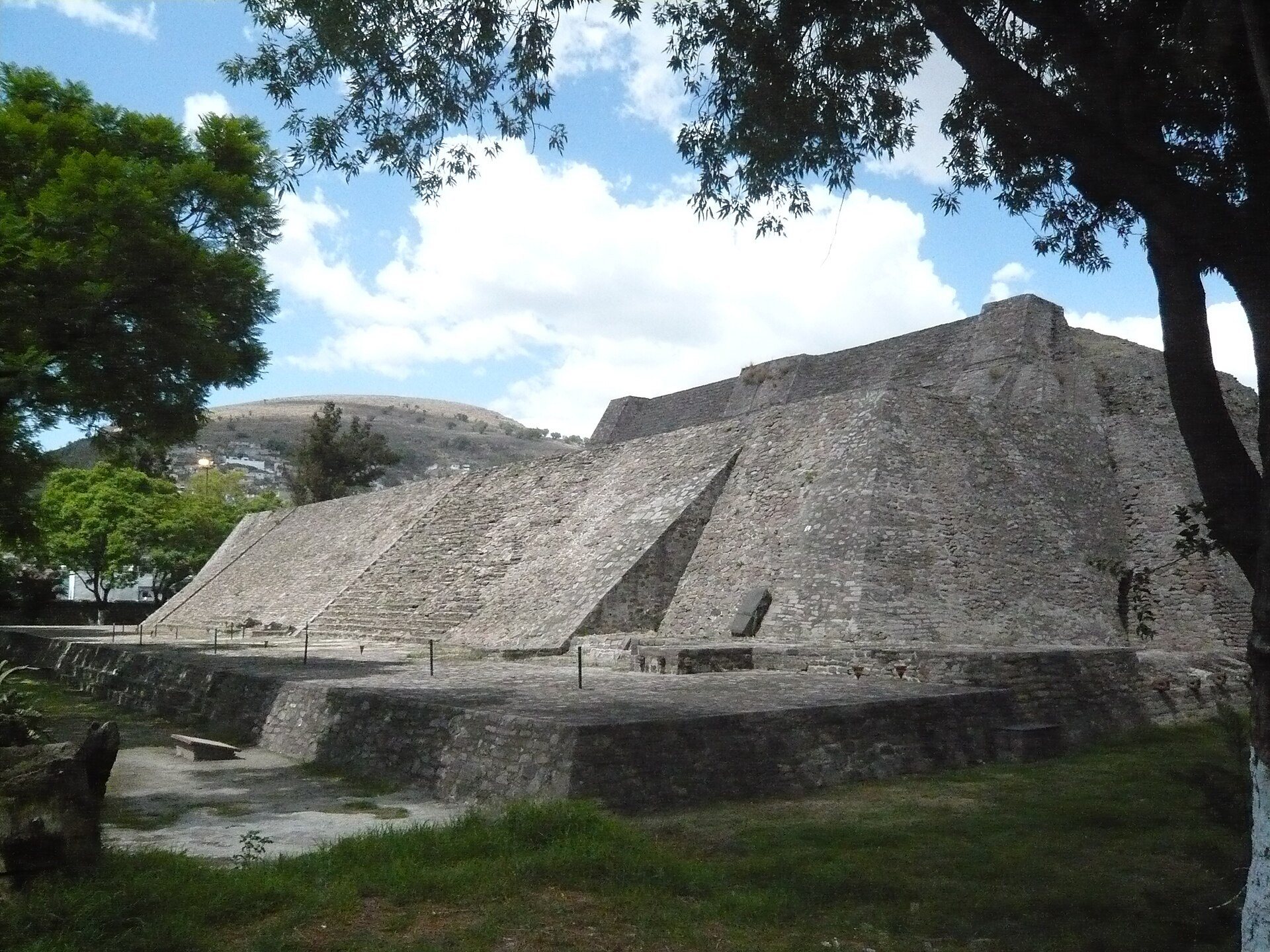
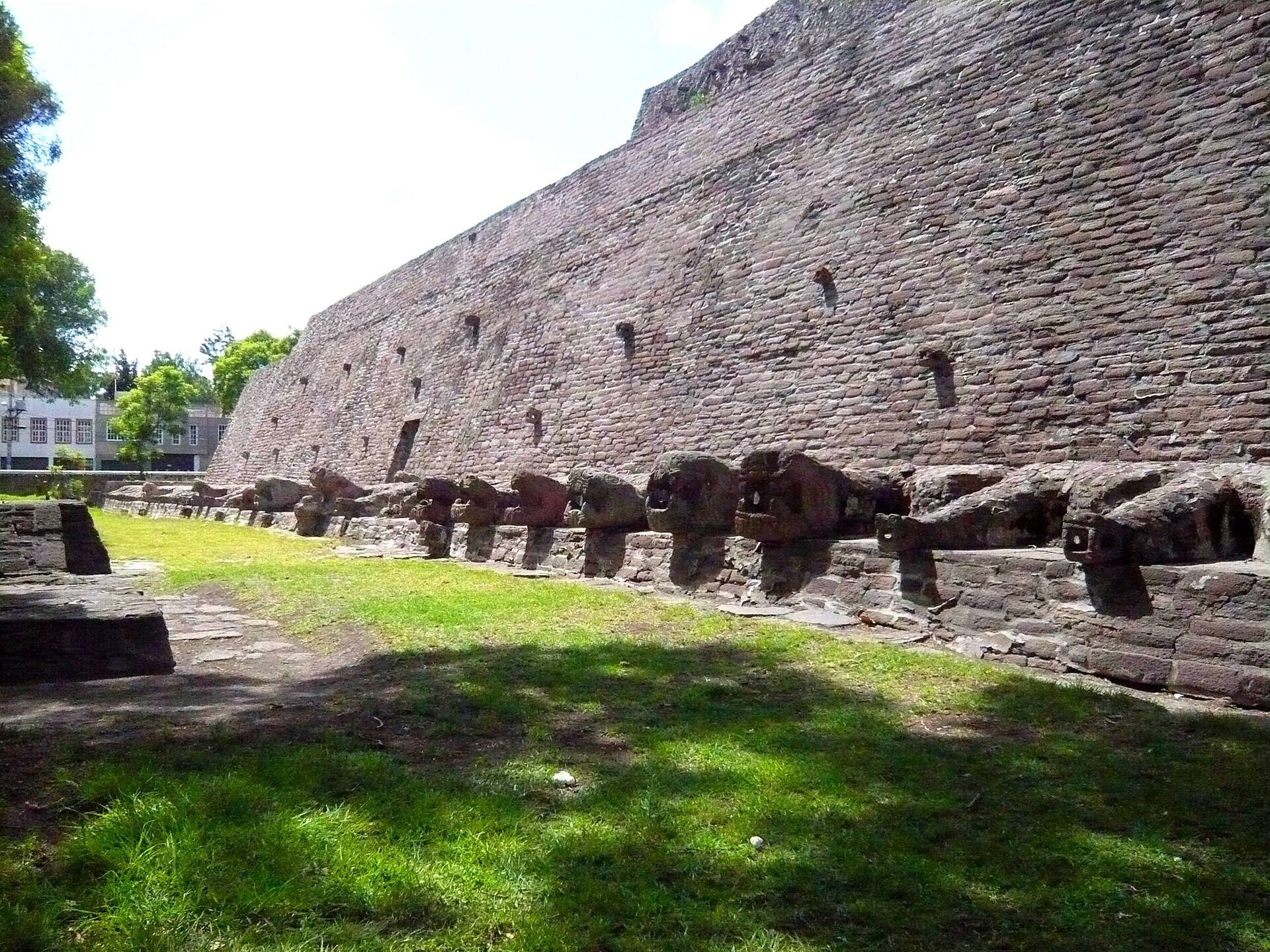
Tenayuca’s principal monument is a massive, truncated pyramidal temple platform with a west-facing facade and a broad staircase divided by a double balustrade. The temple measures approximately 52 meters in length and 60 meters in width, while the final construction phase is also described as about 62 meters wide and 50 meters deep. The pyramid was enlarged through several superimposed building phases while retaining its basic double-pyramid plan.
Pyramid and serpent enclosure
Double temple platform
Two temples once stood on the summit of the platform. The northern sanctuary was dedicated to Tlaloc, a deity associated with rain and fertility, while the southern sanctuary was dedicated to Huitzilopochtli, the principal Mexica deity of warfare and the sun. Their placement made Tenayuca an early example of a joined double pyramid supporting twin temples.
The original structure was enlarged five times. The first enlargement probably took place in 1299, followed by further additions at intervals of 52 years. The third stage, dated to 1351, shows Aztec influence. Later stages display the sloping tiers associated with Aztec architecture rather than the vertical walls of the earlier phases, and the final phase probably dates to 1507.
Carved signs and year-glyphs appear on the stairway and other parts of the building, including knife, circle, and shield forms. A projecting platform south of the main staircase carries sculptures of crossed bones and skulls.
Serpent wall and fire serpents
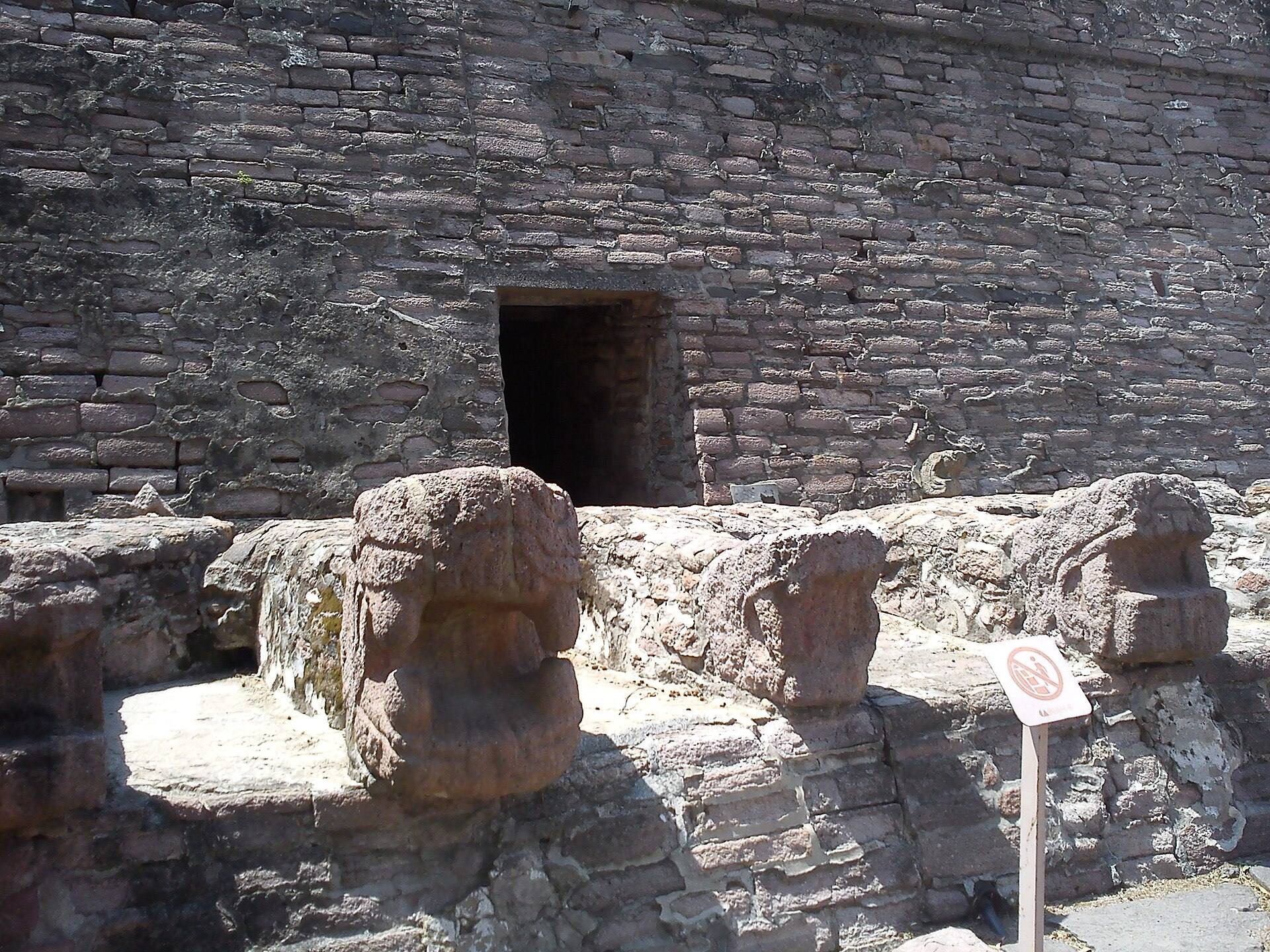
A low coatepantli, or enclosure decorated with serpent imagery, surrounds the pyramid. It consists of 138 stone snake sculptures. The sculptures were originally covered with plaster and painted in several colors. Their scales were painted black, while blue, green, and red pigments were also used, with areas of black and blue coloration on different sides of the enclosure. The serpent wall remains largely intact along three sides of the pyramid’s base.
Two large coiled-serpent sculptures stand at ground level on the north and south sides of the pyramid. Star-like markings on their head crests identify them as xiuhcoatl, or fire serpents. This imagery is associated with fire and solar worship.
Altars and skull-display platforms
Smaller platforms beside the pyramid are identified as tzompantlis, structures used to display the skulls of victims. Nearby altars and shrines were also excavated, and some contained serpent sculptures. One altar was decorated with skulls and crossed bones and was associated with human remains.
The arrangement and coloring of the serpent wall have been interpreted in relation to astronomical and solar symbolism. Tenayuca has been associated with observations of the spring and autumn equinoxes and the summer and winter solstices. The building’s orientation has also been linked to the setting of Aldebaran in the constellation Taurus, although that interpretation remains a proposal rather than a certainty.
Residential and later structures
Tenayuca II
Approximately 200 meters from the principal temple are the remains of an apparent elite residential complex known as Tenayuca II. Some rooms retain plaster floors, and the complex passed through several construction phases.
Church of San Bartolomé
The Church of San Bartolomé, or San Bartolo Tenayuca, has a restrained facade with a lowered semicircular arch, two buttresses, and an upper niche containing a figure of Saint Bartholomew the Apostle. It was built from pink quarry stone from the Sierra de Guadalupe. Its fabric incorporates reused pre-Hispanic masonry, including stones bearing carved glyphs, and also reuses stone from earlier shrines or parts of the pyramid.