Temple of Apollo Grannus: A Roman Healing Sanctuary at Phoebiana
Site at a Glance
- Rating
- 4.3
- Popularity
- Medium
- Country
- Germany
- Primary era
- Classical
- Eras represented
- Classical, Medieval
- Civilizations
- Roman
- Site type
- Religious
- Remains
- Temple
On this page8 sections
History
The Temple of Apollo Grannus was a Roman sanctuary at Phoebiana, the ancient settlement identified with modern Faimingen in Germany. Dating to the third century AD, it formed part of a spring sanctuary known for thermal cures. Apollo was a Roman god of healing, while the Celtic god Grannus was associated with springs and baths. Clear spring water supported ritual bathing and drinking treatments, helping make Phoebiana an important healing centre.
Roman sanctuary and Caracalla
In AD 212, Emperor Caracalla sought relief from his ailments at Phoebiana. He also sought treatment at sanctuaries of Asclepius, a healing deity, and Serapis, a Greco-Egyptian god. The Roman historian Cassius Dio interpreted Caracalla’s symptoms as psychosomatic. The sanctuary at Phoebiana was the first of these therapeutic visits for which a date is known.
An inscription from Ephesus recounts an Ephesian citizen’s repeated diplomatic missions to Caracalla and travels through Rome, Britain, and Upper Germania, a Roman province on the Rhine frontier. The itinerary ends at a sanctuary of "Grannian Apollo." This suggests Caracalla visited a healing sanctuary early in his reign; Phoebiana is the likeliest location. His presence in Upper Germania may have been connected with preparations for a campaign against peoples on the empire’s northern frontier.
Three milestones further connect Phoebiana with Caracalla. Two were found beneath a church in nearby Gundelfingen in 1981, and a third came to light at Sontheim in 2002. Their inscriptions, dated to AD 212–213, name Phoebiana and Apollo Grannus, identify the settlement as a road destination, and record road and bridge works commissioned by Caracalla, probably at his expense. They also support the identification of Phoebiana with modern Faimingen.
Excavation and reconstruction
Excavations began in 1888 under village schoolteacher Magnus Scheller and later uncovered the temple and remains of nearby buildings. In 1972, 150 worked stone blocks recovered from the Brenz River, along with an equal number of stones reused in the fortification wall, made partial reconstruction possible. From 1976 to 1980, the Roman-Germanic Commission of the German Archaeological Institute excavated the site under archaeologist Gerhard Weber. An open-air museum was established there in 1987.
Remains
The temple complex
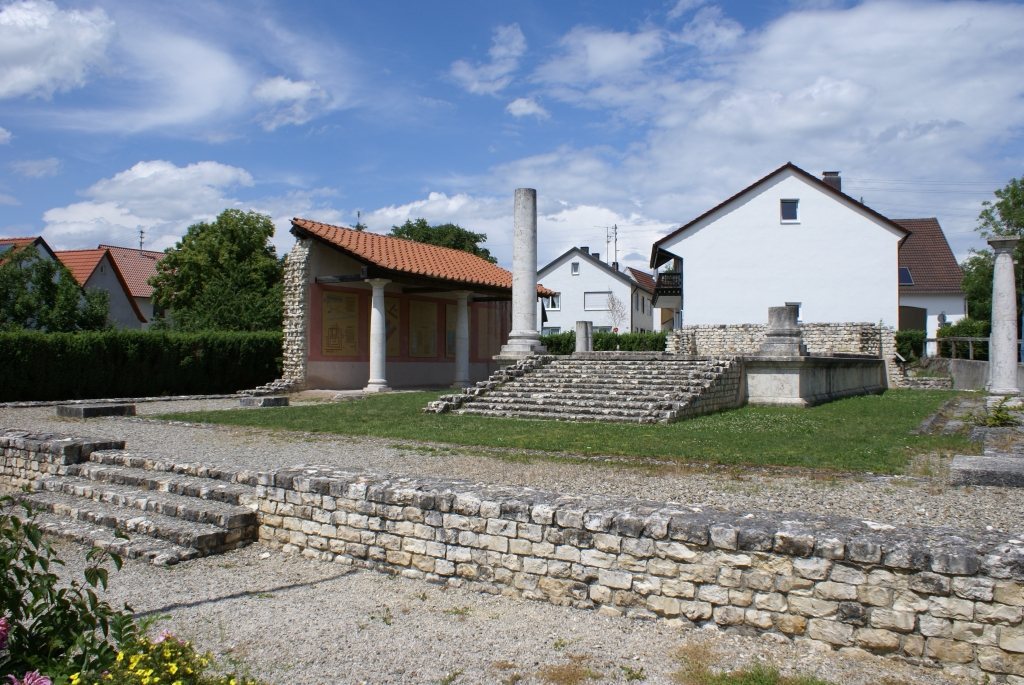
Phoebiana covered about 40 hectares at its greatest extent, and the temple occupied roughly 1,000 square metres. The complex is organized around a colonnaded sacred court and temple. The temple is among the largest Roman temples north of the Alps.
Precinct and approach
Roads entering Phoebiana converged on its forum. At the sanctuary’s southern entrance stands a medieval well. Stairs lead from this area to Porticus II, an inner colonnaded walkway, and onward to the temple court, or temenos (sacred precinct). A ramp connects the court with the pronaos (temple entrance porch) and then the cella (enclosed main room).
Temple court and colonnades
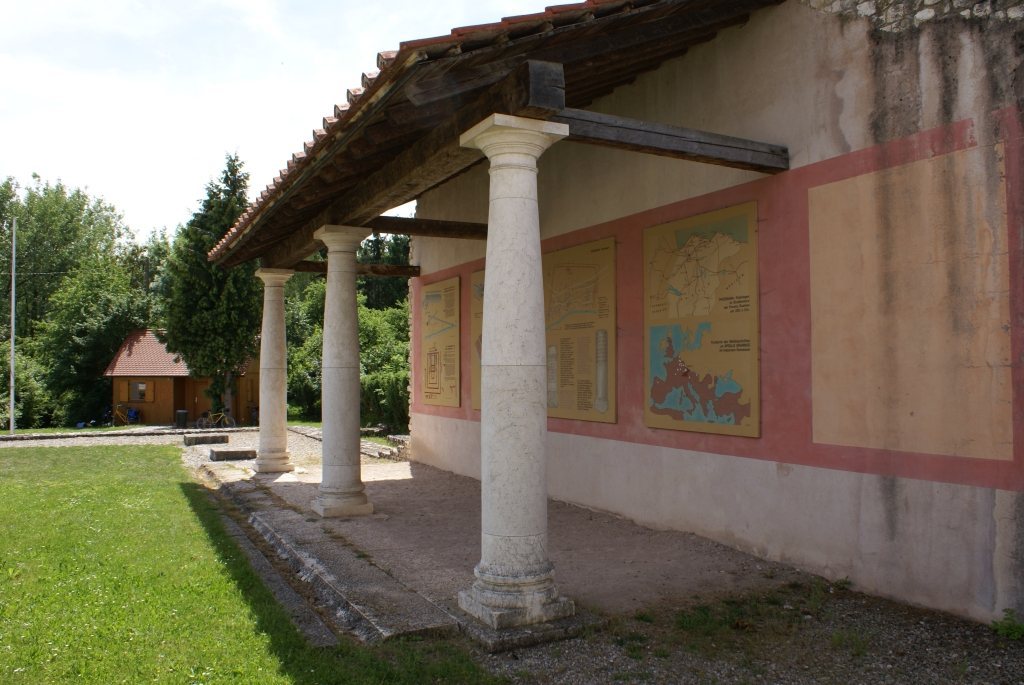
A colonnade originally bordered the court on three sides and had 14 columns. Eight columns survive or have been reconstructed. On the west, three columns align with part of the wall of Porticus I, the outer colonnade, and are covered by a roof. One column from Porticus I remains; the former line of the walkway is marked in white along the path.
Adjacent buildings
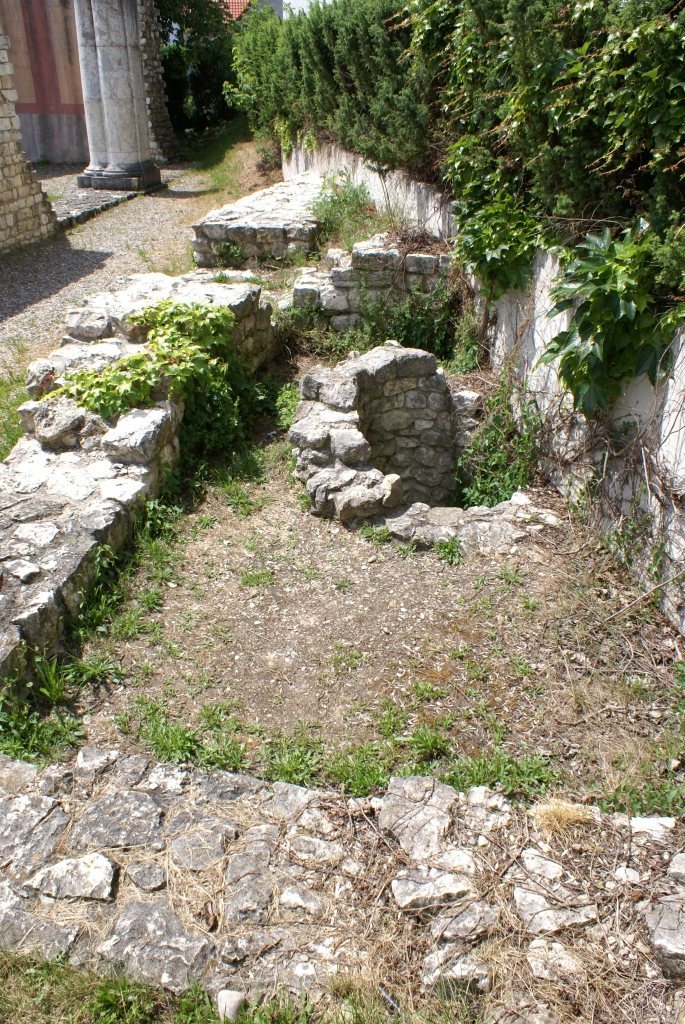
To the north, behind the temple, are remains of a taberna (shop) and a second medieval well. Excavations also revealed remains of other buildings beside the temple.