Tell el-Maschuta: An Ancient Settlement and Trading Center in Egypt
Site at a Glance
- Popularity
- Medium
- Country
- Egypt
- Primary era
- Classical
- Eras represented
- Bronze Age, Iron Age, Classical
- Civilizations
- Achaemenid, Egyptian, Ptolemaic, Roman
- Site type
- City
On this page19 sections
History
Tell el-Maschuta is an ancient settlement in Jazīrat al Maskhūţah, in Egypt’s Wadi Tumilat region. Its earliest settlement dates to the sixteenth century BC, during the Second Intermediate Period, an era between Egypt’s Middle and New Kingdoms. It began as a small community that archaeologists interpret as an outpost and seasonal station for caravan trade. The settlement covered about two to three hectares. Plant remains suggest that people lived there from autumn sowing through the spring harvest, probably spending the hottest months near Tell er-Retaba.
Residents grew wheat and barley and raised cattle, sheep, goats, pigs, and horses. They also hunted birds, hartebeest, and gazelles. Craft activities included pottery-making, bronze-tool production, weaving, and clothing manufacture. Sickles fitted with prefabricated blades were used in agricultural work. After Kamose and Ahmose I, Egyptian pharaohs associated with the expulsion of the Hyksos, rulers of parts of Egypt during the Second Intermediate Period, the settlement declined. Pottery-based interpretations place a long gap in occupation from the New Kingdom through the later Third Intermediate Period, ending around 652 BC. That reconstruction is disputed, and some researchers argue that a community existed there during the Nineteenth Dynasty.
Saite refoundation and Persian rule
At the end of the seventh century BC, the Egyptian pharaoh Necho II refounded the settlement near Tell er-Retaba. Between 610 and 605 BC, he began work on the Bubastis Canal, intended to link the Pelusian branch of the Nile with the Red Sea and provide strategic and agricultural benefits to Egypt. Herodotus, a Greek historian of the fifth century BC, referred to an “Arab city of Patumos” in the region when describing the canal project. The new settlement initially housed canal workers. Apis bulls, sacred animals in Egyptian religion, were sacrificed there, and facilities were established for a temple of Atum, a deity associated with creation. Houses, barns, and ovens were also built.
Building activity changed abruptly, probably after Necho’s defeat at Carchemish in 605 BC and the loss of Egyptian territories in the Levant. A large defensive wall was built soon afterward, but construction of houses within its enclosure paused during the Saite Dynasty, Egypt’s Twenty-sixth Dynasty. The settlement, then about four hectares in extent, was destroyed in 601 BC and again 15 years later. Both destructions are attributed to the Babylonian king Nebuchadnezzar II, following the failed alliance between the Egyptian pharaoh Apries and Zedekiah, king of Judah, against the capture of Jerusalem. Two pieces of Jewish pottery dated to 568 BC have been interpreted as evidence for Jewish refugees at the site around 582 BC.
After destruction and rebuilding, Tell el-Maschuta became a busy trading center under the Saite pharaohs Apries, Amasis, and Psamtik III. Its position between the Mediterranean and Red Sea, its connections to Indian Ocean trade, and its location roughly midway between Suez and Bubastis likely contributed to its importance. Use of the Bubastis Canal also supported expanding Phoenician trade. Cambyses II’s conquest of Egypt in 525 BC, following the Battle of Pelusium, brought another destruction. The settlement was rebuilt under Persian rule and expanded toward the southwest. A cemetery occupied part of the site from the late sixth century BC to about 404 BC.
The Persian king Darius I extended the canal to 84 kilometres and had his achievements inscribed on four large stone monuments in Egyptian, Old Persian, Elamite, and Akkadian. The first of these monuments stood at Tell el-Maschuta. Fighting took place at the site during an Egyptian rebellion against Persian rule that began in 487 BC. After the Persians were driven from Egypt in 404 BC, the settlement remained uninhabited until about 379 BC.
Revival under Egyptian and Ptolemaic rulers
The pharaohs Nectanebo I and Nectanebo II sponsored a substantial building program and promoted ancient Egyptian religion, bringing a brief revival to Tell el-Maschuta. Trade and imports grew during the Thirtieth Dynasty even as silt gradually accumulated in the canal. The cult of Atum flourished again, and incense from southern Arabia was used in its rituals. Trade brought wine, olive oil, fish sauces, and other preserved foods from places including Thasos, Chios, Anatolia, Arabia, and Athens.
The end of the Thirty-first Dynasty and Alexander’s conquest of Egypt led the inhabitants to leave. The site remained unoccupied until about 285 BC. After becoming pharaoh, Ptolemy II began clearing and renewing the Bubastis Canal as part of a program to modernize Tell el-Maschuta. The place again became an important trading post, and Ptolemy II commemorated the canal work on a stone monument erected there. Ptolemy III and later rulers added trading houses and workshops. These buildings date from the second half of the third century BC to about 125 BC. After Ptolemaic rule ended, the settlement lost its main role as a trading station early in the first century BC and was abandoned.
Roman-period cemetery
Tell el-Maschuta remained unused until the early second century AD. When the Roman emperor Trajan again expanded the Bubastis Canal, the site became a cemetery, with graves built over the ruins of the former trading center. It grew to its greatest extent since the settlement’s original foundation and was abandoned in the early fourth century AD. By the beginning of the fifth century, Tell el-Maschuta had become a mound of ruins.
Names, biblical identifications, and excavations
The settlement’s name during its earliest known occupation is unknown. Later names included Per Tem or Pi-Tem, meaning “House of Atum.” In Roman times, the shortened name Ero was used for the probably Hellenistic name Heroonpolis. Egyptian papyri indicate that Tjeku usually referred to a wider area, while Per Tem referred to a temple of Atum within it.
Whether Tell el-Maschuta was the biblical Pithom or Sukkot remains debated. Édouard Naville identified it as Pithom. Kenneth Anderson Kitchen proposed that it was Sukkot and had existed alongside Tell er-Retaba in the New Kingdom, while Donald B. Redford identified it as Pithom but argued that the settlement began about 600 years after the Exodus. Alan Gardiner rejected both identifications. Some historians who favor Pithom have consequently treated the Exodus account as fictional or as an anachronistic addition incorporated around the sixth century BC.
A monolith depicting Ramesses II between two solar deities led early investigators to mistake the site for Pi-Ramesses and helped prompt investigations around 1860; later research established that the identification was wrong. Naville excavated there in 1883 for the Egypt Exploration Society, examining monuments, statues, inscriptions, and building remains and preparing a ground plan. Jean Cledat carried out further investigations in the Wadi Tumilat region from 1900 to 1910. Work at Tell el-Maschuta began again in 1977, including five Wadi Tumilat Project campaigns led by John S. Holladay between 1978 and 1985. Later investigations commissioned by the Egyptian Antiquities Authority added further findings.
Remains
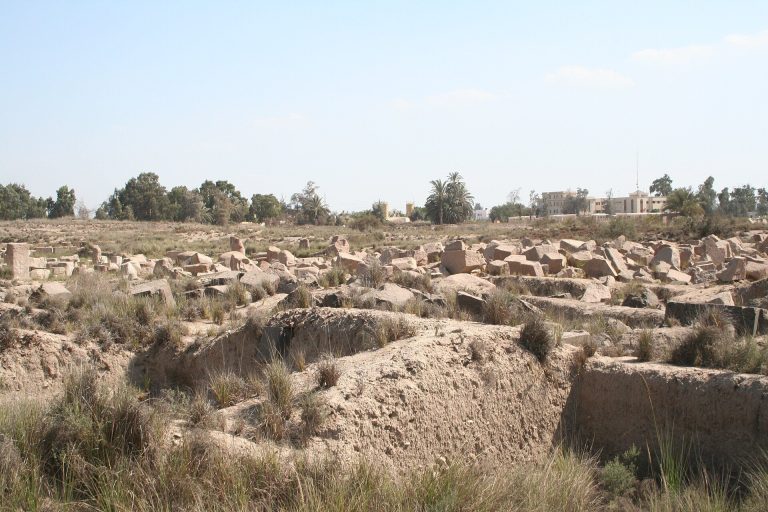
The remains preserve evidence of successive settlement and burial layouts. The earliest community had curved walls and closely spaced houses, while a later town was enclosed by a broad defensive wall. Temple and working areas, canal-side buildings, and extensive cemeteries represent other phases of the site’s use.
Early settlement
Houses, silos, and working areas
The early settlement covered about two to three hectares. Its curved walls were characteristic of the period, and houses were built progressively closer together. Circular silos stood above ground. Excavations also uncovered high-temperature ovens and ochre-colored stakes driven into the earth. The ovens’ purpose is uncertain: they may have served in producing leather goods with metal fittings or in making anvils or grinding tools. Materials from the settlement have parallels among finds from layers E1 to D3 at Avaris, an ancient city in the eastern Nile Delta.
Early graves
Mud-brick graves varied in the quantity and kinds of goods placed with the dead. Some warrior burials contained Asian-style weapons, including daggers and chisel-shaped axes. Other graves held gold or silver headbands, decorated bracelets, earrings, hair rings, scarabs, tools, semi-precious stones, amulets, and food. Children’s graves and burials placed in disused circular silos had fewer grave goods.
Saite and Persian town
Defensive walls
The later settlement was surrounded by a defensive wall about nine metres wide, enclosing an area measuring roughly 200 by 200 metres. A second stone wall was built outside it during the Egyptian rebellion against Persian rule. Rubble, pottery, and other material filled this outer wall.
Temple and canal district
The temple district included a temple of Atum. Houses, barns, and ovens stood to its north. During the Persian period, a cemetery lay north of the site, south of the temple district, beside the Bubastis Canal.
Trade and religious objects
Finds include numerous Phoenician amphorae, two-handled vessels used to transport and store goods, and smaller numbers of Greek examples, mainly from Thasos and Chios. Thick-walled mortars and pestles were probably imported from Anatolia. A terracotta statue found in the remains of a limestone shrine may represent the seated Phoenician goddess Tanit or the West Semitic goddess Asherah. Other finds include cuboid altars showing South Arabian influence and glass fragments bearing ink inscriptions, mostly in Demotic, a later form of ancient Egyptian writing.
A storehouse contained thousands of Athenian tetradrachms, silver coins worth four drachmas, a deposit interpreted as gifts to the temple of Atum. Four bowls, probably of Persian origin, bear similar inscriptions. One names Qaynu, son of Geshem, king of Qedar, as the person who made an offering to Han-Ilat, a pre-Islamic Arabian goddess. Geshem may be the same figure mentioned in the Book of Nehemiah. The bowls and silver coins bearing Athena’s owl date to the transition from the fifth to the fourth century BC.
Ptolemaic buildings and monuments
Temple and canal monuments
Large limestone blocks were brought from elsewhere in Egypt for the rebuilding of the temple of Atum. A stone monument at the site commemorated Ptolemy II’s canal project. A Ptolemaic-period Pithom Stele also preserves the name Per Tem, showing that the name remained in use centuries after Necho II.
Warehouses and workshops
Buildings beside the canal included granaries or multi-room warehouses, some with as many as six rooms. They may have been built toward the end of Ptolemy II’s reign and were connected to furnaces used to make bronze goods for the temple and for export. A two-room building from the Persian period was later rebuilt as a pottery workshop. Ptolemaic trading houses and workshops included structures up to 75 metres long.
Burial areas
Ken-Amun’s burial chamber
In the northern part of the site, a 2010 excavation exposed a large burial chamber associated with Ken-Amun, an official of the Ramesside period, the era of pharaohs bearing the name Ramesses, especially those of the Nineteenth and Twentieth Dynasties.
Roman tombs and burials
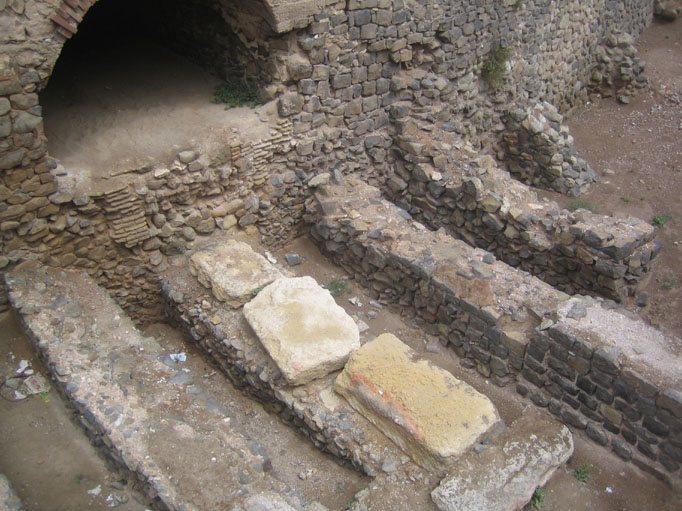
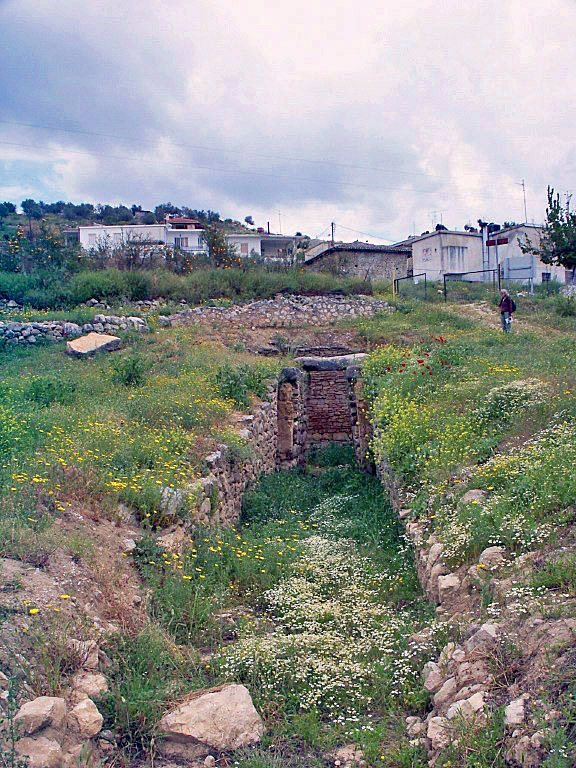
Most Roman tombs were square underground chambers with vaulted mud-brick structures above them. Each burial chamber lay to the east of an entrance passage, which was either simple or formed a walled dromos, an access passage leading to a tomb. Simple passages were sealed after each burial; relatives filled other tombs’ entrance passages with sand. Some grave goods, including gold-plated divine figurines, earrings, glass vessels, and bone hairpins, were looted while the cemetery was in use. Simpler graves occupied open spaces between the mud-brick tombs. The cemetery also included a children’s burial area, where one child was placed in a Gaza amphora bearing a Coptic inscription, in the language and writing tradition of Egyptian Christians, and two Chi-Rho symbols, Christian monograms formed from the first two Greek letters of “Christ.”