Sadat Quraish Mosque: An Early Islamic Mosque in Bilbeis, Egypt


Site at a Glance
- Rating
- 4.7
- Popularity
- Medium
- Country
- Egypt
- Primary era
- Medieval
- External website
- Open
- Eras represented
- Medieval, Early Modern
- Civilizations
- Ottoman
- Site type
- Religious
- Remains
- Mosque
On this page6 sections
History
Sadat Quraish Mosque is a historic mosque in Bilbeis, Egypt, founded during the Muslim conquest of Egypt in 639–640 CE and traditionally attributed to the Arab commander Amr ibn al-As. Some historians regard it as the first mosque built in Egypt, before the Mosque of Amr ibn al-As in Fustat and the Mosque of Mercy in Alexandria. It is also regarded as one of Africa’s oldest mosques, possibly ranking after the al-Najashi Mosque in Abyssinia, a historical region corresponding broadly to present-day Ethiopia and Eritrea.
Foundation and early traditions
The mosque’s name means “Lords of the Quraysh,” referring to Quraysh, the tribe of Muhammad and the dominant tribe of Mecca during the beginnings of Islam. The name commemorates Muslim martyrs among Muhammad’s Companions who died fighting the Romans at Bilbeis. About 120 Companions are said to have taken part in the battle, with approximately 20 to 40 martyred and buried in or around the mosque.
A religious tradition connects the mosque with Sayyida Zaynab, the daughter of Ali ibn Abi Talib and granddaughter of Muhammad. After the Battle of Karbala, she is said to have received a vision in Medina instructing her to take the Ahl al-Bayt, Muhammad’s family, to Egypt. According to the tradition, the people of Bilbeis welcomed her, and she stayed in the mosque for one month.
Abbasid and Ottoman-period changes
Al-Ma’mun, the Abbasid caliph who ruled from 813 to 833 CE, is said to have stayed in the mosque for 40 days while restoring order after unrest against the Abbasid governor Isa ibn Mansur. He ordered the mosque’s restoration, after which it was temporarily known as the al-Ma’mun Mosque.
The mosque was renovated during the Ottoman period by the Egyptian emir Mustafa al-Kashif. This work is associated with the construction of its minaret. The minaret was registered among Egypt’s Islamic antiquities under Ministerial Decree No. 10357 of 1951. Later buildings encroached on the mosque and were constructed around the minaret. Because of fears that the structure might collapse, part of it was dismantled during the 1970s.
Remains
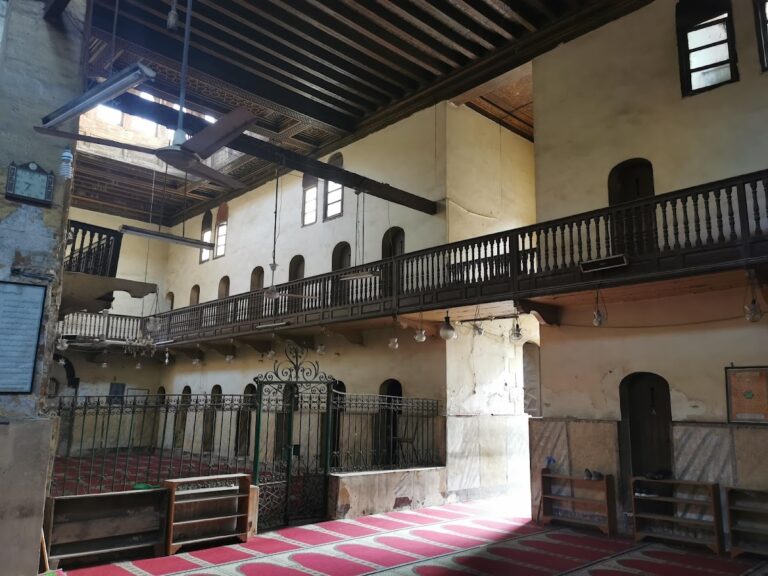
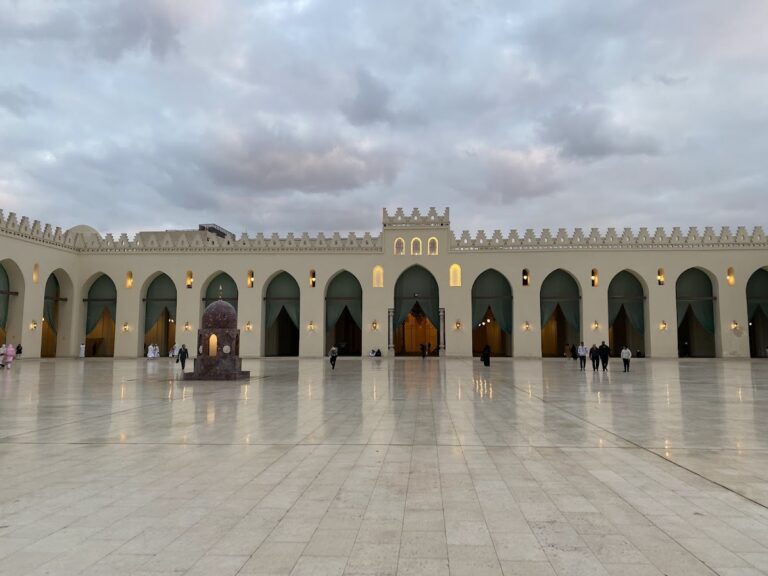
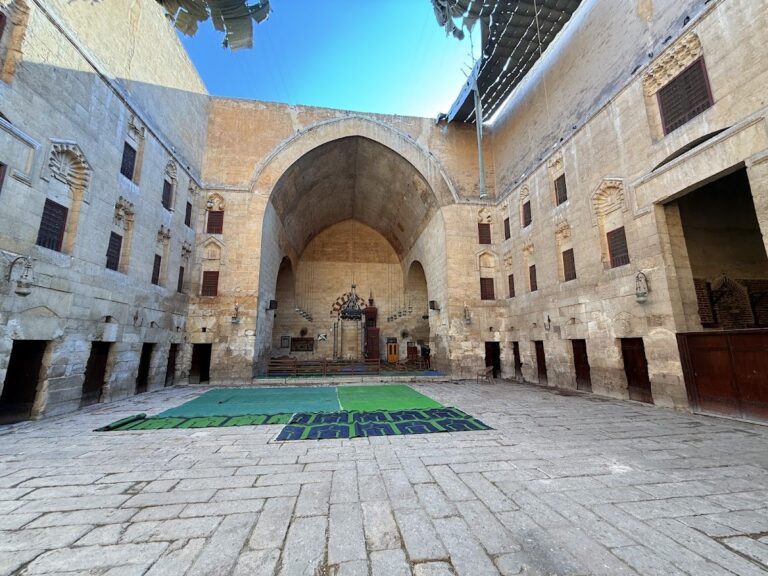
The mosque has a rectangular plan and covers approximately 3,000 square metres. Its surviving prayer space is organized around 18 marble columns arranged in three rows. These columns divide the hall into four arcades running parallel to the qibla wall, the wall oriented toward the Kaaba in Mecca.
Prayer hall
The marble columns have capitals in different forms. Their variety has been interpreted as evidence that the columns were taken from several ancient Egyptian and Roman temples and reused in the mosque. The arrangement of the arcades parallel to the qibla wall gives the prayer space its principal internal organization.
Minaret
Sadat Quraish Mosque has one minaret. It survives without its upper section, and its remaining end is in a ruined condition. A further section dismantled in the 1970s was left beside the standing portion, preserving physical evidence of the minaret’s alteration and partial destruction.