White Horse Stone: Two Stones with Possible Neolithic Long-Barrow Connections
Site at a Glance
- Popularity
- Medium
- Country
- United Kingdom
- Primary era
- Stone Age
- Eras represented
- Stone Age, Modern
- Civilizations
- British
- Site type
- Religious
- Remains
- Sanctuary
On this page13 sections
History
Possible Neolithic origins
White Horse Stone is the collective name for two large prehistoric stones near Maidstone in the United Kingdom, tentatively associated with chambered long barrows dating to the fourth millennium BC. The Early Neolithic was the first part of the Neolithic period, when farming became established in Britain. A chambered long barrow is a long mound containing a burial chamber, sometimes used for collective burials. If either or both stones belonged to such monuments, they were raised by communities that may have relied on pastoralism.
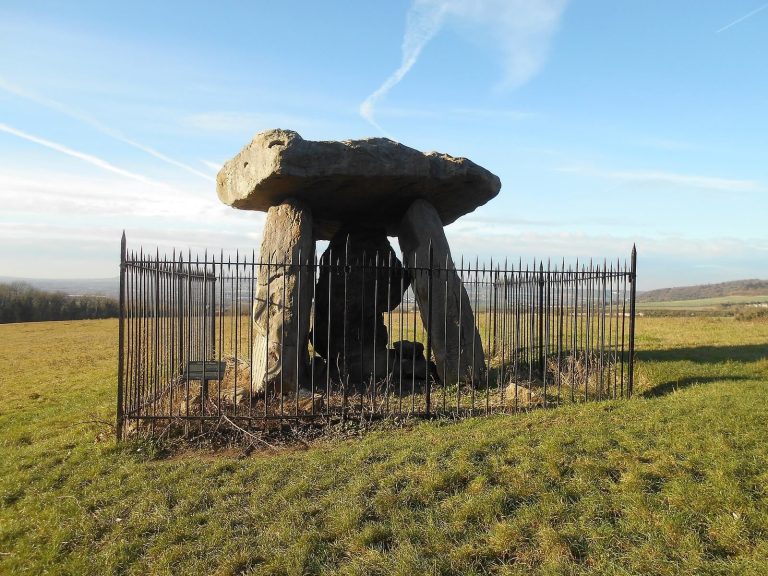
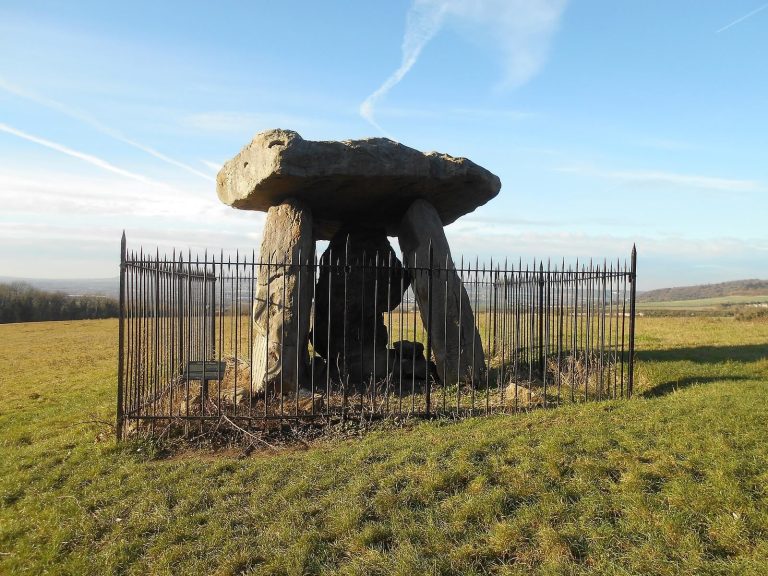
The stones form part of the eastern group of the Medway Megaliths, a cluster of prehistoric monuments around the River Medway. Nearby monuments include Smythe’s Megalith, Kit’s Coty House, Little Kit’s Coty House and the Coffin Stone. Sarsen stones around the White Horse Stones and Smythe’s Megalith may also have come from destroyed barrows. In the Early Neolithic, the surrounding landscape was largely wooded, with oak, ash, hazel and alder.
Nineteenth-century names and stories
The name first belonged to the Lower Stone. After that stone was broken up around 1823, the Upper Stone took its name and the folklore attached to it. The transfer had appeared in print by 1927. Nineteenth-century antiquarians connected the name with the White Horse of Kent, a traditional emblem, and with Hengest and Horsa, legendary figures in early Anglo-Saxon tradition.
A tale published by S. C. Lampreys in 1834 said that a white-horse standard was found at the stone after a battle between Hengest and Horsa and the Britons Vortimer and Catigern. These figures belong to legendary accounts of conflict between Britons and early Anglo-Saxons, rather than securely established history, and the story is not accepted as a historical event. The association with the stone is not known from before the early nineteenth century.
In an unpublished manuscript from the mid-1840s, antiquarian Beale Post suggested several possible origins for the name. He proposed that a Saxon banner had fallen on the stone after the Battle of Aylesford, that sunlight cast a horse-shaped shadow, that druids sacrificed a white horse there during the Iron Age, or that a rider on a white horse died nearby. Later, folklorists Fran and Geoff Doel suggested that the stone might be the “Druid Stone” in a nineteenth-century story about a ghostly dog pursuing a vicar and his companion.
Modern religious use and protection
Since at least the 1980s, folkish Heathen groups, including the Odinic Rite, have treated the Upper Stone as sacred. Folkish Heathenism is a modern form of Heathenism that understands ancestry in ethnic or racial terms. The Odinic Rite’s co-founder, John Yeowell, presented the stone as the symbolic birthplace of England and a place to remember Hengest, Horsa and the Anglo-Saxon migration, the movement of Germanic peoples to Britain in the early medieval period. This differs from Pagan interpretations that connect ancestry with people who lived in the same landscape.
Odinic Rite members have held ceremonies at the stone since 1987, including rites of passage, group commitments and funerary ceremonies. Some members, like other modern Pagans, also associate the stone and other Medway megaliths with “earth energies.” After Yeowell’s funeral in 2010, his cremated ashes were scattered at the stone.
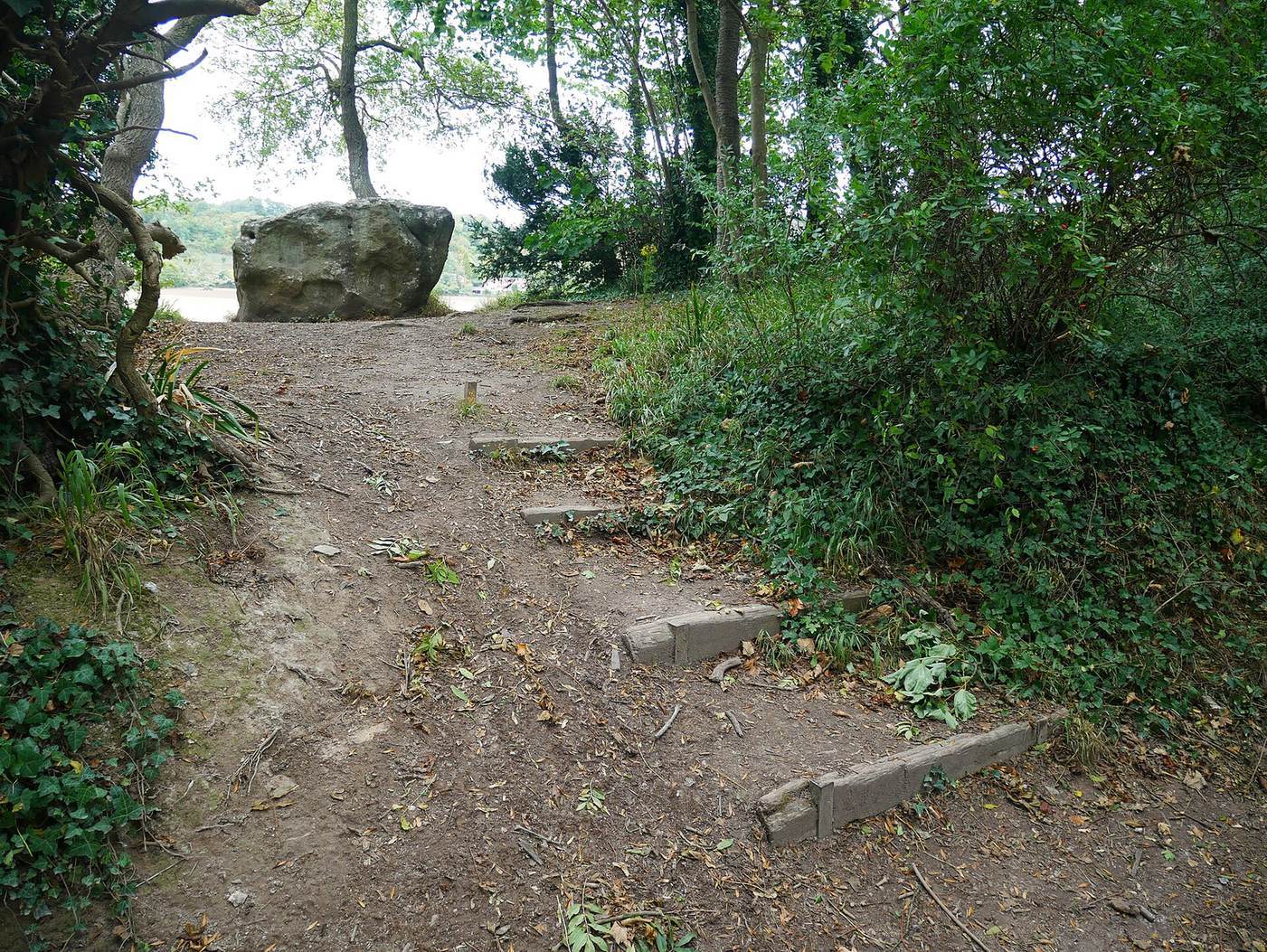
In 1987, Odinic Rite members formed the Guardians of the White Horse Stone and installed timber steps from the Pilgrims’ Way. They opposed the Channel Tunnel Rail Link being tunnelled close to the stone. In 2003, the Odinic Rite and Woden’s Folk successfully petitioned against a proposed radio tower a few metres away, and the Guardians later opposed a more distant site proposed in 2006. The stone has also been vandalised; Odinic Rite members have tried to remove graffiti using methods they consider harmless to it. The site is protected as a scheduled monument under the Ancient Monuments and Archaeological Areas Act 1979.
Remains
The surviving Upper Stone stands in Westfield Wood beside the Pilgrims’ Way, east of the A229. The Lower Stone stood about 300 metres to its west, near the former crossing of the Pilgrims’ Way and the Rochester-to-Maidstone road; its location is thought to lie beneath the A229. Excavations associated with the Channel Tunnel Rail Link also identified prehistoric buildings, a later settlement and a medieval kiln in the surrounding area.
Megalithic remains
Lower White Horse Stone
The Lower Stone was apparently a sarsen and may have been lying on the ground before it was broken up. Its former position was northwest of the point where the Pilgrims’ Way crossed the Rochester-to-Maidstone road, now the A229.
Upper White Horse Stone
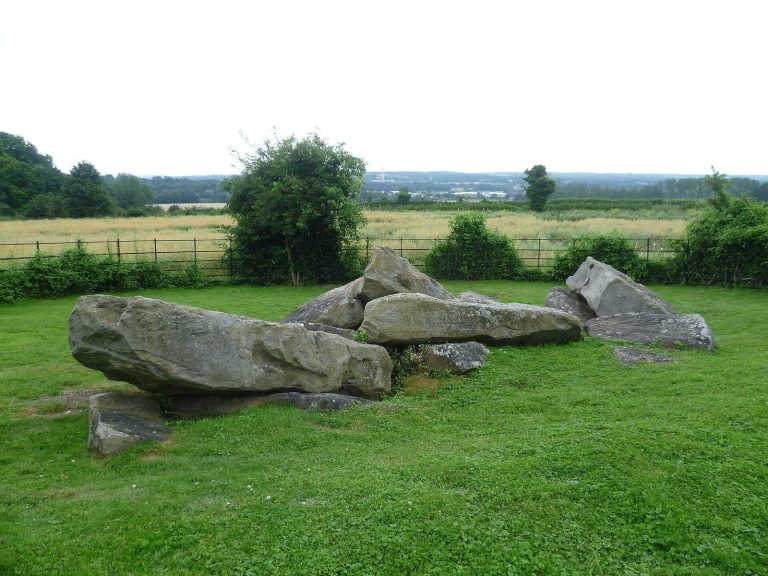
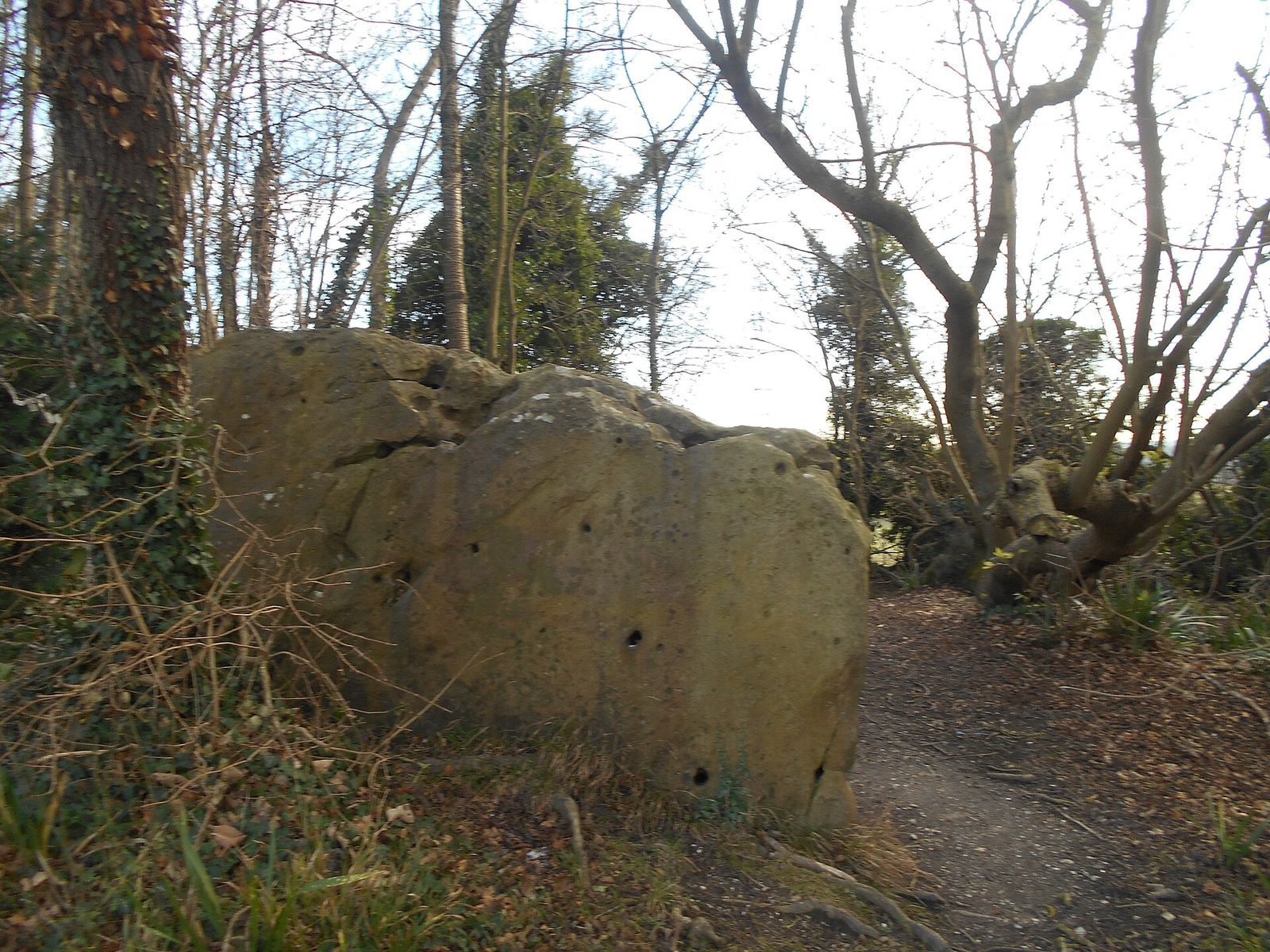
The Upper Stone is a sarsen, a naturally occurring hard sandstone. It measures about 2.9 metres long, 1.65 metres high and 0.6 metres thick. One end has a natural outline that has been interpreted as a crude face. Its upright form has been compared with chamber wall-stones at other Medway monuments. Nine smaller stones extend westward from it for about ten metres; farmers may have moved them there later rather than placing them in the Early Neolithic.
Smythe’s Megalith
Smythe’s Megalith was a chambered long barrow found buried in a field in 1822. Its exposed remnant was about 2.1 metres long and consisted of three supporting stones. The chamber contained fragments of human bones, including parts of a skull, ribs, thigh, leg and arm bones, as well as pottery. The monument was later destroyed.
Other archaeological features
Early Neolithic buildings
South of the White Horse Stone, excavations in the 2000s identified Structure 4806, an Early Neolithic longhouse measuring 18 by 8 metres. Radiocarbon dating places its use in two calibrated ranges, 4110–3820 BC and 3780–3530 BC. Its type is found in several parts of Europe, and it is the only Early Neolithic longhouse identified in Kent. If used as a dwelling, it may have housed no more than a small family group. Other possible purposes include communal or ceremonial activity, funerary practices, preparing human remains or holding shared feasts. It may also have been visible from nearby burial monuments, including Smythe’s Megalith.
A smaller circular building, about 3.75 metres in diameter, lay southeast of the longhouse. Its dating evidence is limited but suggests a Late Neolithic date.
Late Bronze Age and Iron Age settlement
About 200 metres from the Neolithic buildings, a settlement occupied a spur of higher ground. It included several roundhouses and deep pits cut into the underlying chalk. The pits may first have stored corn; later fills contained pottery, iron objects, animal bones and two human burials. These deposits may have had ritual meaning rather than being ordinary household refuse.
Medieval drying kiln
A drying kiln dating to the thirteenth century was found near the North Downs Way.