Burg Tannroda: A Medieval Hill Castle in Germany


Site at a Glance
- Rating
- 4.3
- Popularity
- Very Low
- Country
- Germany
- Primary era
- Medieval
- External website
- Open
- Eras represented
- Medieval, Early Modern, Modern
- Civilizations
- German, Holy Roman Empire
- Site type
- Military
- Remains
- Castle
On this page8 sections
History
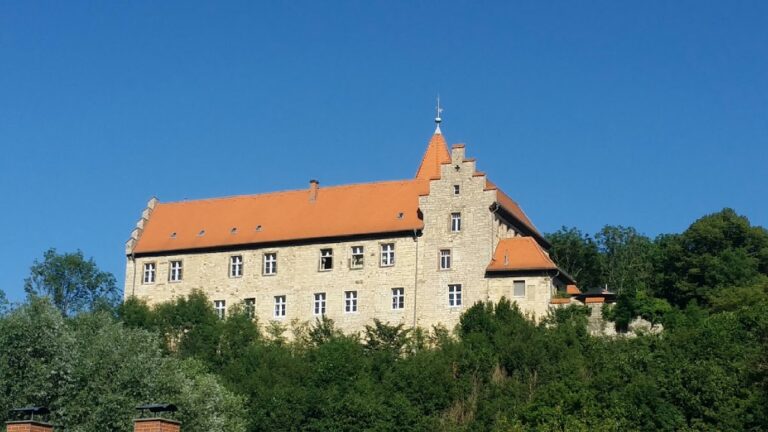
Burg Tannroda, also known as the Blue Castle, is a high medieval hill castle in Germany, probably built in the twelfth century. It became the ancestral seat of the Lords of Tannrode, who were first recorded in 1174, and the castle was mentioned in 1194.
Medieval Lords and Destruction
In 1392, the Lords of Querfurt received Burg Tannroda as a fief, meaning property or authority granted by a superior lord in return for service and allegiance. The castle passed to the Vitzthum family in 1418. In 1465, it was held by the robber knight Apel Vitzthum when citizens of Erfurt and Weimar destroyed it.
After its destruction, the castle came into the possession of the Counts of Gleichen-Blankenhain. In 1487, it passed to the Lords of Bünau.
From Castle to Manor Estate
A fire in 1551 led to the conversion of the site into a two-part castle consisting of the Red Castle and the Blue Castle. The Lords of Gleichen became co-owners in 1597. The Red Castle and the keep burned in 1775, and the Red Castle was demolished in 1824.
From 1854 to 1945, the complex belonged to the Barons of Gleichen-Rußwurm and served as a manor estate. Extensive demolition, alterations, and new construction changed the historic complex during this period. After the site became vacant around 1970, it fell into disrepair.
Protection and Renewal
The municipality of Bad Berka acquired Burg Tannroda in 1994 and arranged extensive safety and stabilization work from the 1990s onward. Since 2018, the complex has belonged to the charitable Burg Tannroda Foundation, whose objectives include renovating and revitalizing the site.
Remains
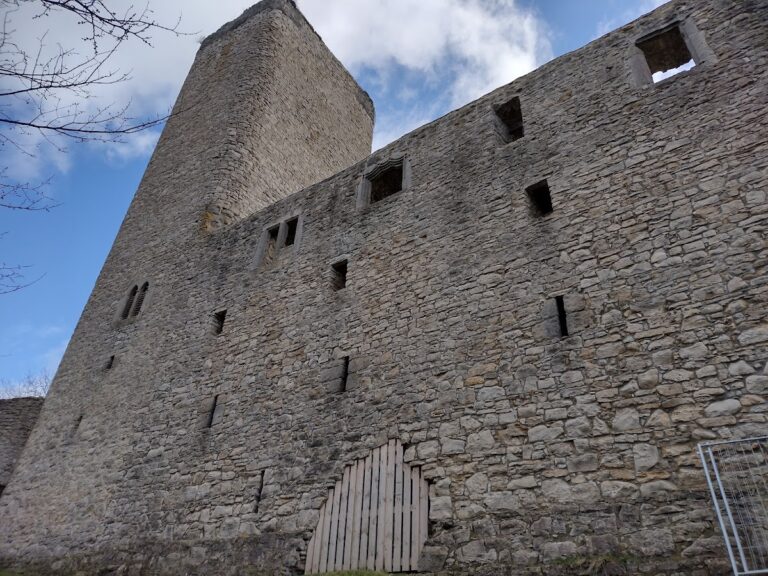
Burg Tannroda occupies the Lindenberg at an elevation of 300 metres above sea level, above the right bank of the Ilm on the western edge of Tannroda. The partially preserved hill castle stands on the southern slope above the river and forms an irregular complex with an outer bailey, an enclosed area outside the main fortified section that commonly contained service and agricultural buildings.
The Keep
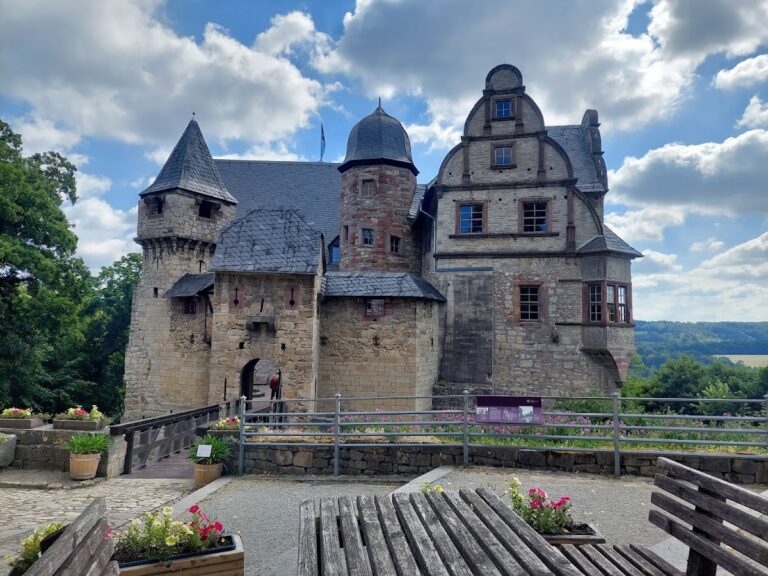
The round keep, probably constructed in the twelfth century, rises 22 metres high at the highest point of the complex. It stands on a square masonry base whose upper corners are chamfered. The surviving tower is now used as an observation tower.
Residential and Service Buildings
Behind the keep are remains of the former residential building, including a round-arched entrance. The service and agricultural buildings occupy the outer part of the complex, reflecting the working functions associated with the castle and its later use as a manor estate.
The Basketmakers Museum
A former service building houses the Thuringian Basketmakers Museum, operated by the local history association. Its exhibitions cover the history of Tannroda, the former castle and palace, their owners, and the town. One section focuses on Carl-Alexander von Gleichen-Rußwurm, described as the last descendant of Friedrich Schiller, the German poet, playwright, and historian. Another presents traditional basketmaking, including furniture designs by Henry Van de Velde, a Belgian architect and designer, made by Tannroda basketmakers. A third section hosts a changing temporary exhibition each year.
The present complex also contains a restaurant, apartments, a seminar house, and an area for cultural events, incorporating later uses into the surviving castle grounds.
Nearby sites