Tango Monastery: A Drukpa Kagyu Monastery in Bhutan
Site at a Glance
- Rating
- 4.7
- Popularity
- Very Low
- Country
- Bhutan
- Primary era
- Early Modern
- Eras represented
- Medieval, Early Modern, Modern
- Civilizations
- Unclassified
- Site type
- Religious
- Remains
- Fortified Monastery
On this page16 sections
History
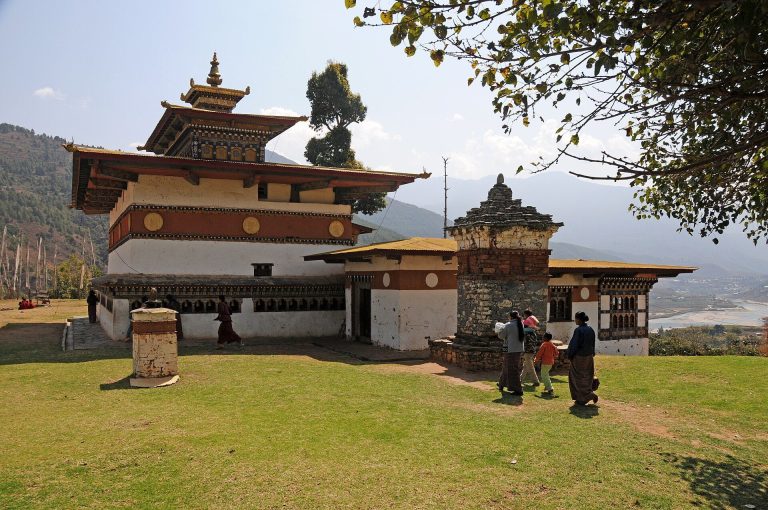
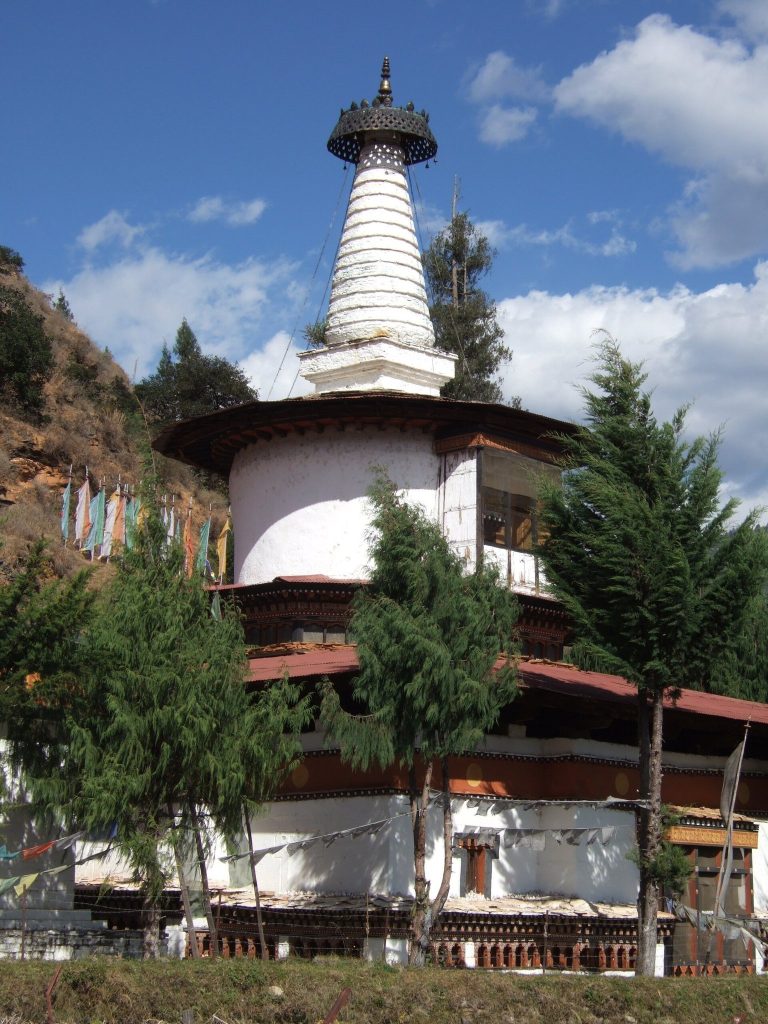
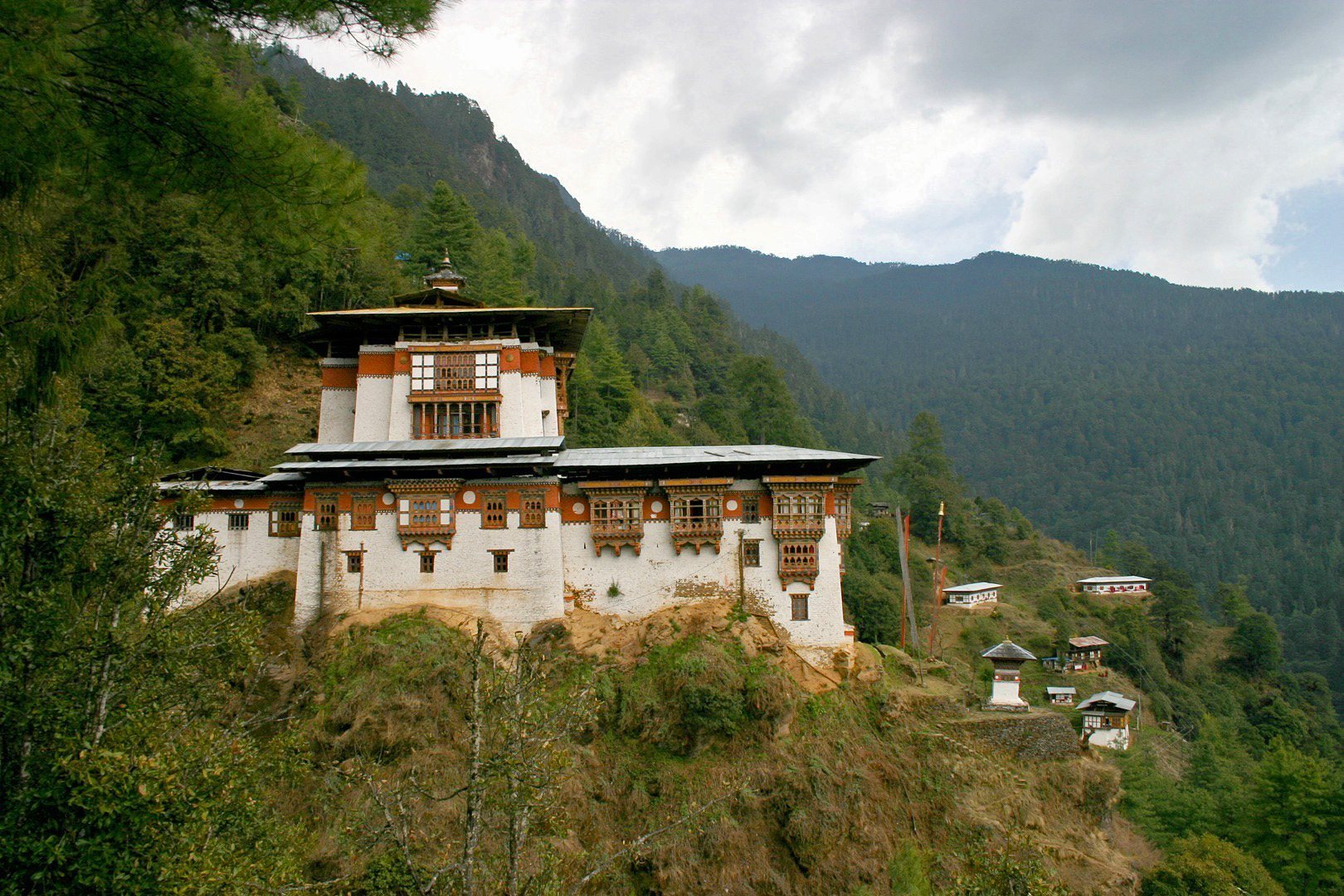
Tango Monastery is a Buddhist monastery of the Drukpa Kagyu school in Bhutan, located above Dotanang in the Thimphu Valley, about 14 kilometres north of Thimphu. Built in the Bhutanese dzong style, a form of fortified Himalayan religious and administrative architecture, the monastery took its present form in 1688 and 1689 under Gyalse Tenzin Rabgye. It stands within Jigme Dorji National Park and remains an important centre of Drukpa Kagyu religious learning.
Early sacred traditions
The sacred history of Tango reaches back to Guru Rinpoche’s visit in the eighth century. Guru Rinpoche, also known as Padmasambhava, is traditionally credited with bringing tantric Buddhism to Tibet and the Himalayan region. At Tango, he identified the site with Hayagriva, the wrathful horse-headed Buddhist deity associated here with protection and spiritual power. The place was recognized again in 1222.
Local tradition connects Tango’s later development with Phajo Drugom Zhigpo, a teacher associated with the teachings of Dodeyna. He heard a horse neighing from the direction of Tango and saw a flaming manifestation of Tandin, the local form of Hayagriva. Tandin foretold that the site would become a meditation monastery, that Phajo would marry the dakini Khando Sonam Peldon, and that he would establish the Drukpa Kagyu school in Bhutan.
Phajo founded Tango Choeying Dzong, a meditation hermitage, in the thirteenth century. It was regarded as one of four meditation dzongs among twelve places entrusted to him by Guru Rinpoche. The name Tango, meaning “horse head” in Dzongkha, refers to the site’s principal deity and its association with the horse-head rock formation above the valley.
Shabdrung Ngawang Namgyal and the caves
In 1616, the Tibetan lama Shabdrung Ngawang Namgyal came to Bhutan at the age of 23. His arrival was connected partly with an invitation from Pal Yeshay Genpo and partly with his conflict with Deb Tsangpa in Tibet. During his preaching travels, he subdued a Tibetan attack and later meditated in Tango’s caves, which Tshewang Tenzing of Dorden, now Dodena, had made available to him.
Namgyal performed tantric rituals of Gempo in the caves. After his victory over forces associated with Deb Tsangpa, he adopted the title Dujom Dorjee, consolidated his authority, issued sixteen tenets, and renamed the cave monastery Duduel Phug. He returned to Tango for further meditation.
According to the tradition surrounding the site, Namgyal’s enemies later attacked the caves using tantric powers. The assault damaged the cliff, and a large boulder, said to have been the size of a yak, blocked the cave while narrowly missing Namgyal. His followers regarded his survival as a miracle. After the death of his father, Tenpai Nima, Namgyal brought the body to the horse-head cave and cremated it there.
In 1620, Namgyal founded Chari Monastery and the Duduel Chorten, a Buddhist reliquary monument, in memory of his father. The building work was carried out by carpenters brought from Nepal.
The monastery under Tenzin Rabgye
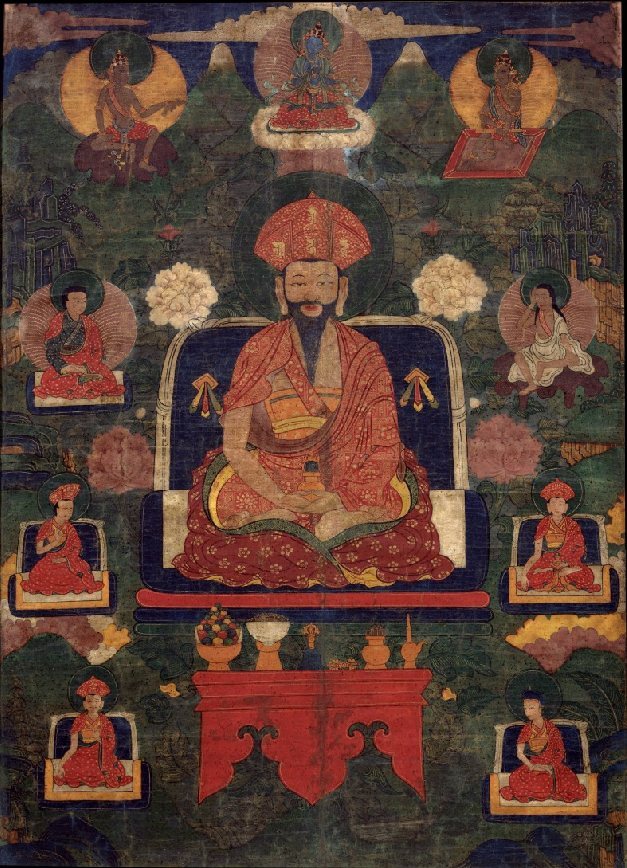
Gyalse Tenzin Rabgye was born in 1638 and received early religious training in the Drukpa Kagyu tradition from Shabdrung Ngawang Namgyal and Damchoe Gyeltshe. He became Desi, the temporal ruler under Bhutan’s former dual religious and secular system, at the age of 31, and became the fourth Desi at the age of 43. He governed according to spiritual and temporal laws.
Tenzin Rabgye rebuilt Tango Monastery in 1688 and 1689, creating the principal structure that stands today. The monastery was extended during the eighteenth and nineteenth centuries, and Shabdrung Jigmre Choegyal installed a golden roof in the late nineteenth century.
Education, restoration, and religious life
In 1966, the 64th Je Khenpo, Jamyang Yeshey Sengyel, and Ashi Phuntshog Chodon reopened the Shaydra School of Buddhist Studies at Tango. The Je Khenpo is Bhutan’s chief religious authority. In 1977, Queen Mother Ashi Kesang Wangchuck expanded and refurbished the school with a new structure opposite the older building. A further restoration took place in the mid-1990s.
Tango now serves as the residence of the seventh Tri Rinpoche, a senior reincarnate Buddhist teacher described as a young incarnation of Tenzin Rabgye. It also houses a higher-education monastic school. Hayagriva remains especially venerated at Tango in the self-emanated wrathful form called Tandin. Local tradition identifies the site as the place where Avalokiteshvara, the Mahayana bodhisattva associated with compassion, revealed himself as this form of Hayagriva.
The annual Yarney festival has been held at Tango since 1967. It represents the monks’ summer retreat and lasts about one and a half months, approximately during August and September. During the retreat, monks observe special vows and strict discipline, wear ceremonial yellow robes, chant prayers before and after meals, eat from begging bowls, abstain from the afternoon meal, remain within the monastery precincts, and avoid entertainment. Laypeople make food offerings during the festival.
Remains
Mountain setting and meditation caves
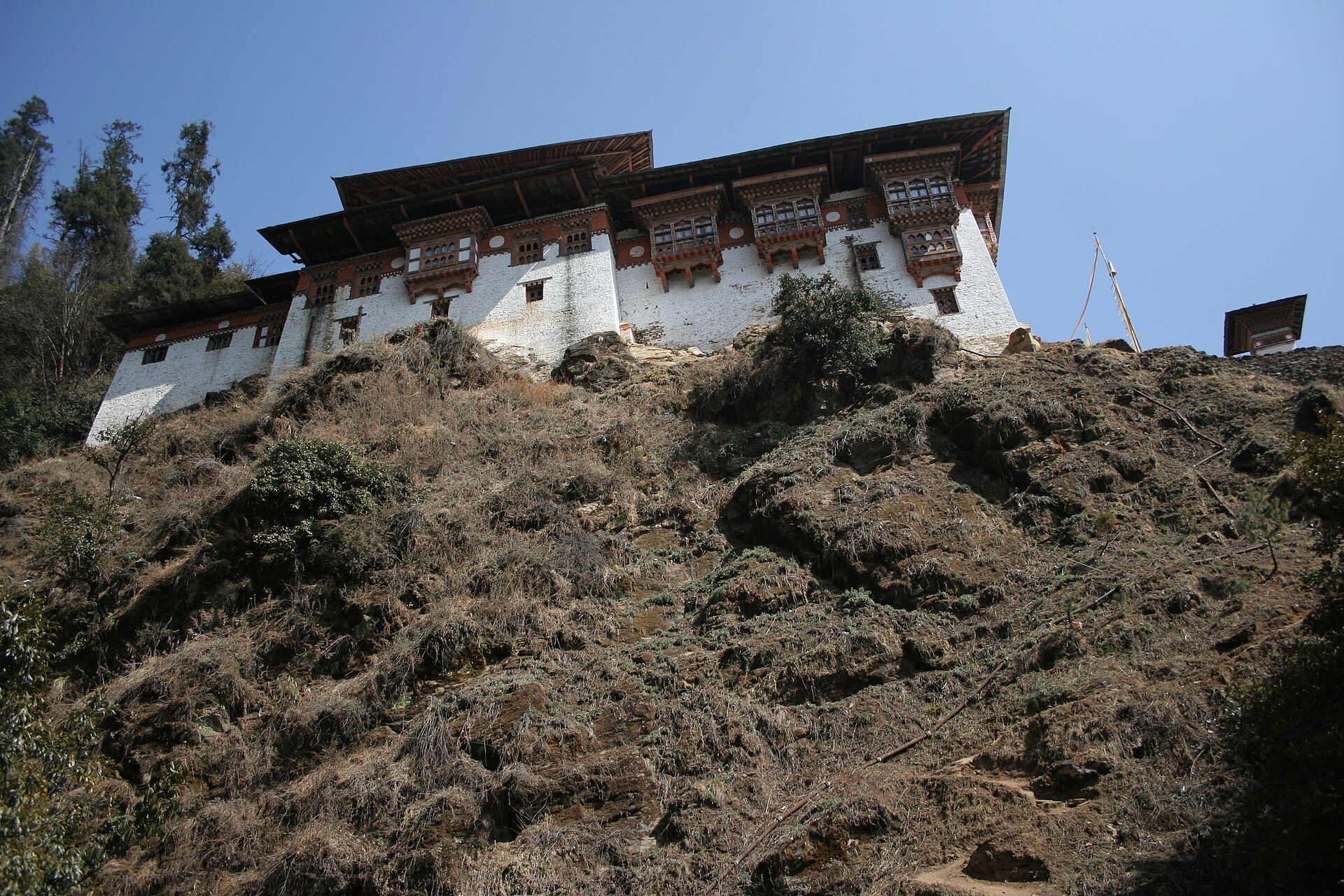
Tango stands at approximately 2,948 metres above sea level, about 400 metres above the valley floor, near Cheri Mountain in the upper Thimphu Valley. The monastery is positioned above Dotanang and above the Thimphu Chu, also called the Wangchu. Its buildings were constructed around meditation caves cut into the cliff, preserving the physical setting associated with holy figures from at least the twelfth century.
The horse-head cliff
A rock formation known as the Horse Head or Hayagriva forms the centre of the cliff and projects toward the valley. The sacred landscape around it is traditionally interpreted as a mandala, with mountains, rivers, valleys, temples, forests, animals, and terraces associated with meditation, the power of the Drukpa Kagyu tradition, the defeat of hostile forces, protection of the Dharma, fertility, abundance, and spiritual attainment.
The upper and lower caves
The original caves occupy two levels, an upper cave and a lower cave, connected by a naturally formed concealed central passage. The central cavern is traditionally described as a dakini cavern containing triangular red and black forms and a naturally formed divine mansion. Rock faces at different levels display formations interpreted as self-manifested figures of the sun, the moon, and the demon Matramrutra.
Other sacred features include figures associated with Sri Cakrasambhara, a tantric Buddhist deity linked with the Cakrasamvara practice tradition, and a long underground passage symbolically distinguishing good from evil. A projecting Hayagriva-shaped rock is associated with fierce forms of Abhicarya, a technical tantric term connected here with fierce forms.
Temples and objects in the caves
The lower cave contains a Hayagriva temple and crystal images of protective deities. It also contains a three-faced Hayagriva said to have been discovered by Ngawang Tenzin, a whip incorporating prayers, and a stone slab bearing a dakini’s footprint. The upper cave contains a temple of four-handed Mahakala, the wrathful protective deity, established by Shabdrung Ngawang Namgyal. A hazardous cave at the bottom is described as a place suitable for hermits.
A large sandalwood tree is traditionally identified as the former walking stick of Phajo Drugom Zhigpo. It is associated with a prophecy that Tango would become the centre from which the Drukpa Kagyu doctrine would spread. Near the cypress trees, a chorten marks the place where Khando Sonam Peldon died and is said to contain her belongings. The Tandin Nye temple, built by Phajo after his meditation, is also located in the cave area.
The main dzong-style monastery
Tango’s principal building has a curved or semicircular outer wall and a prominent central tower with niches. The monastery has twelve corners, while the central tower rises through three storeys and includes a gallery. A natural spring rises in the middle of the courtyard opposite the tower. Behind a series of prayer wheels, engraved slate tablets preserve another element of the monastery’s religious setting, while a courtyard gallery depicts leaders of the Drukpa Kagyu lineage.
Ground-floor temples
The monastery contains six principal temples: Trulku Lhakhang, Longku Lhakhang, Choeku Lhakhang, Guru Lhakhang, Namsey Lhakhang, and the Gonkhang, an inner chapel. On the ground floor, Trulku Lhakhang houses a gold-and-copper Buddha statue three times the height of a man, attributed to the Nepalese sculptor Panchen Deva.
The main Buddha is flanked by a clay image of Dipankara associated with medicinal metals and a statue of Maitreya twice the height of a man. Life-size statues of the Buddha’s eight chief spiritual sons are also installed there: Jamyang, Chador, Chenrizig, Namkhai Nyingpo, Dripa Namsel, Saye Nyingpo, Jamba, and Jampel Zhenu Jurpa. The statues are attributed to the craftsmen Trulku Dzing and Druk Chophel.
Other venerated objects include a stone bearing the footprint of Jetsuen Tenzinma, daughter of Ngawang Tenzin; stone impressions of horses, goats, and sheep; and a golden horse-head-shaped key discovered by Ngawang Tenzin. The adjoining Gonkhang is dedicated to four-handed Mahakala, also called Pel Yeshey Gonpo. Its statue holds a skull traditionally said to have belonged to the Tibetan king Thrisong Detsan.
Upper-floor temples and images
On the second floor, Longku Lhakhang contains a gold-and-copper statue of Avalokiteshvara attributed to Panchen Deva. This floor also includes a temple of Guru Rinpoche, the Namse Palace, and Namsey Lhakhang, where Namsey, the name used at Tango for Vaisravana, is venerated as a deity associated with wealth and guardianship.
The third floor contains temples of Dharmakaya, the ultimate and unmanifested aspect of Buddhahood, and a gold-and-copper statue of Buddha Amitayus, the Buddha associated with long life, made by Panchen Deva. The statue is flanked by an image of Shabdrung Ngawang Namgyal and a life-size clay figure of Gyalse Tenzin Rabgye made with medicinal metals.
Tenzin Rabgye’s chamber and paintings
Tenzin Rabgye’s sleeping chamber lies to the right of the third-floor temples. A central image of Guru Rinpoche is associated with a vision experienced by Tenzin Rabgye. The room also contains Kargyud Serthreng and other images made with medicinal metals. Images throughout this area are attributed to Trulku Dzing.
Wall paintings appear on all three floors. They include “weeping images,” whose expressions of grief commemorate Tenzin Rabgye’s death at the age of 59, as well as a self-portrait of Trulku Jampel Yamtsho.
Memorial monument
Jangchub Chorten
The Jangchub Chorten, also called the Kudung Chorten, stands between the dzong and the monastery. It contains the ashes of Gyalse Tenzin Rabgye and forms a memorial element within the monastery complex.