Punakha Dzong: Bhutan’s Fortress-Monastery and Royal Centre
Site at a Glance
- Country
- Bhutan
- Primary era
- Early Modern
- Eras represented
- Early Modern, Modern
- Civilizations
- Unclassified
- Site type
- Religious
- Remains
- Fortified Monastery
On this page17 sections
History
Punakha Dzong is a Bhutanese fortress-monastery in Punakha Valley, Bhutan, commissioned by Ngawang Namgyal and built in 1637–1638 in Tibetan architectural traditions. A dzong combines religious and administrative functions. The complex was consecrated as Pungthang Dechen Phodrang and is also known as Pungthang Dewa Chhenbi Phodrang, meaning “Palace of Great Bliss.” It is regarded as Bhutan’s second-oldest and second-largest dzong.
Foundation and early monastic role
Ngawang Namgyal, the first Zhabdrung Rinpoche, a title for Bhutan’s spiritual and political leader, intended the dzong to embody Buddhist values. It was one of 16 dzongs built during his rule, from 1594 to 1651. While construction was under way, he became the first leader of a unified Bhutan and established a government modelled on the Tibetan religious-political system.
The dzong was built over an earlier, smaller structure. Tradition says that the architect was told to sleep beneath it and dreamed of a palace associated with Guru Rinpoche, a name for Padmasambhava, an important figure in the introduction of Buddhism to Tibet. The vision guided the design, which was developed without written plans.
In 1639, Bhutanese forces defeated Tibetans at the site, and a chapel was established to hold weapons captured in the fighting. Ngawang Namgyal founded a monastic order of 600 monks, most brought from Cheri Gompa in the upper Thimphu Valley, and lived at the dzong until his death. The monastery became part of the southern Drukpa Kagyu lineage, a branch of the Kagyu tradition of Tibetan Buddhism.
Expansion, damage, and rebuilding
In 1676, the dzong’s abbot, Gyaltsen Tenzin Rabgye, added the spire above the main tower. Substantial enlargement followed between 1744 and 1763, during the rule of Sherab Wangchuk, the 13th Druk Desi, Bhutan’s secular ruler under its traditional system. A ruler donated a large religious painting of Ngawang Namgyal, while the Seventh Dalai Lama, the senior religious leader of the Gelug school of Tibetan Buddhism, gave the dzong a brass roof.
Fires damaged the complex at various times between 1750 and 1849. The 1897 earthquake caused severe damage, followed by further fire damage. A fire in 1986 partially destroyed the dzong, and a large prayer hall was added afterward.
Royal and administrative centre
Ugyen Wangchuck was crowned at the dzong in 1907 as the first Druk Gyalpo, the title of a Bhutanese king and the founder of the current ruling dynasty. Punakha was then the country’s capital, and the dzong has continued to host Bhutanese royal coronations. In 1910, the Punakha Treaty established an arrangement under which Britain agreed not to interfere in Bhutan’s internal affairs, while Bhutan allowed Britain to direct its foreign affairs.
The dzong remained Bhutan’s administrative centre and seat of government until the capital moved to Thimphu in 1955. Its lower elevation and milder climate helped establish it as a winter residence, a role it retained after the move. Each year, the Je Khenpo, Bhutan’s senior monastic leader, and the monastic community move from Tashichho Dzong in Thimphu on the first day of the tenth Bhutanese month. They return on the first day of the fourth month of the following year.
Floods caused by sudden releases of water from glacial lakes on the Mo Chhu and Pho Chhu repeatedly damaged the dzong, notably in 1957, 1960, 1994, and 1996. The 1994 flood damaged the complex, while the 1996 flood damaged its large stupa and caused several deaths.
A major restoration using traditional Bhutanese craft practices brought the complex back to a fully restored condition. The Je Khenpo and monks of the Dratshang, Bhutan’s central monastic body, held a Rabney consecration ceremony from 13 to 15 May 2004.
Religious observances and later events
Before taking office, Bhutan’s kings and the Je Khenpo visit a shrine in the third courtyard to seek blessings. The annual Punakha Dromche and Punakha Tshechu, a Bhutanese religious festival, draw people from villages across the district. Held in February or March, the celebrations include the display of a self-originating image of Avalokiteshvara, a bodhisattva associated with compassion, and performances recalling the 1639 Tibetan invasion and defeat. A battle drama devised by Ngawang Namgyal includes a simulated throwing of a relic into the Mo Chhu.
On the festival’s final day, an image of Ngawang Namgyal is displayed, followed by a dance in the main courtyard performed by 136 people dressed as warriors. They descend from the main entrance amid whistling and shouting. Monks led by the Je Khenpo then process to the Mo Chhu, where the Je Khenpo offers oranges to nagas, serpent-like beings associated with water, in a rite linked to the sacred image displayed at the festival. Mask dances afterward commemorate the dzong’s construction. Another annual observance, Lhenkey Dungchhur, is performed for departed souls.
On 13 October 2011, the dzong hosted the wedding of King Jigme Khesar Namgyel Wangchuck and Jetsun Pema. In 2012, it was included on Bhutan’s UNESCO World Heritage Tentative List as part of a group of five dzongs titled “Dzongs: the Centre of Temporal and Religious Authorities.”
Remains
Setting and overall plan
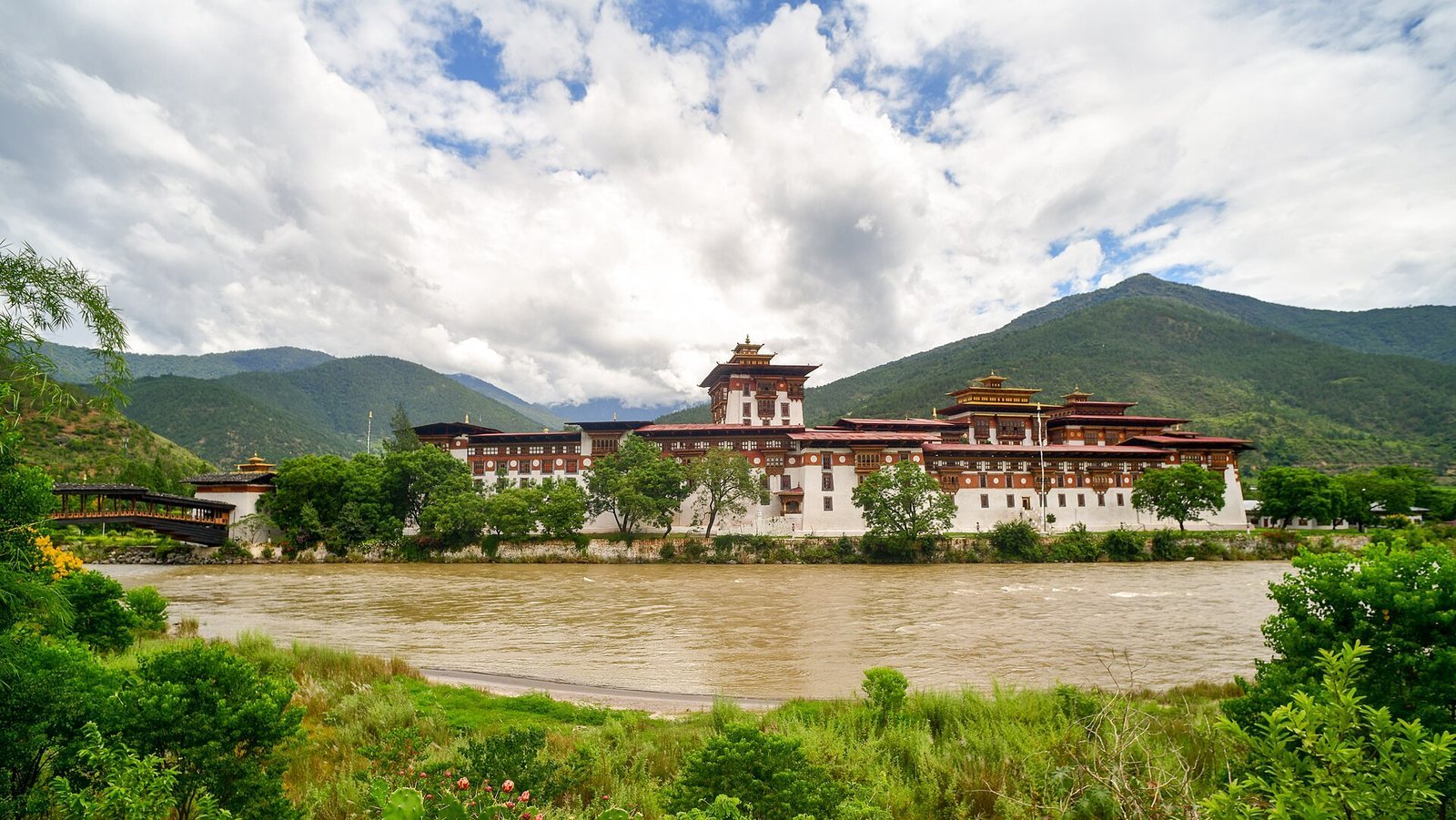
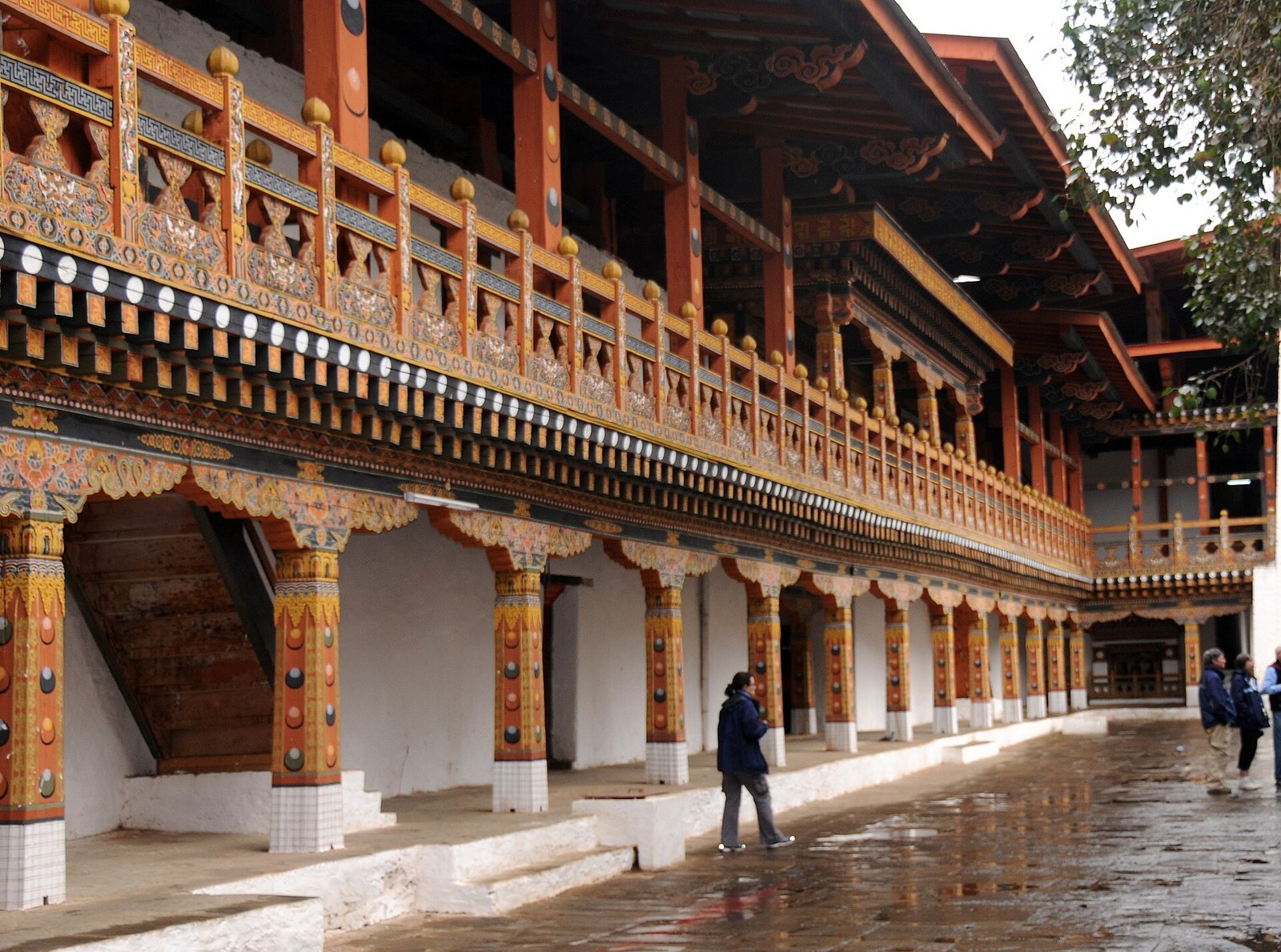
The six-storey complex stands at about 1,200 metres between the Mo Chhu and Pho Chhu rivers, with mountains behind it. The rivers meet downstream as the Puna Tsang Chhu, also called the Sankosh, which eventually joins the Brahmaputra. The dzong measures about 180 metres long and 72 metres wide, with three courtyards arranged around a central tower, or utse. Built from compacted earth, stone, and timber, it has wooden doors and windows and sloping pyramidal roofs, many covered in gilding or copper. The roofs resemble those of Nepalese temples. A steep wooden stairway that could be drawn up and a heavy door closed at night formed part of its defences. Jacaranda trees around the complex flower mauve in spring.
Courtyards and buildings
First courtyard
The first courtyard contains administrative offices, a large whitewashed stupa, a Buddhist monument, and a bodhi tree. On the far left are a mound of stones and a small chapel dedicated to the queen of the nagas.
Second courtyard
The monks’ residential quarters occupy the second courtyard. The central tower and a passage mark the transition from the first courtyard. One hall is associated with Ugyen Wangchuck; in a separate hall, the British political officer John Claude White invested him in 1905 with the title of Knight Commander of the Order of the Indian Empire.
Third courtyard
At the southern end, the third courtyard preserves sacred remains associated with Ngawang Namgyal and Pema Lingpa, a tertön, or Buddhist figure associated with revealing hidden teachings. The Machey Lhakhang, a temple rebuilt in 1995, houses Ngawang Namgyal’s embalmed body in a casket.
Sacred images and decoration
Paintings and statues
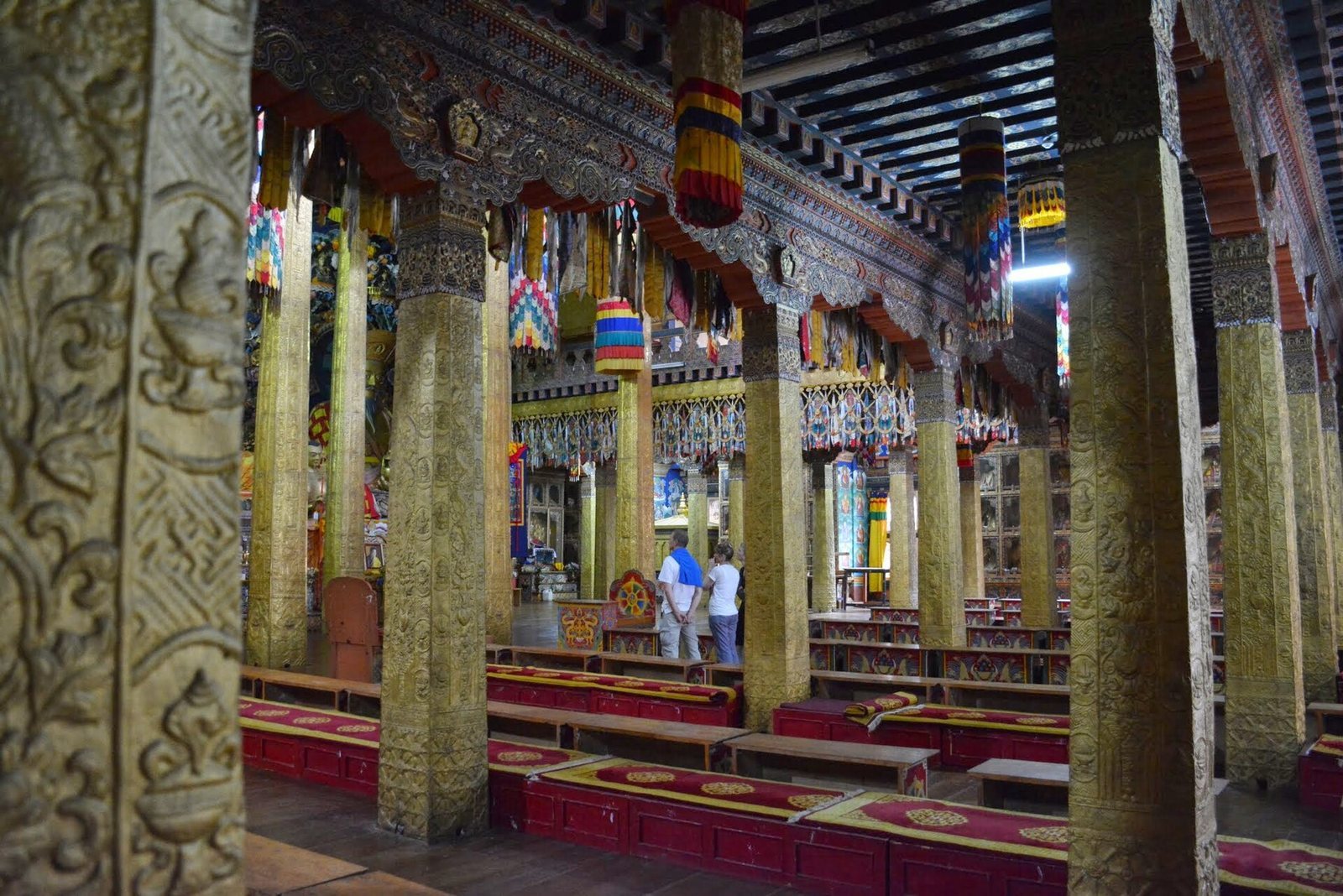
The restored complex includes several temples and more than 200 religious images. Murals depicting the life of the Buddha were painted during the reign of the second Druk Desi. Large gilded statues of the Buddha, Guru Rinpoche, and Ngawang Namgyal date to the mid-18th century, and the interiors also include gilded panels on pillars.
Sacred images and religious painting
The utse houses the Rangjung Kharsapani, a self-originating image of Avalokiteshvara brought from Tibet by Ngawang Namgyal. The dzong also preserves Chenma Thoundral, a large thangka, or religious painting usually made on cloth, depicting Ngawang Namgyal. It is displayed during the annual Tshechu.
River crossing and flood memorial
Wooden bridge
A wooden cantilever bridge, supported by projecting beams, crossed the Mo Chhu in front of the dzong. The 17th-century bridge was swept away by the 1957 flood. Its replacement, built in a traditional style, spans 55 metres. Construction began in 2006, and the bridge was completed in 2008.
Flood memorial
A memorial outside the dzong commemorates the 23 people who died there in the 1994 glacial flood.