Kōgaku-ji Temple: Head Temple of a Rinzai Zen Branch in Japan


Site at a Glance
- Rating
- 4
- Popularity
- Low
- Country
- Japan
- Primary era
- Medieval
- External website
- Open
- Eras represented
- Medieval, Early Modern
- Civilizations
- Ashikaga shogunate, Tokugawa
- Site type
- Religious
- Remains
- Monastery
On this page13 sections
History
Kōgaku-ji Temple is a Buddhist Zen temple in Kōshū, Yamanashi, Japan, founded during the Nanboku-chō period and now serving as the head temple of one of the fourteen autonomous branches of Rinzai Zen. Its principal image is Shaka Nyōrai, the Japanese Buddhist name for Shakyamuni Buddha, the historical founder of Buddhism. The temple’s history began with a hermitage established by the Zen prelate Bassui Tokushō at Takamori in Shioyama in 1378.
Foundation and Takeda patronage
Bassui sought secluded places for meditation as his following grew, but the first site proved inconvenient. On January 20, 1380, the hermitage was moved to Shionoyama on land donated by Takeda Nobunari, the military governor of Kai Province, and received the name Kōgaku-an. Nobunari is said to have surveyed and confirmed the temple estate and donated its statue of Shaka Nyōrai. After Bassui’s death, he also held a memorial service for the teacher.
The character “gaku” in the temple’s name refers to Mount Fuji and recalls a spiritual dream Bassui had previously experienced concerning the mountain. Kōgaku-ji became closely associated with the Southern Court during the civil wars between Japan’s rival Northern and Southern imperial courts. It is said to have been designated by Emperor Go-Kameyama as a chokugan-ji, an imperial temple established for prayers on behalf of the nation.
The Takeda clan, which ruled Kai Province, strongly supported the temple. Through this patronage, Kōgaku-ji received estates and developed numerous subsidiary temples and chapels. Its institutional influence later extended through the Rinzai tradition, a form of Japanese Zen centered on disciplined meditation, teacher-student instruction, and direct insight.
Conflict, decline, and reconstruction
During the Meiō period of the late Muromachi era, a dispute between Takeda Nobutsuna and Aburakawa Nobuyoshi enabled Oyamada Nobunaga, a local warrior from Tsuru District, to seize Kōgaku-ji’s estate at Tahara. When Nobutsuna and Nobuyoshi made peace in 1498, Nobunaga returned the document recording the seizure on September 24, 1499.
The temple’s prosperity gradually diminished after the fall of the Takeda clan and the establishment of the Tokugawa shogunate. During the middle Edo period, many of its affiliated temples were lost. Several subsidiary temples were abolished, while others joined different branches of Rinzai Zen.
Fire repeatedly damaged the complex. Much of the original temple was destroyed in 1782, although the buildings were rebuilt after each fire. Another blaze in April 1926 destroyed the abbot’s quarters and kitchen. The kitchen was rebuilt in 1967, and a wider reconstruction was completed in 1968.
Institutional status and heritage
In 1876, after the beginning of the Meiji period, Kōgaku-ji belonged to the Nanzen-ji branch of Rinzai Zen. It became independent from that branch in 1908 and regained its position as the head temple of its own Rinzai branch. Kōgaku-ji now administers eight sub-temples and has fifty affiliated temples. It is also the twelfth site on the Kai 108 Pilgrimage.
The temple and its associated cultural properties include a National Treasure, Important Cultural Properties, and a National Place of Scenic Beauty. These recognitions relate to the Daruma painting, the Central Gate and other historic materials, and the temple garden.
Remains
Kōgaku-ji’s surviving precinct combines wooden religious buildings, historic paintings and printing blocks, and a stone garden laid out on a mountainside slope. The buildings and objects preserve different phases of the temple’s development from the Muromachi period through the Edo period and later rebuilding.
Temple buildings and garden
Central Gate
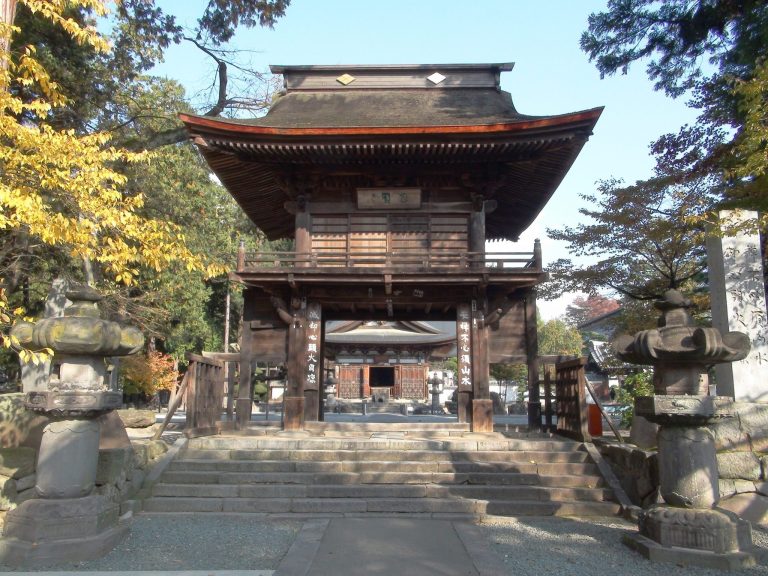
The Kōgaku-ji Central Gate is a wooden structure with four pillars and a roof covered in cypress shingles. Dating from the Muromachi period, it is among the oldest surviving structures in the temple complex. Its timber construction and roof form represent the architectural fabric that remained from the temple’s earlier history.
Buddhist Hall
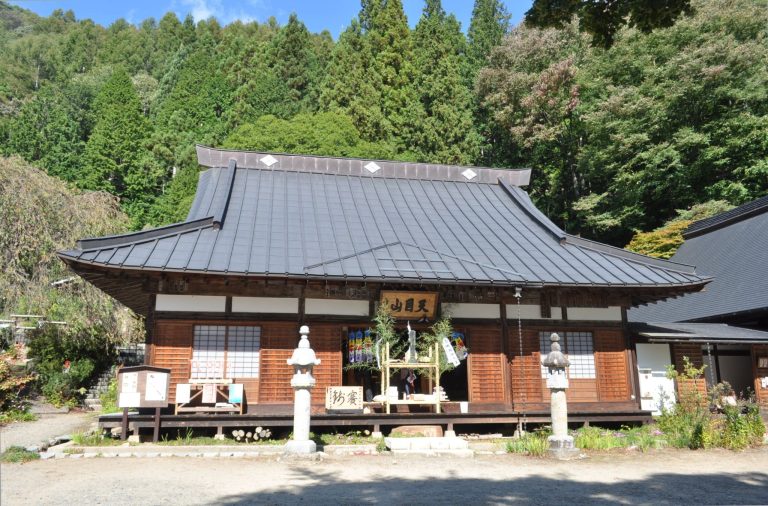
The precinct includes a Buddhist Hall recognized as a municipal cultural property. The temple’s principal image, a statue of Shaka Nyōrai, is associated with the religious center of the complex.
Mountain garden
The Japanese garden occupies a slope on the northern side of the precinct. It is a stone garden believed to date from the early Edo period and was renovated several times during the eighteenth and nineteenth centuries. Excavation in 1990 revealed arrangements of rock formations, ponds, and waterfalls, clarifying the physical organization of the garden.
Paintings and printed materials
National Treasure Painting of Daruma
The National Treasure Painting of Daruma is a hanging scroll, a vertically mounted work designed to be displayed and then rolled for storage. Executed in colored ink on paper, it shows Daruma seated in a formal pose and wearing red robes. The scroll measures 123.3 by 61.2 centimeters. It bears an inscription by Lanxi Daolong, the Chinese Zen priest who served as head abbot of Kenchō-ji in Kamakura, and was painted by an unidentified Japanese artist strongly influenced by Southern Song painting.
Portraits of Zen prelates
The Portrait of Sankō Kokushi is a Muromachi-period hanging scroll in colored ink on paper depicting Kōhō Kakumyō, a Zen prelate from Aizu. He is shown seated on a chair, and the portrait measures 136.4 by 60.6 centimeters.
The Portrait of Daien Zenji is another Muromachi-period hanging scroll in colored ink on paper. It depicts Bassui Tokushō seated on a chair and measures 128.8 by 62.2 centimeters. The work was painted in 1393, seven years after Bassui’s death.
Printing blocks
Kōgaku-ji preserves numerous printing blocks from the Muromachi and Edo periods. A group of thirty-seven blocks dated 1386 contains questions and answers intended for priests. Another block, dated 1389, records regulations concerning prices issued by Bassui Tokushō. These carved blocks preserve written material connected with the temple’s religious instruction and administration.