Swords Castle: An Anglo-Norman Manorial and Archiepiscopal Residence in Ireland


Site at a Glance
- Rating
- 4.5
- Popularity
- Medium
- Country
- Ireland
- Primary era
- Medieval
- External website
- Open
- Eras represented
- Medieval
- Civilizations
- Norman
- Site type
- Military
- Remains
- Castle
On this page12 sections
History
Swords Castle in Ireland stands at Swords, north of Dublin, and was built around 1200 or shortly afterward by John Comyn, the first Anglo-Norman Archbishop of Dublin. It served as his manorial residence, the principal home and administrative centre of his estate, and became the main residence associated with his archiepiscopal office. A settlement attributed to St. Columba, or Colmcille, had existed at Swords since the sixth century, and the Archbishop of Dublin gained control of it during the twelfth century.
The archiepiscopal manor
A manor existed at Swords by 1192, when Comyn received permission to hold a week-long annual fair on 9 June, the feast of St. Columba. The archbishop maintained a seneschal at the manor, an official who managed the estate, and held an ecclesiastical court there, meaning a church-administered court for matters under religious jurisdiction. In 1216 the manor was granted to Henry de Loundres, and William Galrote was recorded in 1220 as chief constable of the castle.
Successive Archbishops of Dublin appear to have occupied Swords Castle for about a century. In 1324, however, Archbishop Alexander de Bicknor built a new archiepiscopal palace at Tallaght. Swords Castle then appears to have been abandoned, and an inquisition held in 1326 found it in disrepair. The decline may have followed damage during Edward Bruce’s campaign in Ireland in 1317. Bruce was a Scottish prince and military leader, but there is no direct evidence that his forces attacked Swords Castle. Its relatively weak fortifications may nevertheless have encouraged the move to Tallaght.
Later medieval and early modern use
The castle probably continued to serve some purpose during the fifteenth century. Its stepped battlements were built or altered during that period, and the complex may have been made available to retired archbishops. Constables occupied at least part of the site during the fourteenth, fifteenth, and early sixteenth centuries, retaining responsibility for the castle’s custody and administration.
Thomas FitzSimons became constable in 1547, after which the Barnewall family retained an interest in the constableship and tenancy. In 1583 Dutch Protestants briefly occupied the castle. It was then described as a severely ruined old castle, and Sir Henry Sydney arranged repairs to parts of the complex for a colony of Dutch weavers.
During the 1641 Rebellion, an uprising in Ireland, Swords Castle became a meeting place for the Anglo-Irish Catholic families of the Pale. The Pale was the area of English administration and settlement centred on Dublin. On 9 December 1641, Sir Charles Coote attacked the armed group assembled at the castle on the orders of the Lords Justices, senior officials governing Ireland for the English Crown. He drove the group from the fortifications and killed two hundred people. Burials discovered during later excavations may be connected with this event.
Garden, guardianship, and restoration
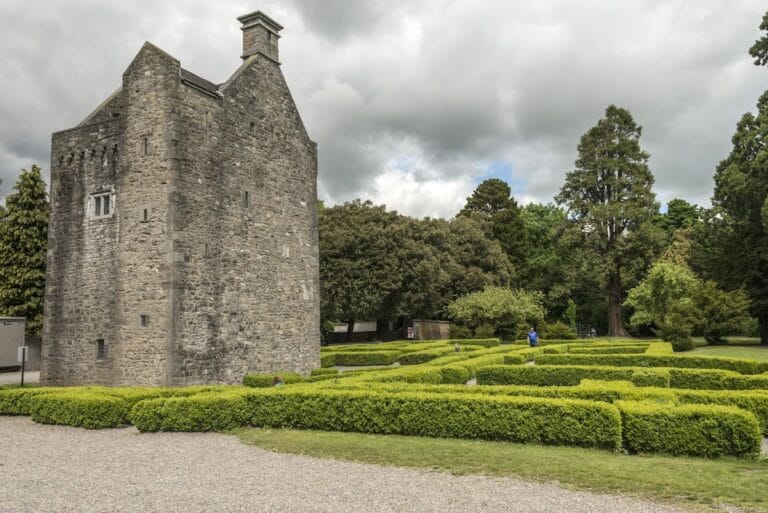
An Ordnance Survey map of 1837 shows the castle grounds, or bawn, converted into a garden. A bawn was an enclosed outer yard or compound associated with a fortified residence. After the disestablishment of the Church of Ireland in 1870, the castle was sold to the Cobbe family and leased to the local shopkeeper Robert Savage. Savage turned the grounds into an orchard and sold its produce.
The Office of Public Works took the site into guardianship during the 1930s. Dublin County Council, later Fingal County Council, purchased it in 1985 for restoration, and the castle is listed on Fingal County Council’s Record of Protected Structures. Studies by the council’s Parks Department included a conservation study of the entire site. A phased restoration plan was agreed in 1995, work on the Constable’s Tower began in 1996 and ended in 1998, and restoration of the remainder of the complex has continued. Swords Castle is a National Monument of Ireland.
Remains
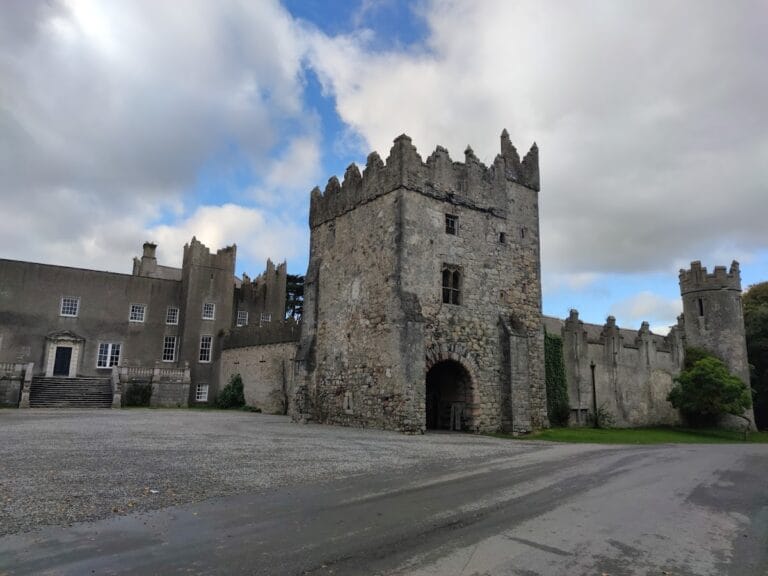
Swords Castle stands near the Ward River within a large pentagonal enclosure. Its perimeter wall measures approximately 305 metres and surrounds nearly 6,000 square metres, or about 1.5 acres. Built largely of rubble stone, the enclosure was unusually extensive for an Irish castle, although the fortification itself was not particularly strong. The surviving layout reflects a combined religious and manorial complex, with residences, service rooms, a chapel, and defensive boundaries arranged around the enclosed space.
Principal towers and entrance
Constable’s Tower
A tower on the northern side of the enclosure probably served as the constable’s residence. Its position within the castle reflects the administrative role of the constable, who was responsible for the custody and management of the complex. The Constable’s Tower was restored between 1996 and 1998, while restoration work elsewhere has continued.
Gateway complex
An impressive gateway complex occupies the southern side of the enclosure. The warder may have lived in quarters to the left of the entrance. To the right was probably a janitor’s room, with a priest’s room above it. These rooms formed part of the working arrangements of the castle, linking control of the entrance with its religious and domestic functions.
Religious and residential buildings
Archbishop’s apartments and hall
The enclosure contained apartments for the archbishop, accommodation for knights, and a banqueting hall. A great hall stood on the eastern side of the enclosure in 1326, but this building has since disappeared. These spaces formed the residential and ceremonial centre of the archbishop’s manor.
Chapel
An adjoining chapel was built in the late thirteenth century and probably served as the archbishop’s private oratory, a small place of personal prayer. Its presence reflects the religious character of a residence controlled by the Archbishop of Dublin.
Walls and later alterations
The stepped battlements indicate a phase of occupation or alteration during the fifteenth century. Together with the perimeter wall, the gateway, northern tower, chapel, and surviving evidence of the residential buildings, they show how the castle developed from an archiepiscopal manor into a complex with both domestic and defensive elements. Some burials found during excavations may relate to the violence of 1641, adding archaeological evidence to the later history of the enclosure.