Malahide Castle: A Medieval Talbot Family Residence in Ireland

Site at a Glance
- Rating
- 4.6
- Popularity
- High
- Country
- Ireland
- Primary era
- Medieval
- External website
- Open
- Eras represented
- Medieval, Early Modern
- Civilizations
- British, English, Norman
- Site type
- Military
- Remains
- Castle
On this page17 sections
History
Malahide Castle is a restored lowland stone castle in Ireland, near the town of Malahide, whose estate began in 1185 under the Talbot family during the period of Anglo-Norman expansion in Ireland. Richard Talbot, a knight who had accompanied Henry II to Ireland in 1174, received the lands and harbour of Malahide. The castle and estate remained associated with the Talbots for 791 years, conventionally dated from 1185 to 1976, apart from an interruption in the mid-17th century.
Talbot ownership and medieval development
The castle was substantially enlarged during the reign of Edward IV, the English king who ruled from 1461 to 1483. Further towers were added in 1765, extending the building’s long process of adaptation. The Talbot family remained Roman Catholic until 1774, while the estate continued through the period of the Penal Laws, restrictions imposed in Ireland against Roman Catholics and others outside the established Anglican church.
War, occupation, and family tradition
Malahide survived the Battle of the Boyne in 1690, the conflict that secured William III’s victory in Ireland. A tradition linked to the battle holds that fourteen members of the owner’s family breakfasted in the Great Hall and were all dead by evening. The estate was also temporarily removed from Talbot ownership after the Cromwellian conquest of Ireland, the mid-17th-century campaign by Oliver Cromwell’s parliamentary and military forces. Cromwell granted Malahide to Miles Corbet, an English administrator, during the settlement. After Cromwell’s fall, Corbet was hanged and the castle returned to the Talbots in 1660.
Modern discoveries and transfer to the state
During the First World War, a mooring-out base for airships was established in the grounds in 1918. Airships from the Royal Naval Air Service base at Anglesey in Wales used it for anti-submarine operations in the Irish Sea. A plan to station airships at Malahide from 1919 was abandoned when the war ended.
Private papers belonging to the Scottish writer James Boswell were discovered at the castle in the 1920s. Boswell’s great-great-grandson, Lord Talbot de Malahide, sold the papers to the American collector Ralph H. Isham. A second cache was later found and also acquired by Isham. The papers subsequently passed to Yale University, which published editions of Boswell’s journals and correspondence.
The 7th Baron Talbot inherited the castle and estate and wished to donate them to the state. After his death in 1973, his sister Rose inherited the property. In 1975, she ceded the castle to the Irish state to meet outstanding inheritance-tax obligations. Much of the contents, especially the furniture, had already been sold, although some objects were recovered through private and governmental efforts. The demesne is now owned by Fingal County Council, while the castle’s transfer ended the Talbots’ direct ownership of the property.
Two exhibitions formerly housed in the demesne were relocated between 2010 and 2011. The Tara’s Palace Museum of Childhood moved to Powerscourt Estate near Enniskerry in 2011, and the Fry Model Railway, displayed at Malahide Castle from 1988 to 2010, later reopened at the restored Casino House near Malahide railway station. The grounds began operating as a concert venue in 2007. They were also selected as the planned base camp for the 16th World Scout Moot in 2021, although the event was cancelled because of the COVID-19 pandemic.
Remains
Castle and immediate grounds
Castle building
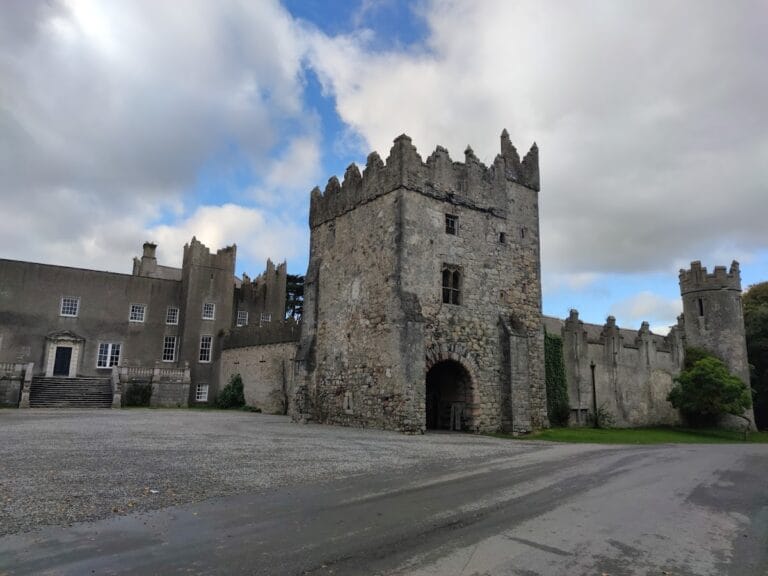
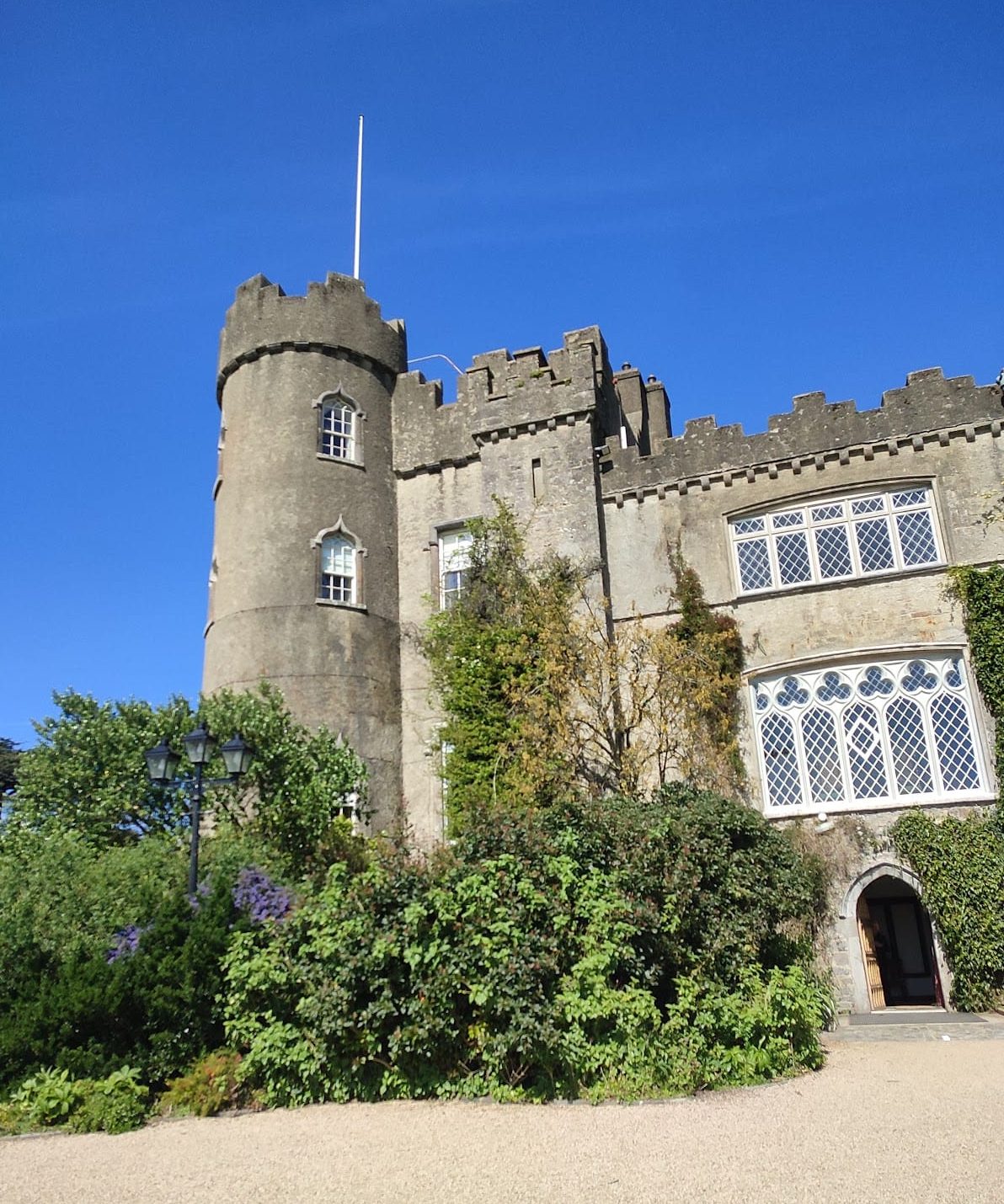
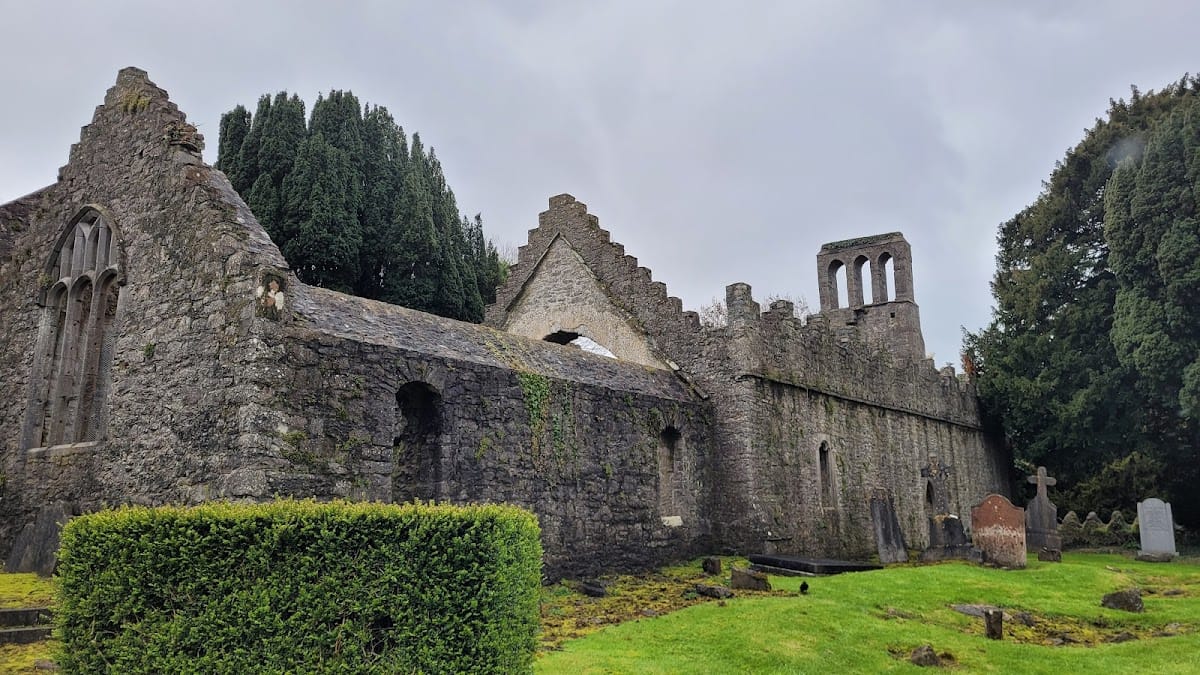
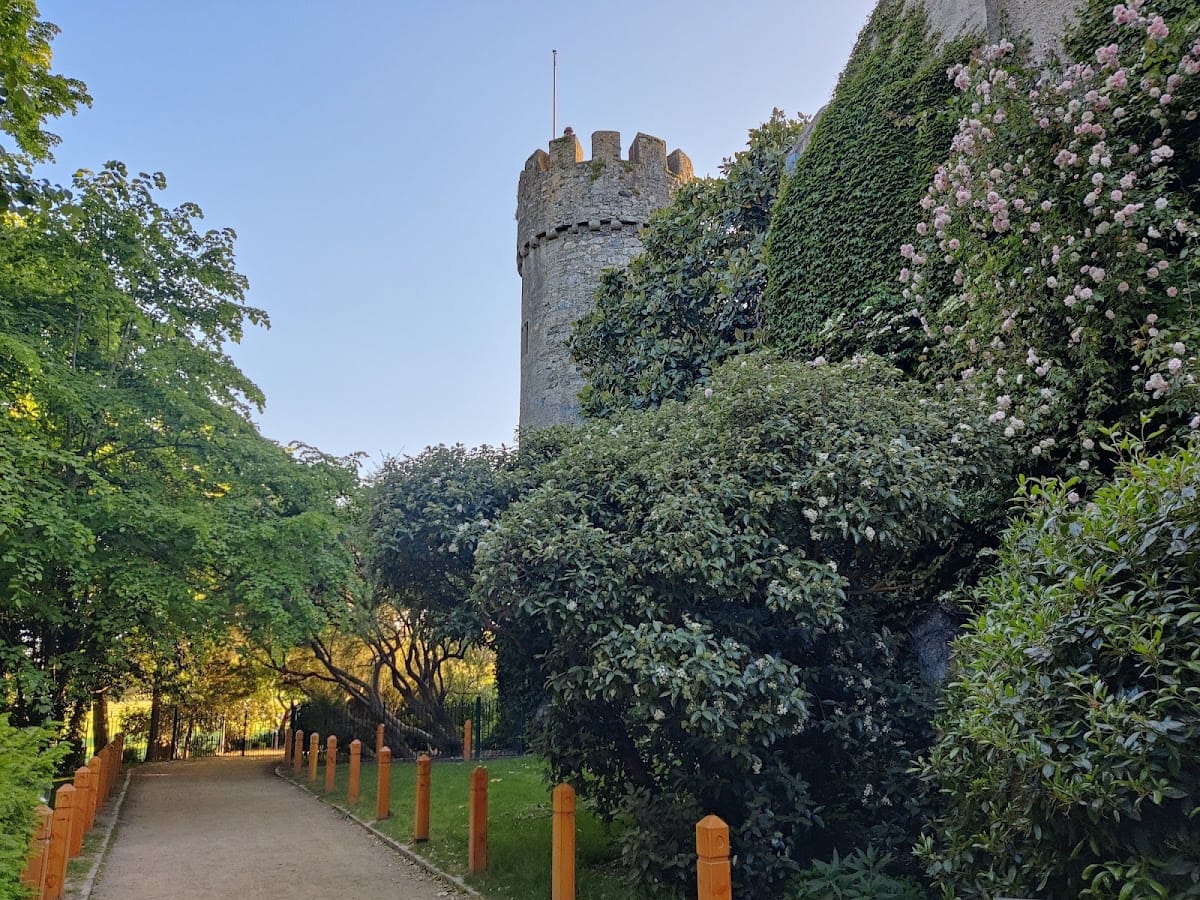
Malahide Castle is built in roughly level terrain, giving it the character of a lowland fortified residence rather than a hilltop stronghold. Parts of the building date from the 12th century, and its walls use rubble-stone masonry, in which irregular stones are set in mortar. The restored castle incorporates the Gothic Great Hall and the Oak Room. Gothic architecture is a medieval European style associated with pointed arches, elaborate tracery, and vertical emphasis.
Great Hall and Oak Room
The Great Hall contains displays relating to the history of the Talbot family. It is also the room associated with the tradition concerning the fourteen family members who were said to have died after the Battle of the Boyne. The Oak Room forms another principal interior of the castle and survives as part of the restored building.
Courtyard
A courtyard behind the castle contains a café, craft shop, and other retail facilities. These spaces form part of the immediate complex surrounding the historic building.
Gardens and designed landscape
Talbot Botanic Gardens
The Talbot Botanic Gardens lie behind the castle and include several hectares of planted areas and lawns. A 1.6-hectare walled garden forms a defined part of the grounds, while seven glasshouses, including a Victorian conservatory, support the garden layout. The collections contain many plants from the Southern Hemisphere, especially Chile and Australia, reflecting the plant-collecting interests of the 7th Baron Talbot de Malahide in the mid-20th century.
Parkland
The surviving demesne covers approximately 267 acres, or about 1.1 square kilometres, and forms Malahide Demesne Regional Park. It is the remaining portion of the original castle estate. The grounds retain one of the few surviving examples of an 18th-century landscaped park, with broad lawns enclosed by a protective belt of trees.
Recreational and estate structures
Sports grounds
The park includes woodland walks, an exercise trail, sports grounds, a cricket pitch, several football pitches, a nine-hole par-three golf course, an 18-hole pitch-and-putt course, tennis courts, and a boules area. Pitch-and-putt is a short-form golf game played on a small course, while boules refers to games in which players throw heavy balls toward a smaller target ball.
Lady Acre cricket ground
The cricket ground lies in the Lady Acre field and is the home ground of Malahide Cricket Club. Temporary grandstands and hospitality pavilions accommodated more than 10,000 spectators for an international match in September 2013, described as a record attendance for the island of Ireland.
Casino House
Near Malahide railway station, the restored Casino House survives as a former shooting lodge of the Talbot de Malahide family. It later became the location of the Fry Model Railway.
Concert grounds
The open grounds provide space for concerts, with a stated capacity of up to 20,000 people in 2017. A pavilion beside the golfing facilities provides access to those areas and contains a café and other facilities, while a large children’s playground stands near the castle.