Święty Krzyż Abbey: A Historic Benedictine Sanctuary in Poland


Site at a Glance
- Rating
- 4.7
- Popularity
- Medium
- Country
- Poland
- Primary era
- Early Modern
- External website
- Open
- Eras represented
- Medieval, Early Modern
- Civilizations
- Kingdom of Poland, Polish–Lithuanian Commonwealth
- Site type
- Religious
- Remains
- Monastery
On this page10 sections
History
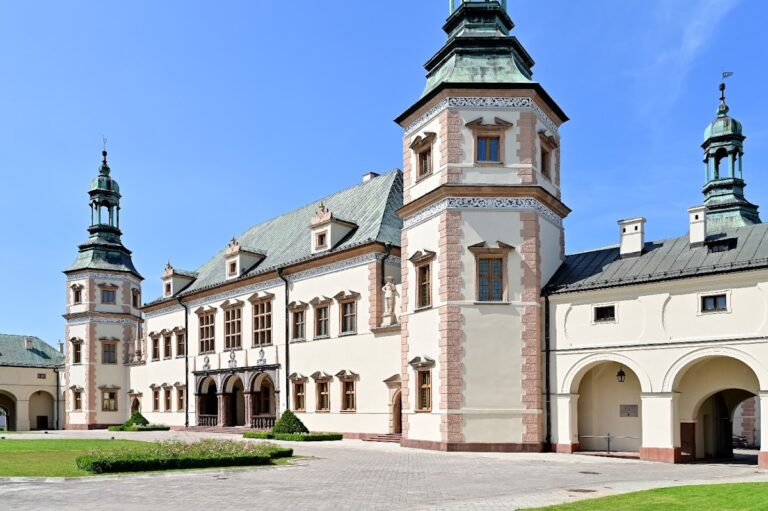
Święty Krzyż Abbey is a historic monastery and sanctuary in Poland, located on Święty Krzyż, also called Łysa Góra or Łysiec, near Nowa Słupia. Founded as a Benedictine institution, it takes its name from relics of the True Cross, the cross traditionally associated with the crucifixion of Jesus. The abbey’s present church is a late Baroque building with a Classical interior, constructed between 1781 and 1789 on the site of two earlier churches.
Foundation and medieval development
The abbey’s foundation date remains uncertain. Benedictine tradition attributes its establishment to Bolesław Chrobry in 1006, while another tradition places the foundation of the monastery and its Romanesque church under Bolesław Krzywousty between 1102 and 1138. The church is also dated to the third quarter of the twelfth century. These traditions place the monastery among Poland’s early religious foundations, although the precise beginning of the institution is unresolved.
In 1306, Władysław Łokietek gave the Benedictines of Łysiec relics of the True Cross. From the eighteenth century, the relics were kept in the Oleśnicki Chapel. A later legend attributed their donation to Emeryk, a Hungarian prince, but the transfer by Władysław Łokietek is central to the abbey’s established religious history. It remains uncertain whether Mongol forces captured the abbey during their second invasion of Poland in 1259.
Royal sanctuary and fifteenth-century rebuilding
During the Jagiellonian period, when members of the dynasty ruled Poland and Lithuania, Święty Krzyż became the most important religious sanctuary in the Kingdom of Poland. Władysław Jagiełło visited seven times, Kazimierz Jagiellończyk ten times, Zygmunt Stary six times, and Zygmunt August three times. These repeated royal visits established the monastery as an important destination for royal pilgrimage.
In the mid-fifteenth century, Abbot Michał of Lipie expanded the Romanesque church with financial support from Kazimierz Jagiellończyk. The work added a Gothic presbytery, the area around the main altar reserved for clergy, together with a sacristy and a western section. Cardinal Zbigniew Oleśnicki financed a new choir and high altar, consecrated on 12 March 1455, and probably also supported the vaulting of the nave and the construction of the monastic cloisters.
A fire damaged the monastery in 1459, after which the present Gothic cloisters around the garth were probably built. During this period, the monk Andrzej of Słupia copied the collection known as the Łysogórskie Songs, regarded as one of the oldest documents created in the Polish language. In 1491, Abbot Maciej of Pyzdry added a northern monastery wing containing an infirmary and pharmacy.
Seventeenth-century transformation and conflict
The abbey continued to attract rulers in the early modern period. In 1607, Zygmunt III Waza visited after defeating the rokoszans, opponents in a political rebellion, at the Battle of Guzów. The Oleśnicki Chapel was built between 1611 and 1620 on the site of the chapter house, with funding from Mikołaj Oleśnicki. From 1723, the True Cross relics were kept in the chapel.
In 1643, Abbot Stanisław Sierakowski began remodelling the church. Two Baroque towers were added to the Gothic body, early Baroque stonework was placed around the doors and windows, and the Chapel of Our Lady of Sorrows was built on the south side. Swedish forces plundered the church in 1655 and killed part of the monastic community. On 22 March 1661, Jan II Kazimierz Waza, his wife, and their court visited the sanctuary while travelling toward Warsaw.
A western monastery wing with a new refectory was constructed between 1686 and 1701. The refectory was later converted into a prison and now contains a museum. Swedish troops occupied the monastery again in 1704, during the Third Northern War. In 1690, Pope Alexander VIII excommunicated Abbot Aleksander Benedykt Wyhowski and the abbey. The excommunication was lifted around 1706. From 1709, Święty Krzyż served as the centre of the Polish Benedictine Congregation of the Holy Cross.
Fire, suppression, and prison use
A fire in October 1777 destroyed the Gothic-Baroque church and monastery. A third church was then built between 1781 and 1789 in the Baroque-Classical style to a design by Józef Karsznicki. It was consecrated in 1806. The monastery was formally suppressed on 6 June 1819 under measures authorized by Pope Pius VII’s bull of 30 June 1818, ending its institutional status as a Benedictine house.
From 1852 to 1865, the complex housed a correctional institution for priests classified as “erring priests.” Insurgents of the January Uprising, a Polish rebellion against Russian rule in 1863, were stationed there in January of that year. In 1884, the Russian authorities converted the abbey into a criminal prison. Sergiusz Piasecki remained imprisoned there until 1937 and began writing his novel Lover of the Great Bear in a cell. The prison continued to operate in the building that now houses the museum until 1939.
War, renewed religious occupation, and preservation
In 1914, Austrian forces blew up the church tower. From 1936, the Missionary Oblates of Mary Immaculate, a Catholic missionary congregation, established a monastery and novitiate in the complex, replacing the Benedictines as the resident order. In September 1939, the Luftwaffe bombed the monastery, causing partial damage. German forces held Soviet prisoners of war there from 1941 to 1944.
After the Second World War, the complex was opened to visitors. The sanctuary received the Catholic Church’s honorific title of minor basilica on 16 June 2013. The church tower was reconstructed in 2014 to a design by the architect Władysław Markulis. Part of the abbey grounds was removed from Świętokrzyski National Park in December 2021. The monastic complex is entered in Poland’s register of immovable monuments under entries dated 24 March 1947 and 23 June 1967.
Remains
Church and sacred spaces
The complex includes the late Baroque church, whose exterior retains Baroque elements while its interior has a Classical character. Built between 1781 and 1789 on the site of earlier churches, it contains seventeenth-century sculptures in wall niches that probably came from an earlier building. The tower destroyed by Austrian forces in 1914 was reconstructed in 2014. The Classical high altar bears a painting of the Holy Trinity by Franciszek Smuglewicz, who also painted Saint Joseph, Saint Emeryk, and Saint Scholastica with Saint Benedict. The church contains a tomb slab for Michał Maliszewski, a royal secretary and abbot, together with a marble portal and eighteenth-century choir stalls.
The Oleśnicki Chapel, also called the Chapel of the Relics of the True Cross, occupies the site of the former chapter house and was built in the 1610s with funding from Mikołaj Oleśnicki. Since 1723, it has housed the True Cross relics and their reliquary. The sacristy has a barrel-cross vault and polychrome decoration showing scenes from the life of Saint Benedict. Its inlaid furniture was funded by Abbot Karski in 1777. The Chapel of Our Lady of Sorrows forms part of the church’s south side and belongs to the seventeenth-century remodelling of the complex.
Cloisters and monastic buildings
The fifteenth-century Gothic cloister surrounds the garth, the enclosed courtyard at the centre of the covered passages. Its vault keystones carry Jagiellonian eagles, the Lithuanian Pogoń, and the Dębno coat of arms. The southern arm incorporates part of a twelfth-century Romanesque wall, preserved from the earlier church. The monastery itself dates from the fifteenth century and was remodelled in the seventeenth and twentieth centuries. An eighteenth-century hospital presbytery is also part of the complex.
The former western refectory wing, built between 1686 and 1701, retains its connection with the monastery’s changing institutional history. Used later as a prison, it now contains a museum. The complex also houses a museum of the order and a museum of Świętokrzyski National Park. The monastic gate, built in 1643, is Baroque, while the eastern gate is also Baroque and of uncertain date. The eastern gate was covered with sheet metal in 1976.
Hill setting and archaeological features
The abbey stands on the summit of Święty Krzyż, also known as Łysa Góra or Łysiec, in the Świętokrzyskie Mountains. The listed complex includes the church, monastery, bell tower, eastern gate, the hill grounds, and prehistoric stone embankments. Together, these elements place the monastery within a wider archaeological landscape that includes both the later religious buildings and earlier stone earthworks on the summit.
Nearby sites