Monastery of Santo Toribio de Liébana: A Gothic Pilgrimage Monastery in Spain


Site at a Glance
- Rating
- 4.5
- Popularity
- Medium
- Country
- Spain
- Primary era
- Medieval
- External website
- Open
- Eras represented
- Medieval, Early Modern
- Civilizations
- Crown of Castile
- Site type
- Religious
- Remains
- Monastery
On this page13 sections
History
The Monastery of Santo Toribio de Liébana is a Roman Catholic foundation in Spain, near Potes in Cantabria, whose present Gothic church was begun in 1256. Its origins lie before, or possibly during, the sixth century, and its later importance grew from royal patronage, monastic activity, the writings of Beatus of Liébana, and veneration of the Lignum Crucis, a relic traditionally believed to be wood from the cross used for the crucifixion of Jesus.
Early foundation and dedication
The monastery’s beginnings are associated with two traditions. One attributes its foundation to Turibius of Astorga, a fifth-century Christian bishop traditionally connected with relics from the Holy Land. According to this account, he brought the Lignum Crucis to Spain in the early fifth century. The other tradition identifies the founder as a sixth-century presbyter or bishop from Palencia named Turibius of Liébana, who withdrew to the valley with companions and followed the Benedictine rule, the monastic code associated with Benedict of Nursia.
The community was first dedicated to Saint Martin of Tours. Its early name was San Martín, later San Martín de Turieno, before the dedication and name developed into Santo Toribio de Liébana. A charter from 828 refers to the church of San Martín, while a charter dated 1090 gives the monastery the name Santo Toribio. A separate reference from 1125 mentions the monastery of Turieno under the patronage of Saint Turibius.
Liébana in the early medieval period
During the ninth century, San Martín gained influence through donations and landed endowments from nearby churches and villages. In 953, religious communities from Espinama, Toranzo, Cahecho, Mieses, and Llaves moved to San Martín. By the end of the tenth century, the institution had become a monastery consecrated to San Martín de Turieno.
Liébana also formed part of the Christian stronghold that developed during the early stages of the Reconquista, the long medieval expansion of Christian polities into territories ruled by Muslim states in the Iberian Peninsula. In 714, the valley served as an important base for the Cantabrian dukes Favila and Pedro of Cantabria, while guerrillas associated with Pelayo, an early medieval Christian leader linked with resistance to Muslim rule, emerged from the region. A charter of 735 records the establishment of early churches in nearby villages by the counts of Liébana.
The monastery was initially a royal possession. Alfonso VIII, the medieval king of Castile, later granted it to Count Gómez and Countess Emilia. The couple transferred it, along with other properties in Liébana and neighboring provinces, to the monastery of Oña in Burgos.
Beatus and the growth of pilgrimage
Beatus of Liébana, an eighth-century Christian monk, theologian, and writer, worked at the monastery. His writings included the Commentary on the Apocalypse, an illustrated work that later became an influential model for medieval Apocalypse manuscripts.
The monastery’s pilgrimage tradition centers principally on the Lignum Crucis. The relic was probably brought to Liébana during the eighth century. Tradition holds that Saint Turibius of Astorga carried it from the Holy Land and concealed it on or near Mount Viorna with his remains during the Muslim invasion of 711. It was later transferred to the monastery, which became an important destination for pilgrims traveling toward Santiago de Compostela.
In 1181, the bishops of León, Palencia, Burgos, and Oviedo founded the Confraternity of Santo Toribio to revive the monastery during a period of crisis. After the institution of the jubilee, it became known as the Confraternity of the Holy Cross, whose feast is celebrated on 3 May. The monastery is regarded as one of five Roman Catholic places with the privilege of granting perpetual indulgences, together with Rome, Jerusalem, Santiago de Compostela, and Caravaca de la Cruz.
The Gothic church and the jubilee
The present church was begun in 1256 with financial support raised through indulgences granted by Fernando, bishop of Palencia, under whose authority the monastery then stood. Its ecclesiastical jurisdiction was later shared with the bishoprics of Oviedo and Burgos and passed to the bishopric of Santander after that see was created in the eighteenth century.
The monastery’s connection with Palencia helped develop the Castilian route to Liébana. A papal document preserved in Palencia Cathedral provides evidence for this route in 1455. Pope Julius II granted the Lebaniego Jubilee in a bull dated 23 September 1512. The jubilee later became associated with a plenary indulgence, the remission of the temporal effects of sin under prescribed conditions, during the pontificates of Julius II and Leo X. In 1967, Pope Paul VI extended the period in which the indulgence could be obtained. The jubilee begins when the feast of Saint Turibius on 16 April falls on a Sunday.
Modern religious and heritage history
The monastic community, historically Benedictine, was forced to leave in 1837 following the ecclesiastical confiscation and sale of religious property under the Mendizábal legislation. A small Franciscan community, belonging to the Order of Friars Minor, was established in 1961. The friars were entrusted with safeguarding the relic and promoting devotion to the Holy Cross.
The monastery was declared a national monument and historical-artistic monument on 11 August 1953 and is protected as a Spanish cultural-interest property. In 2015, it became an individual component of the UNESCO World Heritage property Routes of Santiago de Compostela: Camino Francés and Routes of Northern Spain, through its inclusion in the Camino Lebaniego.
Religious customs continue to connect the monastery with the surrounding villages. Under the tradition known as La vez, two men from each village venerate the cross on an assigned day of the week. Traditionally, pilgrims left home before dawn, traveled through the night, and fasted on the journey. The feast of La Santuca, which existed by the fifteenth century, takes place on 2 May. A statue of the Virgin Mary is carried from Aniezo to the monastery, remains there for several hours, and is then returned.
Remains
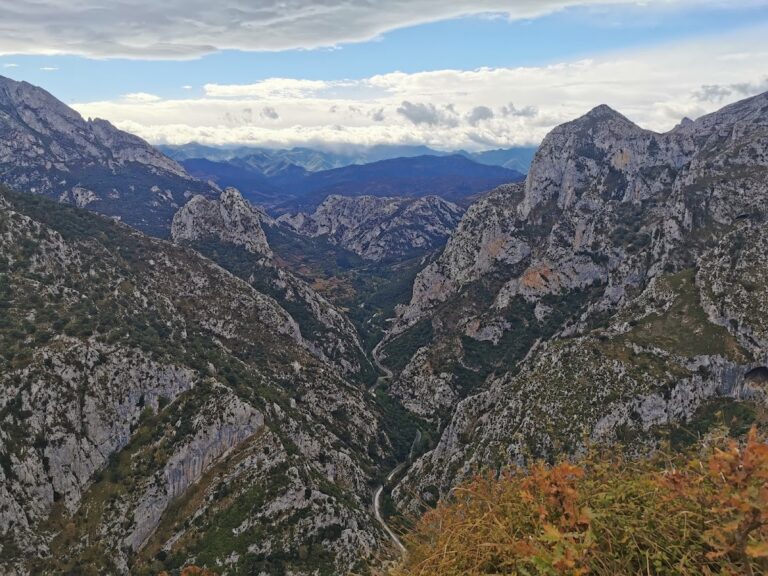
The monastery stands at approximately 410 meters above sea level on the northern slope of the Sierra de la Viorna. The protected site covers about 0.2 hectares, with a buffer area of approximately 0.29 hectares. Its principal surviving elements are the Gothic church, the later cloister, the Baroque chapel of the Lignum Crucis, and several associated religious buildings and ruins.
The church complex
Gothic church
The principal building is a Gothic church begun in 1256 and remodeled several times. It occupies the site of earlier pre-Romanesque and Romanesque buildings, which may have had Asturian or Mozarabic characteristics. Its design has the clear spatial organization and restrained decoration associated with Cistercian-influenced monastic Gothic architecture.
The church has a rectangular plan with three aisles, the longitudinal divisions alongside the central nave. A prism-shaped tower rises at the foot of the central and widest aisle, and three polygonal apses, the polygonal ends of the church, complete the eastern side. The facade resembles that of the Abbey of the Holy Bodies, now Santander Cathedral. Sculptures of apostles and saints occupy niches within the church.
Entrances and former atrium
The doors in the southern wall are Romanesque and may predate the present interior. The principal entrance, the Puerta del Perdón or Door of Forgiveness, is opened only during a Lebaniego Jubilee Year when 16 April falls on a Sunday. Buildings that once enclosed the atrium and gave the monastery a more secluded appearance have disappeared.
Chapel of the Lignum Crucis
The Lignum Crucis is housed in a vaulted Baroque chapel built in 1705 by Pedro Martínez de Cardeña in the church’s north wall. A gilded wooden housing protects the relic, while an effigy of Francisco de Cosío y Otero overlooks the chapel. Born locally, Cosío y Otero served as Grand Inquisitor of Madrid and later as Archbishop of Bogotá.
The relic is traditionally identified as the left arm of the True Cross. It consists of wood described as having been sawn and assembled into a cross, with the nail hole associated with Christ’s hand left intact. The upright measures 635 millimeters, the crossbar 393 millimeters, and the thickness 38 millimeters. The wood is enclosed within a Gothic silver-gilt cross made by a Valladolid workshop in 1679.
An investigation by Madrid’s Forestry Research Institute in 1958 identified the wood as Mediterranean cypress, a species common in Israel, and concluded that it could be more than 2,000 years old. In 1817, two pieces of the relic arranged as a cross were removed with the Benedictine prior’s permission and given to Joachim and Felix Columbus, descendants of Christopher Columbus, for their family chapel in Asturias. The fragments were transferred with the chapel interior to Boalsburg, Pennsylvania, in 1909.
Cloister and chapel decoration
The cloister, a covered walkway enclosing a monastery courtyard, was completed in the seventeenth century. It now contains a miniature exhibition based on the Commentary on the Apocalypse. The dome of the chapel has elaborate stonework decorated with garlands, putti, and representations of the Evangelists.
Associated religious sites
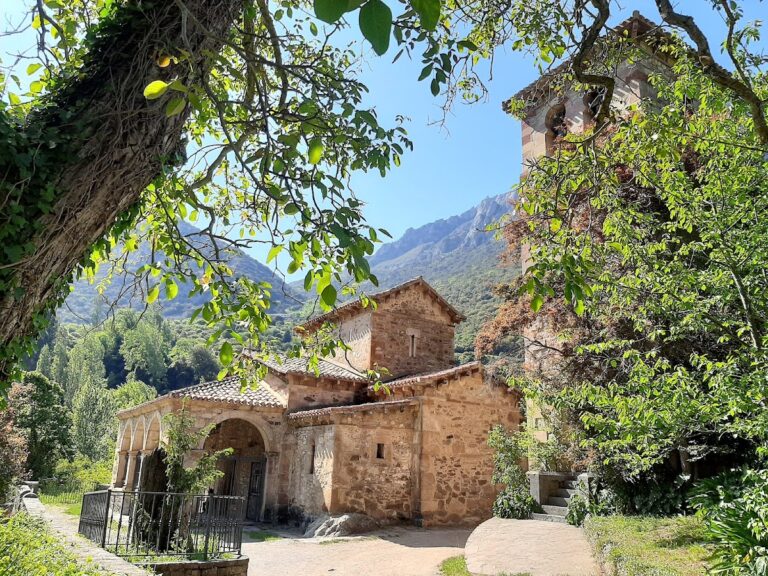
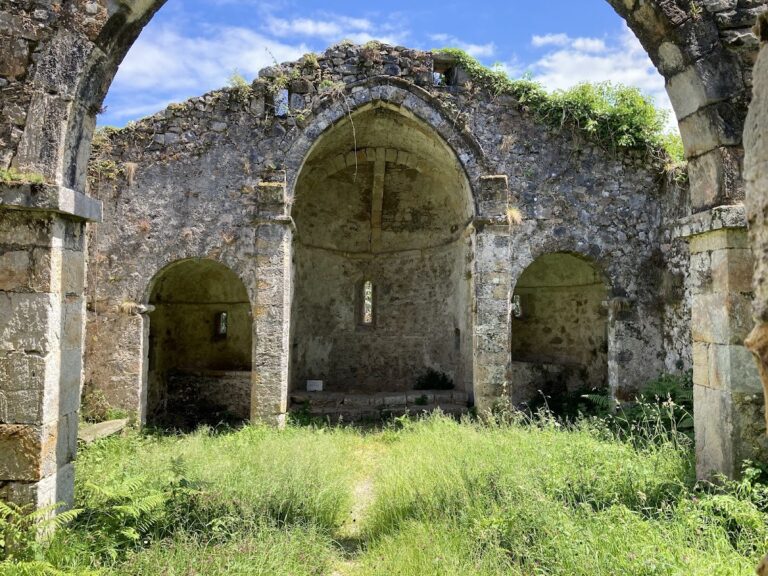
Several religious features near the monastery form part of its wider archaeological and devotional setting. They include the pre-Romanesque Cueva Santa, the ruins of the sanctuary of Santa Catalina, the sixteenth-century hermitage of San Juan de la Casería, and the thirteenth-century hermitage of San Miguel.
Nearby sites