Zákupy Castle: A Bohemian Dynastic Residence and Museum


Site at a Glance
- Rating
- 4.6
- Popularity
- Medium
- Country
- Czechia
- Primary era
- Early Modern
- External website
- Open
- Eras represented
- Early Modern, Modern
- Civilizations
- Habsburg, Holy Roman Empire
- Site type
- Domestic
- Remains
- Palace
On this page8 sections
History
Zákupy Castle is a historic residence in Zákupy, Czechia, developed from a fortress into a Renaissance and Baroque castle. Its later history connected it with the Saxe-Lauenburg, Wittelsbach, Habsburg, and Habsburg-Lorraine dynasties.
Fortress Origins and Renaissance Reconstruction
The original fortress was associated with the Panczer von Smojn knights and the Zákupský von Wartenberg lords. The Berka von Dubá family later acquired it and, in 1532, united the Mühlstein and Zákupy estates. Around 1559, the family commissioned a Renaissance castle using the masonry of the earlier fortress. The new building was damaged by fire approximately two decades later.
Destruction and Baroque Renewal
Johann von Kolowrat-Nowohradský acquired the Reichstadt estate and its ruined castle in 1612. The property entered the Saxe-Lauenburg family after his widow, Anna Magdalena, married Julius Heinrich of Saxe-Lauenburg in 1632. Protestant Swedish troops destroyed the castle in 1634 during the Thirty Years’ War, a European conflict fought from 1618 to 1648 through intertwined religious, dynastic, and political struggles.
Between 1670 and 1683, Duke Julius Franz of Saxe-Lauenburg ordered the castle’s reconstruction in the Baroque style. The work was carried out by Jeremias Süssner, a Saxon architect and sculptor, together with Giovanni Domenico Orsi and Giulio Broggio. After Julius Franz died in 1689, his daughters Franziska Sibylla Augusta and Anna Maria Franziska lived at Reichstadt Castle with their aunt, a princess of the Lobkowitz family.
Dynastic Transfers and the Duchy of Reichstadt
Marriage and inheritance brought the castle to Ferdinand Maria and the Counts Palatine of Neuburg, members of the Wittelsbach dynasty, a ruling house associated with Bavaria and the Palatinate. In 1805, the Reichstadt estate passed by inheritance to Maximilian Joseph III of Palatinate-Zweibrücken. After he assumed the Bavarian royal title in 1806, he surrendered his Bohemian possessions to Duke Ferdinand of Salzburg.
In 1815, a family agreement of the Habsburg-Lorraine dynasty united Reichstadt and several other Bohemian estates under the title Duchy of Reichstadt. In 1818, Emperor Francis I of Austria transferred the duchy to his grandson Napoleon Franz Bonaparte, the son of Napoleon I of France and Marie-Louise of Austria. Napoleon Franz consequently bore the title Duke of Reichstadt, although he never visited the castle. He died in 1832, and the duchy reverted to the Austrian imperial family before being dissolved.
Habsburg Residence and Twentieth-Century Use
Through Duke Ferdinand d’Este, the castle passed to a Tuscan collateral branch of the Habsburgs and, in 1847, to the Habsburg main line. In 1848, it became one of the residences of the abdicated Emperor Ferdinand I. The interior was then richly refitted through the work of architect J. Bělský, painters Josef Navrátil and Wilhelm Kandler, sculptor Václav Levý, and stuccoist J. Effenberger.
On 8 July 1876, Emperor Francis Joseph I of Austria and Tsar Alexander II met at Zákupy Castle to negotiate Austrian neutrality in the impending Russo-Ottoman War. On 1 July 1900, Archduke Franz Ferdinand d’Este, heir to the Austrian throne, married Countess Sophie Chotek of Chotkow, later Duchess of Hohenberg, in the castle chapel.
During the First World War, the castle housed a military hospital, a wartime medical facility for soldiers and other military casualties. Land reform in Czechoslovakia expropriated the property from its owners in 1918. The castle opened as a museum in 1951, underwent renovation in 1977, and has functioned as a cultural center together with its Baroque-style park since 1995.
Remains
Zákupy Castle retains a Baroque complex built over the masonry of the earlier fortress. Four two-storey wings surround a spacious courtyard, forming the principal organization of the surviving building. The present arrangement reflects the renewal carried out between 1670 and 1683 after the Renaissance castle had been damaged by fire and destroyed during the Thirty Years’ War.
Castle Complex
The principal facade includes an early Baroque portal bearing the coat of arms of the Berka von Dubá family. The masonry beneath the later building belongs to the earlier fortress, while the surrounding wings express the Baroque rebuilding of the seventeenth century.
Chapel, Interior, and Park
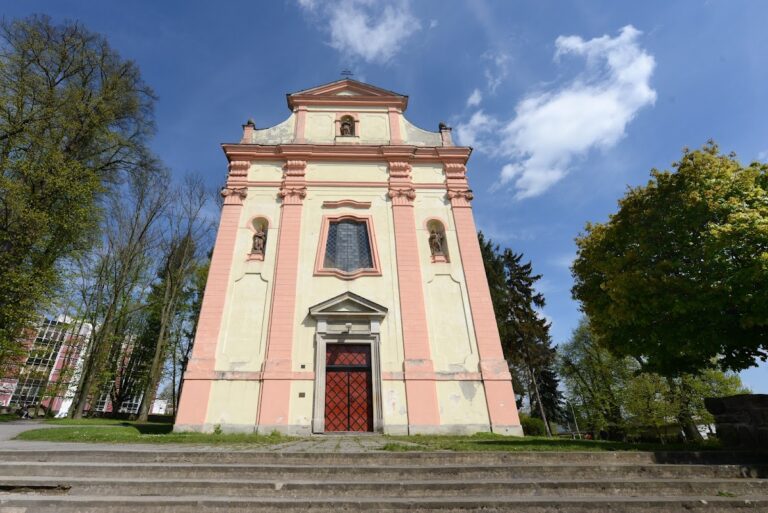
The complex includes a Baroque chapel, which became the setting for the marriage of Archduke Franz Ferdinand d’Este and Sophie Chotek in 1900. Inside, the lavish refitting undertaken in 1848 brought together architectural work by J. Bělský, paintings by Josef Navrátil and Wilhelm Kandler, sculpture by Václav Levý, and stucco by J. Effenberger.
A park laid out in the Baroque style is associated with the castle and forms part of its surviving cultural setting.