Chateau at Kamenice nad Lipou: A Renaissance and Neoclassical Museum Complex


Site at a Glance
- Rating
- 4.5
- Popularity
- Medium
- Country
- Czechia
- Primary era
- Early Modern
- External website
- Open
- Eras represented
- Medieval, Early Modern, Modern
- Civilizations
- Habsburg, Holy Roman Empire, Kingdom of Bohemia
- Site type
- Domestic
- Remains
- Castle
On this page8 sections
History
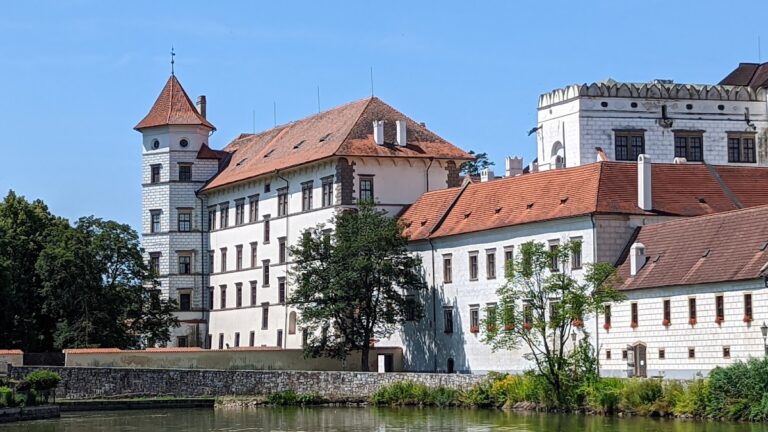
Chateau at Kamenice nad Lipou is a historic chateau in Czechia that occupies the site of a former thirteenth-century castle, traditionally dated to 1248. The property developed through Renaissance and Neoclassical phases and is now a museum and exhibition complex.
Castle Origins and Renaissance Rebuilding
The original castle was converted into a Renaissance mansion between 1580 and 1583. Renaissance architecture revived classical forms in European building from roughly the fifteenth to the early seventeenth century. The rebuilding created an arcaded courtyard, meaning a courtyard lined with sequences of arches supported by columns or piers, together with an adjoining garden.
Ownership passed through several established families. The Benešovici and the Sezimové of Ústí were followed by the Hartig family, the Vratislavs of Mitrovice, and finally the Geymüller family.
Baroque and Neoclassical Transformations
A Baroque entrance tower was added in 1744. Baroque architecture was an elaborate European style that developed during the seventeenth and eighteenth centuries. In the early nineteenth century, F. Rilke, the grandfather of the poet Rainer Maria Rilke, modified the chateau.
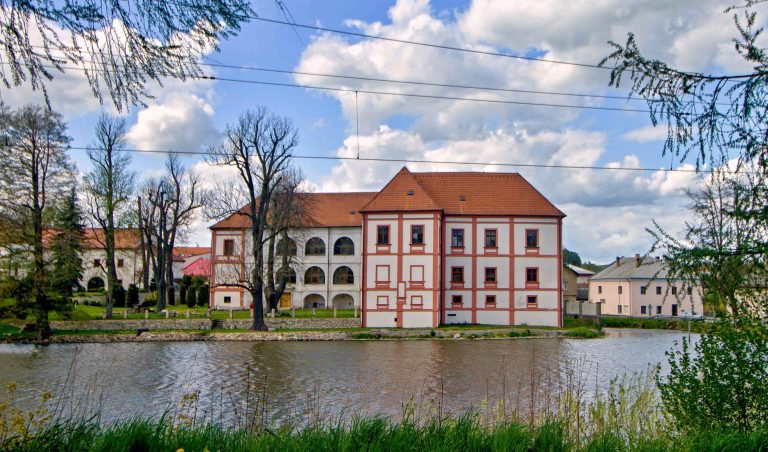
Between 1839 and 1842, the Geymüller family rebuilt the property into its present Neoclassical form. Neoclassical architecture revived the balanced forms and motifs of ancient Greek and Roman architecture, especially during the late eighteenth and nineteenth centuries. The Geymüllers remained the chateau’s last private owners.
State Ownership and Museum Use
The property was confiscated from the Geymüller family in 1945. From that year until 1998, it served as a children’s sanatorium. The chateau became a protected cultural monument in 1958.
Since 1998, the Museum of Decorative Arts in Prague has managed the chateau and maintained a depository there. A museum depository stores and cares for collections that may later be studied or presented in exhibitions. Extensive restoration carried out between 1999 and 2004 renewed major historic interiors, including the large Renaissance hall in the east wing and the large Gothic hall.
The chateau opened to the public as a museum and exhibition complex in 2004. The Museum of Decorative Arts presents exhibitions devoted to furniture, locksmithing, garden ceramics, toys, and the Geymüller family. The town of Kamenice nad Lipou uses the southern wing for its municipal museum, including the Museum for the Senses, which presents the town’s history of more than 750 years.
The annual summer toy festival Hračkobraní was first held in 2006. It continues the town’s tradition of toy making and brings together work by toy designers, manufacturers, art-school students, and collectors from the Czech Republic and abroad.
Remains
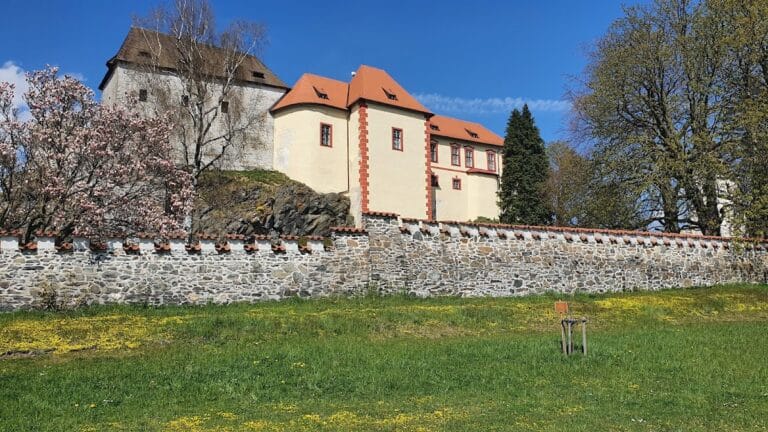
The chateau combines a Renaissance courtyard and garden arrangement with a later Neoclassical exterior. Its surviving historic spaces include remains of the earlier castle, the Renaissance hall in the east wing, and the Gothic hall in the cellars. The grounds contain an English park and a garden with a linden tree estimated to be 700 to 800 years old. The tree is associated with the name Kamenice nad Lipou, meaning “Kamenice at the linden tree.”
Courtyard, Wings, and Historic Halls
The Renaissance rebuilding organized the chateau around an arcaded courtyard and an adjoining garden. The east wing contains the large Renaissance hall as well as surviving remains of the earlier castle. In the cellars, the large Gothic hall preserves a medieval architectural element within the later building. Gothic architecture was the medieval European style associated with pointed arches, vaulting, and vertically emphasized spaces.
Exhibition Areas
The ground floor of the north wing contains the permanent and temporary exhibitions of the Museum of Decorative Arts. The southern wing includes municipal museum exhibition spaces and a ceremonial hall. The cellars contain examples from the garden ceramics collection, while another exhibition is devoted to the Geymüller family.
Collections of Decorative Arts
The permanent exhibition “Lattices, Keys, Locks” presents forged ironwork ranging from the Gothic period to the beginning of the twentieth century. Its objects include grilles, chests, keys, locks, door knockers, and other architectural fittings. “Toys for Boys and Girls,” drawn from the František Kyncl collection, presents toys from the late nineteenth and twentieth centuries. A study depository of nineteenth- and twentieth-century furniture traces the development of furniture design in Bohemia, Moravia, and other European countries.