Sugar Manufacturers’ Palace: A Sugar-Industry Headquarters and Family Residence in Warsaw
Site at a Glance
- Popularity
- Medium
- Country
- Poland
- Primary era
- Modern
- Eras represented
- Modern
- Civilizations
- Russian
- Site type
- Domestic
- Remains
- Elite Residence
On this page11 sections
History
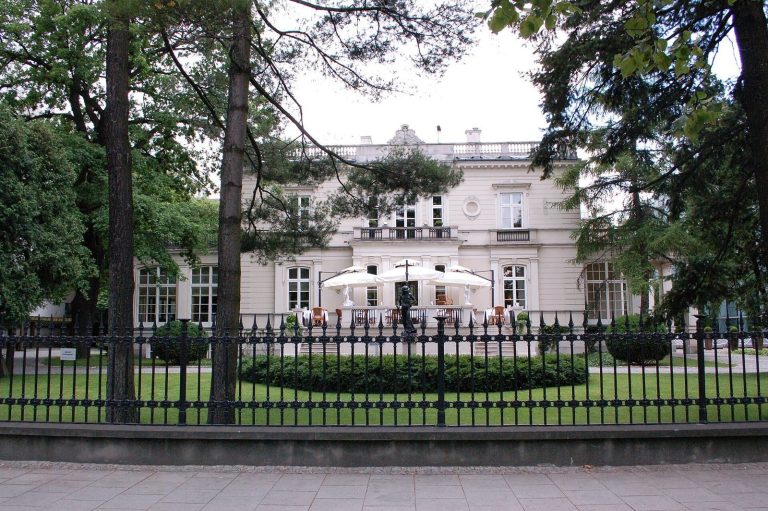
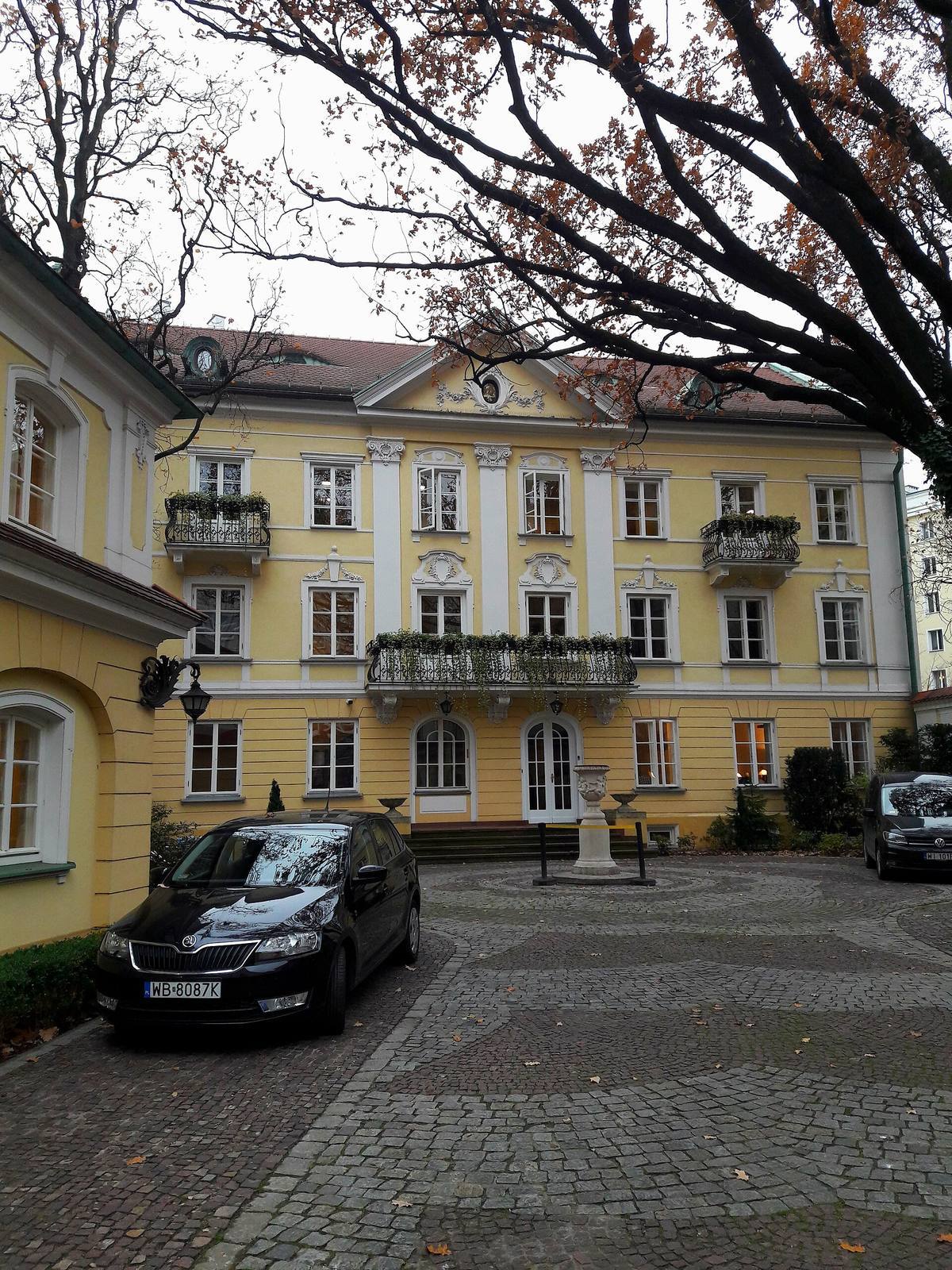
The Sugar Manufacturers’ Palace, also known as the Palace of the Board of Lublin Sugar Factories, is a palace complex at 25 Mokotowska Street in Warsaw, Poland. Its history began with a single-storey manor built in 1878; the later complex is described as Neo-Rococo, a revival style drawing on eighteenth-century Rococo architecture and ornament.
Manor house and early industrial use
The property belonged to Józef Kaczyński, and the manor was built for Kazimiera Ćwierciakiewiczowa, born Kaczyńska. In 1907, Kaczyński’s descendant Mieczysław took over the property and, with Wacław Cywiński, operated a printing house, lithography workshop, and bag factory there.
Sugar companies and private residence
In 1910, the building became the headquarters of the management of four sugar companies: Zbierski, Garbów, Lublin, and Nielepów. Around 1915, an adaptation of the building was commissioned. The Board of Lublin Sugar Factories bought the property in 1922, then extensively remodeled and enlarged it, adding new wings.
In 1935, industrialist and sugar-industry specialist Mieczysław Broniewski bought the property and converted it into a family residence. The sugar-company board moved to 8 Koszykowa Street.
Wartime and postwar institutions
During the German occupation in the Second World War, offices handling sales for sugar factories near Warsaw operated in the building. It suffered slight damage in 1944. After the war, the premises housed the Working Intelligentsia Club of the Union of Youth Struggle, a communist youth organization, and the Central Party Training Center of the Polish United Workers’ Party, Poland’s ruling communist party.
From 1971, the building housed the Institute of Mathematics of the Polish Academy of Sciences, Poland’s national academy of sciences. A later mathematical institution there was the International Mathematical Center named for Stefan Banach, a Polish mathematician and founder of modern functional analysis.
Protection and later ownership
The palace, courtyard, and fence entered Poland’s register of historic monuments in 1977. A major facade renovation followed in 1987. The property was returned to an heir of its last private owner in 2000, then became the property of the Adam Mickiewicz Institute in 2005. The Polish cultural institution, which promotes Polish culture internationally, now occupies the building.
Remains
Palace and courtyard complex
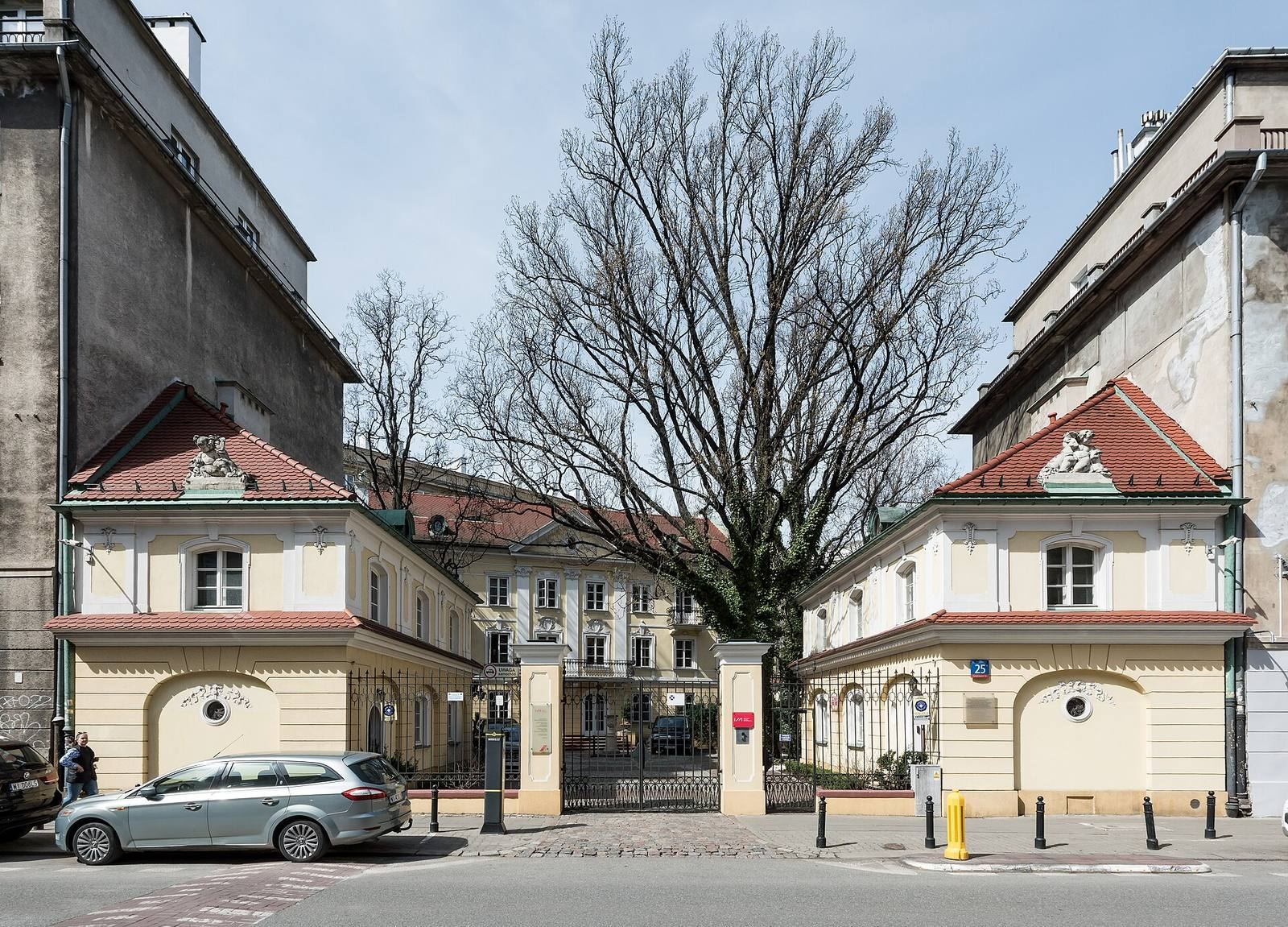
The complex comprises the main palace, two wings, an entrance courtyard, and a fence. Its Neo-Rococo design draws on eighteenth-century Rococo forms and decoration.
Main palace
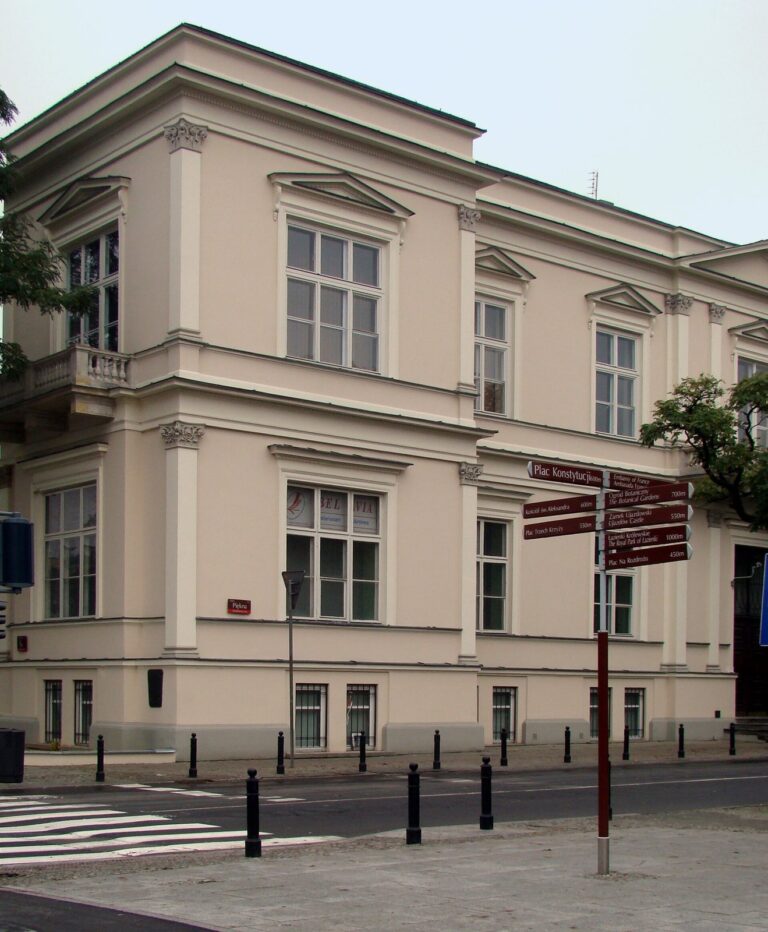
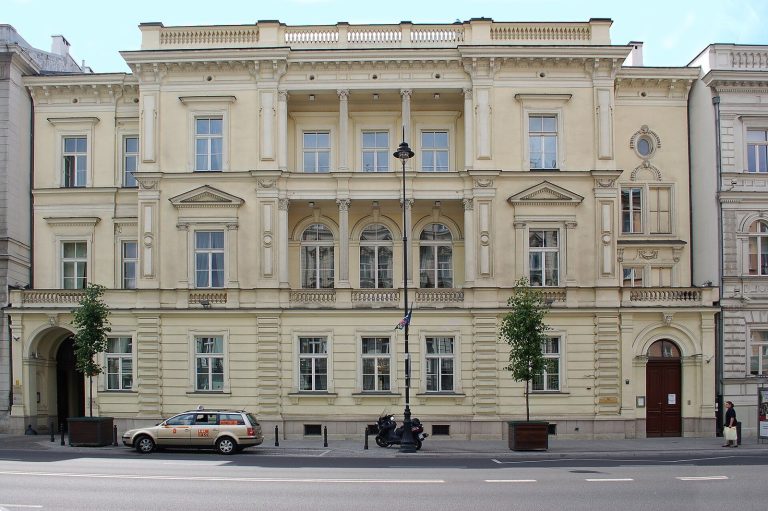
The three-storey main building stands at an angle to the street. Its facade has eight sections above a low base, with a large balcony on the first upper floor, flat attached columns, and a triangular decorative feature at the top. The main house received Rococo ornament.
Wings and roof sculptures
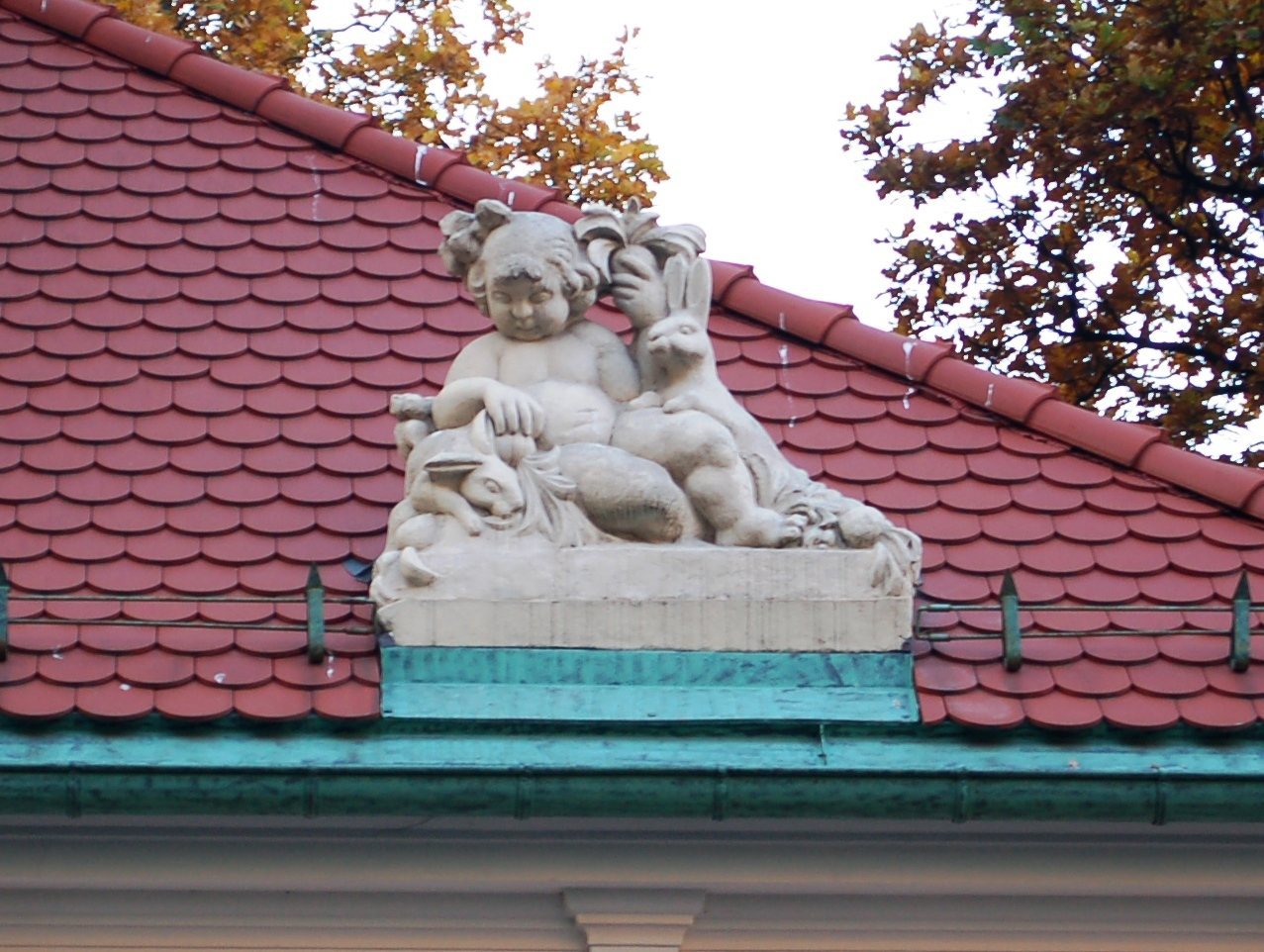
The two-storey wings at the front enclose the entrance courtyard. Small sculptures at the base of their roofs depict reclining Cupids, the Roman god of love: the left wing has figures accompanied by rabbits, while the right wing has figures with calves.
Interior
Elements of the prewar interior decoration survive in the main body of the palace.
Entrance gate and fence
The complex includes a fence and an entrance gate bearing a memorial plaque unveiled in 2010. It commemorates Andrzej Zakrzewski and Bronisław Geremek, founders of the Adam Mickiewicz Institute.