Stogursey Castle: A Medieval Motte-and-Bailey Fortress in Somerset


Site at a Glance
- Rating
- 4.5
- Popularity
- Very Low
- Country
- United Kingdom
- Primary era
- Medieval
- External website
- Open
- Eras represented
- Medieval
- Civilizations
- English
- Site type
- Military
- Remains
- Castle
On this page6 sections
History
Stogursey Castle is a medieval castle in Stogursey, England, built south of the village by the De Courcy family, probably in the late eleventh or early twelfth century. Its name derives from a corruption of “Stoke Courcy,” linking the place to its medieval lords.
Royal control and attempted destruction
During the First Barons’ War, a rebellion by English barons against King John, the castle came under the control of the English king. In 1215, John ordered its destruction, but the castle survived. His lieutenant Falkes de Bréauté, a prominent military commander and royal official, subsequently took control of it.
After Falkes de Bréauté’s death, a second order to destroy Stogursey Castle was issued in 1228. That order also appears to have been ignored, allowing the castle to remain in use.
Stone expansion and later decline
The Fitzpayne family extended the castle in stone in 1300. The castle is traditionally said to have been destroyed in the 1450s by the Yorkist faction during the Wars of the Roses, the dynastic conflicts between factions associated chiefly with York and Lancaster. The specific claim that it was destroyed in 1457 has no supporting documentary or archaeological evidence.
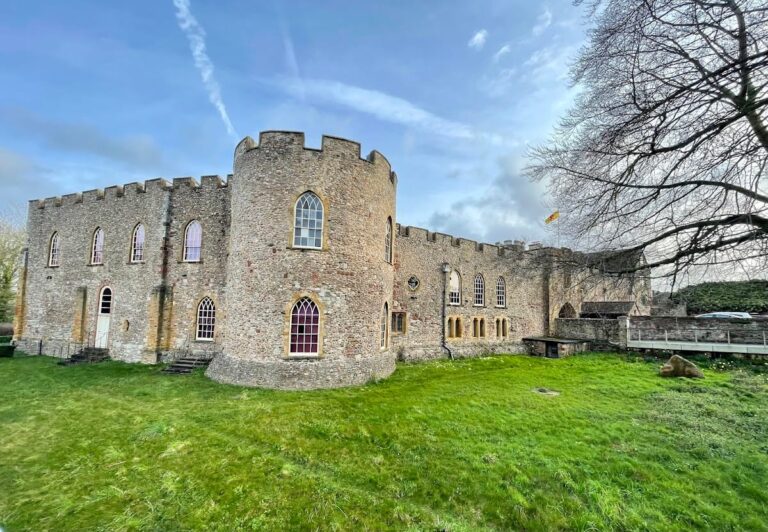
A house was built within the castle grounds during the seventeenth century and restored in the 1870s. By the late twentieth century, the house had become ruinous. The Landmark Trust, which preserves historic buildings and adapts them for temporary accommodation, restored the gatehouse between 1981 and 1982 for use as a holiday rental. The castle is a scheduled monument, and the gatehouse is a Grade II* listed building. The Landmark Trust is the owner.
Remains
Stogursey Castle stands south of Stogursey village in a largely agricultural landscape. The terrain is flat to the northeast and hilly to the southwest, while the sea lies to the north. Most of the castle survives as ruins arranged around a motte-and-bailey complex, with a raised mound, enclosed baileys, and a water-filled moat.
Motte, baileys, and moat
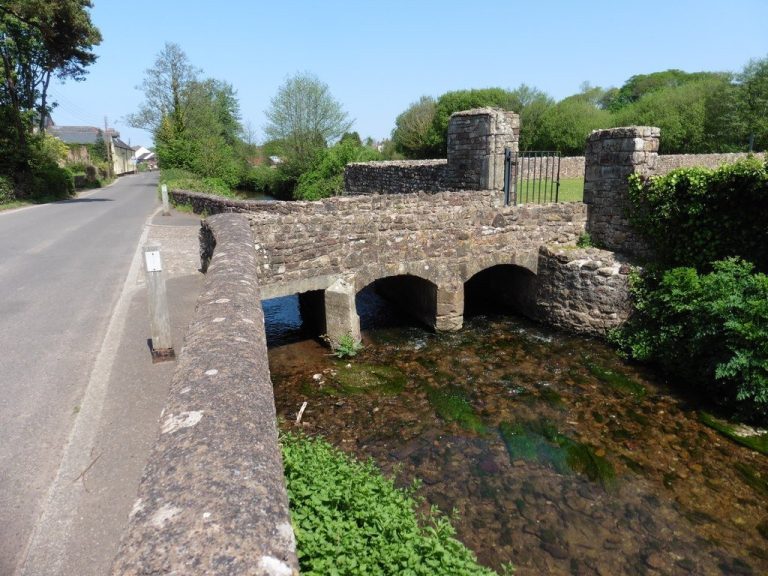
The motte is approximately 60 metres wide and 2 metres high. Two bailey enclosures surrounded the raised earthwork, providing enclosed areas for buildings and activities. A moat supplied with water from the nearby Stogursey Brook helped protect the complex. Stone was used in the castle’s construction, including the fourteenth-century extension made for the Fitzpayne family.
Gatehouse and later house
The surviving gatehouse is one of the principal standing remains. It is thatched and was restored between 1981 and 1982 after the later house within the grounds had become ruinous. The gatehouse is now used as a holiday rental and has Grade II* listed status, while the wider archaeological site is protected as a scheduled monument.